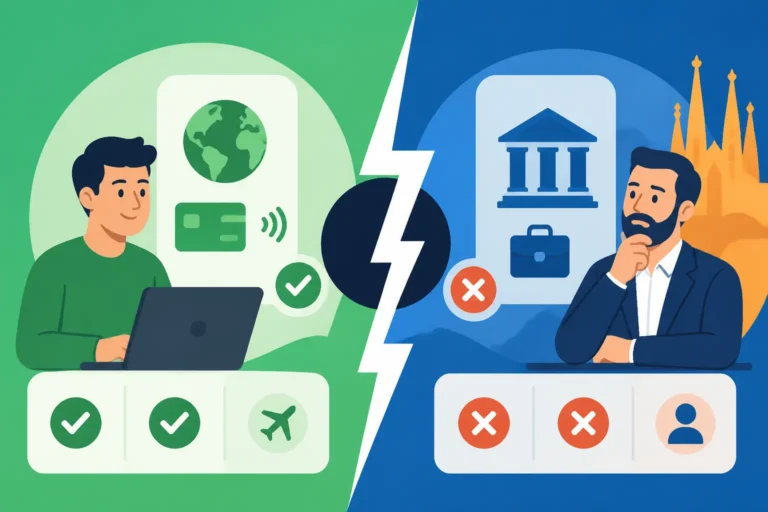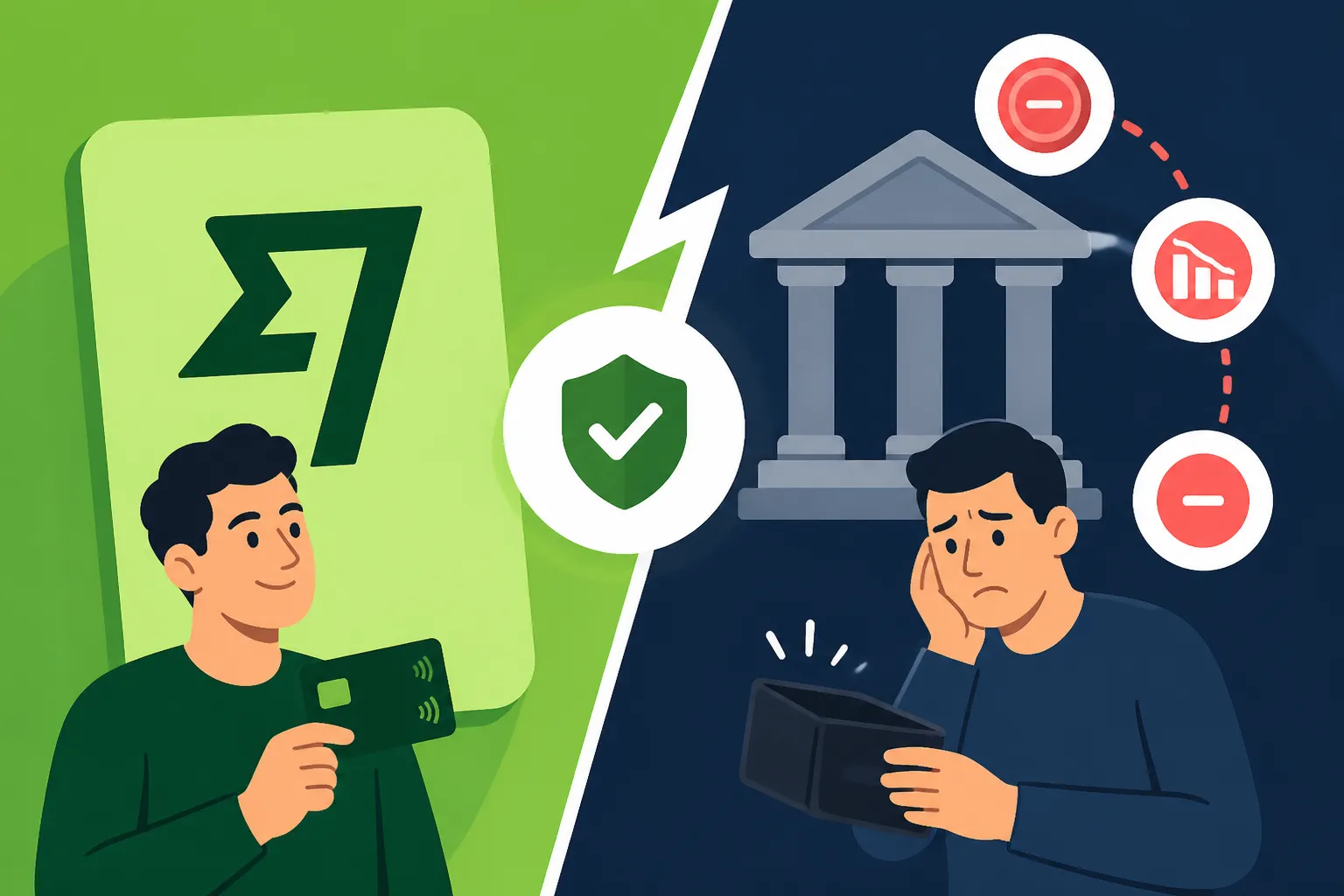
Wise vs BBVA, Santander, and CaixaBank: Fees for Foreign Residents
Ah, the eternal expat dilemma in Spain: how do you manage your money without feeling like you're constantly bleeding cash through hidden fees and baffling exchange rates? It's a common frustration, believe me. You arrive in this beautiful country, excited for a new life, only to find that your hard-earned euros seem to disappear faster than a plate of jamón serrano at a fiesta when you try to send money home or deal with foreign currency. This guide is here to untangle the financial web, diving deep into the traditional Spanish banking landscape – looking at giants like BBVA, Santander, and CaixaBank – and comparing them head-to-head with a modern solution, Wise, to help you navigate the murky waters of international money management.
Disclosure: This post may contain affiliate links. We may earn a commission at no extra cost to you if you make a purchase through these links. Read full disclosure.
The Expat Banking Predicament in Spain
When you first land in Spain, setting up your financial life can feel like deciphering an ancient scroll written in a language you only partially understand. You’re bombarded with new terms, different processes, and a general air of "this is how we've always done it." Many expats rush to open an account with a big-name Spanish bank, thinking it’s the most straightforward path, only to later discover the cumulative impact of various charges on their balance.
Why Traditional Spanish Banks Can Be Tricky for Foreigners
For new arrivals, the process of simply opening a bank account in Spain can be a hurdle in itself. You might need your NIE, proof of address, maybe even a work contract, and sometimes banks are hesitant if you don't have a regular Spanish income or residency already solidified. Once you get an account open, that's when the true financial tango begins. Traditional banks like BBVA, Santander, and CaixaBank often have a tiered system of accounts, where the "free" options are usually contingent on meeting specific criteria. This could mean maintaining a certain minimum balance, having your salary directly deposited, making a set number of card transactions per month, or holding other financial products with them.
If you don't meet these conditions, you'll find yourself paying account maintenance fees. These aren't usually astronomical in isolation, but seeing €10-€20 or more chipped away every quarter (or even monthly) just for the privilege of having an account can quickly add up and feel like an unnecessary drain. For someone just starting out or working on a variable income, these conditions can be hard to meet consistently, leaving you feeling penalized for simply being an expat without a perfectly conventional Spanish financial footprint. Navigating these requirements can be as complex as understanding regional dialects! For a detailed roadmap on getting set up, you might want to check out our guide on Opening a Bank Account in Spain: Step‑by‑Step for Foreigners.
The Hidden Costs of International Transfers
Beyond the monthly account fees, the real kicker for many expats using traditional banks comes with international money transfers. Whether you're sending money back to your family, paying off a mortgage in your home country, or receiving payments from an employer abroad, these transactions are often ripe for hidden charges.
Traditional Spanish banks typically use the SWIFT network for international transfers outside the SEPA zone. While reliable, this system comes with its own set of fees. You might pay an upfront transfer fee from your bank, but then a "correspondent bank" in the middle might take its own cut, and finally, the recipient bank could levy another charge. What started as a simple transfer can become a game of financial whack-a-mole, with unexpected deductions along the way. Furthermore, these banks often apply their own exchange rates, which are typically marked up from the real mid-market rate. This difference, often a percentage point or two, might seem small on paper but translates to a significant loss on larger transfers. For instance, if you're transferring €5,000, even a 1% markup means you're effectively paying €50 in hidden fees through the exchange rate alone, on top of any explicit transfer charges. It’s a frustrating reality that many foreigners discover the hard way.
A Deep Dive into Traditional Spanish Banks: BBVA, Santander, and CaixaBank
These three banks are giants in Spain, household names you’ll see on nearly every street corner. They offer comprehensive services, from current accounts to mortgages and investments, but their fee structures can be a maze for expats.
BBVA: Account Types, Monthly Fees, and International Transfer Costs
BBVA is one of Spain’s largest banks and has a significant international presence. For foreign residents, they often promote accounts that aim to simplify banking, such as their "Online Account" or specific packages for newcomers.
- Account Types and Fees: Historically, BBVA has offered fee-free accounts if you meet certain criteria. Their "Cuenta Online sin Comisiones" (Online Account without Fees) is popular, often requiring you to be a new customer and manage everything digitally. If you don't use the online account or fail to meet the requirements of a standard account (like a minimum monthly income deposit, specific card usage, or maintaining investments), you can face maintenance fees, which typically hover around €10-€20 per quarter. These are known to change, so always check the latest conditions on their website or directly with a branch. For instance, sometimes simply having two direct debits set up can waive fees.
- International Transfer Costs: When sending money internationally from a BBVA account, especially outside the Eurozone, you're looking at a combination of fees. SEPA transfers (within the Eurozone) are usually free or very low cost. For transfers outside SEPA, BBVA applies a commission, which is often a percentage of the amount sent, with a minimum and maximum fee. For example, it might be 0.6% of the amount with a minimum of €15 and a maximum of €150. On top of this, the exchange rate used will have a markup, which is less visible but effectively adds to the cost. If you’re regularly receiving international payments, the combined effect of these fees can be substantial.
Santander: Maintenance Charges, Debit Card Fees, and Exchange Rates
Santander is another banking behemoth, well-known globally. They, too, offer a range of accounts that can be attractive, particularly their "Cuenta Online" for digital-savvy customers.
- Maintenance Charges and Debit Card Fees: Similar to BBVA, Santander's basic accounts for non-residents or those who don't meet specific conditions (like direct deposit of salary, minimum balance, or holding other products) will incur maintenance fees. These can range from €0 to €20 per month if conditions aren't met. They often try to push bundled products or loyalty programs (like their "Cuenta Zero" or "Cuenta Smart") which offer fee waivers in exchange for specific financial behaviors. Debit cards can also sometimes carry an annual fee, typically around €20-€30, though this is often waived if you fulfill certain account requirements. It's crucial to understand these requirements upfront, as they are not always explicitly clear when you first open the account.
- Exchange Rates and International Transfers: Santander's fees for international transfers outside the SEPA zone follow a similar pattern to BBVA: a commission based on the amount, plus an unfavorable exchange rate. You might see a charge of around 0.7% with minimums of €15-€20. The exchange rate is where a significant chunk of money can be lost, as the bank profits from the difference between the interbank rate and the rate they offer you. This means if you’re trying to move a large sum, say to convert your savings into euros or send a substantial amount back home, the total cost can be surprisingly high, impacting your overall Cost of Living in Spain: Realistic Budgets and Savings Tips.
CaixaBank: Package Deals, ATM Charges, and Foreign Currency Handling
CaixaBank has a very strong presence, particularly in Catalonia and parts of the Levante region. They are known for their extensive branch network and various customer segments.
- Package Deals and ATM Charges: CaixaBank often structures its offerings as "packages" or programs like "MyAccount" or "Programa Estrella" that bundle services and waive fees if you meet certain criteria. These often include having your salary or pension deposited, direct debits set up, or investing in their products. Without meeting these, you could face quarterly maintenance fees of around €15-€25. ATM charges within Spain are generally free at CaixaBank’s own ATMs. However, using ATMs from other banks in Spain will almost certainly incur a fee from the ATM operator, and if you use your CaixaBank debit card abroad, especially outside the Eurozone, you'll face currency conversion fees and potentially additional ATM withdrawal charges from the bank itself, typically a percentage of the amount withdrawn.
- Foreign Currency Handling: For transactions in foreign currencies, whether online purchases or ATM withdrawals abroad, CaixaBank will apply its own exchange rate markup. While convenient for everyday expenses within Spain, managing significant foreign currency transactions through CaixaBank can prove costly. Expats often juggle various currencies, and the cumulative impact of these small markups on every transaction can erode your budget, making careful planning essential. You’ll want to be familiar with concepts like Spanish IBAN, SEPA, and SWIFT: Sending and Receiving Money Explained to understand how your money moves.
The Wise Approach: Transparency and Lower Costs
Enter Wise (formerly TransferWise), a financial technology company that completely changed the game for international money transfers. Born out of a frustration with traditional banking fees and opaque exchange rates, Wise offers a refreshing alternative, built on transparency and efficiency. For an expat in Spain, understanding Wise is like finding a secret hack for your finances.
How Wise Disrupts Traditional Banking Fees
The core philosophy of Wise is simple: move money internationally at the real, mid-market exchange rate, and charge a small, upfront fee. They achieve this by operating a network of local bank accounts around the world. When you send money from Spain to the UK, for example, your euros go into Wise's Spanish account, and then Wise pays out the equivalent in pounds from its UK account. This avoids costly international SWIFT transfers, cutting out intermediary bank fees and slow processing times.
- Mid-Market Exchange Rate: This is the rate you see on Google. Traditional banks add a margin to this rate, which is how they make extra money. Wise gives you the real rate, which means more of your money actually gets converted.
- Transparent, Upfront Fees: Before you even commit to a transfer, Wise shows you the exact fee you'll pay and the exact amount your recipient will receive. No hidden surprises, no mysterious deductions. The fee is typically a small percentage, often less than 1%, combined with a small fixed fee for some currencies.
- Multi-Currency Account: Wise offers a multi-currency account that allows you to hold balances in over 50 currencies, receive money in 10 different currencies with local bank details (like a UK sort code and account number, a US routing number, or a Euro IBAN), and spend money with their debit card. This is a game-changer for expats who often deal with multiple currencies, whether it's receiving a salary from abroad, managing savings, or traveling. This level of flexibility is simply not available with standard Spanish bank accounts.
Practical Scenarios: When Wise Shines for Expats
Wise isn't just for sending large sums; it's incredibly versatile for the day-to-day financial needs of expats.
- Receiving a Foreign Salary/Income: If you're a freelancer working for international clients or someone whose salary is still paid into an account in your home country, Wise is invaluable. You can provide your clients or employer with your Wise multi-currency account details (e.g., a US routing number for USD payments). The money comes into your Wise account as a local transfer, avoiding international transfer fees. You can then convert it to EUR at the mid-market rate and send it to your Spanish bank account for local expenses, or spend directly with your Wise debit card. This flexibility is a huge advantage for many who are Freelancing (Autónomo) in Spain: Taxes, Invoicing, and Setup Guide.
- Sending Money Home Regularly: Whether it's supporting family, paying a mortgage, or simply transferring savings back to your home country, Wise makes it cost-effective. Instead of paying multiple fees and losing out on exchange rates with a traditional bank each month, Wise offers a consistent, low-cost solution.
- Paying International Bills: Have a subscription, a loan, or a specific bill that needs to be paid in a foreign currency? Wise allows you to do this directly from your multi-currency account, again, using the real exchange rate and transparent fees.
- Travel Outside the Eurozone: With the Wise debit card, you can spend in local currencies wherever you go, automatically converting from your balances at the mid-market rate. If you don't have enough in a specific currency, it converts from another balance with the lowest possible fee. This beats the unfavorable rates and foreign transaction fees typically charged by traditional Spanish bank cards. This is incredibly useful for tourists and expats traveling, and another reason why many consider it one of the Top Banks in Spain for Expats: Fees, Apps, and Requirements, even though it’s not a traditional bank itself.
Direct Comparison: Wise vs. the Big Three
Let's get down to brass tacks and compare Wise directly against BBVA, Santander, and CaixaBank on the issues that hit expats' wallets the hardest.
Side-by-Side: International Transfers & Exchange Rates
This is where the differences are most stark. For expats, especially those dealing with non-Euro currencies, the method and cost of international transfers are paramount.
- Wise: Wise operates on a model of transparency and the mid-market exchange rate. When you initiate a transfer, you see exactly what fee you pay and the exact amount the recipient will get. There's no hidden margin built into the exchange rate. The fees are typically a variable percentage (e.g., 0.4-0.8%) plus a small fixed fee, making even large transfers relatively inexpensive compared to traditional banks. For example, sending €1,000 to the UK might cost you around €5-€7 in fees, with the recipient getting almost the full converted amount at the real exchange rate.
- BBVA, Santander, and CaixaBank: These banks, while capable, typically rely on the SWIFT network and apply their own exchange rates with a markup. The fees usually involve a percentage commission (e.g., 0.6%-0.8%) with a minimum fee (€15-€20) and often a maximum. On top of this, the exchange rate margin is a significant, yet often unnoticed, cost. For that same €1,000 transfer, you might pay an upfront fee of €15-€20, and then lose another €10-€20 or more due to the unfavorable exchange rate. The total cost can easily be double or triple that of Wise for transfers outside the Eurozone. For more in-depth comparisons, refer to Sending Money to/from Spain: Comparing Banks vs Transfer Services.
Here’s a simplified table comparing estimated costs for a non-SEPA transfer of €1,000 (actual fees can vary):
| Feature / Service | Wise (Estimated) | BBVA (Estimated) | Santander (Estimated) | CaixaBank (Estimated) |
|---|---|---|---|---|
| Exchange Rate | Mid-market rate (real rate) | Bank's own rate (with markup) | Bank's own rate (with markup) | Bank's own rate (with markup) |
| Transfer Fee (Non-SEPA) | ~€5-€8 (variable percentage + small fixed fee) | ~€15-€25 (percentage with min/max) | ~€15-€25 (percentage with min/max) | ~€15-€25 (percentage with min/max) |
| Hidden Exchange Rate Cost | ~€0 (using mid-market) | ~€10-€20+ (margin on rate) | ~€10-€20+ (margin on rate) | ~€10-€20+ (margin on rate) |
| Total Estimated Cost | ~€5-€8 | ~€25-€45+ | ~€25-€45+ | ~€25-€45+ |
| Speed | Often same-day or 1-2 business days | Typically 2-5 business days (SWIFT) | Typically 2-5 business days (SWIFT) | Typically 2-5 business days (SWIFT) |
| Transparency | High (all fees upfront) | Moderate (fees listed, rate markup hidden) | Moderate (fees listed, rate markup hidden) | Moderate (fees listed, rate markup hidden) |
Account Maintenance & Everyday Banking Costs
This section focuses on the recurring fees you might encounter just for keeping your account open and using basic services.
- Wise: For personal accounts, Wise generally has no monthly account maintenance fees. Their multi-currency account is free to open and maintain. There is a small, one-time fee to order the physical debit card (typically around €7-€10, but check current pricing), and some free ATM withdrawals are usually included up to a certain limit per month (e.g., 2 free withdrawals up to €200, after which a small percentage fee applies). Beyond that, spending with the debit card in a currency you hold is free. If you don't hold the currency, it converts it from another balance at the mid-market rate with a tiny fee. This makes Wise incredibly cost-effective for daily use and managing different currencies.
- BBVA, Santander, and CaixaBank: As discussed, the "free" accounts at these banks almost always come with conditions. If you're a new expat, retired, or have an irregular income not consistently deposited in Spain, you may struggle to meet the criteria for fee waivers. This can lead to monthly or quarterly maintenance fees (e.g., €10-€25 per month or quarter), plus potential annual debit card fees. While they offer a wide range of services, the cost of these services can accumulate, especially if you’re not actively using them for a full Spanish financial setup, like having a mortgage or multiple investments. These banks are essential for things like setting up utility direct debits, as they often require a Spanish IBAN, as outlined in How to Set Up Automatic Utility Payments in Spain (Domiciliación), but the fees can be a sticking point.
Beyond Fees: User Experience and Other Considerations
While cost is a huge factor, especially for expats mindful of every euro, the overall user experience, reliability, and security of your financial service provider are equally important.
Ease of Setup and Digital Experience
For many expats, the initial hassle of setting up any official service in Spain is legendary. Banking is no exception.
- Wise: Opening a Wise account is incredibly straightforward and can usually be done online or via their app in minutes. You'll need to provide identity verification (passport, residency card) and often a selfie. The process is entirely digital, smooth, and designed for international users. Their app is intuitive, user-friendly, and offers real-time notifications for transactions, easy transfers, and quick management of your multi-currency balances. For a digital nomad or someone new to Spain, this ease of access is a huge relief.
- BBVA, Santander, and CaixaBank: Opening an account with a traditional Spanish bank typically requires an in-person visit to a branch, even if you start the process online. You'll need your NIE (Número de Identificación de Extranjero), passport, and often proof of address and income. The process can be slower, involve more paperwork, and might require some Spanish language skills or a patient bank employee. While their online banking portals and apps have improved dramatically over the years, they can still feel a bit more complex or less intuitive for users accustomed to purely digital challenger banks. For example, their apps are excellent for managing your Spanish direct debits and local payments, but might not be as seamless for managing multiple foreign currencies or international transfers as Wise. However, for obtaining an official Spanish bank statement for visa renewals, or having a physical branch to visit for complex issues, these banks do offer that traditional peace of mind.
Security, Regulations, and Customer Support
When it comes to money, security and reliable support are non-negotiable.
- Wise: Wise is regulated by financial authorities worldwide, including the Bank of Spain (under its designation as an Electronic Money Institution) and bodies like the FCA in the UK and FinCEN in the US. This means your money is protected and they adhere to strict financial guidelines. They don't lend out your money; instead, they safeguard it in segregated accounts with leading banks. Customer support is primarily online (chat, email) and through their comprehensive help center, with phone support available in certain regions. For digital natives, this is usually sufficient, but some may miss the option of walking into a physical branch for assistance.
- BBVA, Santander, and CaixaBank: As established, fully regulated banks, they offer a very high level of security. Your deposits are protected by the Spanish Deposit Guarantee Fund (Fondo de Garantía de Depósitos) up to €100,000 per account holder, per institution. They have extensive customer support networks, including phone lines, online chat, and, crucially for many, physical branches where you can speak to someone face-to-face. This can be a huge comfort, especially for more complex issues or for those less comfortable with purely digital interactions. For things like appealing a charge or dealing with a lost card, having that local presence can be invaluable. However, for quick international payment queries, their larger, more bureaucratic structures can sometimes feel slower than Wise's specialized support.
Making the Smart Choice for Your Finances in Spain
So, which is it? Wise or a traditional Spanish bank? The answer, like many things in expat life, isn't a simple either/or. It often comes down to your specific financial needs and how you want to manage your money in Spain.
Hybrid Strategies: Combining the Best of Both Worlds
For many seasoned expats, the most effective strategy is a hybrid approach, leveraging the strengths of both Wise and a local Spanish bank.
- Spanish Bank for Local Essentials: A traditional Spanish bank account is almost a necessity for life in Spain. You'll need it for things like:
- Setting up domiciliación (direct debits) for utilities (electricity, water, internet) and rent, as many providers prefer a Spanish IBAN.
- Receiving your Spanish salary or pension.
- Making local cash withdrawals or deposits with ease.
- Having a physical presence for administrative tasks, like signing documents or resolving disputes face-to-face.
- Gaining access to credit facilities or mortgages in the future, as having a banking history in Spain is usually required.
For these reasons, having an account with BBVA, Santander, or CaixaBank makes perfect sense. Just be sure to pick an account with the most favorable fee conditions, perhaps one of their online-only options or an account with waivers you can easily meet. Our guide on Top Banks in Spain for Expats: Fees, Apps, and Requirements can give you more insights.
- Wise for International Flow and Savings: This is where Wise truly shines. Use it for:
- All international money transfers: Sending money to or from your home country, especially if it's not in euros, to take advantage of the mid-market rate and low, transparent fees.
- Receiving foreign income: If you're a freelancer or remote worker paid in USD, GBP, or other currencies, use your Wise multi-currency account to receive funds as a local transfer, avoiding costly conversions.
- Managing foreign currency savings: Hold money in various currencies, protecting yourself from currency fluctuations, and convert when the rate is favorable.
- International travel: Use the Wise debit card when you travel outside the Eurozone to save on foreign transaction fees and get the best exchange rates.
This combination allows you to enjoy the convenience and administrative necessity of a Spanish bank while maximizing savings on international transactions with Wise. It's about being financially savvy, not just in Spain, but globally. You might also find tools like Budgeting Apps for Spain: Tools for Tracking Spend and Bills useful in monitoring all your accounts.
Final Thoughts for the Savvy Expat
Navigating the financial landscape as an expat in Spain doesn't have to be a constant headache. The key is to be informed and proactive. Don't just settle for the first bank account offered to you. Research the fees, understand the conditions for fee waivers, and compare them meticulously.
Wise is more than just a money transfer service; it’s a global financial tool that empowers expats to manage their international finances with unprecedented transparency and efficiency. By strategically integrating Wise into your financial toolkit alongside a traditional Spanish bank, you can significantly reduce fees, optimize exchange rates, and gain greater control over your money. It’s an easy, smart choice that lets you focus on enjoying your life in Spain, rather than stressing about bank charges.
Ready to take control of your international money? Sign up for Wise today and see how much you can save on fees and enjoy transparent, mid-market exchange rates.
Disclaimer
The information provided in this article is for general informational purposes only and does not constitute financial or legal advice. Fees, exchange rates, and banking policies are subject to change by the respective financial institutions. It is essential to conduct your own research, review the most up-to-date terms and conditions, and consider consulting with a financial advisor to make informed decisions tailored to your personal circumstances.