Barcelona Airport Transfer Tickets: What to Book Ahead and What to Buy There
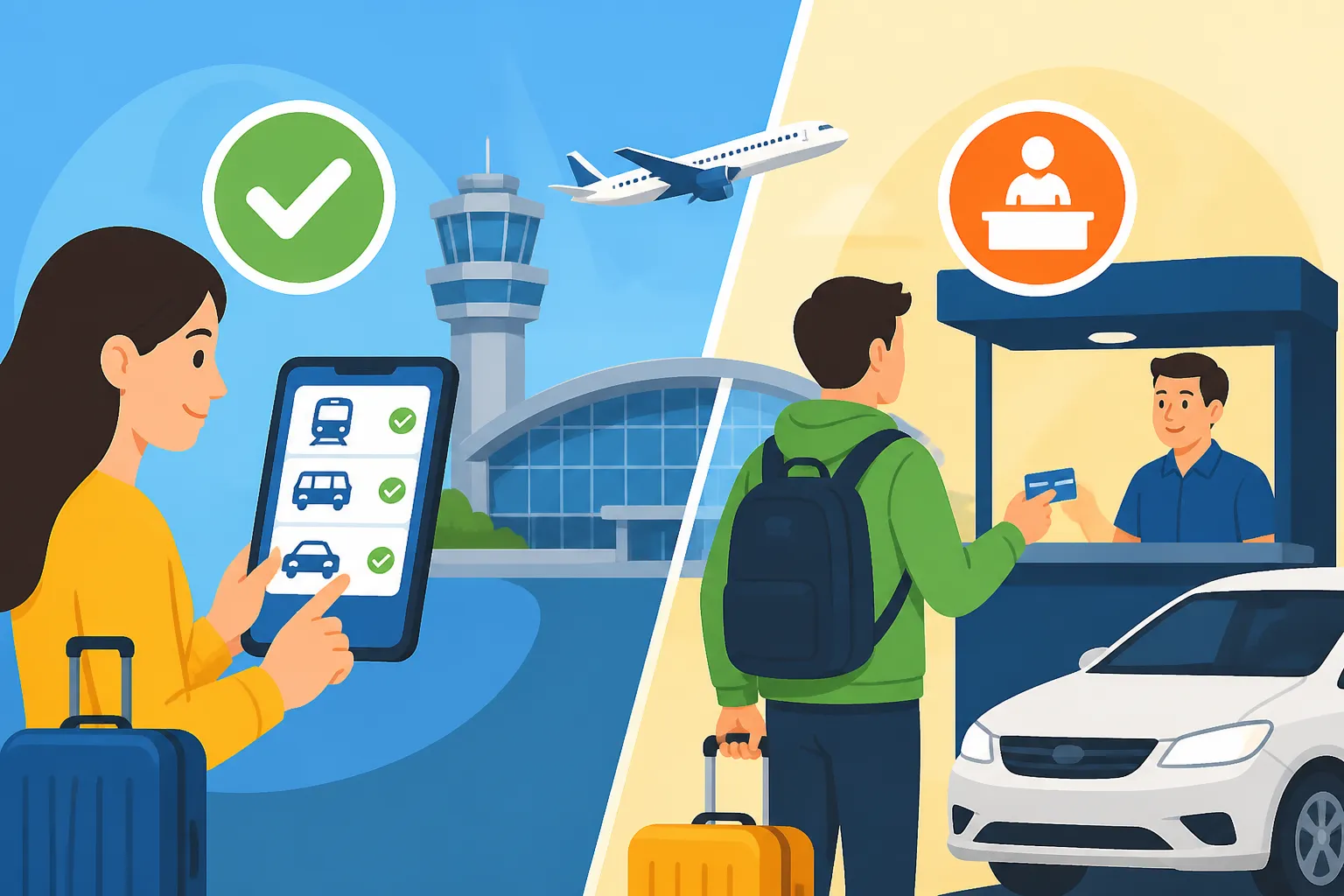
Your flight lands at El Prat late, your phone is on two percent, and the ticket machine in front of you is offering three options that all look identical. A lot of first-time visitors and newly arrived expats hit this exact wall at Barcelona airport. This guide explains which transfer tickets you should book before you fly, which ones you can buy at the airport, and how to plan your onward journey without stress.
Disclosure: This post may contain affiliate links. We may earn a commission at no extra cost to you if you make a purchase through these links. Read full disclosure.
Why Barcelona Airport Transfers Feel Harder Than They Should
I have lived in Barcelona long enough to have picked up friends, in-laws, clients and one very jet-lagged cousin from El Prat. Every one of them arrived with a plan they had found online, and almost every one of them hit a snag at the ticket machine. The problem is rarely a lack of options. Barcelona has plenty of ways out of the airport. The confusion comes from how many there are, and from how much the right choice depends on which terminal you land at, where you are sleeping, what time it is, and whether Barcelona is your final stop.
Before we get into what to book ahead and what to buy on the spot, it helps to understand why the airport works the way it does. Once the layout makes sense, the ticketing logic follows.
Two Terminals With Different Transport Options
Barcelona-El Prat has two passenger terminals, Terminal 1 and Terminal 2, and they are not side by side. They sit some distance apart on the airport grounds and are linked by a free shuttle bus. That matters because not every transport option serves both terminals in the same way. The Rodalies commuter train station, for example, is at Terminal 2. If you land at Terminal 1 and want the train, you first need the shuttle bus to Terminal 2.
The airport express bus, Aerobús, runs two separate lines, one for each terminal. They follow the same broad route into the city. Metro Line 9 Sud has a station at each terminal. Taxis queue outside both. So your terminal does not cut you off from any option, but it changes how many steps each option involves. A traveller landing at Terminal 1 with heavy bags will feel the extra shuttle ride far more than someone breezing out of Terminal 2 with a backpack.
Check your terminal before you fly. It is printed on your booking confirmation or in your airline’s app. The low-cost carriers and the full-service airlines tend to use different terminals, so do not assume your return flight leaves from the terminal you arrived at.
Tickets That Look Interchangeable But Are Not
This is the part that catches people. Barcelona’s public transport runs on an integrated fare system managed across the metropolitan area, and the standard multi-trip card, the T-casual, is excellent value for getting around the city. The airport metro stations, however, are a special case. To enter or leave the Line 9 Sud stations at the terminals, you need a dedicated airport metro ticket. A standard T-casual will not open the gates there.
The Rodalies train from Terminal 2 works differently and is generally covered within the integrated fare system, so the rules for the train and the metro are not the same even though both are rail and both leave from the airport. The Aerobús is a separate service with its own tickets altogether. Then there are tourist travel cards, such as the Hola Barcelona card, which bundle unlimited travel for a set number of days and include the airport metro journey.
None of this is complicated once you know it, but at eleven at night with a toddler on your hip, it can feel like a puzzle. Ticket rules on airport routes do get revised from time to time, so check the transport operator’s own website for current conditions shortly before your trip. For a full walkthrough of each route into town, see How to Get From Barcelona Airport to the City Center.
Why Your Final Destination Changes Everything
A big share of people landing at El Prat are not staying in Barcelona at all. They are heading to Girona, Sitges, the Costa Brava, Tarragona, Andorra, or catching a high-speed train from Barcelona Sants to Madrid, Valencia or Zaragoza. For those travellers, the airport transfer is only the first leg of a two-part journey, and the second leg is where advance booking pays off.
That is the main reason this guide splits tickets into two groups. Short city hops are flexible and you can almost always buy them on the day. Onward intercity journeys usually reward planning, because the cheapest fares, the best departure times and the seats you want tend to go first. That is where a comparison and booking platform like Omio earns its place in your travel prep.
What to Book Ahead Before You Land
Here is my rule of thumb after years of airport runs. If a journey has a fixed departure time, limited seats or a price that rises as the date gets closer, book it in advance. If it runs frequently and costs the same whatever day you buy it, keep it flexible and buy on arrival.
Onward Trains and Long-Distance Buses Through Omio
If Barcelona is a stopover rather than your destination, the most valuable thing you can do before your flight is lock in the onward leg. High-speed trains from Barcelona Sants to Madrid and other major cities are run by several competing operators, including Renfe, Iryo and Ouigo, and their fares tend to move as departure day approaches. Long-distance and regional coaches out of Barcelona and from the airport itself are run by a range of companies with their own schedules.
This is where Omio is useful. Instead of opening a separate website for every train and bus operator, you search once, for example “Barcelona Airport to Girona” or “Barcelona to Valencia”, and Omio shows you the trains, buses and sometimes flights side by side, with journey times and departure points. You can see straight away whether a direct coach from the airport beats taking the Rodalies to Sants and then a train, which is exactly the kind of decision that is hard to make while standing in arrivals.
My cousin’s arrival is the scenario I always use. She landed at Terminal 1 mid-afternoon and was heading to the Costa Brava. On her phone in the baggage hall she found a coach leaving the airport and a train-plus-bus combination via the city. Comparing the two on Omio took a couple of minutes. She picked the direct coach, booked it with her foreign card, and had a mobile ticket before her suitcase appeared on the belt. Without that, she would have been flipping between operator sites in Spanish and Catalan on a weak signal. Omio does not cover every small local operator, so if a route does not appear, check the operator directly. For the main intercity corridors out of Barcelona, though, it is the quickest way to compare and book in one place.
Private Transfers and Late-Night Arrivals
The second category worth booking ahead is a private transfer, especially if you are landing late at night, travelling with lots of luggage, arriving with young children or older relatives, or heading somewhere public transport serves poorly, such as a rural villa inland. A pre-booked driver meeting you in arrivals with a name sign takes all the decision-making out of a tired evening.
The cost structure here is different from public transport. Private transfers are usually priced per vehicle rather than per person, so they become far better value for a group or family than for a solo traveller. Prices tend to depend on distance, vehicle size, time of day and whether you add extras such as child seats. Read the cancellation and waiting-time terms carefully, because flight delays happen and you want to know whether the driver will track your flight or leave after a set wait.
If you would rather not commit to a pre-booked car, Barcelona’s official taxis are always an option at the rank outside both terminals. They are metered, with an airport supplement on top of the standard fare, and they are reliable at any hour. Ride-hailing apps also operate in the city. A taxi is a perfectly good fallback; a pre-booked transfer simply gives you certainty about who is waiting for you and what you will pay.
Group and Family Bookings
Families and groups are where advance planning matters most, because problems multiply with every extra person. Four people trying to buy four tickets at one machine with a queue behind them is nobody’s idea of a holiday start. If your group is going beyond Barcelona, booking the onward train or coach for everyone in a single transaction means seats are held together and everyone’s ticket is in one place on one phone.
Omio lets you add several passengers to one booking, and on trains you can often see the seat or carriage options the operator offers. For families with prams, car seats or a mountain of luggage, check each operator’s baggage and child-fare rules before you book. Booking Spanish Transport With Kids: Child Fares, Seats, and Prams goes into those rules in detail. For the city leg, a family of four or more often finds that a taxi or pre-booked transfer costs about the same as individual public transport tickets once you add them up, while saving a lot of hassle.
What to Buy When You Arrive at El Prat
Now for the good news. For most travellers staying in central Barcelona, you do not need to pre-book anything for the city leg. The main public transport options run frequently, sell tickets at the airport, and do not usually sell out. Buying on arrival keeps you flexible if your flight is delayed or your plans change.
Aerobús at the Stop
The Aerobús is the airport express bus, and for a lot of first-time visitors it is the easiest option. It runs from outside each terminal into the city centre, stopping at Plaça d’Espanya and along Gran Via before ending at Plaça de Catalunya, which puts you within reach of much of the Eixample and the old town. The buses have space for luggage and run frequently throughout the day.
You can buy Aerobús tickets from the machines and staff at the stop, and card payment is generally accepted when boarding. Return tickets are available, which is handy if you know you will fly out from the same airport, but check how long the return portion stays valid before you pay for it. Online purchase in advance is also possible, though for this route it mostly saves you a short queue rather than money or a guaranteed seat.
The Aerobús suits you best if you are staying near one of its stops, travelling light to medium, and arriving during the day or evening. If your accommodation is in a neighbourhood far from Plaça de Catalunya, you may need to add a metro or taxi ride at the other end, so check your hotel’s location first. What’s the Best Area to Stay in Barcelona? can help you work out how your neighbourhood connects to the main transfer routes.
Metro Line 9 Sud and the Airport Ticket
Line 9 Sud connects both terminals to the metro network, with interchange stations for other lines further along. It is a good choice if your accommodation is near one of those connecting stations, or if you are staying in the western or southern parts of the city. The journey takes longer than you might expect because the line takes a long route before reaching the denser parts of the network.
The key thing to remember is the ticket. At the airport metro stations, you need the dedicated airport ticket, sold from the machines in the station. A standard T-casual will not get you through the airport gates on this line. If you have a tourist travel card such as the Hola Barcelona card, the airport journey is included, and some visitors buy one of these at the airport to cover their whole stay. Whether that is worthwhile depends on how much you plan to travel around the city during your visit.
The metro is also where you need to be most alert with your belongings. Tired travellers with big bags are an easy target on busy carriages. How to Avoid Pickpockets on the Barcelona Metro has practical tips that are worth reading before your first ride.
Rodalies R2 Nord From Terminal 2
The Rodalies commuter train, line R2 Nord, leaves from the station at Terminal 2. It runs to Barcelona Sants, Passeig de Gràcia and onward through the city. For anyone catching a long-distance train at Sants, or staying near Passeig de Gràcia in the Eixample, it is often the most efficient choice.
If you land at Terminal 1, take the free shuttle bus to Terminal 2 first, then walk to the train station via the covered walkway. Allow extra time for this, especially with luggage. Tickets are sold from machines in the station, and the train generally falls within Barcelona’s integrated fare system, so a T-casual is usually accepted, unlike at the airport metro stations. Check the current conditions on the Rodalies and Renfe websites before your trip. For a wider picture of how commuter trains work across Spain, see Regional and Local Trains in Spain (Cercanías and Media Distancia).
This is also where your two journeys connect. If you have booked an onward high-speed train from Sants through Omio, the R2 Nord gets you there without leaving the rail network. Leave a generous buffer between your landing time and your train departure to allow for baggage reclaim, the shuttle if you need it, and any delays.
Choosing Your Transfer by Destination and Situation
The right ticket depends on your circumstances. Use the table below as a quick reference, then read the scenarios that follow.
| Your situation | Best option | Book ahead or buy there | Where to get the ticket |
|---|---|---|---|
| Staying near Plaça de Catalunya or Gran Via, travelling light | Aerobús | Buy there | Machines, staff or card on board at the stop |
| Staying near a metro interchange in the west or south | Metro Line 9 Sud | Buy there | Airport ticket from station machines, or a tourist travel card |
| Staying near Passeig de Gràcia or catching a train at Sants | Rodalies R2 Nord from Terminal 2 | Buy there | Station machines at Terminal 2 |
| Heading to Girona, the Costa Brava, Tarragona or Andorra | Direct coach or train via Sants | Book ahead | Omio, or the operator’s own site |
| Connecting to a high-speed train to Madrid, Valencia or Zaragoza | Rodalies to Sants, then high-speed train | Book the train ahead | Omio for the train; station machine for the Rodalies |
| Late-night arrival, heavy luggage or a family group | Pre-booked transfer or taxi | Book ahead for a transfer; taxi on the day | Transfer company, or the official taxi rank |
| Rural villa or hard-to-reach accommodation | Pre-booked transfer or car hire | Book ahead | Transfer company or car rental desk |
Heading to Central Barcelona
For most visitors staying in the city itself, keep it simple. Work out which neighbourhood you are staying in, then choose between the Aerobús, the metro and the train based on which one drops you nearest your door. If you are in the Eixample near Passeig de Gràcia, the train is hard to beat. If you are near Plaça de Catalunya or in the Gothic Quarter, the Aerobús is straightforward. If you are out towards the university area or the southern neighbourhoods, look at Line 9 Sud.
Take a common example. A couple lands at Terminal 1 on a weekday afternoon, staying in an apartment in Gràcia. The Aerobús to Plaça de Catalunya and then a short metro ride north is the easiest combination. They buy their Aerobús tickets at the stop, buy a T-casual at the first metro station they reach in the city, and they are settled in before dinner. Nothing needed booking.
Now compare a solo business traveller landing at Terminal 2 with an early meeting the next morning near Sants. The R2 Nord train runs straight there from the terminal. A ticket from the station machine and a short ride is all it takes. Again, nothing to book ahead. Where to Stay in Barcelona: Eixample, Gotic, Gracia, and Barceloneta compares the main neighbourhoods if you are still deciding where to base yourself.
Heading Beyond the City
This is where your approach should change. Say you are flying into Barcelona to spend a week in Girona. You could take the Rodalies to Sants and then a train, or look for a direct coach from the airport. Fares, frequency and journey times vary between those options, and the best choice can change depending on the day and time you land. Searching your route on Omio before you travel shows the options together, so you can pick the one that fits your arrival time and budget. How to Visit Girona From Barcelona Without a Car covers the Girona options in more depth.
Heading to the beaches of the Costa Brava follows the same logic, with the added wrinkle that some coastal towns are much easier to reach by coach than by rail. Reaching the Costa Brava Without a Car: Rail, Bus, and Transfers breaks down the routes town by town. For destinations like Andorra, which has no rail link, coaches are the main public option, and booking ahead is wise in ski season and on holiday weekends when seats fill quickly.
If you are connecting to a high-speed train at Sants, book that train in advance and plan your airport-to-Sants leg with plenty of slack. Fares and seat availability on the busy Barcelona–Madrid corridor tend to reward early booking, and you do not want to discover that the departure you wanted has sold out while you are still waiting for your bags.
Booking Your Onward Journey With Omio Step by Step
If your trip includes an onward train or coach, setting it up properly before you fly makes landing much calmer. Here is the process I walk friends and visiting family through.
Setting Up Before You Fly
Do this a few days before departure, at home, on decent Wi-Fi.
- Download the Omio app, or open the website, and create an account so your tickets are saved in one place.
- Enter your departure point and destination. For coaches leaving the airport, search from Barcelona Airport. For trains, search from Barcelona Sants or simply “Barcelona” to see every option.
- Choose your travel date and set the time filter to leave a realistic buffer after your scheduled landing. Factor in baggage reclaim, passport control if you are arriving from outside the Schengen area, and the shuttle bus if you land at Terminal 1.
- Compare the trains and buses shown side by side, looking at journey time, departure station, number of changes and price.
- Check the fare conditions for your chosen option, especially whether it allows changes or refunds, before you pay.
- Add all passengers in your group to the same booking so seats are held together where the operator allows it.
- Pay with your card, and check the final checkout screen carefully, including any service fee, before confirming.
- Save the mobile ticket to your phone and take a screenshot as a backup in case you have no signal at the airport.
Paying with a foreign card is usually smooth on Omio, which is one of its biggest advantages over some Spanish operator websites that can reject international cards. If you have had trouble paying on Spanish booking sites before, Paying for Spanish Transport With a Foreign Card: Declines and Fixes explains why it happens and what to do. The English-language interface also removes a lot of guesswork, a point Booking Spanish Transport in English: Sites That Work and Sites That Don’t covers more widely.
Using Mobile Tickets on Travel Day
Once you land, make sure your phone can show your ticket. Mobile data matters here, because some apps need a connection to refresh or display tickets. Sort out an eSIM or local SIM before you fly so you are not depending on airport Wi-Fi. How to Get a Local eSIM for Travel in Spain explains the options.
On trains, your mobile ticket is usually scanned at the platform gates or by staff on board, depending on the operator and the route. On coaches, the driver or attendant typically scans it as you board. Keep your passport or ID handy, because some long-distance services may ask you to show the document whose details match the booking name.
If you are connecting from the airport to Sants for a high-speed train, arrive at the station with time to spare. Large stations like Sants have security screening for high-speed services and boarding can close before the scheduled departure, so do not treat the departure time as the moment you can walk on.
Changes, Delays, and Missed Connections
Flights run late. It happens to all of us, and the stress is usually worse than the problem. Before you book, read the change and cancellation conditions for your fare carefully. Cheaper, non-flexible fares often cannot be changed or refunded, while flexible fares let you move to a later departure if your flight is delayed. If your arrival time is uncertain, a flexible fare may be worth the difference for peace of mind.
If you do miss an onward connection, start by checking your booking in the Omio app to see what your fare allows and whether a change can be made there. Some changes must go through the operator directly, depending on the fare and the company. Keep your booking reference and any flight delay information to hand, because it helps if you need to explain what happened.
Strikes and service disruptions are a fact of life in Spain, and they can affect trains, buses and airports. Strikes and Cancellations in Spain: Your Rights and Rebooking Options explains what you are entitled to and how to rebook when services are cancelled.
Practical Arrival-Day Tips From Years of Airport Runs
After more airport pickups than I can count, a few habits keep making the difference between a smooth arrival and a frazzled one.
Luggage, Timing, and Energy Levels
Be honest with yourself about how much you are carrying and how tired you will be. The metro involves stairs, escalators and crowded carriages. The train from Terminal 1 involves a shuttle bus and a walk. The Aerobús and taxis are kinder to heavy luggage. If you are arriving after a long-haul flight with several big cases, spending a bit more on a taxi or pre-booked transfer is often the right call for your back and your mood.
Timing matters too. During the day and evening, public transport runs frequently and is easy to use. Late at night, frequencies drop and some services stop, so check the last departure times for your chosen option before you fly. If you are landing close to or after midnight, plan on a taxi or pre-booked transfer rather than hoping the last train is still running.
For onward long-distance journeys, check the operator’s luggage rules before you book. Trains and coaches in Spain have different allowances, and bulky items like bikes, surfboards or skis may need special arrangements. Luggage Rules on Spanish Trains and Buses: Limits and Fees explains what to expect.
Language and Signage at the Airport
Signs at El Prat are generally in Catalan, Spanish and English, so finding your way to the bus stops, the metro or the train station is straightforward. Ticket machines usually have an English option, typically shown with a flag or language button on the opening screen. Staff at the Aerobús stops and transport information points generally speak at least some English.
If you want to ask a question, a little effort goes a long way. “Perdone, ¿dónde está la parada del Aerobús?” means “Excuse me, where is the Aerobús stop?” and “Un billete para el aeropuerto, por favor” means “One airport ticket, please.” In Catalan, “Bon dia” for good morning and “Gràcies” for thank you are always appreciated. You will see Catalan on signs all over the city, and Regional Languages in Spain: Catalan, Basque, and Galician explains why and how it fits into everyday life.
Building Your Personal Arrival Checklist
Before you leave home, run through this quick checklist. It takes a few minutes and saves a lot of stress.
- Confirm which terminal you are landing at and which terminal you will fly out from.
- Decide your city transfer method based on your neighbourhood, luggage and arrival time.
- Check the last departure times if you are landing late in the evening.
- If you are going beyond Barcelona, compare and book your onward train or coach on Omio, with a realistic buffer after landing.
- Save all mobile tickets offline and take screenshots as backups.
- Set up mobile data so you can show tickets and use maps on arrival.
- Have a card that works for contactless payments and a small amount of cash as a fallback.
- Note the address of your accommodation in a form you can show to a taxi driver.
The pattern is simple once you see it. City transfers from El Prat are flexible and can be bought when you land. Onward journeys, private transfers and group bookings reward planning. If your trip continues past Barcelona, the smartest move you can make before you fly is to open Omio, compare your trains and coaches side by side, and book the leg that matters most. Then when you land, the only decision left is which exit to walk out of. Welcome to Barcelona.
Disclaimer
This article is for general informational purposes only and does not constitute professional advice. Laws, prices and regulations vary by location and change over time. Consult a qualified professional for guidance on your specific situation.