How to Plan a Cycling Trip Along a Spanish Greenway (Vía Verde)
Many newcomers to Spain quickly realize that while the country is famous for its stunning landscapes, the combination of aggressive drivers on narrow country roads and the punishing verticality of the Sierras can make a cycling holiday feel more like a survival exercise than a vacation. This guide provides a detailed roadmap for navigating the Vías Verdes system, ensuring you can enjoy Spain’s natural beauty on flat, car-free paths without the administrative or physical stress usually associated with Spanish cycling trips.
Disclosure: This post may contain affiliate links. We may earn a commission at no extra cost to you if you make a purchase through these links. Read full disclosure.
Understanding the Vía Verde System in Spain
If you have spent any amount of time living in Spain, you know that the country loves to repurpose its history. The Vías Verdes, or "Greenways," are a prime example of this. These are old, disused railway lines that have been painstakingly converted into non-motorized paths for cyclists, walkers, and riders. With over 3,300 kilometers of trails spread across the peninsula and the islands, they offer a way to see the "deep Spain" that remains hidden from those who stick strictly to the high-speed rail lines or major highways.
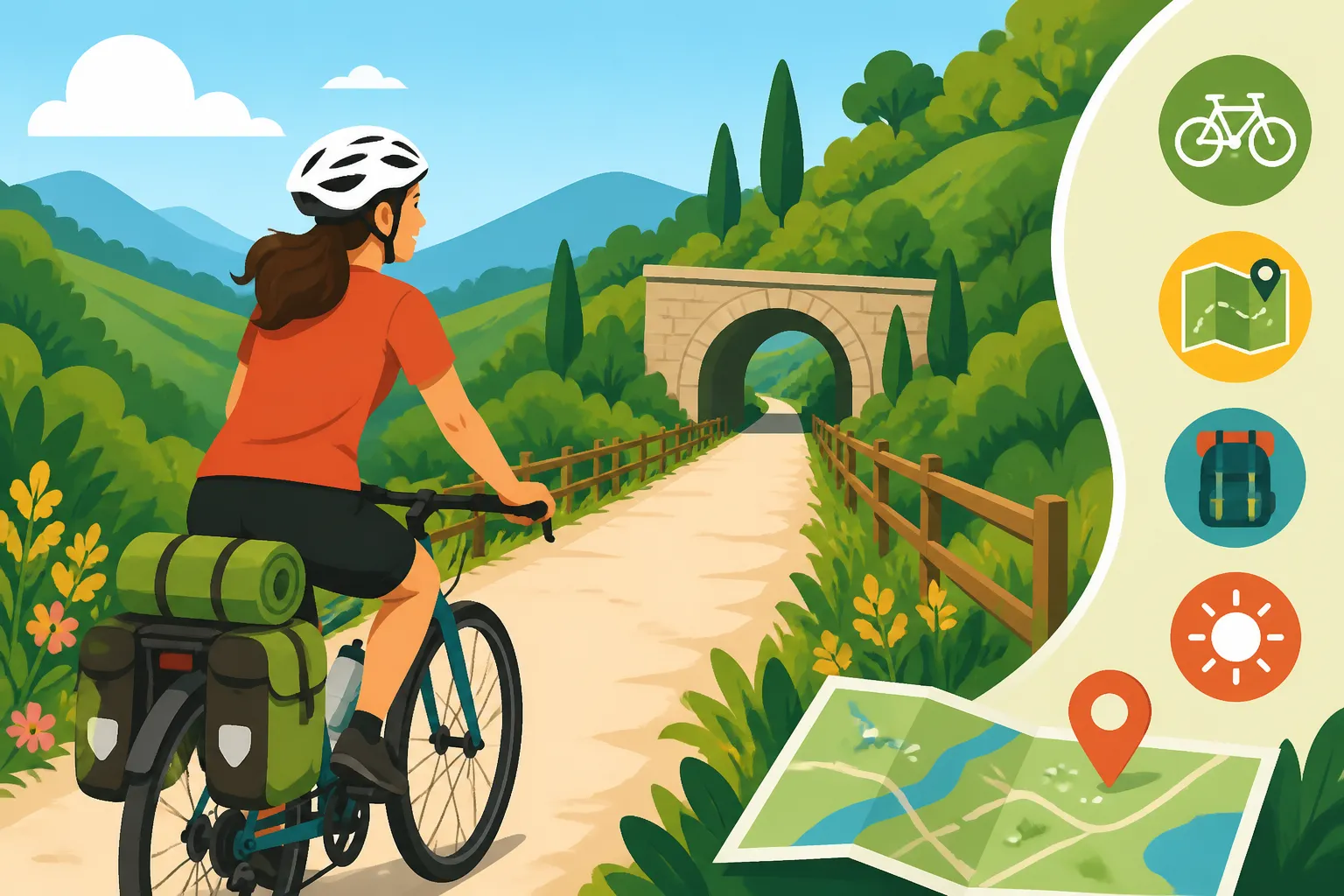
The beauty of a railway-based trail is the gradient. Locomotives aren't fans of steep hills, which means these paths rarely exceed a 3% incline. For those of us who aren't professional athletes but still want to engage in Outdoor Adventures and Nature in Spain, this is a godsend. You get the views of the mountains without the grueling climbs. Most of these routes are well-maintained, featuring restored stations that have been turned into charming cafes, hostels, or museums. However, don't let the "well-maintained" tag fool you into thinking it's all smooth sailing; some sections can be rugged, and the tunnels—oh, the tunnels—are a whole different story.
One thing I learned early on is that Spanish infrastructure can be inconsistent. While one province might have a pristine asphalt Vía Verde, the neighboring one might have a gravel path that hasn't seen a rake in years. This is why researching Spain's Regions and Where to Go: A Traveler's Overview is essential before you pack your panniers. Each region manages its own sections, and the quality often reflects local investment. But regardless of the surface, the lack of cars is the real luxury here. You can finally stop looking over your shoulder for a speeding SEAT Leon and actually look at the olive groves.
Selecting Your Ideal Greenway
Choosing the right route is the difference between a dream trip and a logistical nightmare. Spain has over 120 Vías Verdes, ranging from tiny 5-kilometer local spurs to massive multi-day journeys. If you are looking for diversity, you need to look at the big players.
The Vía Verde de Ojos Negros is often cited as the king of Spanish greenways. Stretching over 160 kilometers from the high plains of Teruel down to the Mediterranean coast near Valencia, it is technically the longest in the country. It is divided into two main sections. The first part, through the province of Teruel, is high, windy, and lonely—perfect if you want to escape the city noise. As you cross into the Valencian Community, the landscape shifts into lush orchards and Mediterranean pines. Because of its length, you'll want to plan your stops carefully. Using tools like Omio can help you figure out how to get your bike to the starting point in Santa Eulalia, as the regional train connections in Teruel are notoriously sparse.
For something a bit more manageable but equally spectacular, the Vía Verde de la Sierra in Andalusia is a personal favorite. It runs for 36 kilometers between Olvera and Puerto Serrano. This route is famous for its tunnels—over 30 of them—and the Peñón de Zaframagón, home to one of Europe’s largest colonies of griffon vultures. Seeing these massive birds circling above as you cycle through the silent valley is a core memory for many expats. This route is a highlight when exploring Andalusia for Travelers: Cities, Coast, and Culture, providing a stark, beautiful contrast to the bustling streets of Seville or Málaga.
If you are based in the north, the Carrilet routes in Catalonia offer a wonderful transition from the volcanic landscapes of Garrotxa down to the sea. The Carrilet I runs from Olot to Girona, and the Carrilet II continues from Girona to Sant Feliu de Guíxols. This is a fantastic way to see Catalonia Beyond Barcelona: What to See while staying active. The paths are generally very well-signed and pass through several medium-sized towns where finding a good meal or a bike shop is easy.
Mastering the Logistics of a Cycling Trip
The biggest headache for any cycling trip in Spain isn't the cycling; it’s the logistics. Transporting a bicycle on Spanish public transport can feel like a bureaucratic puzzle designed to test your patience. Renfe, the national rail provider, has varying rules depending on the type of train. On Cercanías (suburban) and Media Distancia (regional) trains, you can usually take a bike for free or a small fee, but space is limited and often requires a prior reservation. On the high-speed AVE, your bike must be folded or disassembled and placed in a carrying bag.
This is where planning ahead becomes vital. It is often wise to use Omio to compare train and bus options, as some bus companies like Alsa are actually more bike-friendly than the trains, provided you book the bike space in advance. If the thought of hauling your own gear across the country makes you break out in a cold sweat, consider local rentals. Most major Vías Verdes have specialized companies that offer bike hire and, more importantly, "shuttle" services. They will drop you and the bikes at the high point of the trail so you can enjoy a 40-kilometer downhill ride back to your car or hotel.
When it comes to accommodation, look for the "Ciclogreen" or "Bicycle Friendly" labels on platforms like Booking.com. These hotels and guesthouses offer secure storage, basic repair tools, and sometimes even a place to wash your bike. Never assume a standard hotel will let you take your muddy mountain bike up to the fourth-floor suite. Always call ahead or check the amenities list. Being stuck in a small town in the middle of La Mancha with no place to lock up your bike for the night is a situation you want to avoid.
| Vía Verde Name | Location (Region) | Length | Difficulty | Top Feature |
|---|---|---|---|---|
| Ojos Negros | Aragon / Valencia | 160 km | Medium | Longest route in Spain |
| De la Sierra | Andalusia | 36 km | Easy | Vulture colony & 30 tunnels |
| El Carrilet | Catalonia | 95 km | Easy/Medium | Pyrenees to Costa Brava |
| Plazaola | Navarre / Basque Country | 68 km | Medium | Lush Atlantic forests |
| De la Jara | Castile-La Mancha | 52 km | Easy | Remote viaducts & reservoirs |
Preparing for Your Trip: Gear, Safety, and Local Etiquette
One mistake I see people make constantly is underestimating the Spanish sun. When you are cycling, the breeze masks how much you are actually sweating and burning. If you are planning this during the warmer months, you must read up on Heatwaves in Spain: Health Precautions for Expats. Even on a "flat" greenway, dehydration can hit you fast. Always carry more water than you think you need, as the "fountains" marked on some maps haven't flowed since the 1990s.
Safety on the Vías Verdes is generally high because of the lack of cars, but the tunnels present a specific risk. While the most popular routes have motion-sensor lighting in the tunnels, these systems frequently fail. Entering a 500-meter-long, curved tunnel in total darkness is terrifying and dangerous. Always bring a high-quality front light and a rear red light. Also, remember that these trails are shared with hikers and horse riders. Spanish trail etiquette is relatively relaxed, but a friendly "¡Hola!" or a ring of your bell goes a long way.
Don't forget the culinary aspect of the trip. One of the best parts of cycling through rural Spain is the "Menú del Día." Most villages along the trails will have a local bar serving a three-course meal for a very reasonable price. It’s a great way to experience Spanish Food and Drink: A Practical Culture Guide in an authentic setting. Just be warned: a heavy Spanish lunch with a glass of wine might make those last 15 kilometers feel much longer than they are. Plan your eating stops around the mid-point of your day to avoid the afternoon "siesta" slump where shops and some cafes might close. For organized tours or guided experiences that include these culinary stops, checking GetYourGuide can sometimes reveal local operators who handle all the food and history portions of the trip for you.
Essential Packing List for the Greenway
Beyond the bike and the lights, there are a few "expat-tested" items you should never leave without. First, a basic repair kit is non-negotiable. While you might pass through towns, the Vías Verdes often take you through remote areas where the nearest mechanic is two valleys away. Carry a multi-tool, a spare tube, and a pump. Even if you don't know how to use them, a passing local cyclist usually will—if you have the parts.
Second, consider the terrain. Many Vías Verdes use crushed limestone or fine gravel. This can be incredibly dusty in the summer and a bit "soupy" after rain. If you are using a road bike, ensure your tires are at least 28mm wide; otherwise, you'll be feeling every vibration in your teeth. A hybrid or mountain bike is usually the best tool for the job.
Lastly, carry a physical map or a downloaded offline version on your phone. Mobile coverage in the deeper valleys of the Sierra Morena or the Pyrenees can be spotty at best. Knowing exactly where the next access point or Spanish Food and Drink: A Practical Culture Guide opportunity is will keep your morale high when the legs start to tire. If you find yourself in a bind or need to pivot your plans, knowing How to Find a 24‑Hour Clinic in Spain (Urgencias) or having the local emergency numbers saved is a standard safety precaution for any resident or traveler.
Navigating the Cultural Landscape of Rural Spain
Cycling the Greenways isn't just about the physical exercise; it's a cultural immersion. You will pass through "Pueblos Blancos" (white villages) and abandoned stations that look like film sets from a 1950s cinema. People in these rural areas are generally incredibly welcoming to cyclists, as the Vías Verdes have brought much-needed tourism to "España Vaciada" (Empty Spain). Take the time to stop in the local plazas. This is where you really get to practice your language skills and understand Spanish Customs, Etiquette, and Social Life far away from the tourist bubbles of the coast.
If you are traveling with family, the Greenways are the safest way to introduce children to the joy of cycling in Spain. Many of the routes, like the Vía Verde del Tajuña near Madrid, are fully paved and very flat, making them ideal for little legs. It is a fantastic alternative to the usual beach holiday, allowing the kids to explore tunnels and bridges while staying away from traffic. For those moving here permanently, these trips are a great way to overcome "culture shock" by connecting with the land and the quiet, traditional rhythm of Spanish life that still exists just a few kilometers outside the big cities.
Disclaimer
The information provided in this guide is for informational purposes only and does not constitute professional travel or safety advice. While we strive to keep information up to date, the condition of Vías Verdes, train regulations, and local services can change without notice. Always check with local tourism offices or official transit providers before embarking on your trip. Cycling involves inherent risks; ensure you have appropriate insurance and are in suitable physical condition for the chosen route.