Valencia City Guide: Old Town, Beaches, and Science Park
Many travelers get stuck in the Madrid-Barcelona loop, missing out on Valencia because the logistics of connecting its medieval heart with its futuristic coast feel like a puzzle. When I first moved to Spain, I spent my first three days in Valencia just trying to figure out why the "river" was a park and how to get to the beach without a thirty-minute trek. This guide simplifies that chaos, giving you a veteran’s perspective on mastering the Old Town, the Science Park, and the sea.
Disclosure: This post may contain affiliate links. We may earn a commission at no extra cost to you if you make a purchase through these links. Read full disclosure.
Navigating the Contrasts of Valencia's Major Districts
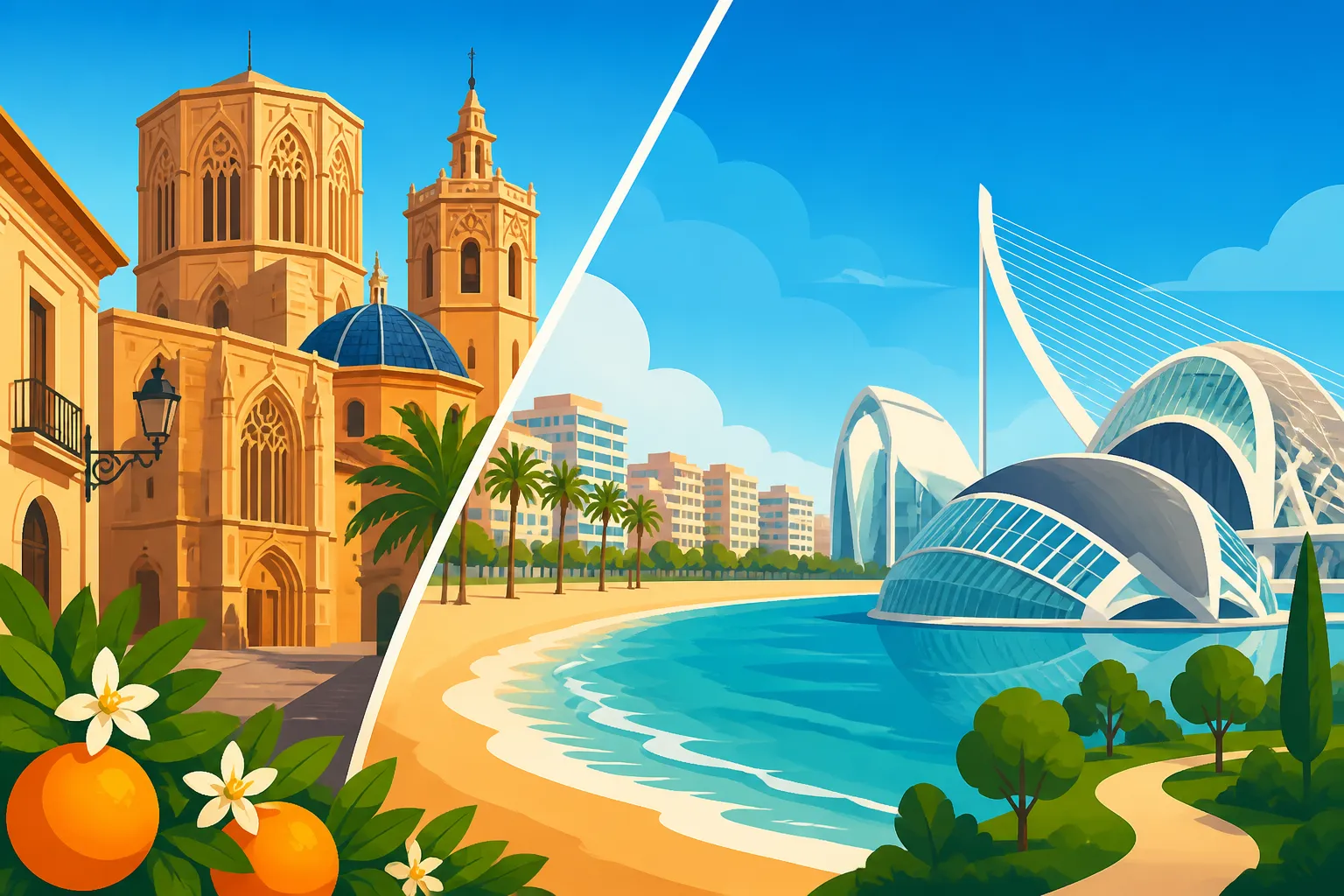
Valencia isn’t a city you can just "walk" in a single afternoon. It is effectively three distinct worlds connected by a nine-kilometer ribbon of green. Understanding how these districts interact is the first step to not wearing yourself out. You have the Ciutat Vella (Old Town), which is a labyrinth of Gothic stones; the Eixample and Ruzafa, which offer a trendy, modernist vibe; and the Poblats Marítims, where the city finally meets the Mediterranean.
The Historic Heart (Ciutat Vella)
The Ciutat Vella is where newcomers are usually advised to start, but with a warning: Google Maps will fail you here. The streets are a tangle of medieval layouts designed to confuse invaders, and they’ve been doing a great job on tourists ever since. This district contains the Cathedral, the Central Market, and the Barrio del Carmen. It’s where you feel the weight of Roman, Visigoth, and Moorish history beneath your feet.
Living here taught me that the Old Town is best experienced early in the morning. By 11:00 AM, the cruise ship crowds descend on Plaza de la Reina, and the magic evaporates. If you want to see the real Carmen, walk it at 8:00 AM when the shopkeepers are rolling up their shutters and the smell of fresh fartons (sweet pastries) fills the air. It’s a place of architectural pride, but it’s also a living neighborhood where residents still hang laundry from 15th-century balconies.
The Turia Gardens and the City of Arts and Sciences
One of the most unique things you’ll learn while Valencia and the Costa Blanca: Highlights for Visitors is that the city’s greatest park used to be a deadly river. After a catastrophic flood in 1957, the Spanish government diverted the Turia River around the city and turned the dry bed into a sunken park. This green lung separates the old from the new and serves as the primary highway for cyclists and joggers.
At the eastern end of this park sits the City of Arts and Sciences. It looks like a set from a high-budget sci-fi film. Designed largely by Santiago Calatrava, these white, skeletal structures are iconic but can be polarizing. Some locals see them as a symbol of overspending, while others see them as the city's modern crown jewel. Regardless of politics, walking through the Umbracle at sunset is an essential Valencia experience. It provides a sharp, aesthetic jolt after the dusty brown stones of the historic center.
The Maritime Quarters and Beaches
The beach in Valencia is not "right there" like it is in San Sebastián or Barcelona. It is a deliberate trip. The area known as Poblats Marítims encompasses the port, Las Arenas beach, and the old fisherman’s quarter of El Cabanyal. For decades, this area was neglected, but it has recently undergone a massive revival. It still retains a gritty, authentic edge that you won't find in the polished center.
When you head to the beach, you aren't just going for the sand. You're going for the social ritual. The promenade is lined with restaurants that have been serving families for generations. This is where the maritime identity of the city shines. You’ll see grandmothers in their Sunday best sitting next to surfers, both waiting for the same thing: a massive pan of rice. It’s a sprawling, breezy environment that offers the physical space the Old Town lacks.
Getting to and Around Valencia Like a Local
Logistics in Spain can be a headache if you don't know the quirks. Valencia is well-connected, but there are "gotchas" regarding train stations and bus routes that catch even seasoned expats off guard. Knowing How to Get Around a Spanish City Without Speaking Spanish is helpful, but Valencia’s specific layout requires a bit more tactical knowledge.
Arrival via High-Speed Rail and Air
If you are coming from Madrid or Barcelona, you will likely use the high-speed AVE. A common mistake is not checking which station you’re arriving at. The AVE arrives at Joaquín Sorolla station, while the local and regional trains arrive at the stunning, tile-covered Estació del Nord. They are about 15 minutes apart on foot, though a free shuttle bus connects them if you have a train ticket. It is useful to use Omio to compare these train times and prices, as the difference between a regional "Media Distancia" and a high-speed AVE can be hours.
If you’re flying in, the Metrovalencia (Lines 3 and 5) takes you directly from the airport to the city center (Xàtiva or Colón stations) in about 25 minutes. It’s efficient and cheap. Don’t bother with a taxi unless you have four suitcases and a small child; the metro is remarkably clean and reliable. Just remember to keep your ticket for the exit turnstiles—many frustrated travelers get stuck at the gate because they tucked their ticket into a deep pocket.
Mastering the Metro and EMT Bus Network
Valencia's metro is great for getting from the outskirts to the center, but it’s less useful for moving within the center. For that, you need the EMT bus system. The number 95 bus is your best friend; it runs along the Turia park and connects the Bioparc (zoo) at one end to the City of Arts and Sciences at the other. It is the easiest way to see the city's highlights without having to navigate underground tunnels.
To pay, you should buy a "SUMA" card at a tobacco shop (Estanco) or a metro station. This card allows you to hop between the metro, the bus, and the tram. The tram (Line 4) is specifically useful for getting to the beach from the northern parts of the city. Tapping your card is much cheaper than buying individual tickets from the driver, and in fact, many buses in Valencia have moved toward being cashless or card-only for certain types of fares.
The Joy of Biking the Turia
If you have the stamina, the best way to see Valencia is on two wheels. The city is pancake-flat, which is a godsend for those of us who aren't in Olympic shape. The Turia Gardens have dedicated bike lanes that never cross with car traffic, making it a safe and scenic route from the heart of the city down to the City of Arts and Sciences. You can rent bikes from dozens of small shops in the Barrio del Carmen for about 10 to 15 Euros a day.
There is also the public bike-share system called Valenbisi. While great for residents, it can be a bit of a faff for short-term visitors to set up. If you're staying for more than a few days, it’s worth the effort, but for a 48-hour trip, a private rental is easier. Just a tip from someone who has had a bike stolen: always use two locks and never leave it outside overnight. Valencia is safe, but bike theft is the one "professional sport" that local thieves excel at.
| Neighborhood | Vibe | Best For | Distance to Beach |
|---|---|---|---|
| Ciutat Vella | Historic, narrow, bustling | Sightseeing & History | 25 mins by bus/tram |
| Ruzafa | Hipster, nightlife, cafes | Dining & Nightlife | 20 mins by bus |
| El Cabanyal | Gritty, authentic, colorful | Beach access & Seafood | 2 mins walk |
| Eixample | Grand, upscale, shopping | Luxury stays & Boutiques | 15 mins by bus |
Exploring the Ciutat Vella: A Journey Through Time
The Old Town is where Valencia hides its secrets. It isn't just one big museum; it’s a collection of mini-neighborhoods that each have a different personality. You can spend an entire day just within the old walls and still miss a hidden plaza or a spectacular piece of street art.
The Cathedral and the Holy Grail
The Valencia Cathedral is a strange mix of architectural styles—Gothic, Romanesque, and Baroque all smashed together. But the real draw for most is the Chapel of the Holy Chalice. Now, whether or not you believe it’s the actual cup from the Last Supper, the history surrounding it is fascinating. It’s been hidden in stone walls and smuggled across borders to keep it safe from various wars.
While there, you absolutely must climb the Miguelete bell tower. It’s a narrow, spiral stone staircase that will test your calves, but the 360-degree view from the top is the best in the city. You can see all the way to the Sierra Calderona mountains and out to the Mediterranean. If you want a more structured deep dive into the history, it is often worth finding a walking tour on GetYourGuide, as the layers of history in the Cathedral are hard to decipher without a professional guide.
The Silk Exchange (La Lonja de la Seda)
Across from the Central Market stands one of the most beautiful Gothic buildings in Europe. La Lonja was the center of the silk trade when Valencia was a global economic powerhouse. The main hall, with its towering twisted columns, is designed to look like a stone forest of palm trees. It’s a UNESCO World Heritage site for a reason—the craftsmanship is staggering.
What I love most about La Lonja are the "gargoyles." If you look closely at the stone carvings around the windows and roofline, you’ll see some rather scandalous and humorous figures. The medieval stonecutters had a sense of humor that was surprisingly bawdy. It’s a quiet, cool refuge on a hot day, and the orange-tree-filled courtyard (Patio de los Naranjos) is the perfect spot to sit and reflect on the city's mercantile past.
The Central Market (Mercado Central)
The Mercado Central is the soul of Valencia. This isn't just a place for tourists to buy overpriced smoothies; it is where local chefs and grandmothers buy their daily produce. The building itself is a masterpiece of Valencian Modernism, featuring stained glass, colorful ceramics, and a giant parrot on its weather vane.
Inside, you’ll find over 1,200 stalls. My routine is always the same: a cone of Iberian ham from a butcher, followed by a fresh juice, and then a hunt for the specific types of beans (garrofó) used in authentic paella. If you are staying in a place with a kitchen, this is your pantry. Make sure to check Spanish Shopping: Supermarkets, Markets, and Budget Strategies to understand how to navigate the scales and the "who’s next" system at the stalls. The market closes at 2:30 PM, so don't leave it for the late afternoon!
The Future is Now: The City of Arts and Sciences
Transitioning from the Old Town to the City of Arts and Sciences is like traveling forward 500 years in a single kilometer. This complex redefined Valencia’s image on the world stage, and even if you don't go inside the buildings, the exterior architecture is a must-see.
Architectural Marvels of Santiago Calatrava
The complex consists of several major structures: the Hemisfèric (an eye-shaped IMAX cinema), the Museu de les Ciències (the science museum), the Oceanogràfic (the aquarium), and the Palau de les Arts (the opera house). The sheer scale of these buildings is hard to grasp until you are standing next to them. The white concrete and broken ceramic tiles (trencadís) reflect the sun so intensely that you'll definitely need sunglasses.
Walking through the Umbracle—a landscaped walkway covered by floating arches—is free and offers the best views of the entire complex. For many, this is the "Valencia" they see on Instagram. It’s worth noting that these buildings have a reputation for being high-maintenance; keep an eye out for the intricate tile work that covers the structures, a nod to Valencia’s long history of ceramic production.
Inside the Oceanogràfic and Science Museum
If you have kids, or if you’re just a fan of marine life, the Oceanogràfic is non-negotiable. It is the largest aquarium in Europe and is designed as a series of underwater towers. Walking through the shark tunnel while a massive sawfish swims inches above your head is an experience that never gets old. It’s organized by ecosystem, so you move from the Arctic (complete with beluga whales) to the Red Sea.
The Science Museum (Museu de les Ciències) is more "hands-on." It’s designed around the philosophy that visitors should touch and experiment with everything. It’s great for families, though if you’ve been to major science museums in London or San Francisco, you might find some of the exhibits a bit dated. However, the building itself is the star. I recommend booking tickets in advance via GetYourGuide to skip the lines, especially on weekends when local families flock to the site.
Finding the Best Photography Spots
For the photographers among you, the City of Arts and Sciences is a playground of lines and reflections. The best time to visit is during the "Blue Hour"—just after the sun sets but before the sky goes completely dark. The buildings are illuminated, and the shallow pools of water surrounding them act as perfect mirrors.
There’s a specific spot on the bridge (Pont de l'Assut de l'Or) that gives you a view of the "Agbar" style Agora building and the Science Museum in one frame. Also, don't miss the "Gulliver Park" nearby, where a massive sleeping giant serves as a playground for kids. It’s a great example of how the city integrates art and play into its public spaces.
Sun, Sand, and Sea: Valencia’s Coastal Life
Valencia’s relationship with the sea is complicated. The city was built slightly inland to protect it from pirates and the humid marshes, but today, the coast is its biggest draw.
Las Arenas and La Malvarrosa
These are the two main city beaches. They are wide—exceptionally wide. You could fit several football pitches between the boardwalk and the shoreline. This means that even in the height of August, you can usually find a spot to plant your umbrella. The sand is fine and golden, and the water is generally calm and warm.
The boardwalk (Paseo Marítimo) is where the city comes to eat. You will see dozens of restaurants, many of which claim to have the "best" paella. Be careful here. While there are some gems, there are also tourist traps. Always look for places where you see large Spanish families gathered on a Sunday afternoon. If you want to know what to look for, read How to Find the Best Paella in Valencia (and Avoid Bad Ones) before you commit to a table.
The Marina and the Port
The Marina of Valencia was transformed for the America’s Cup and now serves as a hub for innovation and leisure. It’s a great place to walk or grab a cocktail at one of the trendy beach clubs. You’ll see massive yachts docked next to historic port buildings. It’s much more modern and "posh" than the neighboring El Cabanyal.
One of the highlights here is the Veles e Vents building, a stunning piece of minimalist architecture that houses several restaurants and an exhibition space. It’s a great spot for a "sun-downer" drink. From here, you can also take boat tours that go out into the Mediterranean for a view of the skyline. Check Booking.com if you’re looking for high-end hotels in this area, as there are some spectacular waterfront options that offer a different experience than staying in the cramped Old Town.
El Cabanyal: The Traditional Fisherman’s Quarter
If you want soul, go to El Cabanyal. This neighborhood is a grid of narrow streets lined with "casitas" (small houses) covered in elaborate tiles. For years, the city government wanted to demolish part of this neighborhood to extend a grand boulevard to the sea. The locals fought back and won, and now the area is being restored house by house.
It is the best place in the city for a "tapas crawl." You’ll find old-school taverns like Casa Montaña, which has been serving wine and mussels since 1836, sitting alongside new, experimental bars. It feels like a village within a city. If you’re interested in the local food scene beyond the tourist menus, check out Spanish Tapas Culture: How to Order and Where to Go to prepare for the fast-paced environment of a busy Valencian bar.
Practical Tips for a Smooth Valencia Experience
To truly enjoy Valencia, you have to lean into its rhythm. This is not a city that rewards a rushed itinerary.
Dining Times and the Paella Rule
This is the most important thing I can tell you: Do not order paella for dinner. In Valencia, paella is a lunch dish. It’s heavy, rice-based, and traditionally eaten with the family between 2:00 PM and 4:00 PM. Many of the best, most authentic rice restaurants won't even have paella on the menu in the evening. If you see a place pushing paella at 9:00 PM, it’s a tourist trap.
Furthermore, remember that Spanish Meal Times and Dining Etiquette Explained are strictly followed here. Lunch starts at 2:00 PM, and dinner rarely starts before 9:00 PM. If you show up at a restaurant at 7:00 PM, you’ll find the staff still having their own break or just beginning to set the tables. For a mid-afternoon snack, do as the locals do and grab an Horchata—a refreshing tiger nut milk drink—at the legendary Santa Catalina.
Best Neighborhoods to Stay In
Where you sleep will dictate your experience. If you want to be in the thick of the history and don't mind some noise, the Ciutat Vella is great. If you want something more "local" and trendy with incredible food, Ruzafa is the place. It’s the Soho of Valencia, filled with art galleries, vintage shops, and late-night bars.
For those who want peace and sea air, El Cabanyal is becoming a very popular choice for boutique rentals. You can find beautiful apartments on Booking.com that are just a five-minute walk from the beach. Just keep in mind that staying by the beach means a 20-minute commute into the center for sightseeing. I personally think Ruzafa or the Eixample offer the best balance of local life and accessibility.
Safety and Connectivity
Valencia is generally one of the safest cities in Spain. I’ve walked through most neighborhoods at 2:00 AM without a second thought. However, like any major tourist destination, pickpockets are active in crowded areas like the Central Market and on the number 95 bus. Keep your bag in front of you and don't leave your phone on the table at an outdoor terrace.
For connectivity, the city has a decent public Wi-Fi network in some plazas, but it’s patchy. Buying a local SIM card is easy at any phone shop in the center. If you’re worried about navigating the specifics of local laws and safety, a quick glance at Staying Safe in Spain: Practical Safety Tips for New Residents can give you that extra layer of confidence. Also, keep the number 112 in your phone—it’s the universal emergency number in Spain and they usually have English speakers available.
Disclaimer
This guide is provided for informational purposes and reflects the personal experiences of the author as a long-term resident of Spain. Travel regulations, opening hours, and local conditions are subject to change. Always verify essential details with official sources before your trip.