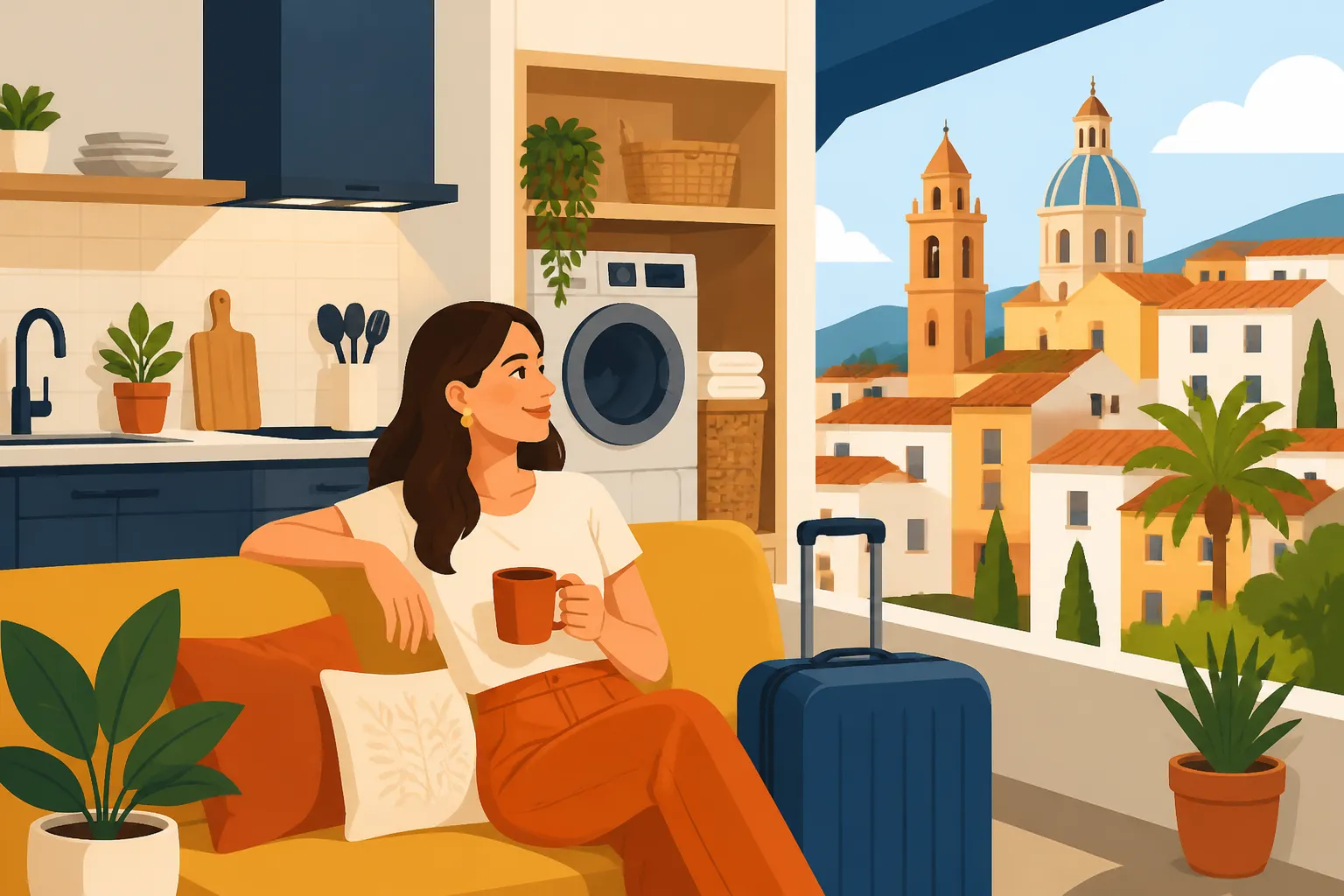
Aparthotels in Spain: Kitchens, Laundry, and Long Stays
You land in Málaga for a six-week stay and book what looks like a serviced apartment. Then you find a two-ring hob, no oven, a washing machine with a Spanish-only dial, and nowhere to dry anything. This guide covers what Spanish aparthotels actually include, how to filter for real kitchens and laundry, and how to book a long stay without unpleasant surprises.
Disclosure: This post may contain affiliate links. We may earn a commission at no extra cost to you if you make a purchase through these links. Read full disclosure.
What an Aparthotel in Spain Really Gives You
I have done the long-stay shuffle in Spain more times than I like to admit. There was a month in Madrid while waiting for a rental contract, two winters in Gran Canaria, and a frantic few weeks in Valencia when a flat fell through. Aparthotels saved me every time, but only after I learned that the word means different things to different properties. Before you book anything, it helps to know what you are actually buying.
Aparthotel vs Tourist Apartment vs Standard Hotel
In Spain, an aparthotel, often listed as a hotel-apartamento or apartahotel, is legally a hotel-type business. Each unit has its own cooking facilities. You usually get a reception desk, some level of housekeeping, a lift, and a single company responsible for the whole building. That differs from an apartamento turístico, a privately managed flat in an ordinary residential building. Those often have a key box, a WhatsApp check-in, and an owner who may or may not answer on a Sunday.
The difference matters most on a long stay. Suppose the washing machine floods the bathroom on day nine. In an aparthotel you go downstairs and someone deals with it. In a tourist flat you message the host, wait, message again, and maybe end up with a plumber who speaks no English, arriving at a time that “más o menos” means sometime that afternoon. For the private-flat side of the market, see Apartamentos Turisticos: Licence Numbers, Check-In, and What Can Go Wrong.
A standard hotel gives you the reception and the cleaning but no kitchen. That is fine for a long weekend in Seville and miserable by week three, when you are tired of eating out at 21:30. If you are still weighing up the three formats for a month or more, Monthly Stays in Spain: Hotel vs Aparthotel vs Short-Term Rental goes deeper into that decision.
| Feature | Aparthotel | Tourist Apartment | Standard Hotel |
|---|---|---|---|
| Kitchen in the unit | Usually, from kitchenette to full kitchen | Usually a full domestic kitchen | Rarely, sometimes a minibar or kettle only |
| Washing machine | Varies, sometimes in-unit, sometimes a shared laundry room | Often in-unit, dryer uncommon | Paid laundry service only |
| Reception and on-site help | Yes, hours vary | Rarely, host contact by phone or app | Yes, often around the clock |
| Housekeeping | Weekly or every few days on long stays, varies | Usually none during the stay | Daily |
| Building type | Purpose-run accommodation | Private flat in a residential block | Purpose-run accommodation |
| Best fit | Stays of one week to a few months | Stays where you want to live like a local | Short city breaks |
| Main risk | Kitchenette smaller than photos suggest | Slow responses when things break | Eating out every meal |
What “Equipped Kitchen” Means in a Spanish Listing
“Cocina equipada” covers a huge range. At the generous end you get a four-zone induction hob, an oven, a full-size fridge-freezer, a dishwasher, a Nespresso or Dolce Gusto machine, and a decent frying pan. At the other end, and I have stayed there, it means two vitrocerámica rings, a microwave, a bar fridge, one blunt knife, and four mismatched plates.
Spanish kitchens have their own quirks even at the good end. Ovens are less common than you might expect, especially in older city-centre buildings in Barcelona’s Gòtic or Madrid’s Lavapiés. A microwave with a grill function often stands in for one. Kettles are hit and miss, because many Spaniards heat water in a saucepan or the microwave. Extractor fans can be weak, and in a studio that means your clothes smell of garlic prawns by bedtime. None of this is a disaster if you know before you arrive.
On a long stay, the useful questions are practical ones. Is there a freezer compartment so you can batch-cook? Is there an oven if you like roasting vegetables? Is there a dishwasher, or will you be hand-washing every night? Is there a proper table, or just a bar stool at a counter? I learned the hard way that “kitchenette” in a Madrid aparthotel can mean a cupboard-wall unit that folds behind sliding doors. It is cleverly designed and fine for breakfast. You would not cook a Sunday stew in it.
The Laundry Reality
Laundry is where long-stay guests get caught out most. Spanish homes overwhelmingly use a washing machine (lavadora) and a drying rack or a line strung outside the window (tendedero). Tumble dryers (secadoras) are much rarer than in Northern Europe or North America. An aparthotel may proudly list a washing machine in every unit and still give you nowhere sensible to dry a week’s worth of clothes.
Aparthotels handle this in a few different ways. Some put a washer-dryer combo in each unit, which is brilliant until you discover the drying cycle takes three hours and still leaves jeans damp. Some have a shared laundry room on the ground floor with coin or token machines. Others offer a paid laundry service through reception. A few put nothing in the unit at all and point you to the nearest lavandería autoservicio, the self-service laundrettes that have spread across Spanish city neighbourhoods. Many are open long hours and have big dryers that will finish your load in under an hour.
Climate changes the equation too. A drying rack on a balcony in Seville in June will dry a shirt faster than you can make a coffee. That same rack in a north-facing studio in Bilbao in November may leave socks damp for two days. Interior patios (patios de luces) in older buildings are where locals hang laundry, but they get little sun. Air conditioning or heating speeds up indoor drying, which is one more reason to check what climate control the unit has; see Air Conditioning and Heating in Spanish Accommodation: What to Verify.
Using Booking.com to Find a Long-Stay Aparthotel That Actually Works
I have tried most of the ways to find long-stay accommodation in Spain: estate agents, Facebook groups, local classifieds, and walking into lobbies to ask. For aparthotels specifically, Booking.com is where I start and usually where I finish. That is not because it is the only option. It is because the filters, the volume of Spanish aparthotel inventory, and the review system let you check kitchens and laundry before you commit, which is exactly what matters on a long stay.
The Filters That Matter for Kitchens and Laundry
The default search results on any platform are tuned for a two-night city break, so the first job is to reshape them for living rather than visiting. On Booking.com, I work through the filters in this order:
- Enter your full dates rather than a sample week, because availability and long-stay rates often only show for the exact length you need.
- Under property type, select apartments and aparthotels, and leave hotels unticked unless you are flexible on cooking.
- In the facilities or room facilities filters, tick kitchen or kitchenette, and washing machine if laundry in the unit is a deal-breaker.
- Add any other must-haves, such as air conditioning, a lift, parking, or a balcony for drying clothes.
- Switch to the map view and drag it over the neighbourhoods you actually want, such as Chamberí rather than Gran Vía in Madrid, Ruzafa rather than the beachfront in Valencia, or Soho rather than the port in Málaga.
- Sort by guest review score, then open the top results and read the room description, not just the headline facilities list.
That last step is important. The facilities filter tells you a property has a kitchen somewhere. The room-level description tells you whether your specific unit type has one. Large aparthotels on the Costa del Sol and in Tenerife often mix room types, with studios on one floor and one-bed apartments with full kitchens on another. The cheapest rate in the list may belong to the unit with the microwave and nothing else. Always click through to the room type and check it lists a hob, an oven, a fridge, and whatever laundry facility you need.
Reading Listings and Reviews Like a Long-Stay Guest
Photos are the first place I look, and I look at them suspiciously. A wide-angle shot of a gleaming kitchen tells me little. A close-up of the hob tells me whether it is two zones or four. I look for a dishwasher door under the counter, a washing machine in the bathroom or a utility cupboard, and anywhere that could plausibly hold a drying rack. If the listing has fifty photos of the rooftop pool and none of the kitchen, I treat that as an answer in itself. For decoding the Spanish terminology in room descriptions, see Reading Spanish Hotel Listings: Room Types, Bed Sizes, and Terms Decoded.
Reviews on Booking.com can only be left by guests who booked and stayed, which makes them more useful than random comments elsewhere. The trick on a long stay is to search within the reviews rather than skim the scores. I type words like “kitchen”, “cocina”, “washing”, “lavadora”, “month”, “long stay” and “weeks” into the review search, and only read what comes back. A family that stayed three nights and loved the breakfast tells me nothing. A digital nomad who stayed five weeks and complained the Wi-Fi died every evening tells me a lot.
Look for patterns, not single complaints. One review saying the oven did not work could be bad luck. Three reviews across different months saying the pans are worn out and the kitchen is missing basics is a management issue that will not be fixed for you. If you will be working from the unit, the same review-search method applies to Wi-Fi speed, desk space, and street noise; see Digital Nomad Stays in Spain: Booking for Wi-Fi, Desks, and Quiet.
Messaging the Property Before You Book
For anything longer than a week, I always message the property through Booking.com before paying. The built-in messaging keeps a written record, and that record matters if what you were promised does not match what you find. Spanish aparthotels are generally responsive to these questions, and the reply often tells you as much about the management as the answer itself.
These are the questions I send, in English, with a short Spanish line at the top as a courtesy:
- Does the unit type I am booking have an oven, or only a hob and microwave?
- Is there a washing machine inside the unit, and is there a dryer or a drying rack provided?
- If there is no in-unit laundry, is there a guest laundry room on site, and how do I pay for it?
- How often is cleaning and towel change included on a stay of this length, and can I request extra?
- Is there a long-stay rate if I book directly for these dates, or is the platform price the best available?
- Are there any building works planned nearby during my dates?
A good reply is specific, along the lines of “Sí, horno, lavadora en el apartamento, tendedero en el armario, limpieza semanal incluida”. A vague reply, or no reply within a couple of days, is useful information too. For the wider question of when going direct beats a platform, see Booking Platforms vs Direct Booking in Spain: When Calling the Hotel Wins.
Making a Long Aparthotel Stay Work Day to Day
Booking the right place is half the battle. The other half is building a routine so that an aparthotel feels like a temporary home rather than a slightly better hotel room. Here is what has worked for many newcomers.
Stocking a Spanish Aparthotel Kitchen Without Overbuying
The temptation on day one is a giant supermarket trip. Resist it, at least until you have checked what is already in the cupboards. Many Spanish aparthotels leave olive oil, salt, a little dish soap, and sometimes coffee pods. Others leave nothing at all. Do a quick inventory of pans, knives, a chopping board, storage containers, and a colander, and write down what is missing. Then decide whether to buy it cheaply or ask reception, who often have spares tucked away in a storeroom.
For the actual food shopping, the neighbourhood matters more than the chain. A Mercadona within walking distance is a gift on a long stay. So is a municipal market such as Mercado de Triana in Seville, Mercado de Ruzafa in Valencia, or Mercado de Atarazanas in Málaga, where you can buy exactly two tomatoes and a handful of fresh anchovies without committing to a family pack. Shop opening hours catch people out, especially Sunday closures outside the big tourist zones, so plan your main shop for Saturday morning. For more on that rhythm, see Spanish Shopping: Supermarkets, Markets, and Budget Strategies.
A small starter kit makes a long stay much easier. I travel with a decent folding knife sharpener, a few zip-lock bags, a couple of reusable shopping bags, and a small bottle of my preferred spices, because the “salt and pepper” in many units means salt. If you plan to batch-cook, buy a few cheap plastic containers at a bazar chino, the ubiquitous Chinese-run variety shops found in every Spanish town. You can leave them behind at the end without guilt.
Building a Laundry Routine That Fits the Unit
If you have a washing machine in the unit, learn its dial on day one rather than with your last clean shirt. Spanish machines typically label programmes in Spanish: algodón (cotton), sintéticos (synthetics), delicado (delicates), rápido (quick wash), centrifugado (spin), and aclarado (rinse). Most long-stay guests settle on a short programme at a low temperature for everyday loads. Detergent is sometimes supplied as a starter pack, but on a stay of several weeks you will want your own, and a small bottle of liquid detergent from any supermarket is the easiest choice.
Drying is the bigger planning problem. If the unit has a drying rack, set it up near a window or in the warmest room. Run small loads more often rather than one enormous load once a week, so the rack is never overwhelmed. If you have a balcony, check the building rules before hanging laundry over the railing. Some communities and some aparthotels prohibit it on street-facing façades for appearance reasons, and reception will politely but firmly ask you to bring it in.
Where there is no in-unit machine, I build the week around the nearest lavandería autoservicio. Most are simple: you load a big machine, pay at a central terminal, and come back later. Taking a book or a laptop and doing a full wash-and-dry in one sitting beats carrying damp laundry back to a studio with nowhere to dry it. In tourist-heavy neighbourhoods some of these laundrettes also offer a service wash, which is worth it in the final week when you are packing.
Cleaning, Towels, Noise, and Living Alongside Short-Stay Guests
Housekeeping on long aparthotel stays rarely means the daily service you would get in a hotel. A common pattern is a weekly clean with fresh sheets and towels, sometimes with an extra towel change midweek. Some properties offer extra cleans for a fee. Agree on the schedule early, so you are not caught in pyjamas when the cleaner knocks at 10:00. If you are working from the unit, ask for a set day and time and plan calls around it.
Noise is the other daily-life issue. Aparthotels in central Madrid, Barcelona, and Seville often share the building with short-stay guests who are on holiday mode while you are on work mode. Asking for a higher floor, an interior-facing unit, or a room away from the lift and the breakfast area makes a real difference. Also ask whether the property has a pool or rooftop terrace with evening events. On the Costa Blanca and in parts of Tenerife and Lanzarote, some aparthotels run evening entertainment programmes in high season, which is lovely on holiday and less lovely when you have a 09:00 meeting.
Families have their own considerations. Many aparthotels are a good fit for families precisely because a one-bed or two-bed apartment with a sofa bed sidesteps the occupancy caps that apply to standard hotel rooms. For families of four or more, see Why Spanish Hotels Cap Rooms at Three: Booking for Families of Four Plus, and check the bed configuration at the room level before you book.
Booking Strategy for Stays of Weeks and Months
Long aparthotel stays reward planning. The approach that works for a weekend in Barcelona, booking the cheapest refundable room a week before and hoping for the best, tends to cost you money or flexibility over a month.
Rates, Cancellation Terms, and Long-Stay Discounts
On Booking.com, many Spanish aparthotels show a lower nightly rate once your stay passes a week or a month. They do this either through a dedicated long-stay rate or through the general loyalty programme for frequent bookers. The only reliable way to see what applies is to search with your real dates and compare the total, not the headline nightly figure. Try nudging your dates by a day or two either side, because pricing sometimes changes around weekends or local events.
Cancellation terms matter far more on a long stay than a short one. Paying a non-refundable rate for a whole month is a bigger bet than paying it for two nights, especially if your plans depend on a rental contract, a visa appointment, or a job start date. I usually choose a flexible rate for the first booking, even if it costs more, and only commit to a non-refundable one once my dates are fixed. To weigh that trade-off properly, see Refundable vs Non-Refundable Rates in Spain: When the Discount Is Worth It. For what “free cancellation” actually allows in practice, see Free Cancellation in Spain: What the Policy Really Allows.
If an aparthotel is close to what you want but the long-stay price is not quite there, a polite message asking whether there is a better rate for your length of stay is worth sending. Spanish aparthotels, particularly outside peak season on the coasts, are often open to a conversation about extended stays. For approaches that work, see Long-Stay Discounts in Spain: Negotiating Weekly and Monthly Rates.
Picking the Right City and Season
Where and when you stay changes how useful an aparthotel is. Big cities have plenty of business-oriented aparthotels with good kitchens, often in residential districts close to metro lines. Coastal resort towns have huge supply, but much of it is tuned for one-week holidays, and some properties close or scale back in winter. The Canary Islands are a special case, because their mild winters make them a long-stay favourite and the good aparthotels fill up early.
| Base | Where to Look | What Aparthotels There Tend to Suit | Things to Check |
|---|---|---|---|
| Madrid | Chamberí, Salamanca, Argüelles, Retiro | Work stays, flat hunting, longer city stays | Interior vs street-facing units, weekday noise |
| Barcelona | Eixample, Gràcia, Poblenou | Remote work, longer stays near the beach | Tourist tax, summer heat, licence on the property |
| Valencia | Ruzafa, Benimaclet, Ciutat Vella | Slow travel, month-long trial moves | Las Fallas in March, nightlife streets |
| Málaga | Soho, El Ensanche, Huelin | Winter sun, coastal access with city services | Cruise-day crowds in the centre |
| Seville | Triana, Nervión, Alameda | Spring and autumn stays | Extreme summer heat, Semana Santa pricing |
| Gran Canaria and Tenerife | Las Palmas, Puerto de la Cruz, Costa Adeje | Winter long stays | Early booking for peak winter months |
Do not forget the regional tourist tax, which applies in some regions and is often charged at the property rather than included in the platform total. On a long stay that can add up, so ask at booking or check before you pay; see Spain’s Tourist Tax by Region: Catalonia, the Balearics, and What You Pay.
Your Long-Stay Booking and Arrival Checklist
Here is the sequence I follow for any aparthotel stay longer than about ten days in Spain:
- Search Booking.com with your exact dates and the apartment, kitchen and washing machine filters switched on.
- Shortlist three or four properties in the neighbourhoods you have chosen, using the map view.
- Read the room-level descriptions and search reviews for kitchen, laundry, Wi-Fi and noise comments.
- Message your top two properties through Booking.com with your kitchen, laundry and cleaning questions.
- Book a flexible rate first, then switch to a cheaper non-refundable rate later if your plans firm up and the price still makes sense.
- Note the check-in hours and the passport registration requirements, which every Spanish property must collect; see Check-In Documents in Spain: Why Hotels Register Your Passport.
- On arrival, check the kitchen, the laundry setup, the heating or air conditioning, and the Wi-Fi before you unpack, and report problems the same day in writing.
- Agree the cleaning schedule with reception and confirm how to request extra towels or supplies.
- Do a small first food shop, then a larger one once you know what the kitchen can handle.
If your aparthotel stay is a stopgap while you wait for a rental or a visa appointment, you will want to plan the move out as carefully as the move in; see Bridge Accommodation: Where to Stay Between Landing and Getting Keys. Done well, a long aparthotel stay can be the calmest part of a move to Spain. You get a proper kitchen, a laundry routine, and someone downstairs who will fix the boiler. When you are ready to start, open Booking.com, set your real dates, switch on the kitchen and washing machine filters, and start messaging properties. The right aparthotel for a long stay in Spain is out there.
Disclaimer
This article is for general informational purposes only and does not constitute professional advice. Laws, prices and regulations vary by location and change over time. Consult a qualified professional for guidance on your specific situation.