Christmas and Three Kings in Spain: Traditions Explained
Navigating the holiday season in Spain can feel like running a festive marathon that simply refuses to end. My first year here, I packed away my decorations on Boxing Day, only to realize my neighbors were just getting their second wind for another two weeks of celebrations. This guide solves the confusion of the Spanish holiday calendar, explaining exactly what happens between the lottery in December and the arrival of the Kings in January.
Disclosure: This post may contain affiliate links. We may earn a commission at no extra cost to you if you make a purchase through these links. Read full disclosure.
The Spanish Holiday Timeline: A Three-Week Celebration
The holiday season in Spain is not a single weekend event but a sprawling, three-week odyssey that begins in late December and doesn't conclude until nearly a week into the new year. For many expats, the sheer length of the festivities is the first major culture shock. While many countries focus heavily on December 25th, in Spain, that date is merely one milestone in a much larger series of events. To navigate this successfully, you need to understand the rhythm of the local calendar and how it dictates everything from store openings to family gatherings.
The Kick-off: El Gordo and Nochebuena
The season officially feels "underway" on December 22nd with the Sorteo Extraordinario de Navidad, better known as El Gordo (The Fat One). This is the biggest lottery in the world, and nearly everyone in Spain participates. You will see people lining up outside lottery shops for hours in the weeks leading up to it. On the morning of the 22nd, the winning numbers are sung by schoolchildren on national television. It is a slow, rhythmic event that provides the soundtrack for every bar and household in the country. Winning even a small prize is seen as the perfect start to the holidays.
Nochebuena, or Christmas Eve, is arguably the most important family meal of the year. Unlike in some cultures where the big meal is on Christmas Day, Spaniards gather on the night of the 24th for a multi-course feast that often lasts until the early hours of the morning. If you are traveling during this time, you must be aware that almost everything shuts down by 8:00 PM on the 24th. Using Festivals, Fiestas, and Public Holidays in Spain as a reference will help you realize that finding an open restaurant for a last-minute dinner on Nochebuena is nearly impossible without a prior reservation.
Santos Inocentes and Nochevieja
Between Christmas and New Year’s Eve lies a quirky tradition on December 28th called Día de los Santos Inocentes. This is the Spanish equivalent of April Fools' Day. You might see children pinning paper cut-outs of "monigotes" (little men) onto people's backs, or read news stories that seem entirely too bizarre to be true. It is a day of lighthearted pranks, so if you see something strange in the local papers, don't take it at face value. It is another example of how Spanish Customs, Etiquette, and Social Life often prioritize humor and community interaction.
Nochevieja (New Year's Eve) in Spain is famous for the "Twelve Grapes" tradition. As the clock strikes midnight, you must eat one grape for each chime of the bell to ensure twelve months of luck. It sounds easy, but trying to swallow a grape every three seconds is a genuine logistical challenge that often leads to fits of laughter and purple-stained faces. Most cities gather in the main plaza, like Puerta del Sol in Madrid, to do this together. If you are planning to attend such a massive event, booking your central hotel through Booking.com well in advance is essential, as the city centers become incredibly crowded.
The Grand Finale: Los Reyes Magos
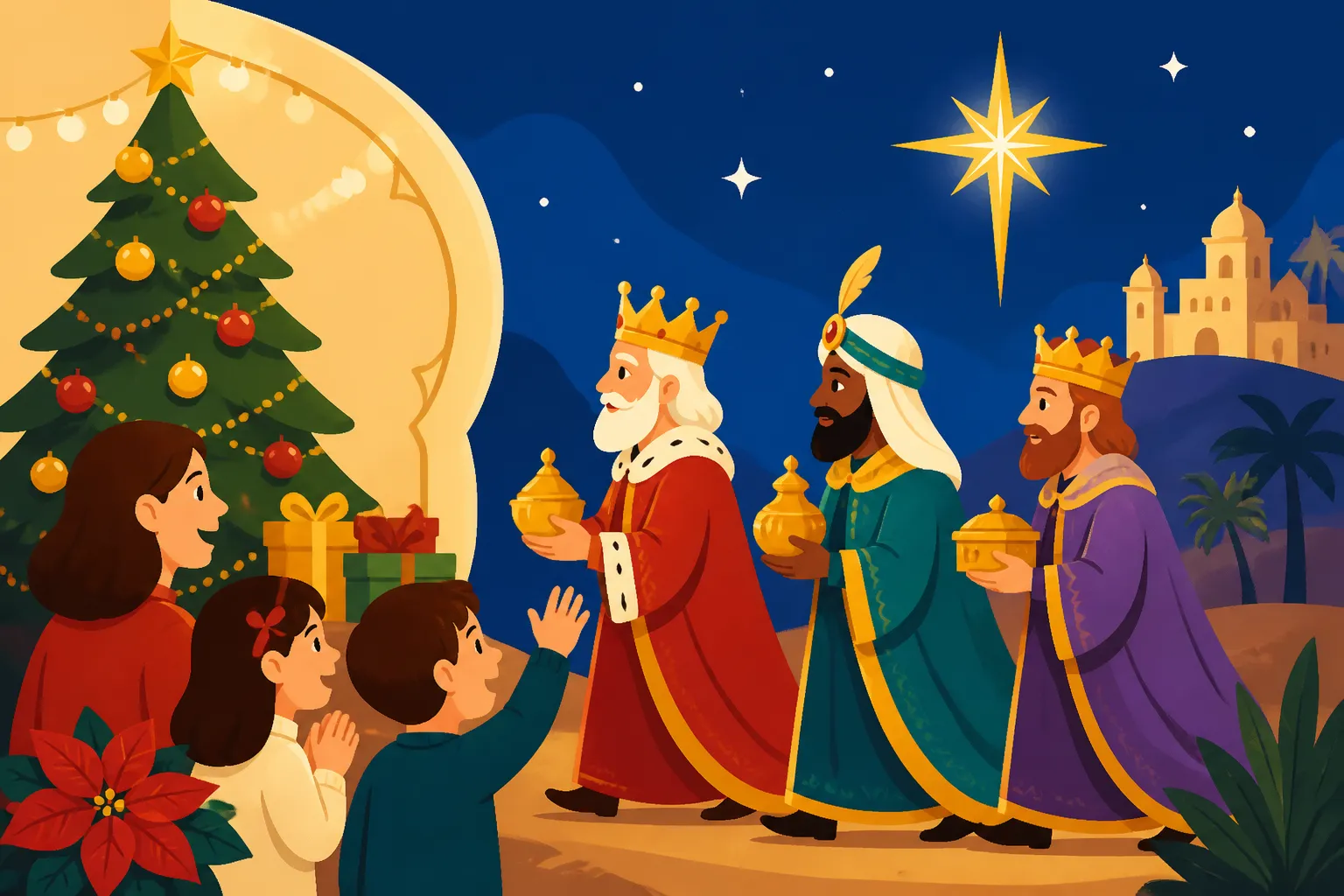
The climax of the season for Spanish children is not Christmas Day, but the arrival of the Three Kings on the night of January 5th. Known as Los Reyes Magos (Melchior, Caspar, and Balthazar), these biblical figures are the ones traditionally responsible for bringing gifts. While Santa Claus (Papá Noel) has gained popularity in recent years, the Kings remain the undisputed heavyweights of the holiday season. The festivities culminate on January 6th, which is a quiet public holiday dedicated to opening presents and eating the traditional Roscón de Reyes cake.
The Magic of Los Reyes Magos: Spain’s True Christmas Heroes
If you are an expat with children, you will quickly learn that the pressure to perform on the night of January 5th is intense. The Three Kings are treated with the same reverence and excitement that Santa Claus receives elsewhere. Understanding the nuances of this tradition is vital for fitting in with the local community and ensuring your kids don't feel left out when their classmates talk about what "Balthazar" brought them.
The Cabalgata: Tips for Surviving the Parades
On the evening of January 5th, every city and large town in Spain hosts a Cabalgata de Reyes, a massive parade where the Kings arrive on elaborate floats. These parades are a spectacle of lights, music, and—most importantly for the kids—mass amounts of candy thrown from the floats. In major cities like Madrid or Barcelona, the crowds are immense. People will bring ladders to the back of the crowd just so their children can see over the adults.
To survive a Cabalgata, you need a plan. Dress warmly, arrive at least 90 minutes early to secure a spot near the barriers, and bring a sturdy bag to collect the flying sweets. Be prepared for a bit of chaos; the excitement is palpable, and the scramble for candy can be surprisingly competitive. If you are moving between cities to see different parades, checking routes on Omio can help you find the most efficient train connections during this busy travel period.
Letters, Shoes, and the Ritual of the Night
Long before the Kings arrive, children write letters to their favorite King, detailing their behavior over the past year and listing the gifts they hope to receive. These letters are often handed to "Royal Postmen" who set up stations in town squares in late December. On the night of the 5th, children leave their shoes out—usually by the window, under the tree, or near the front door—so the Kings know where to leave the presents.
It is also customary to leave a little something for the Kings and their camels. Typically, this involves a glass of cognac or wine and some sweets for the Kings, and a bowl of water or some hay (or crackers) for the camels. When the children wake up on the morning of the 6th, the food is gone, the water is drunk, and the shoes are surrounded by gifts. If a child has been naughty, the Kings are said to leave "carbón dulce"—a hard, black sugar candy that looks exactly like lumps of coal.
The Roscón de Reyes Tradition
Breakfast on January 6th is centered around the Roscón de Reyes. This is a ring-shaped brioche-style cake decorated with candied fruits (representing the jewels on the Kings' robes) and often filled with cream or chocolate. However, this is no ordinary cake; it is a game of culinary Russian roulette. Hidden inside the dough are two items: a small ceramic figurine (usually one of the Kings or a baby Jesus) and a dry fava bean.
The rules are simple: the person who finds the figurine is crowned "King" or "Queen" of the day and gets to wear the paper crown that comes with the cake. The person who finds the bean, however, has the "honor" of paying for the Roscón. It is a beloved tradition that ends the holiday season on a high note of family fun. You can find these cakes in every bakery, but the best ones often require ordering days in advance. Learning about Spanish Markets and Food Halls: Where to Eat and Shop can give you a lead on where to find artisanal versions rather than mass-produced supermarket cakes.
Culinary Traditions: What to Expect on a Spanish Holiday Table
Food is the soul of Christmas in Spain. Unlike the Anglo-American tradition of a turkey or ham, the Spanish festive table is a sophisticated marathon of seafood, cured meats, and specific seasonal sweets. If you are invited to a Spanish home during this time, come hungry and expect the meal to last for four or five hours.
Seafood and Meat: The Festive Feast
A traditional Nochebuena dinner usually begins with an array of "entremeses"—platters of Jamón Ibérico, Manchego cheese, and various chorizos. This is followed by a seafood course that often features expensive delicacies like "langostinos" (king prawns), "bogavante" (lobster), or "besugo" (sea bream). In many regions, especially in the north, seafood is the star of the show.
The main course varies by region but frequently includes "cordero lechal" (suckling lamb) or "cochinillo" (suckling pig) roasted until the skin is shatteringly crisp. Because these ingredients are in high demand, prices at the local markets skyrocket in December. If you are hosting, you should read up on Regional Spanish Dishes Every Visitor Should Try to understand which specialties are local to your specific part of Spain, as the "traditional" dish in Galicia will be vastly different from the one in Andalusia.
Turrón, Polvorones, and Mantecados
Once the main courses are cleared, the "bandeja de dulces" (sweets tray) appears. The king of Spanish Christmas sweets is Turrón, a nougat made of almonds and honey. There are two primary types: Turrón de Jijona, which is soft and crumbly, and Turrón de Alicante, which is hard and brittle. Today, you can also find modern versions with chocolate, truffle, or even gin and tonic flavors.
Alongside the turrón, you will find "polvorones" and "mantecados." These are heavy, crumbly shortbread cookies made with lard (manteca), flour, and sugar. They are often flavored with cinnamon, sesame, or lemon. A pro-tip for eating a polvorón: since they are incredibly crumbly, Spaniards often squeeze the wrapper to compress the cookie into a solid block before opening it so it doesn't disintegrate into a cloud of sugar on their shirt.
The 12 Grapes of Luck: A New Year’s Survival Guide
As mentioned earlier, the 12 grapes are non-negotiable for New Year's Eve. If you are at a restaurant or a party, they will likely provide a small tin or sachet of twelve seedless grapes. If you are buying them yourself, look for "uvas de la suerte" in the supermarket—these are often smaller and peeled to make them easier to swallow quickly.
The tradition follows the chimes of the clock at the Puerta del Sol in Madrid, broadcast live. There are four double-chimes (the "cuartos") to warn you the start is near, and then the twelve main bells begin. You must have finished the previous grape before the next bell rings. It is a frantic, hilarious, and slightly dangerous tradition that perfectly encapsulates the Spanish spirit of communal celebration. For those who want to see the clock in person, consider booking a guided city tour through GetYourGuide to learn about the history of the plaza before the New Year's Eve chaos begins.
Key Dates and Traditions Summary
| Date | Event Name | Core Tradition | Business Impact |
|---|---|---|---|
| Dec 22 | El Gordo | The National Christmas Lottery draw. | Normal hours; high TV/radio usage. |
| Dec 24 | Nochebuena | Massive family dinner; seafood and lamb. | Early closing (6-8 PM). |
| Dec 25 | Navidad | Family lunch; quiet day of rest. | Almost everything closed. |
| Dec 28 | Santos Inocentes | Pranks and jokes (like April Fools). | Normal hours. |
| Dec 31 | Nochevieja | 12 grapes at midnight; parties. | Early closing; late-night bars packed. |
| Jan 1 | Año Nuevo | Recovery day; New Year's Day lunch. | Almost everything closed. |
| Jan 5 | Cabalgata | Three Kings Parades in the evening. | Normal morning; evening road closures. |
| Jan 6 | Reyes Magos | Opening gifts; eating Roscón de Reyes. | Everything closed. |
Regional Quirks: More Than Just a Tree
While the core traditions of the Kings and the lottery are national, Spain’s diverse regions have their own eccentric ways of celebrating. Some of these are charming, while others are downright bizarre to the uninitiated.
The Belén: The Art of Nativity Scenes
In Spain, the "Belén" (Nativity scene) is often more important than the Christmas tree. Families, shops, and town halls compete to create the most elaborate scenes, which often go far beyond the manger to include entire miniature villages with running water, real moss, and moving figures. Visiting the "Ruta de Belenes" (Nativity Route) in your city is a great way to spend a December afternoon.
These displays are a point of local pride. In some cities, the Belén is life-sized and occupies an entire plaza. If you are interested in the craftsmanship behind these, many Spanish Markets and Food Halls: Where to Eat and Shop will have stalls selling individual figures so you can start your own collection. It is a hobby that many Spaniards take very seriously, spending hundreds of Euros on tiny, hand-painted shepherds and sheep.
Quirky Icons: Caganers and Caga Tió
If you find yourself in Catalonia, you will encounter two of the world's strangest holiday traditions. The first is the "Caganer," a small figurine found in the back of the Nativity scene. The figure is typically a man in traditional Catalan dress, crouched down with his trousers around his ankles, performing a bowel movement. While it seems crude, it is actually a symbol of fertility and good luck, as he is "fertilizing" the earth for the coming year. Nowadays, you can find Caganers modeled after celebrities, politicians, and even the Pope.
Then there is the "Caga Tió," or the "Pooping Log." This is a hollow log with a smiley face painted on one end, wearing a traditional red hat (barretina). From December 8th, children "feed" the log every night and cover it with a blanket to keep it warm. On Christmas Eve or Christmas Day, the children hit the log with sticks while singing a song, demanding that it "poop" presents. When they lift the blanket, they find candies and small toys hidden underneath. It is a highlight of a Catalan childhood and a fascinating example of how Spanish Customs, Etiquette, and Social Life can be wonderfully irreverent.
Practical Logistics for Expats and Travelers
Spending the holidays in Spain requires a bit of logistical foresight. The country effectively operates on a "stop-start" basis for two weeks, and if you don't plan your shopping and travel carefully, you may find yourself hungry or stranded.
Transport and Opening Hours
During the key dates—December 24th, 25th, 31st, January 1st, and January 6th—public transport runs on a reduced schedule. In many cities, the metro and buses stop running entirely for a few hours on Christmas Eve and New Year's Eve to allow drivers to have dinner with their families. If you need to get to the airport or another city, use Omio to check the specific holiday timetables well in advance.
Supermarkets also close early on the "Eves" and stay closed on the holidays. Unlike in the US or UK, where "convenience stores" might stay open, in Spain, when things are closed, they are truly closed. Always check Public Holidays in Spain: How They Affect Travel and Opening Hours to ensure you have enough food and supplies to get through the two-day stretches where shops are shuttered.
Booking and Safety
If you are visiting Spain as a tourist during this time, be aware that pickpockets are especially active in the crowded Christmas markets and during the Three Kings parades. Read Staying Safe in Spain: Common-Sense Tips for Travelers for advice on how to secure your belongings in dense crowds. Using Money for Travel in Spain: Cards, Cash, and ATMs is also useful, as you'll want to have some cash for the smaller market stalls where cards might not be accepted.
Finally, remember that the "holiday spirit" in Spain is loud and late. If you are staying in a central apartment booked through Booking.com, don't expect a quiet night on New Year's Eve or the night of the Kings. The celebrations spill into the streets, and the "siesta" culture is replaced by a "fiesta" culture that lasts until dawn. Embrace the noise, eat your grapes, and enjoy the longest, most magical holiday season in Europe.
Disclaimer
The information provided in this guide is intended for general informational purposes only. Holiday traditions, event schedules, and business opening hours in Spain can vary significantly by region and year. While every effort has been made to ensure accuracy at the time of writing, travelers and residents are encouraged to verify specific local details with municipal authorities or official event websites. The author is not responsible for any inconveniences or financial losses resulting from changes to traditional schedules or local regulations.