Semana Santa in Spain: What to Expect as a Visitor
If you have ever found yourself trapped on the wrong side of a narrow cobblestone street in Seville while a three-ton float inches toward you, you know that Holy Week is not just a holiday—it is a logistical marathon. I remember my first year in Spain, blissfully unaware, trying to cross a plaza to get groceries only to be held captive by a procession for four hours. This guide solves the confusion of navigating these ancient traditions, helping you plan your visit with the grace of a local rather than the bewilderment of a lost tourist.
Disclosure: This post may contain affiliate links. We may earn a commission at no extra cost to you if you make a purchase through these links. Read full disclosure.
Understanding the Essence of Semana Santa
Semana Santa, or Holy Week, is the most significant cultural and religious event in the Spanish calendar. While it is technically a religious commemoration of the Passion of Christ, for many Spaniards, it is a deep-seated tradition that transcends the church. It is about family, local pride, and a staggering display of artistry that has remained largely unchanged for centuries. Each city and town has its own way of doing things, but the core elements remain the same: the streets belong to the people and the processions.
The Significance of the Cofradías and Hermandades
To understand the spectacle, you have to understand the cofradías (brotherhoods) and hermandades (fraternities). These are local associations, often centuries old, that organize the processions. They aren't just for the elderly; you will see children as young as three and teenagers proudly wearing their tunics. Being a member is a lifelong commitment, often passed down through generations. These groups spend the entire year preparing, fundraising, and practicing for their specific day of the week.
When you see a procession, you are seeing the culmination of a year’s worth of labor. Each brotherhood has its own distinctive colors and emblems, and there is a fierce, albeit friendly, rivalry between neighborhoods over whose paso (float) is the most beautiful or whose band plays with the most soul. Seeing this firsthand is a lesson in Spanish community spirit that you won't find in any Spain's Biggest Festivals: A Year-Round Calendar guide.
The Anatomy of a Procession: Pasos, Costaleros, and Nazarenos
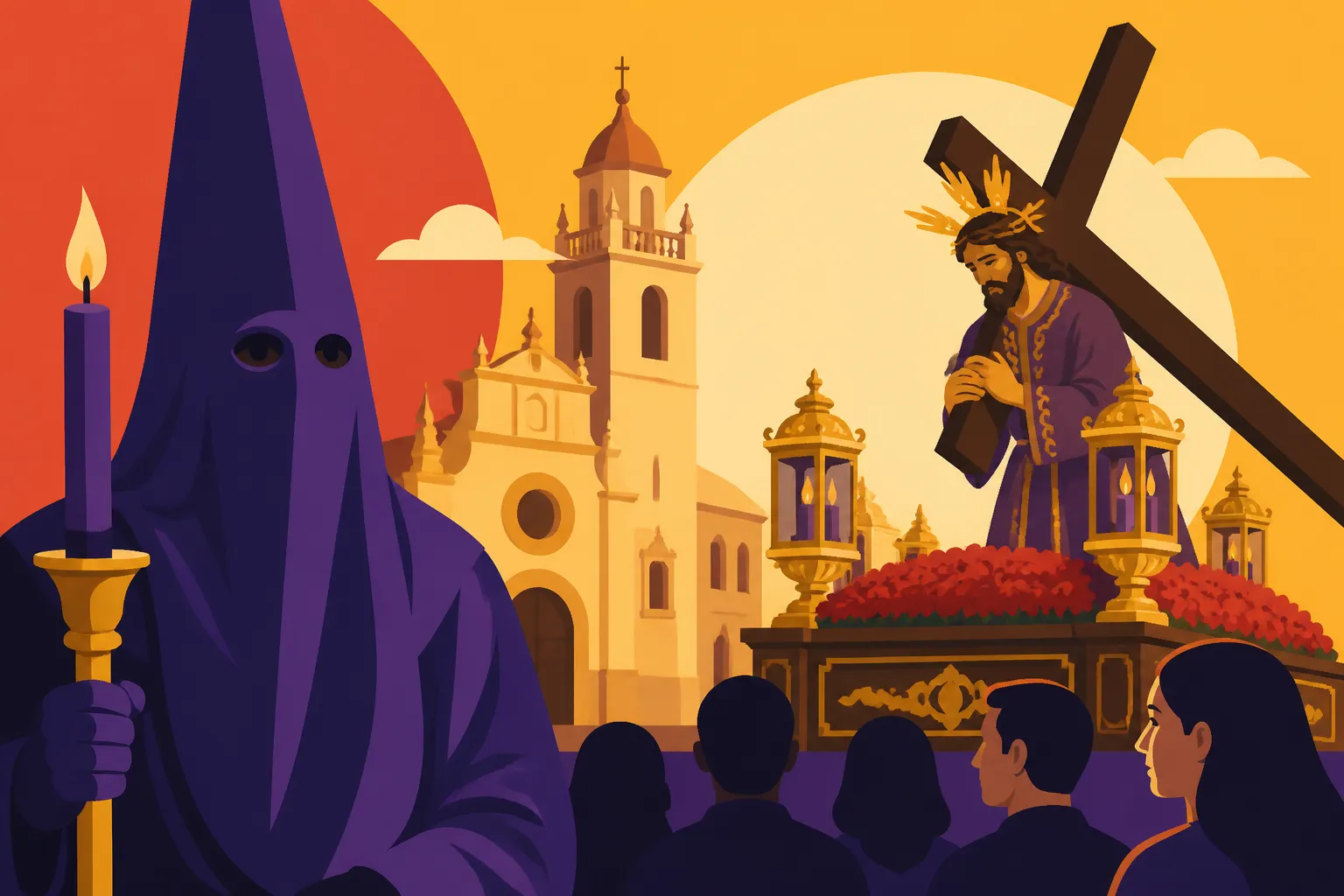
The most striking visual element for any visitor is the paso. These are massive, ornate floats featuring lifelike wooden sculptures of scenes from the Passion or the Virgin Mary in mourning. What surprises most people is that these aren't motorized. They are carried on the necks and shoulders of costaleros. These men (and increasingly women in some regions) walk in sync under the float, hidden from view by a velvet fringe. The swaying motion of the float is meant to mimic a human gait, making the statues appear as if they are walking through the crowd.
Then there are the nazarenos. For many North Americans, the sight of the pointed hoods (called capirotes) can be jarring because of their historical association with the KKK. However, in Spain, the tradition dates back to the Middle Ages. The hood represents penance and the idea that the penitent’s identity should remain humble and hidden before God. Watching thousands of these silent, hooded figures march through the flickering candlelight is an eerie, beautiful experience that stays with you long after the week is over.
Where to Witness the Most Iconic Celebrations
Spain does not celebrate Semana Santa with a single voice. The experience changes drastically depending on whether you are in the sun-drenched south or the austere plains of the north. Deciding where to go depends entirely on the "vibe" you are seeking—though honestly, you should try to experience both at different points in your expat life.
The Grandeur of Seville and Andalusia
Seville is the undisputed heavyweight champion of Semana Santa. Here, the atmosphere is electric, bordering on the theatrical. The processions are famous for their "baroque" style—lots of gold leaf, thousands of fresh flowers, and emotional outbursts. It is in Seville and Malaga where you are most likely to hear a saeta, a haunting, flamenco-style song belted out from a balcony as a float passes by. The entire city shuts down, and the scent of orange blossoms mixes with incense and beeswax.
However, be warned: Seville is also the most crowded. Getting around requires a level of patience you might not knew you possessed. If you are planning to head south, I highly recommend using Omio to compare train and bus schedules, as the high-speed AVE tracks fill up months in advance. Booking a central hotel via Booking.com is essential if you want a "home base" to retreat to when the crowds become too much, though be prepared for "Semana Santa pricing."
The Somber Tradition of Castile and León
For a completely different experience, head to cities like Valladolid, Zamora, or Salamanca. In these northern hubs, the "Castilian style" prevails. The processions are silent, save for the rhythmic beat of a single drum or the clanking of chains dragged by barefoot penitents. The statues here are often masterpieces of Spanish Renaissance sculpture, carved by greats like Gregorio Fernández.
The focus in the north is on silence and sobriety. It feels less like a street party and more like a collective meditation. It is profoundly moving in a way that the Andalusian celebrations aren't. If you prefer history and art over crowds and flamenco, the north is where you belong. For those interested in the artistic history of these regions, looking into History, Art, and Architecture in Spain can provide a deeper context for the imagery you’ll see on the streets.
| Feature | Andalusia (e.g., Seville, Malaga) | Castile and León (e.g., Valladolid, Zamora) |
|---|---|---|
| Atmosphere | Vibrant, noisy, emotional, and social. | Austere, silent, and deeply religious. |
| Music | Large brass bands and flamenco saetas. | Minimalist; single drums or silence. |
| Float Style | Highly ornate, gold-leafed, and floral. | Realistic, dark wood, focused on raw emotion. |
| Crowd Level | Extremely high; very difficult to navigate. | Moderate to high; more manageable. |
| Local Food | Torrijas, pestiños, and fried fish. | Potaje de vigilia (chickpea and cod stew). |
Practical Survival Tips for the Crowds
If there is one thing I’ve learned from living through a decade of Spanish Holy Weeks, it’s that you cannot "wing it." Spontaneity is the enemy of a successful Semana Santa. You need a strategy for everything from where you’ll pee to how you’ll get across town.
Navigating Road Closures and Transport Chaos
During Holy Week, the city center of any major Spanish town becomes a giant pedestrian zone. Taxis won't be able to get you to your hotel door, and buses will be rerouted to the outskirts. This is why understanding Regional and Local Trains in Spain (Cercanías and Media Distancia) is so important; the train is often the only reliable way to move between neighborhoods.
If you find your path blocked by a procession, do not try to push through. It is considered incredibly rude, and the police (and the locals) will not let you pass. You have two options: wait it out (which could take an hour) or find the nearest "cross point" where officials allow human traffic through during gaps in the parade. It is wise to download a local "Semana Santa App"—most cities release one that shows the real-time GPS location of every float.
Booking Accommodation and Logistics
I cannot stress this enough: book your stay as early as possible. Most seasoned travelers use Booking.com to secure rooms with free cancellation a year in advance. If you stay in the old town, you will have the processions right under your window. This is amazing for photos but terrible for sleep. The bands often play until 3:00 or 4:00 AM, and the street cleaners start their loud work at 6:00 AM.
If you are a light sleeper, stay slightly outside the city center near a metro stop. You will save money and your sanity. Also, consider booking a guided walking tour through GetYourGuide for the first day of your trip. Having a local explain the specific history of that city's brotherhoods will make the rest of your week much more meaningful. It helps to check Public Holidays in Spain: How They Affect Travel and Opening Hours before you arrive, as many shops and supermarkets will close on Maundy Thursday and Good Friday.
Etiquette and Cultural Nuances for Foreigners
As a visitor, you are a guest at a very old, very private family event that just happens to take place in public. While Spain is generally laid back, there are unspoken rules of conduct during this week that will help you blend in and show respect.
Respectful Observation and Dress Codes
You don't need to wear a suit, but don't show up in flip-flops and a tank top either. On Maundy Thursday and Good Friday, locals tend to dress up—men in jackets and women in the traditional mantilla (a black lace veil). While tourists aren't expected to follow this, wearing "smart casual" clothing is a sign of respect.
Moreover, keep your voice down when a float is passing, especially during the "silent" processions. Nothing earns you a "shush" from a Spanish abuela faster than shouting to your friend over the sound of a funeral march. If you're looking for more general tips on blending in, my guide on Spanish Customs, Etiquette, and Social Life is a great primer.
The Silent Processions vs. The Saeta
There are moments during the week where the entire crowd will suddenly go dead silent. This usually happens when a saeta singer begins their prayer from a balcony. It is an incredible moment—thousands of people standing in absolute silence, focused on a single voice. Do not talk, do not use flash photography, and try to keep your phone at chest level so you don't block the view of those behind you.
Understanding these cues is part of the "expat intuition" you develop over time. It is about reading the room—or in this case, the street. If you are unsure what to do, just look at the locals. If they are standing and crossing themselves, stay still. If they are clapping (which happens for some joyful Virgin floats), it’s okay to join in. For more on the emotional side of these events, check out Festivals, Fiestas, and Public Holidays in Spain.
Food and Gastronomy During Holy Week
You cannot survive on spiritual awe alone. Fortunately, Semana Santa has its own specific menu, largely dictated by the Catholic tradition of abstaining from meat on certain days. Even if you aren't religious, the seasonal treats are a highlight of the year.
Seasonal Treats: Torrijas and Pestiños
The undisputed queen of Holy Week food is the torrija. Think of it as the Spanish version of French toast, but much more indulgent. Thick slices of bread are soaked in milk or wine with honey and spices, dipped in egg, fried, and then smothered in sugar or cinnamon. Every bakery in the country will be stacked high with them.
In the south, you will also find pestiños—honey-glazed fritters flavored with sesame and aniseed. These are dangerously addictive. Newcomers are often advised to find a local "convent bakery" where cloistered nuns sell these sweets through a revolving wooden window. It is one of those "only in Spain" experiences that makes the holiday feel truly special. If you're worried about how to order these, my guide on Ordering Food and Drinks in Spanish: A Practical Phrasebook will give you the right vocabulary.
Meat-Free Traditions and Local Specialties
On Good Friday, many restaurants will serve Potaje de Vigilia, a hearty stew made from chickpeas, spinach, and salt cod (bacalao). It is soul-warming food that was designed to be filling without breaking the "no meat" rule. Cod becomes the star of the show this week, served in everything from croquettes to elaborate stews.
Keep in mind that dining out during this week is a challenge. Restaurants along the procession routes will be packed, and many require reservations weeks in advance. If you do manage to snag a table, remember that service will be slow because the waiters are also trying to catch glimpses of the floats! For a breakdown of how much to budget for these meals, see How to Tip at a Restaurant in Spain.
Planning Your Trip: Timing and Budgeting
To make the most of your 2026 visit, you need to look at the calendar now. The dates of Holy Week change every year based on the lunar cycle, and the "big" days are always the end of the week.
The 2026 Calendar and Peak Days
In 2026, Semana Santa will take place in late March or early April. While the processions start on Palm Sunday (Domingo de Ramos), the most dramatic events happen on:
- Jueves Santo (Maundy Thursday): The day of the most famous evening processions.
- La Madrugá: The night between Thursday and Friday, where processions run all night long until dawn. This is the peak experience in Seville.
- Viernes Santo (Good Friday): The most somber and artistic day.
If you can only stay for a few days, arrive on Wednesday and stay through Sunday. This allows you to see the transition from the somber Friday to the joyful Easter Sunday celebrations. Make sure you've cleared your schedule, as Public Holidays in Spain: How They Affect Travel and Opening Hours means most administrative tasks will be impossible during this window.
Managing Expectations and Expenses
Budgeting for Holy Week requires a "peak season" mindset. Flights, trains, and hotels will all be at their most expensive. However, the processions themselves are free. You don't need a ticket to stand on the street and watch history pass you by. Some cities sell seats in grandstands along the "Official Route," but these are usually snatched up by locals years in advance.
Expect to spend more on food and drink, as many bars near the center will have special (read: higher) prices for the week. My advice is to eat a big lunch (the menú del día) away from the center and then rely on street snacks or tapas as you move between procession spots. For more on managing your money while here, check out Money for Travel in Spain: Cards, Cash, and ATMs.
Disclaimer
The information provided in this guide is for general informational purposes only. While I strive to provide accurate and up-to-date advice based on my personal experience living in Spain, local traditions, schedules, and regulations for Semana Santa can change without notice. Always verify specific procession times and transport routes with official municipal websites or local tourist offices before planning your daily itinerary. Religious and cultural sensitivities vary by region, and visitors are encouraged to act with respect toward local customs and participants.