Castile and Central Spain: History and Landscapes
Many travelers land in Madrid and mistakenly believe that the surrounding plains are merely a dusty transit zone to be crossed as quickly as possible. I remember my first winter trip to Ávila, shivering in the shadow of those massive granite walls and wondering why no one had warned me about the biting wind of the high plateau. This guide provides an expansive look at the history, landscapes, and logistical realities of Castile and Central Spain to ensure you don't miss the soul of the country.
Disclosure: This post may contain affiliate links. We may earn a commission at no extra cost to you if you make a purchase through these links. Read full disclosure.
The Soul of the Meseta: Landscapes and Climate Realities
The geography of Central Spain is dominated by the Meseta Central, a vast high-altitude plateau that defines the Spanish interior. When you look out the window of a train heading north or south from the capital, you are seeing a landscape that has shaped the Spanish character for millennia. It is a land of immense horizons, where the sky feels larger than anywhere else in Europe. This isn't just "flat" land; it is a complex tapestry of rolling wheat fields, limestone escarpments, and sudden, deep river gorges. The colors of the Meseta change dramatically with the seasons—vivid green in the brief spring, golden-brown under the scorching summer sun, and a haunting, pale ochre during the frosty winter months.
Living here as an expat, you quickly learn that the landscape dictates the rhythm of life. The vastness can be intimidating if you are used to the cozy, green hills of Northern Europe or the crowded coastal strips of the Mediterranean. To truly appreciate Castile, you have to embrace the silence of the "España Vaciada" (the Emptied Spain). Small villages often sit miles apart, huddled around a single church tower that acts as a beacon across the plains. Understanding this geography is essential before you begin Traveling Around Spain: Trains, Buses, Flights, and Car Hire because the distances are deceptive, and the terrain influences how quickly you can move between the historic hubs.
The Endless Plains of the Meseta Central
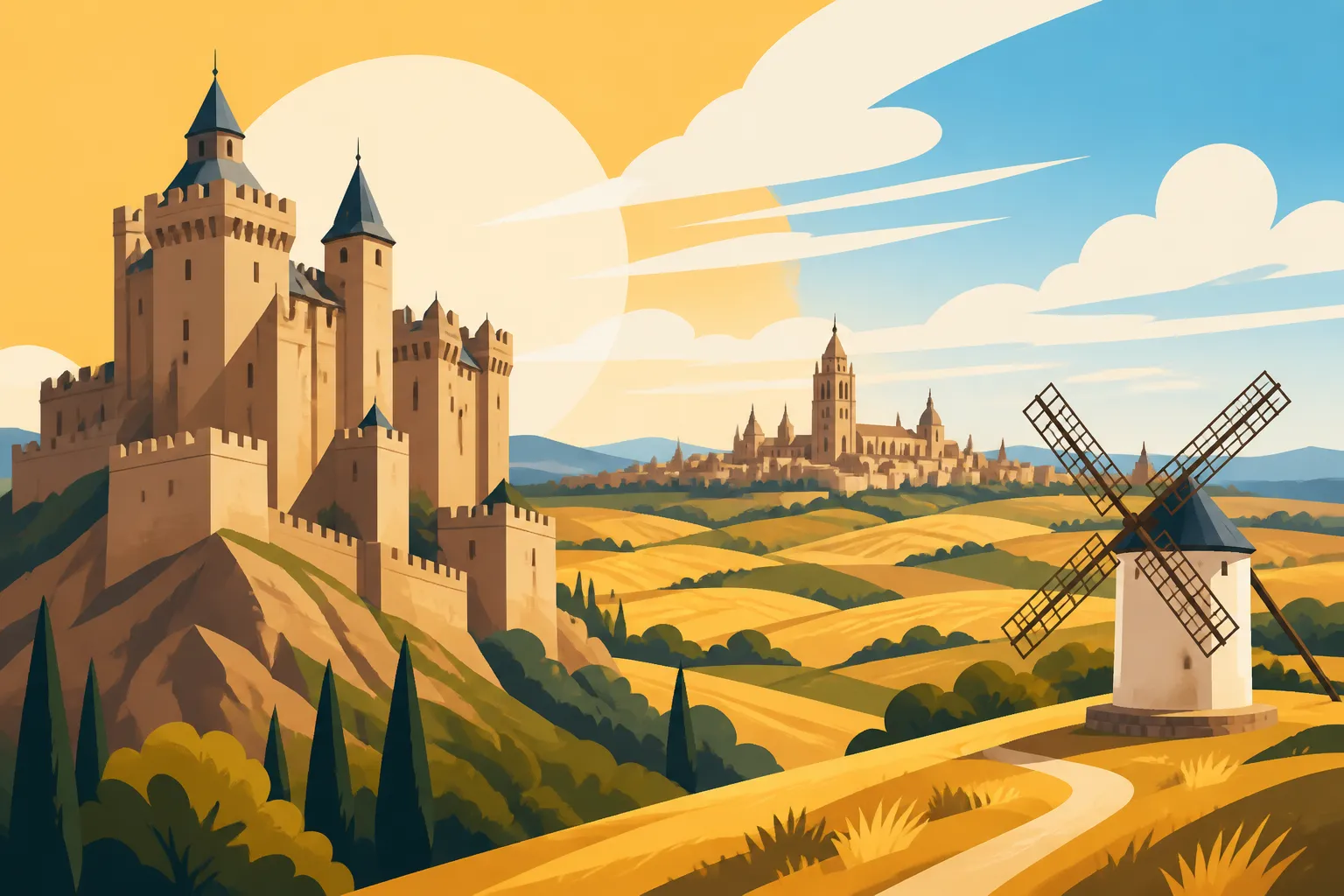
The Meseta is divided into two parts by the Sistema Central mountain range: the Submeseta Norte (mostly Castile and León) and the Submeseta Sur (Castile-La Mancha and Madrid). The northern section is slightly higher and cooler, famous for its vast cereal harvests. This is the heartland of the old Kingdom of Castile, where the soil is rich with history. You will see the ruins of ancient castles perched on "cerros" (hills) overlooking the plains, a reminder of the centuries-long frontier between Christian and Moorish territories.
In the south, the plains of La Mancha offer a different kind of beauty. This is the land of Don Quixote, characterized by iconic windmills and endless vineyards. It is remarkably flat, making it perfect for long road trips where the sunset lasts for what feels like hours. However, the lack of shade is a serious consideration. If you are planning a self-drive tour, you need to be prepared for the psychological impact of these long, straight roads. Newcomers are often told that the Meseta is an acquired taste; at first, it looks like nothing, but after a few weeks, you start to notice the subtle shifts in light and the way the wind ripples through the barley fields like waves on an ocean.
The Rugged Sistema Central Mountain Ranges
Cutting right through the heart of the plateau are the mountains of the Sistema Central, including the Sierra de Guadarrama and the Sierra de Gredos. These peaks act as a vital lung for the residents of Madrid and provide a stark contrast to the surrounding plains. These are not just "hills"; many peaks exceed 2,000 meters, and they remain snow-capped well into the spring. The landscape here is characterized by granite outcrops, pine forests, and glacial lagoons.
For the expat or long-term visitor, these mountains offer an escape from the "nueve meses de invierno y tres de infierno" (nine months of winter and three of hell) that supposedly defines the Madrid climate. The air is thinner and crisper here. If you enjoy hiking, the Sierra de Guadarrama is easily accessible via the C-8 Cercanías line, though I recommend using Omio to compare bus and train schedules if you're heading further afield to the Sierra de Gredos. The mountains also house hidden valleys like the Valle del Jerte, which explodes into white cherry blossoms every spring, a sight that rivals anything you’ll see in Japan.
Medieval Might: The UNESCO Heritage Cities
Central Spain is home to some of the most concentrated historical wealth in Europe. The cities of Toledo, Segovia, and Ávila form a "golden triangle" around Madrid, each offering a distinct window into a different era of Spanish history. People often ask me if they can "do" these cities in a single weekend. My honest expat advice? Don't even try. Each one demands a full day and an overnight stay to appreciate the atmosphere once the tour buses have departed.
These cities were built for defense and prestige. They are rugged, stony, and incredibly steep. You will spend your day walking on cobblestones that have been polished smooth by centuries of footsteps. It is a visceral experience—you can smell the woodsmoke in the winter and feel the heat radiating off the ancient stones in the summer. For those planning their itinerary, checking Toledo and Segovia: Historic Cities Near Madrid is a great starting point for understanding the logistical links between these giants of the interior.
Toledo: A Journey through the City of Three Cultures
Toledo is arguably the most complex city in Spain. Perched on a granite hill and surrounded on three sides by the Tajo River, it served as the capital of the Visigothic Kingdom and later as a vital center of the Spanish Empire. Its nickname, the "City of Three Cultures," refers to the long period during the Middle Ages when Christian, Jewish, and Muslim communities lived in close proximity, contributing to a unique intellectual and architectural fusion.
The streets of Toledo are a literal labyrinth. I’ve lived in Spain for years and I still get lost every time I step into the Jewish Quarter. This is not a city for people who hate hills; the climb from the Bisagra Gate to the Zocodover Square is a workout. You’ll want to visit the Cathedral, which is a masterpiece of Spanish Gothic architecture, and the Synagogue of Santa María la Blanca. To make the most of the history, it helps to book a specialized walking tour via GetYourGuide to find the hidden "subterranean" Toledo that most tourists miss. Just remember to wear your most supportive shoes; the "Toledo toe-stub" is a real phenomenon for the unprepared.
Segovia: Beyond the Roman Aqueduct
Segovia feels like a fairytale that has been carved out of the Castilian rock. Most people come for the Roman Aqueduct, an engineering marvel that stands without a drop of mortar, but the city has so much more to offer. The Alcázar, with its slate-roofed turrets, supposedly inspired the Disney castle, and the Cathedral is often called the "Lady of Cathedrals" due to its elegance and late Gothic style.
What I love most about Segovia is the transition from the arid plains to the lush valley of the Eresma River. If you walk down from the Alcázar toward the Vera Cruz church, you get a perspective of the city that feels like looking at a ship sailing across the landscape. Segovia is also significantly cooler than Madrid, making it a popular refuge in July and August. If you're coming from the capital, Best Day Trips From Madrid by Train will explain how the high-speed AVE can get you there in under 30 minutes, though you'll arrive at an out-of-town station that requires a quick bus ride into the center.
Ávila: Guarding the Frontier of Old Castile
Ávila is defined by its walls. They are the most complete medieval fortifications in Spain, featuring 88 towers and nine gates. Walking the perimeter of the walls at sunset is one of those "bucket list" experiences that actually lives up to the hype. The city is sits at over 1,100 meters above sea level, making it the highest provincial capital in Spain. This altitude means the light is incredibly sharp and the air is perpetually brisk.
Historically, Ávila was a frontier town, a place of knights and mystics like Saint Teresa. The architecture is "Romanesque of the Granite," which gives the city a grey, somber, and incredibly sturdy feel. It doesn't have the flamboyant Moorish influence of Toledo or the Roman grandeur of Segovia; instead, it offers a sense of austere, medieval power. Inside the walls, the city is surprisingly quiet and contemplative. Visitors are encouraged to try the "Yemas de Santa Teresa," a local sweet made of egg yolks and sugar, while sitting in the Plaza del Mercado Chico. It’s the perfect fuel for a long walk around the battlements.
Gastronomy of the High Plateau
You cannot understand Castile without eating its food. This is not the land of light seafood or gazpacho. The cuisine of Central Spain is "cocina de subsistencia"—food designed to sustain people through harsh winters and long days of agricultural labor. It is centered on meat, legumes, and bread. When you sit down at a traditional "mesón," you are partaking in a ritual that hasn't changed much in five hundred years.
The flavors are bold and honest. There is an obsession with the quality of the raw ingredient rather than complex sauces. If you are a vegetarian, you will find it challenging in the smaller towns, though the situation is improving in the cities. For a broader look at the national context, I recommend reading Spanish Food and Drink: A Practical Culture Guide. In Castile, the stars are the pig, the lamb, and the garbanzo bean.
The Art of the Roast (Asado)
The pinnacle of Castilian dining is the "asado." In Segovia, this means Cochinillo (suckling pig), which is roasted in a wood-fired oven until the skin is as thin and crisp as glass and the meat is tender enough to be cut with the edge of a ceramic plate. In the provinces of Valladolid and Burgos, the preference shifts to Lechazo (suckling lamb).
Eating an asado is an event. You typically order a "cuarto" (a quarter) of the animal, which is served simply with its own juices and perhaps a basic salad of lettuce, tomato, and onion to cut through the richness. My tip for expats: look for restaurants with the "Hornos de Leña" (wood ovens) sign. The smell of holm oak smoke is your first indicator of quality. It’s heavy, celebratory food that is best enjoyed during a long Sunday lunch followed by a serious "siesta."
Legumes and the Cocido Ritual
Central Spain is the world capital of the bean. In Ávila, you must try the Judiones de la Granja, massive white beans that are cooked until they have a buttery texture, usually flavored with chorizo, blood sausage (morcilla), and pig's ear. In Madrid and the surrounding towns, the Cocido Madrileño is the king of the table.
This chickpea-based stew is traditionally served in three "vuelcos" (courses). First comes the broth with thin noodles. Then, the chickpeas and vegetables (cabbage, carrots, potatoes). Finally, the "vuelco de carne" features the meats—brisket, chicken, lardo, chorizo, and morcilla. It is a marathon, not a sprint. If you see a menu del día offering cocido on a Tuesday or Wednesday, clear your afternoon schedule. You won't be doing much else.
Navigating the Vastness: Travel Logistics
Getting around Central Spain requires a bit more planning than the coastal regions. While the high-speed rail network is excellent for jumping between major cities, the real charm of Castile is found in the smaller towns that are often poorly served by trains. You have to decide between the speed of the AVE and the flexibility of a rental car.
| Destination | From Madrid (Train) | From Madrid (Car) | Key Highlight |
|---|---|---|---|
| Toledo | 33 mins (Avant) | 1 hour | Medieval Labyrinth |
| Segovia | 28 mins (AVE) | 1 hour 15 mins | Roman Aqueduct |
| Ávila | 1 hour 30 mins (Regional) | 1 hour 20 mins | Granite Walls |
| Cuenca | 55 mins (AVE) | 2 hours | Hanging Houses |
| Salamanca | 1 hour 40 mins (Alvia) | 2 hours 15 mins | Plateresque Architecture |
Trains vs. Buses vs. Car Hire
If you are sticking to the UNESCO cities, the train is your best friend. The High-Speed Trains in Spain (AVE): Routes, Booking, and Savings guide will help you navigate the Renfe website, which is notoriously difficult for foreigners. For Segovia and Toledo, the trains depart from Chamartín and Atocha respectively. Note that these are "Avant" trains—mid-distance high-speed services—and they do sell out on weekends and holidays.
However, if you want to see the windmills of Consuegra or the castles of the Duero Valley, you need a car. Driving in Castile is a dream; the roads are generally excellent and largely empty once you get 50 kilometers away from Madrid. Parking in the historic centers, however, is a nightmare. My advice is to always look for "Parking Público" outside the city walls and walk in. If you prefer not to drive, the bus network (primarily ALSA and Avanza) is surprisingly extensive and often cheaper than the train, especially for reaching places like San Lorenzo de El Escorial. Use Omio to check the bus alternatives when the train times don't line up.
Best Times to Visit (Avoiding the Extremes)
The climate of Central Spain is continental, meaning it lacks the moderating influence of the sea. Summer (July and August) can be brutal, with temperatures in Toledo regularly hitting 40°C. Walking through a stone-walled city in that heat is not just uncomfortable; it can be dangerous. Conversely, winter can be surprisingly cold, with frost and even snow not uncommon in Ávila and Segovia.
The "sweet spots" are May, June, September, and October. During these months, the days are long, the sky is that perfect Castilian blue, and the temperatures are ideal for walking. If you must visit in summer, do as the locals do: start your day at 8:00 AM, retreat to a cool museum or hotel during the mid-afternoon, and don't head back out for dinner until 9:30 PM. For more on local timing, see Spanish Customs, Etiquette, and Social Life.
Practical Tips for the Modern Explorer
Planning a trip into the heart of Spain requires a balance between spontaneity and reservation. While I love the idea of just "showing up," the reality is that Spain has become an incredibly popular destination, and the interior is no longer the "undiscovered" secret it once was.
For accommodation, Booking.com is the standard here, and I highly recommend looking for "Paradores." These are government-run hotels often located in converted palaces, monasteries, or castles. The Parador in Cuenca, for example, is located in an old convent overlooking the gorge and offers one of the most spectacular views in the country.
Booking Accommodations and Tours
If you're staying in Madrid and doing day trips, remember that you are competing with millions of other tourists. For the Alhambra-level attractions (like the Alcázar in Segovia or the Monastery in El Escorial), pre-booking is essential. Too many people stand in a two-hour queue in the sun because they didn't buy a ticket online.
Using platforms like GetYourGuide can also help you bundle transport and entry fees, which takes some of the stress out of navigating the Renfe ticket machines. If you are staying in smaller towns, be aware that many hotels still close their "reception" during siesta hours (usually 2:00 PM to 5:00 PM). Always call ahead if you plan to arrive in the afternoon to ensure someone is there to let you in.
Hidden Gems and Lesser-Known Towns
While the big cities get the glory, the real magic of Central Spain is found in the "pueblos." Places like Sigüenza in Guadalajara, with its massive fortress-cathedral, or Almagro in Ciudad Real, home to the only intact 16th-century theater (Corral de Comedias) in the world. These towns offer a much more authentic glimpse into Spanish life without the "theme park" feel that some parts of Toledo can have.
In these smaller locales, you'll need at least basic Spanish phrases to get by. People are incredibly friendly, but English is not widely spoken once you leave the main tourist track. Always carry some cash, as the "only card" lifestyle hasn't fully reached the rural bars of Castile-La Mancha yet. Most importantly, keep your eyes open for the "Carteles de Carretera" (road signs) pointing to Romanesque churches or local wineries. Some of my best memories of Spain come from taking a random turn off the N-110 and finding a 12th-century chapel all to myself.
Before you set off, make sure to review Staying Safe in Spain: Common-Sense Tips for Travelers to keep your belongings secure, especially in the busier train stations like Atocha or Chamartín. Castile is generally very safe, but being a "prepared expat" is always better than being a "surprised tourist."
Disclaimer
This guide is intended for informational purposes only. While every effort has been made to ensure the accuracy of the information provided, travel conditions, transport schedules, and local regulations in Spain are subject to change. Readers should verify all critical details, including visa requirements and health safety protocols, with official government sources or relevant service providers before making travel arrangements. The author and publisher assume no liability for any inconveniences or losses incurred while following the advice in this article.