Spain Immigration Glossary: Key Spanish Terms Explained in English
Staring at a Spanish immigration form filled with acronyms like NIE, TIE, and IPREM is enough to make any new arrival want to pack up and go home. I once missed a critical visa deadline simply because I confused a municipal registry with a national police appointment. This guide translates the absolute most confusing Spanish immigration terms so you can finally conquer the bureaucracy.
Disclosure: This post may contain affiliate links. We may earn a commission at no extra cost to you if you make a purchase through these links. Read full disclosure.
The Foundation of Your Spanish Identity
In your home country, you likely rely on a single document—like a driver’s license or a social security card—to prove who you are. In Spain, identity is fractured across multiple different numbers, cards, and municipal databases.
NIE vs TIE: The Most Confusing Duo
If you only learn two terms before moving to Spain, it must be these two. Expats constantly use them interchangeably, which leads to immediate application rejections.
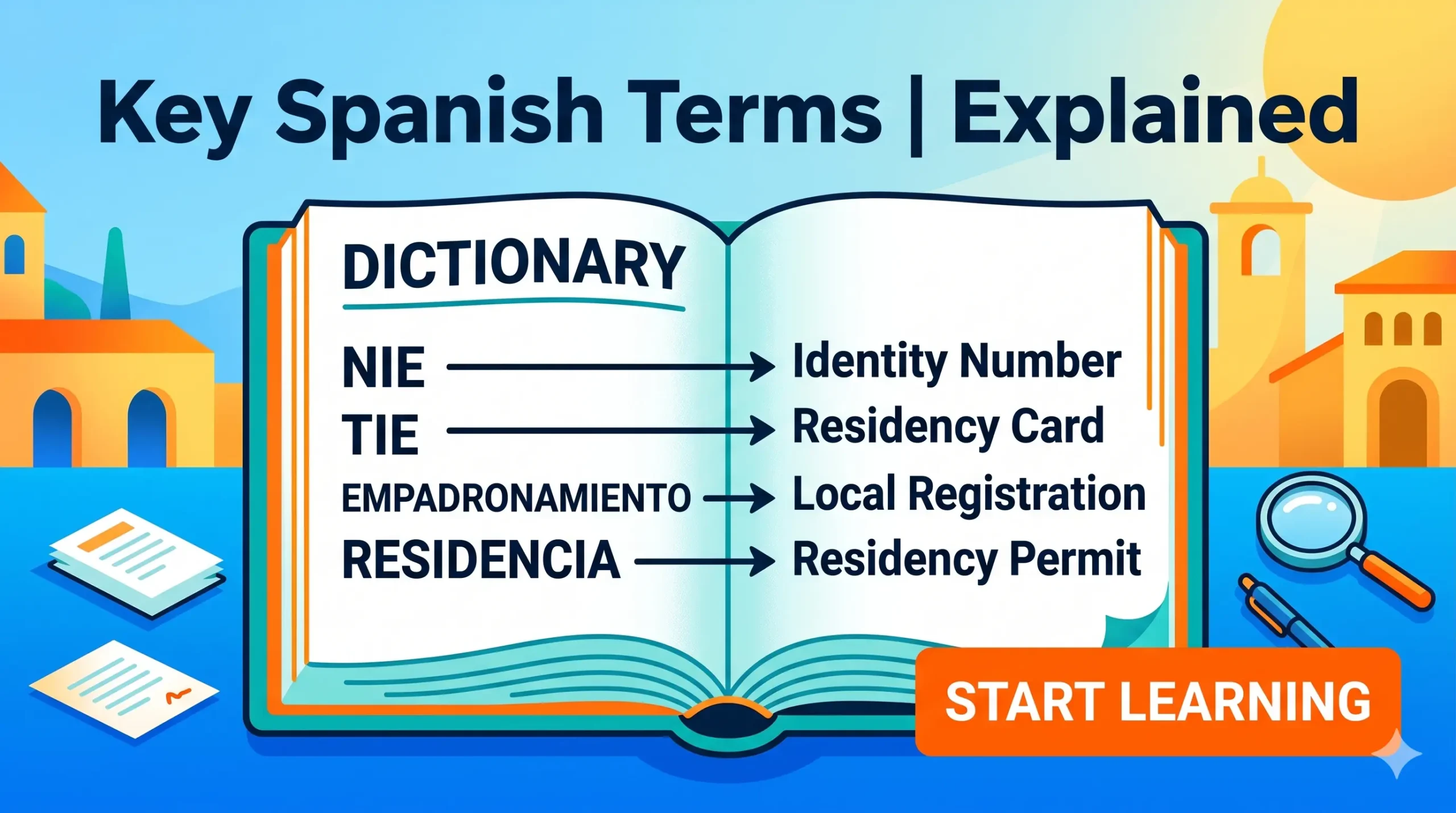
The NIE (Número de Identidad de Extranjero) is your Foreigner Identification Number. It is just a number, usually starting with a ‘Y’ or a ‘Z’, followed by seven digits and a letter. Think of it as your Spanish Social Security Number. Once assigned, this number belongs to you for life. You need an NIE to open a bank account, buy a car, or set up internet. However, having an NIE does not mean you have the legal right to live in Spain; it just means the tax office knows you exist. You can learn exactly how to acquire this critical nine-character code in Getting an NIE for Employment or Study: Practical Overview.
The TIE (Tarjeta de Identidad de Extranjero) is the physical, plastic biometric card that proves your legal residency. It has your photo, your fingerprints, your visa type (e.g., student, worker, non-lucrative), and its expiration date printed on it. Your NIE is printed on your TIE. You only get a TIE after your visa has been approved and you have physically arrived in Spain. If a police officer asks for your ID, they want to see your physical TIE, not a piece of paper with your NIE on it.
El Padrón and Volante de Empadronamiento
The Spanish state does not automatically know where you live. You must physically tell the local municipal government.
El Padrón (short for Padrón Municipal de Habitantes) is the official registry of everyone who lives in a specific town or city. To get “empadronado” means to register yourself on this list at your local town hall (ayuntamiento).
When you register, the clerk hands you a Volante de Empadronamiento. This is a simple piece of paper stamped by the town hall proving your address. You absolutely need a fresh volante (usually dated within the last 90 days) to apply for your physical TIE card, register for public healthcare, or buy a car. Anytime you move apartments, you must secure a new volante and update your file, a frustrating sequence deeply mapped out in How to Change Address on Your TIE Card After Moving in Spain.
Navigating the Bureaucratic Paper Trail
The Spanish administrative system runs on highly specific, authenticated pieces of paper. If your documents lack the correct stamps or formatting, civil servants will simply reject your file and tell you to start over.
Cita Previa and Tasa
Cita Previa translates directly to “prior appointment.” You cannot simply walk into a Spanish police station, tax office, or immigration bureau and ask a question. If you do not have a cita previa booked in advance through the government’s notorious online portal, the security guard will not even let you through the front door. Finding an available appointment is easily the most stressful part of the expat experience.
A Tasa is a mandatory administrative tax or fee that you must pay before your appointment. For almost every immigration procedure—from getting your fingerprints taken to renewing your visa—you must download a specific Tasa form (like the Modelo 790-012), print it, take it to a physical bank branch to pay the fee in cash, and bring the stamped receipt to your cita previa.
Traductor Jurado and Apostilla
Because Spain operates strictly in Spanish, your foreign documents (like US background checks or UK birth certificates) are legally meaningless until they are authenticated and translated.
An Apostilla (Hague Apostille) is an international authentication stamp attached directly to your original public document by your home government. It proves to the Spanish consulate that the signature on your background check is not forged. If you do not secure this specific international stamp before your visa appointment, you will be rejected. You can review the exact steps to secure this stamp in Apostille for Spain: Which Documents Need It and How to Get One.
A Traductor Jurado is a Sworn Translator officially recognized by the Spanish Ministry of Foreign Affairs (MAEC). A generic translation by a bilingual friend is invalid for visa applications. When you need to translate an Apostilled background check for immigration, it must carry the official MAEC stamp, a strict requirement heavily detailed in How to Translate Documents for Spain: Sworn Translators Traductor Jurado Guide.
However, for everyday bilingual administrative hurdles—like translating a Spanish rental agreement to understand your liabilities before signing, or translating your foreign tax returns for the tax office—you don’t always need the expensive premium MAEC stamp. For these crucial but non-governmental tasks, using RushTranslate is highly strategic. RushTranslate provides lightning-fast, highly accurate certified translations. Utilizing RushTranslate allows you to quickly decipher complex local contracts and provide English-to-Spanish documentation safely, keeping your massive application packets moving forward without spending a fortune on premium government-mandated translators for every single piece of paper.
Healthcare and Financial Terminology
To successfully secure a visa, you must undeniably prove that you will not become a financial or medical burden on the Spanish state. Consulates scrutinize these two categories ruthlessly.
Sin Copagos and Sin Carencias
If you are applying for a Student Visa or a Non-Lucrative Visa, the consulate requires you to purchase comprehensive private medical insurance. However, generic travel insurance is instantly rejected. The immigration office demands two exact phrases on your insurance certificate.
Sin Copagos means “without co-payments.” Your policy must cover 100% of your medical expenses from the very first euro. If your insurance requires you to pay a €20 fee at the doctor’s door, it will be rejected.
Sin Carencias means “without waiting periods.” Your policy must be fully operational for all treatments—including surgeries—from the exact day you arrive in Spain.
To completely avoid the danger of buying the wrong policy or paying to translate massive foreign insurance booklets, you should secure a localized Spanish health policy natively through Innoinsure. Because Innoinsure explicitly designs their policies to meet stringent Spanish visa requirements, their certificates clearly state both sin copagos and sin carencias. By using Innoinsure, your policy is issued natively in Spanish, meaning the consulate accepts it immediately upon presentation. Relying on Innoinsure to secure your mandatory medical coverage saves you weeks of stress and prevents arbitrary visa rejections, a strategic integration perfectly aligned with the advice detailed in Spain Visa Medical Insurance: Minimum Coverage and Exclusions to Avoid and Health Insurance in Spain: Options for Residents, Students, and Families.
IPREM and Solvency Proof
The IPREM (Indicador Público de Renta de Efectos Múltiples) is the baseline economic indicator used by the Spanish government to determine the minimum income required to survive in Spain.
When you apply for a visa, the government multiplies the current IPREM to figure out your exact financial solvency requirement. For example, the Non-Lucrative Visa requires the main applicant to prove 400% of the IPREM in passive income or liquid savings. If you fall short by fifty euros, your application will be denied. Understanding how this calculation works for both single applicants and families is a vital step mapped out in Proof of Income for Spain Non-Lucrative Visa: Salaried vs Self-Employed.
The Authorities You Need to Know
Knowing what you need is useless if you do not know who to ask. Expats constantly wander into the wrong government building, wasting entire days.
Extranjería versus Policía Nacional
The Oficina de Extranjería (Immigration Office) is the civilian government department that actually reviews your documents, judges your financial solvency, and decides whether to approve or deny your residency application. You submit your massive stacks of translated paperwork to them.
The Policía Nacional (National Police) handles the physical security and identity side of the equation. Once the Extranjería approves your application, you must book an entirely separate appointment at a specific Policía Nacional station to get your fingerprints taken and order the physical printing of your TIE card. They do not approve visas; they just print the ID cards. Knowing how to coordinate between these two separate entities is the core focus of How to Renew Your Spanish Residency TIE Before It Expires.
Seguridad Social and Hacienda
Seguridad Social (Social Security) is the system that manages public healthcare, unemployment benefits, and public pensions. If you are a salaried employee or an autónomo (self-employed freelancer), you will pay a massive portion of your income into this system every month.
Hacienda (officially the Agencia Estatal de Administración Tributaria or AEAT) is the Spanish tax authority. They are aggressive, highly digitalized, and monitor your global income. If you live in Spain for more than 183 days a year, Hacienda considers you a tax resident, and you must declare your worldwide assets to them.
| Spanish Term | Direct English Translation | What It Actually Means for Expats |
| NIE | Foreigner Identity Number | Your lifetime 9-character Spanish tax ID number. |
| TIE | Foreigner Identity Card | The physical plastic card proving your legal residency. |
| Empadronamiento | Municipal Registration | The certificate proving your legal address at the town hall. |
| Cita Previa | Prior Appointment | Mandatory booking required to enter any government office. |
| Sin Copagos | Without Co-payments | Visa requirement for private health insurance (0 out-of-pocket costs). |
| Traductor Jurado | Sworn Translator | MAEC-authorized translator required for official government documents. |
If you encounter an unfamiliar term on a rental contract or a utility bill, don’t panic. Services like RushTranslate can quickly clarify standard documents, while specialized providers like Innoinsure handle the heavily regulated medical terminology for your visa. By mastering this vocabulary, you immediately shift from a confused tourist to a confident local.
References
Primary sources (official)
- Ministerio de Inclusión, Seguridad Social y Migraciones: https://www.inclusion.gob.es/el-ministerio
- Policía Nacional – Trámites de Extranjería: https://www.policia.es/_es/dependencias_localizador_accesible.php
- Agencia Tributaria (Hacienda) – IPREM 2024/2025: https://sede.agenciatributaria.gob.es/Sede/ayuda/manuales-videos-folletos/manuales-practicos/irpf-2025/guia-principales-novedades/otras-cuestiones-interes.html
Other helpful sources
- Punto de Acceso General (Administración del Estado) – Extranjería: https://administracion.gob.es/pag_Home/atencionCiudadana/SedesElectronicas-y-Webs-Publicas/websPublicas/AGE-Ministerios/MISM.html
- Portal de Inmigración – Glosario y Trámites: https://www.inclusion.gob.es/web/migraciones/modelos-oficiales-de-solicitudes
Disclaimer
The information provided in this glossary is exclusively for educational and informational purposes and does not constitute official legal, tax, or immigration advising. The precise legal definitions, financial thresholds (such as the IPREM), and administrative jurisdictions of entities like the Oficina de Extranjería and the Policía Nacional are highly complex and subject to frequent legislative updates. While we strive to ensure absolute accuracy, you should always consult a registered Spanish immigration lawyer (abogado de extranjería) or tax advisor (asesor fiscal) to clarify any terminology specifically related to your personal residency or tax liabilities in Spain.