What to Do If Your Spain Residency Renewal Is Denied (Appeal Options)
Opening an official notification from the Extranjería only to read the word “DENEGADA” induces a level of panic that shakes your entire world. I once stared at a renewal rejection letter, convinced my life in Madrid was instantly over simply because of a single missing bank statement. This guide explains exactly what to do when your Spanish residency renewal is denied and how to successfully fight the decision.
Disclosure: This post may contain affiliate links. We may earn a commission at no extra cost to you if you make a purchase through these links. Read full disclosure.
Understanding the Reasons for a Denied Renewal
Before you can file an appeal, you must absolutely dissect the rejection letter. The Spanish government does not deny renewals out of pure malice; they deny them because your application failed to satisfy their incredibly rigid, algorithmic checklist. The specific reason for your denial dictates your exact path forward.
Missing Deadlines and Requerimientos
The most common reason expats face a denied renewal has nothing to do with their actual eligibility. It happens because they missed a requerimiento.
When you apply to renew your TIE, the Oficina de Extranjería reviews your file. If a document is missing or formatted incorrectly, they issue a formal demand (requerimiento) giving you exactly 10 working days to upload the correct file. If you are not actively monitoring the government’s digital portal, that 10-day window closes. Once it closes, your file is automatically closed and denied. Understanding how to aggressively monitor these portals is a vital survival skill deeply mapped out in How to Set Up AEAT Online Notifications DEHú in Spain.
Financial Solvency and Health Insurance Failures
If the reviewing officer actually assessed your file and denied it, it is usually because you failed the financial or medical tests.
If you are on a Non-Lucrative Visa or a Student Visa, the government meticulously reviews your bank statements to ensure you maintained the required IPREM threshold throughout the year. If your balance dipped too low, or you failed to prove passive income correctly, they will issue a denial. You can review the exact financial math they use in Proof of Income for Spain Non-Lucrative Visa: Salaried vs Self-Employed.
Equally fatal are health insurance errors. If you renewed your private medical insurance but the new policy contains a hidden co-payment (copago) or an arbitrary waiting period (carencia), the Extranjería will reject it. To completely insulate yourself from this trap, you should manage your expatriate health coverage through Innoinsure. Because Innoinsure natively underwrites policies designed explicitly for Spanish residency renewals, their certificates explicitly state “sin copagos” right on the first page. Relying on Innoinsure guarantees your medical safety net is flawlessly compliant, completely neutralizing one of the most common reasons for a visa denial. This strategic integration is heavily aligned with the advice detailed in Spain Visa Medical Insurance: Minimum Coverage and Exclusions to Avoid and Health Insurance in Spain: Options for Residents, Students, and Families.
Criminal Records and the 183 Day Rule
Finally, renewals are frequently denied if the police background check run by the Extranjería flags a local arrest—even for something as minor as a severe traffic violation or a public disturbance.
Additionally, if you hold a standard temporary residency, the immigration office will check your passport stamps to verify that you did not spend more than 183 days outside of Spain during the calendar year. If you violated this physical presence requirement, your renewal will be denied because the government assumes you abandoned your residency. Understanding the strict timelines required to maintain your status is the core focus of How to Renew Your Spanish Residency TIE Before It Expires.
The Recurso de Reposición: The Administrative Appeal
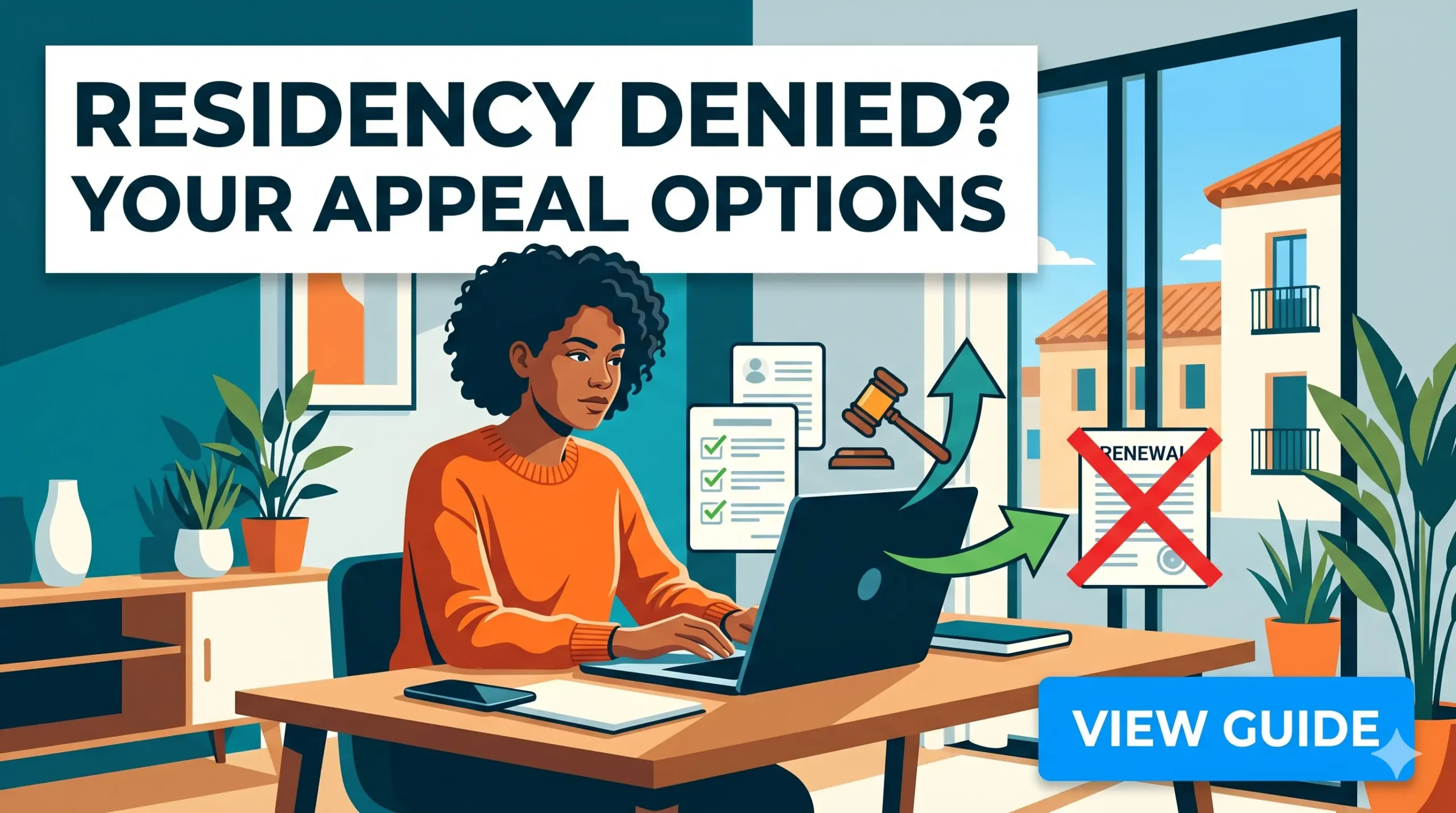
If your denial is based on a correctable error—like you actually had the money but submitted the wrong bank statement, or you missed the 10-day requerimiento window because you were in the hospital—your fastest option is the Recurso Potestativo de Reposición.
The 30 Day Window to Fight Back
The Recurso de Reposición is an administrative appeal filed directly to the exact same Extranjería office that denied your application. You are essentially asking the director of the office to reconsider your file based on new, clarifying evidence.
You have exactly one month from the day you received the official denial notification to file this appeal. Do not wait until day 29. You submit this appeal through the government’s Sede Electrónica using your Digital Certificate. You must draft a formal legal argument explaining why the denial was incorrect, citing the specific articles of the Immigration Law (Ley Orgánica 4/2000), and attaching the missing evidence.
Gathering Missing Evidence and Translations
If your renewal was denied because the Extranjería didn’t understand a foreign financial document, you must fix the translation immediately. You cannot submit an English bank statement or an untranslated foreign tax return in an appeal.
Because the 30-day window is incredibly tight, you must use a rapid service like RushTranslate to quickly convert your missing foreign documents into professional Spanish. RushTranslate provides highly accurate, certified translations with a 24-hour turnaround, allowing you to bridge the language gap safely without missing your appeal deadline. Utilizing RushTranslate ensures that your newly submitted evidence is perfectly legible to the reviewing officer. If the missing document is an official government certificate, you may also need a premium sworn translation, a distinction heavily detailed in How to Translate Documents for Spain: Sworn Translators (Traductor Jurado) Guide.
By law, the Extranjería has one month to respond to your Recurso de Reposición. If they do not respond within one month, the appeal is legally considered rejected by “administrative silence” (silencio administrativo).
The Recurso Contencioso Administrativo Judicial Appeal
If the Extranjería rejects your Recurso de Reposición, or if you know the administrative office is hopelessly backlogged and biased, you must escalate the fight to the Spanish judicial system.
Taking the Immigration Office to Court
The Recurso Contencioso-Administrativo is a formal lawsuit filed against the Spanish government in a regional administrative court. You are taking the case out of the hands of the immigration bureaucrats and placing it before a judge.
You have two months from the date of your initial denial (or from the rejection of your Reposición) to file this lawsuit. Unlike the administrative appeal, you cannot do this yourself. By Spanish law, you are required to hire an immigration lawyer (abogado) and a court representative (procurador) to file and manage a Contencioso. Because you are paying legal fees, this path is expensive—often costing between €1,000 and €2,500.
However, judges are entirely independent and frequently overturn arbitrary Extranjería denials, especially if the denial was based on highly technical or unfair interpretations of the financial solvency rules.
| Appeal Type | Where It Is Filed | Deadline to File | Lawyer Required? | Processing Time |
| Recurso de Reposición | The same Extranjería office | 1 Month | No (but highly recommended) | 1 to 3 Months |
| Recurso Contencioso | Regional Administrative Court | 2 Months | Yes (Lawyer & Procurador) | 9 to 18 Months |
Your Legal Status During the Appeal Process
The absolute most terrifying part of a residency denial is the immediate fear of deportation. Expats constantly panic, assuming the police will show up at their door the next morning.
Can You Work and Travel?
If you file a Recurso de Reposición or a Contencioso within the legal deadlines, your legal status in Spain is generally placed in a “tolerated” extension while the appeal is pending.
If you held a work permit (such as a Cuenta Ajena visa), filing the appeal generally allows you to continue working legally until the judge issues a final ruling. However, you cannot travel outside of Spain. Your TIE card is officially expired, and because your renewal is denied, the police will not issue you a return authorization (Autorización de Regreso). If you leave Spanish territory while your appeal is pending, border control will not let you back in.
Furthermore, you must proactively inform your local bank that your residency is under an active legal appeal. Legacy Spanish high-street banks rely on automated software to freeze the accounts of foreigners whose TIE cards expire. Showing your branch manager the stamped appeal receipt prevents you from waking up financially paralyzed, a terrifying reality deeply explored in What to Do If Your Spanish Bank Account Is Frozen Common Causes.
Starting Over Versus Leaving Spain
If your lawyer looks at your denial and tells you that your appeal has a zero percent chance of winning—perhaps because you genuinely spent eight months outside of Spain and broke the law—fighting in court is a waste of money. You must look at alternative paths to secure your life in Spain.
Arraigo Options and Modificacion
If you have been living in Spain for two or three years, a denied renewal does not mean you have to pack your bags immediately. Many expats whose standard renewals are denied pivot to the Arraigo (Roots) system.
If your student visa renewal is denied, but you have successfully lived in Spain for three years, you might qualify for Arraigo Social, a process that grants residency based on your deep integration into Spanish society and a formal job offer. If you have been living in Spain for two years and recently completed a 200-hour vocational training course, you can apply for Arraigo para la Formación. Understanding how these transitional pathways work is just as important as the initial filings detailed in Spain Student Visa: How to Show Enrollment and Attendance.
Avoiding the Deportation Notice
When your renewal is finally, undeniably rejected, the letter will usually give you 15 days to voluntarily leave the country. Do not panic and assume you will be physically dragged to the airport.
However, if you stay beyond this period without filing an appeal or pivoting to an Arraigo application, you officially become an undocumented immigrant (irregular). While mass deportations are incredibly rare for expats without violent criminal records, living undocumented means you cannot legally work, you cannot rent a new apartment, and you risk a heavy fine or a multi-year ban from the entire Schengen Area if you are stopped by the police. Hiring a competent immigration lawyer the second you see the word “DENEGADA” is the only way to successfully navigate this bureaucratic minefield and save your life in Spain.
References
Primary sources (official)
- Ministerio de Asuntos Exteriores, Unión Europea y Cooperación (MAEC) – Presentación de Recursos Administrativos: https://www.exteriores.gob.es/Consulados/casablanca/es/Consulado/PublishingImages/Paginas/Visados/PRESENTACI%C3%93N%20RECURSOS%20ADMINISTRATIVOS.pdf
- Ministerio de Educación, Formación Profesional y Deportes – Recurso Potestativo de Reposición: https://www.educacionfpydeportes.gob.es/servicios-al-ciudadano/catalogo/general/19/1932903/ficha/1932903.html
Other helpful sources
- Ministerio de Inclusión, Seguridad Social y Migraciones – Renovación de la autorización de residencia: https://www.inclusion.gob.es/documents/410169/2260168/13.+Renovaci%C3%B3n+de+la+autorizaci%C3%B3n+de+residencia+temporal+y+trabajo+por+cuenta+ajena.pdf/e9758a79-7758-d9e5-c08b-258ed383539d
- Portal de la Administración General del Estado – Recursos y Peticiones: https://administracion.gob.es/
Disclaimer
The information provided in this guide is exclusively for educational and informational purposes and does not constitute official legal, immigration, or judicial advice. The specific deadlines for filing a Recurso de Reposición (one month) or a Recurso Contencioso-Administrativo (two months) are rigidly enforced by Spanish law. The determination of your legal status and working rights during an active appeal is highly complex and subject to the discretionary enforcement of regional Oficinas de Extranjería and administrative courts. While we strive to ensure absolute accuracy, you should always consult a registered Spanish immigration lawyer (abogado de extranjería) immediately upon receiving a denial notification to evaluate the viability of your specific appeal.