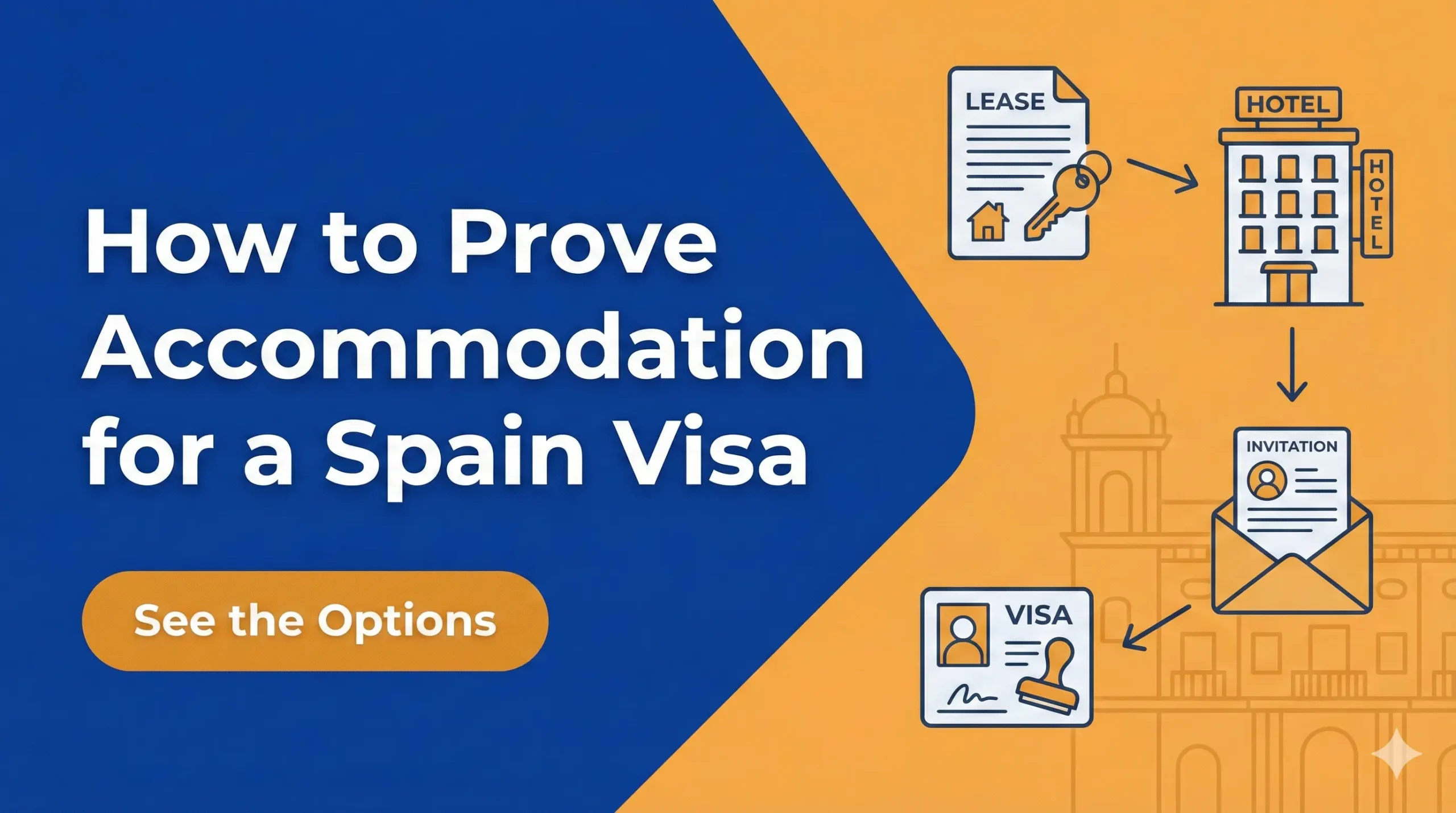
How to Prove Accommodation for a Spain Visa (Lease, Hotel, Invitation Letter)
Disclosure: This article contains affiliate links. If you buy through them, we may earn a commission at no extra cost to you. Read our full disclosure.
Securing a visa for Spain requires rigorous proof of where you will sleep. Whether you are booking a hotel, signing a rental contract, or staying with friends via an Invitation Letter, this guide details the exact documentation standards consulates demand to approve your application.
The Logic Behind Accommodation Proof
To successfully navigate the bureaucracy, you must understand what the consulate is looking for. The Spanish Ministry of Foreign Affairs and the National Police enforce these rules to prevent two things: illegal overstaying and irregular migration.
When you submit proof of accommodation, you are legally declaring your location. This allows authorities to verify that your travel plans are coherent. For example, if you apply for a 10-day tourist visa but provide a hotel booking for only 3 nights, your application is incoherent and likely to be rejected. Similarly, if you apply for a Non-Lucrative Visa (which implies stable residency) but only show a two-week Airbnb booking, you signal a lack of preparation for long-term life in Spain.
The documentation must cover the entire duration of your intended stay (for short-stay visas) or a significant initial period (for long-term visas), and it must be verifiable.
Method 1: Commercial Accommodation (Hotels and Hostels)
For tourists, business travelers, and short-term visitors (Schengen Visa Type C), commercial accommodation is the standard method of proof. While it seems straightforward, “booking a room” has nuances that can trip up applicants.
The Booking Confirmation Requirements
A simple screenshot of a search result is not enough. You need a formal confirmation receipt. The document must clearly state:
- Your Full Name: It must match your passport. If you are traveling as a family, every applicant’s name should ideally appear on the booking, or the main applicant’s name must clearly cover the number of guests.
- The Hotel’s Details: Name, full address, email, and telephone number. Consulates do occasionally call to verify bookings.
- Exact Dates: The check-in and check-out dates must cover every single night you plan to be in the Schengen area. If you are taking a night train or flight, include the ticket as proof for that specific night.
- Booking Reference Code: A verifiable reservation number.
Paid vs. Unpaid Reservations
A common dilemma is whether to pay in full before the visa is approved.
- Consulate Preference: Consulates prefer “fully paid” or “partially paid” bookings as they demonstrate commitment.
- The Risk: If your visa is denied, you lose the money.
- The Strategy: Most seasoned travelers book “fully refundable” rates. These often require a credit card hold or a deposit. The confirmation email usually looks identical to a non-refundable one. However, be warned: some strict consulates (depending on your country of origin) may specifically request proof of payment. Always check the specific requirements of the Spanish consulate in your jurisdiction.
The “Dummy Booking” Trap
Do not use “dummy booking” services that generate fake reservations for a fee. Consulates have tools to verify the validity of reservation codes. If a consular officer checks your reservation and finds it cancelled or non-existent, your visa will be denied for “submission of false documents,” which can lead to a long-term ban from the Schengen zone.
Method 2: Private Rental Contracts (Leases)
For long-term visas—such as the Non-Lucrative Visa (NLV), Digital Nomad Visa (DNV), or Student Visa—a hotel booking is rarely sufficient. You are moving to Spain to live, not to tour, and the consulate expects to see a stable home.
The Lease Agreement Requirements
If you are renting an apartment, you must submit a signed lease agreement (Contrato de Arrendamiento).
- Duration: For long-term visas, the contract should ideally be for at least 6 months to 1 year. Presenting a 1-month rental contract for a 1-year residency application looks suspicious.
- Legal Validity: The contract must be signed by both the landlord (arrendador) and the tenant (arrendatario).
- ID Inclusion: It should include the DNI or NIE of the landlord and your passport number.
“Nota Simple” Requirement
This is the detail that most applicants miss. A contract alone proves you signed a paper, but it does not prove the landlord actually owns the house.
Most consulates now require you to attach a Nota Simple to the rental contract. The Nota Simple is a land registry extract (dated within the last 3 months) that verifies the property ownership.
- Why it’s needed: It prevents fraud where people “rent” apartments from friends who don’t actually own them just to get a visa.
- How to get it: Your landlord must provide this. If they refuse, it is a red flag that the rental might be illegal or sublet without permission.
Short-Term vs. Mid-Term Rentals
For Digital Nomads or students, “mid-term” rentals (1 to 11 months) are common. These are legally distinct from permanent housing contracts. If you are using a platform like Airbnb or Spotahome for a long-term visa application, ensure the receipt shows a booking for at least 1-3 months (depending on the consulate) and is accompanied by a host statement or contract. However, moving from a temporary Airbnb to a permanent apartment is a standard process once you arrive. To understand the legal differences in these contract types, reviewing Short-Term vs Mid-Term Rentals in Spain: What’s Allowed is highly recommended before you sign.
The “Padrón” Connection
Remember that your ability to register with the town hall (Empadronamiento) depends entirely on your lease. If you present a “room rental” in a shared flat for your visa, ensure the contract explicitly allows you to register on the Padrón, as you will need this immediately upon arrival to get your TIE card. See Renting in Spain: Contracts, Deposits, and Tenant Rights for the clauses to look for.
Method 3: The Invitation Letter (Carta de Invitación)
This is the most misunderstood method of accommodation proof. Many applicants assume they can simply have their friend or relative in Spain write a handwritten letter saying, “John is staying with me,” and submit it. This will be rejected.
For visa purposes, an “Invitation Letter” is a specific official document issued by the Spanish National Police.
The Process for the Host
The burden of this method falls on the person living in Spain (the host). They cannot just write a letter; they must apply for the official Carta de Invitación at their local National Police station.
- Application: The host submits a request detailing their relationship to the guest, the exact dates of the visit, and proof that they have adequate space in their home (usually requiring the Escritura or deed of the house).
- Fee: The host must pay a processing fee (approx. €70-€80).
- Timeline: It can take 2 to 6 weeks for the police to issue the official letter.
- Liability: By signing this document, the host becomes legally responsible for the guest. If the guest overstays their visa, the host faces severe fines (ranging from €500 to over €100,000 in extreme trafficking cases).
The Process for the Guest
Once the police issue the official, stamped Carta de Invitación, the host must mail the original hard copy to the guest in their home country.
- Submission: The guest submits this original document with their visa application. A scan or photocopy is often not accepted by the consulate.
- No “Informal” Letters: There is no “informal” alternative for tourist visas. If you are staying with a friend, you need the official police letter.
If you are considering this route, you must start the process months in advance. It is not a last-minute solution. For a deep dive into the police requirements and costs, read Invitation Letter (Carta de Invitación) in Spain: When You Need It.
Method 4: Proof of Property Ownership
If you are fortunate enough to already own a home in Spain, this is the strongest form of accommodation proof.
Required Documents
- Escritura de Compraventa: The public deed of sale.
- Nota Simple: An up-to-date extract from the Property Registry (Registro de la Propiedad), issued within the last 3 months, proving you are still the current owner.
- IBI Receipt: Proof of payment of the annual property tax (Impuesto sobre Bienes Inmuebles) is often requested to show the property is in good standing.
This method is commonly used for the Golden Visa (which is based on investment) but is equally valid for the Non-Lucrative Visa or simple tourist visas for holiday home owners.
Method 5: Student Dormitories and University Housing
For those applying for a student visa, university housing provides a streamlined path.
Required Documents
- Certificate of Admission: A letter from the university or designated student residence (Colegio Mayor) confirming that a room has been reserved for you.
- Details: The letter must include the full address of the residence, the cost, and the dates of the reservation.
- Proof of Payment: Ideally, proof that the deposit or the first month’s rent has been paid.
If you have not yet secured a dorm room, some consulates allow you to submit proof of “temporary accommodation” (like a hotel for 2 weeks) along with a letter explaining you will find permanent housing upon arrival. This varies by consulate, so check Spain Student Visa: Application Steps and Common Mistakes for specific student visa nuances.
Critical Comparison of Proof Types
| Proof Type | Best For | Complexity | Key Requirement | Cost |
| Hotel Booking | Tourist Visa (Short Stay) | Low | Verifiable booking code | Booking deposit |
| Rental Contract | NLV, Digital Nomad, Work | High | Signed contract + Nota Simple | Deposit + Rent |
| Carta de Invitación | Visiting Family/Friends | High | Police-issued document (Original) | ~€80 fee (Host) |
| Property Deed | Property Owners | Medium | Nota Simple (<3 months old) | None (if owned) |
| Dorm Acceptance | Student Visa | Medium | Official School Letter | Deposit |
Common Pitfalls and Rejection Triggers
Even with a booking, things can go wrong. Here are the most common reasons accommodation proof is rejected.
1. Inconsistent Dates
If your flight arrives on June 1st but your hotel booking starts on June 3rd, you have a gap. Where are you sleeping for two nights? The consulate assumes the worst. Ensure your flight dates and accommodation dates match perfectly.
2. Cancellations Mid-Process
Consulates know that people book refundable hotels and cancel them immediately after applying. They often perform spot checks days before issuing the visa. If they call the hotel and find the reservation cancelled, your visa is denied instantly. Do not modify your reservation until the visa is in your passport.
3. Lack of Host Capacity
For the Carta de Invitación, if your host lives in a one-bedroom apartment but invites a family of five, the police will deny the letter request due to lack of habitable space.
4. Informal Airbnbs
An Airbnb receipt is generally accepted for tourist visas, but for long-term residency, consulates are increasingly skeptical of standard Airbnb bookings unless they are for a substantial duration (e.g., 3 months). They prefer standard leases under the LAU (Urban Leasing Act).
Financial Means and Accommodation
There is a direct link between your accommodation and the money you need to show.
- Paid Accommodation: If you have already paid for your hotel or have a prepaid tour, you still need to show daily spending money, but the “roof over your head” is secured.
- Unpaid Accommodation: You must prove you have funds to cover the hotel bill plus your daily expenses.
- Private Accommodation (Invitation): Staying with a friend significantly reduces your daily financial requirement because you do not need to budget for a hotel. However, you still need to meet the minimum daily amount for food and travel (approx. €113/day or a minimum of €1020 per person per trip in 2026).
Understanding how these numbers interact is vital. Check What Counts as ‘Sufficient Financial Means’ for Spain Entry? to calculate the exact amount you need in your bank account based on your accommodation type.
Tips for Specific Visas
The Digital Nomad Visa (DNV)
Since DNV applicants can apply from within Spain, they often enter as tourists (using a hotel booking) and then rent an apartment. However, if applying from your home country, you need a 1-year contract. Many nomads use services like Flatio or Idealista to find “mid-term” rentals that accept foreign tenants without a Spanish payroll.
The Non-Lucrative Visa (NLV)
This is the strictest category. Some consulates (like Los Angeles or London) have historically been very strict, demanding a 1-year lease or property deed. Others may accept a 3-month temporary rental with a notarized letter of intent to find permanent housing. Always check the specific “consulate cheat sheet” for your region.
Checklist Before Submission
Before you seal your visa application envelope, run through this final check:
- Name Match: Does the booking/lease have YOUR name on it?
- Date Coverage: Does it cover every single night of the trip?
- Verifiability: Is the phone number of the hotel/landlord included?
- Originals: Do you have the original Carta de Invitación (if applicable)?
- Language: Is the contract in Spanish? (If not, it must be sworn translated).
For a broader look at the pre-departure document shuffle, review Spain Visa Checklist: What to Do Before You Fly.
Conclusion
Proving accommodation is an exercise in coherence. The Spanish authorities want to see that your housing plans align with your travel purpose and your financial reality. A tourist stays in a hotel; a resident signs a lease; a family member visits via an official invitation.
Do not try to cut corners with informal letters or fake bookings. The systems are digitized, and the risk of a ban is too high. Whether you are hunting for an apartment in Madrid or booking a hostel in Seville, ensure your paperwork is transparent, verifiable, and complete. Once your accommodation is proven, you have laid the foundation for a successful application.
References
Primary sources (official)
- Ministry of Interior (Carta de Invitación): https://www.policia.es/_es/tramites_extranjeria_tramite_cartainvitacion.php
- Schengen Visa Code (Regulation EC No 810/2009): https://eur-lex.europa.eu/legal-content/EN/TXT/?uri=celex%3A32009R0810
- Ministry of Foreign Affairs (Entry Requirements): https://www.exteriores.gob.es/Consulados/londres/en/ServiciosConsulares/Paginas/index.aspx
Other helpful sources
- Idealista (Rental Market Data): https://www.idealista.com/en/
Disclaimer
The information provided in this article is for general informational purposes only and does not constitute legal advice. Visa requirements, particularly regarding accommodation proof, can vary significantly between different Spanish Consulates and are subject to change. Always verify the specific requirements on the official website of the Spanish Consulate where you intend to apply.