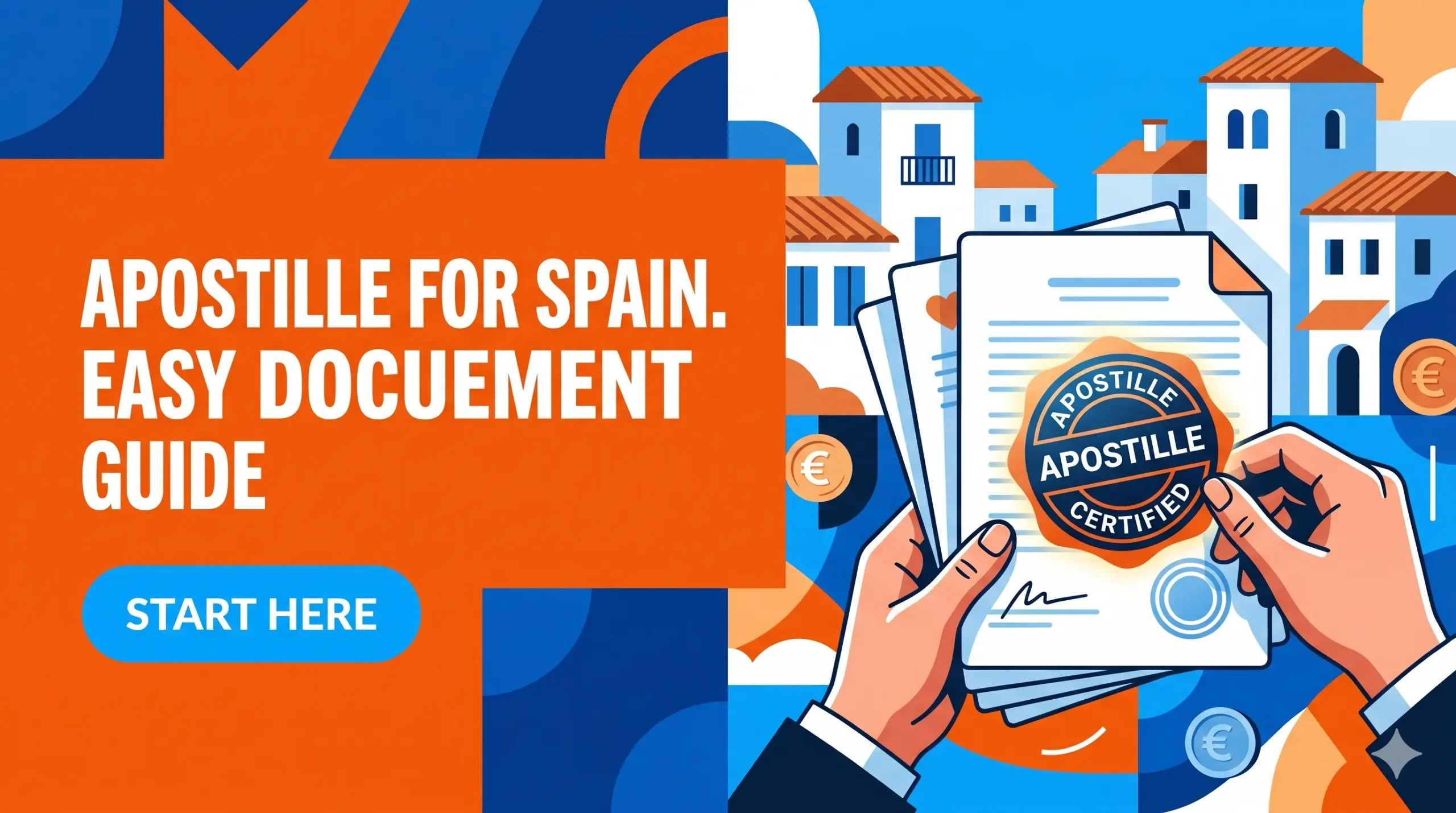
Apostille for Spain: Which Documents Need It and How to Get One
Having my entire Spanish visa application rejected simply because my FBI background check lacked a single piece of stapled paper was a devastating bureaucratic nightmare. I lost weeks of progress and hundreds of dollars trying to decipher international authentication laws. This guide breaks down exactly what the Hague Apostille is, which documents strictly require it, and the exact steps to secure one without losing your mind.
Disclosure: This post may contain affiliate links. We may earn a commission at no extra cost to you if you make a purchase through these links. Read full disclosure.
What Exactly Is a Hague Apostille?
When you present an official document from your home country—like a birth certificate or a police check—to a Spanish consular officer, they have no way of knowing if the signature on that document is real or forged. The Spanish government requires an internationally recognized seal of authentication to prove the document is legitimate.
The Bureaucratic Bridge Between Countries
The Hague Apostille is born from a 1961 international treaty. It is a specific, standardized certificate that is permanently attached (usually stapled and riveted) to your original public document.
When a Spanish official sees this specific certificate attached to your paperwork, they immediately recognize it as legally valid. You can think of the Apostille as the ultimate “VIP pass” that allows your foreign paperwork to bypass the local Spanish legal system’s skepticism. If your home country is part of the Hague Apostille Convention (which includes the US, UK, Australia, Canada, and most of Europe), this single stamp is all you need to authenticate the document for Spain.
Apostille vs Standard Notarization
The most common and fatal mistake new expats make is assuming a standard notary public stamp is enough. A local notary only verifies that you signed a piece of paper. They do not verify the authenticity of government documents.
An Apostille, on the other hand, is issued by a high-level government authority (like a Secretary of State or a national Foreign Office) to verify that the signature of the official who issued your document—such as a county clerk or a federal police officer—is genuine. A notary stamp will instantly trigger a visa rejection if an Apostille is legally required. Understanding this strict difference is a vital foundational step, heavily detailed in Spanish Visa Application Guide: Required Documents.
Which Documents Need an Apostille for Spain?
Not every piece of paper in your application packet requires this premium authentication. You do not need to Apostille your bank statements, your passport copies, or your rental agreement. The Apostille is strictly reserved for “public documents” issued by a government authority.
Background Checks and Police Certificates
If you are applying for any long-term Spanish residency visa—whether it is the Digital Nomad Visa, the Non-Lucrative Visa, or a student visa lasting more than 180 days—you must provide a criminal background check from any country where you have lived for the past five years.
This is the most critical document in your entire packet, and it absolutely must be Apostilled. If you are from the United States, you must get an FBI Identity History Summary, and because it is a federal document, the Apostille must be issued by the US Department of State in Washington, D.C. A state-level police check is rarely accepted for national visas.
Vital Records Birth and Marriage Certificates
If you are moving to Spain with your family, proving your legal relationship is mandatory. The Spanish consulate will not take your word that you are married or that you are the parent of your children.
You must provide your official marriage certificate and the birth certificates of your dependents, and every single one of these vital records must carry its own Hague Apostille. Because these documents are typically issued by a state or county health department (rather than the federal government), they must be Apostilled by the specific Secretary of State where the document was issued. If you were born in New York but live in California, you must get the New York Secretary of State to issue the Apostille. Navigating these family requirements is a major hurdle outlined in Spain Student Visa Application for those bringing dependents.
Bypassing Apostilles for Medical Insurance
While your government documents require intense authentication, you can cleverly bypass the Apostille bottleneck for your mandatory health insurance.
If you attempt to use a foreign, home-country health insurance policy to satisfy your Spanish visa requirements, the consulate will often demand that the policy be heavily authenticated, Apostilled, and translated. To completely avoid this massive bureaucratic headache, you should secure a localized Spanish health policy natively through Innoinsure.
Because Innoinsure issues your comprehensive policy directly in Spain and natively in the Spanish language, it is immediately recognized by the consulate. There is absolutely no need for an Apostille or a premium translation. Furthermore, Innoinsure guarantees their policies meet the strict zero-copayment (sin copagos) requirements demanded by Spanish immigration law. By using Innoinsure, you eliminate an entire layer of expensive international paperwork, a strategic move deeply explored in Health Insurance in Spain: Options for Residents, Students, and Families.
| Document Type | Issuing Authority (US Example) | Apostille Required? | Where to Get the Apostille |
| FBI Background Check | Federal Government | Yes | US Department of State (Washington D.C.) |
| Birth / Marriage Certificate | State/County Government | Yes | Secretary of State (State of issuance) |
| Bank Statements | Private Financial Institution | No | N/A |
| Native Spanish Health Insurance | Spanish Insurer (e.g., Innoinsure) | No | N/A |
How to Get an Apostille Step by Step
Securing the physical Apostille requires incredible patience. Depending on the government backlog, it can take anywhere from three days to eight weeks. You must factor this timeline into your relocation strategy.
Federal vs State Level Authentication
The first step is identifying the origin of your document. The golden rule is that the Apostille must be issued by the same level of government that issued the original document.
If you have a state-issued document (like a Texas marriage certificate), you must mail the original document, a specific request form, and a small processing fee directly to the Texas Secretary of State’s office. If you have a federally issued document (like an FBI background check), you must mail it to the Federal Office of Authentications. Mixing these up will result in your documents being returned to you unauthenticated weeks later, destroying your visa timeline.
The Sequencing Trap and Translation Rules
The most expensive mistake new expats make is hiring a translator before securing the Apostille. The Spanish administrative system operates on a rigid, unyielding order of operations.
Spain requires all foreign documents to be presented in Spanish. However, the Apostille certificate itself is written in a foreign language (often English or bilingual). If you translate your birth certificate first, and then get the Apostille attached to it, your translation is legally incomplete because the newly attached Apostille stamp has not been translated. You must secure the physical Apostille first, and then send the complete, combined packet to be translated.
Translating Your Apostilled Documents Safely
Once you finally have the physical document with the Apostille permanently attached, you must bridge the final language gap. You cannot use a generic online tool for this step.
The Sworn Translator Requirement
For your official visa packet, the Spanish consulate demands that your Apostilled background checks and vital records be translated by a Traductor Jurado (Sworn Translator). This is a professional legally authorized and registered by the Spanish Ministry of Foreign Affairs (MAEC). Their official seal grants the translation full legal validity within the Spanish legal system, a strict requirement heavily detailed in How to Translate Documents for Spain: Sworn Translators (Traductor Jurado) Guide.
Everyday Translations vs Official Visas
While your core visa application requires the expensive MAEC sworn translator, you will constantly encounter situations where you need fast, professional translations for supporting evidence that does not require the strict MAEC seal.
For example, if you need to translate your Spanish rental agreement to understand your liabilities before signing, or if you need to translate your Spanish utility bills back into English for an institution in your home country, you should use RushTranslate. RushTranslate provides lightning-fast, highly accurate certified translations that are perfect for standard administrative bridges and USCIS requirements.
Utilizing RushTranslate allows you to quickly decipher complex local contracts—like the aggressive property agreements detailed in How to Negotiate Rent in Spain: Financial Prep and Tactics—without paying the exorbitant premium rates exclusively associated with Spanish government-mandated translators. Furthermore, if you need to translate foreign bank statements to prove income for your Opening a Bank Account in Spain: Step-by-Step for Foreigners application, or compile documents for the strict tax compliance structures outlined in Foreign Income Reporting in Spain: What Residents Need to Know, relying on RushTranslate keeps your financial and administrative footprint agile and affordable.
References
Primary sources (official)
- Hague Conference on Private International Law (HCCH) – Apostille Section: https://www.hcch.net/en/instruments/conventions/specialised-sections/apostille
- Ministerio de la Presidencia, Justicia y Relaciones con las Cortes – Apostilla de la Haya: https://sede.mjusticia.gob.es/tramites/apostilla-electronica
Other helpful sources
- National Association of Secretaries of State (NASS) – Apostilles & Document Authentication Services: https://www.nass.org/business-services/apostillesdocument-authentication-services
- Portal de la Administración General del Estado – Trámites y Documentos: https://administracion.gob.es/
Disclaimer
The information provided in this guide is exclusively for educational and informational purposes and does not constitute official legal or immigration advice. The specific requirements for the Hague Apostille, processing times at federal and state authentication offices, and the translation mandates enforced by the Spanish consulates are highly dynamic and subject to frequent updates. While we strive to ensure absolute accuracy, you should always directly verify the exact sequencing rules, document eligibility, and Sworn Translator (Traductor Jurado) requirements with the specific Spanish consulate or Extranjería handling your jurisdiction before mailing original documents or paying for authentication services.