Spanish Citizenship by Marriage: Requirements and Timeline
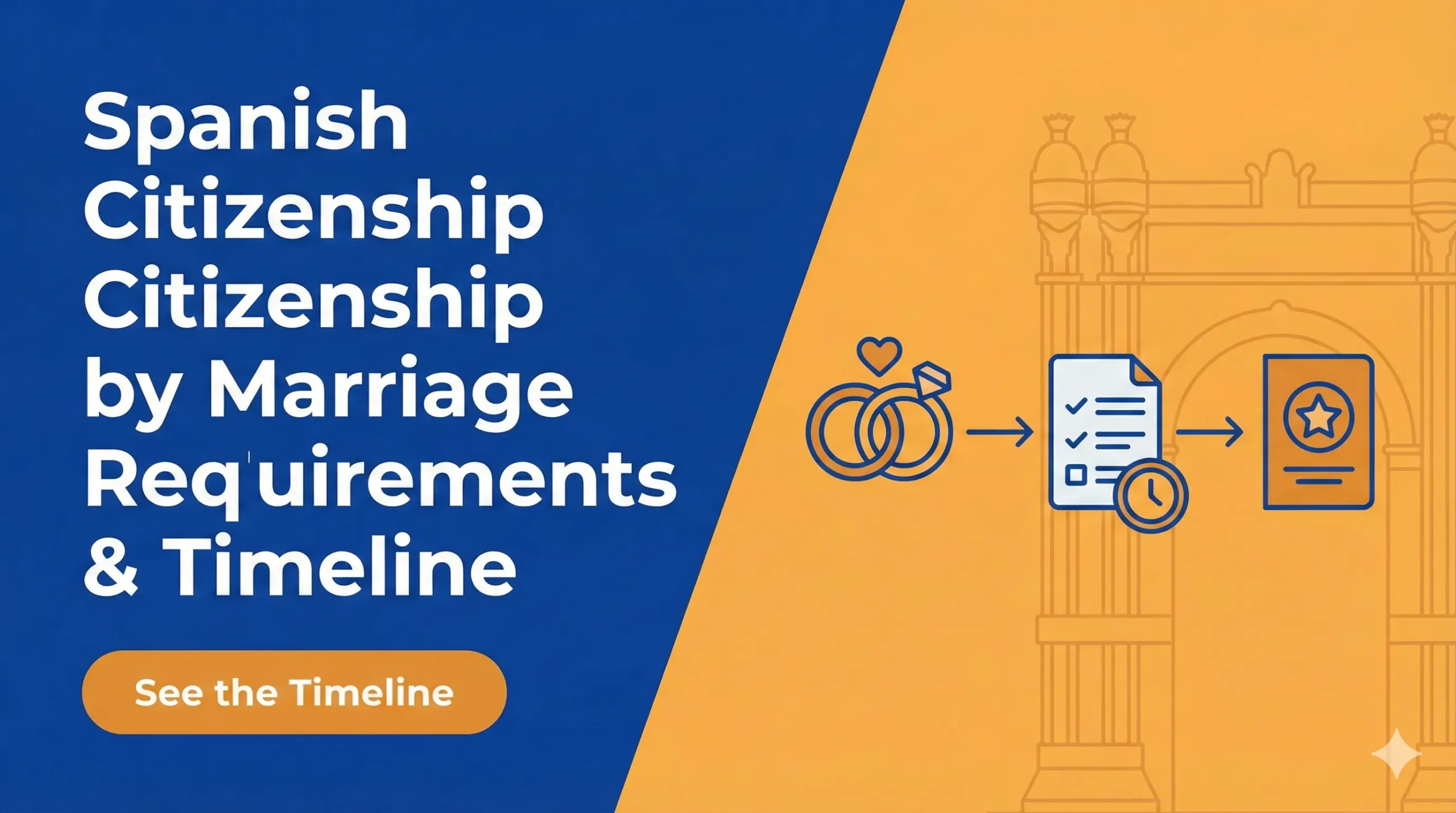
Marrying a Spanish citizen offers the fastest route to naturalization, reducing the residency requirement from 10 years to just one year. However, the clock only starts once you hold the correct residency card. This comprehensive 2026 guide details the strict “12-month rule,” the mandatory exams, the critical marriage registration process (transcripción), and the timeline from application to oath.
Disclosure: This post may contain affiliate links. We may earn a commission at no extra cost to you if you make a purchase through these links. Read full disclosure.
The Core Concept: The “One-Year” Rule Deconstructed
The “fast track” allows you to apply for citizenship after one year of legal residence. The wording here is specific and often misunderstood.
It is NOT: “One Year of Marriage”
You cannot get married today and apply for citizenship next year if you haven’t been living in Spain. The marriage is the condition that allows the shorter timeframe, but the residency is the requirement.
It IS: “One Year of Residency with a TIE”
The clock starts ticking the moment your residency status is officially recognized.
- The Starting Gun: The date stamped on your TIE Card (Tarjeta de Identidad de Extranjero). Specifically, you should be holding the Tarjeta de Familiar de Comunitario (Family Member of EU Citizen card).
- The Condition: You must be married and living with your spouse for that entire year.
- The Trap: If you lived in Spain for 5 years as a student or a tourist before you got married, that time counts for zero toward this specific one-year requirement. Student visas are considered “stays” (estancia), not “residency” (residencia). Your citizenship clock effectively resets to Day 1 when you get your marriage-based residency card.
If you have not yet secured your physical residency card, this is your immediate priority. You cannot start the citizenship countdown without it. Review the steps in How to Get the TIE Card in Spain: Fingerprints, Fees, and Pickup to ensure you have the valid document in hand.
Part 1: Validating the Marriage (The Transcripción)
Before you even think about the “One Year Rule,” you must prove your marriage exists in the eyes of Spain.
Scenario A: Married in Spain
If you got married in a Spanish Town Hall (Ayuntamiento), Notary, or Church within Spain, you are safe. Your marriage is already in the Spanish system. You simply need to request a fresh Literal Marriage Certificate (Certificado Literal de Matrimonio) from the Civil Registry.
Scenario B: Married Abroad (The Hurdle)
If you got married in Las Vegas, London, or Cancun, Spain does not automatically know about it. You cannot just translate your US marriage certificate and submit it.
- The Requirement: You must register (transcribir) your foreign marriage into the Spanish Civil Registry.
- The Process: This is done at the Spanish Consulate where you married OR at the Central Civil Registry in Madrid.
- The “Interview”: To prevent “sham marriages” (marriages of convenience), the authorities may interview you and your spouse separately. They will ask personal questions (Which side of the bed do they sleep on? What is their mother’s name?) to verify the relationship is genuine.
- The Timeline: This registration can take 6 to 12 months depending on the consulate. You cannot apply for citizenship until this is finished and you have the Spanish certificate in your hand.
Part 2: The Residency Requirements
Once your marriage is registered and your TIE card is active, you must maintain “continuous and legal” residence for 12 months.
1. Continuous Presence
You must physically live in Spain.
- Absences: You should not leave Spain for more than 3 consecutive months during this pre-application year. Frequent, long trips that suggest your “center of life” is elsewhere can lead to rejection.
- Passport Check: The examiner will scan every page of your passport to count stamps. If they see you spent 6 months in Miami, your application will be denied.
2. Cohabitation (Convivencia)
You must live with your spouse.
- The Proof: The Empadronamiento (census registration). You must provide a “Collective” certificate showing both you and your spouse registered at the same address for the full year.
- The Risk: If you work in Barcelona but your spouse is registered in Madrid, the government will assume the marriage is broken or fake. Ensure your registration is updated and unified. For details on how to manage this crucial document, refer to Empadronamiento in Spain: How to Register Your Address.
Part 3: The Integration Exams (DELE & CCSE)
Unless you fall into a specific exemption category, you cannot become Spanish without passing two exams administered by the Instituto Cervantes. These tests prove you have integrated into the culture and language.
1. The Language Exam: DELE A2
- What it is: A basic Spanish test proving you can communicate in everyday situations (shopping, family, work). Level A2 is elementary; you do not need to be fluent, but you must be functional.
- Who is Exempt? Nationals of Spanish-speaking countries (Argentina, Colombia, Mexico, etc.).
- Note: US citizens who speak Spanish are not exempt unless they also hold a passport from a Spanish-speaking country.
- Cost (2026): Approx. €138.
- Validity: Does not expire.
2. The Culture Exam: CCSE
- What it is: A 25-question multiple-choice test on the Spanish Constitution, geography, history, and culture. You need 15/25 to pass.
- Who is Exempt? Only those who completed Junior High (ESO) or High School (Bachillerato) in Spain.
- Cost (2026): €85.
- Validity: 4 years.
Study Tip: For the CCSE, download the official app from Instituto Cervantes. It contains the exact bank of 300 questions that appear on the exam. If you practice the app for a week, passing is almost guaranteed.
Part 4: The Document Checklist
Gathering documents is the most stressful part because they have expiration dates. If you gather them too early, they expire. If you gather them too late, you delay your application.
The Golden Rule of Validity: Most foreign documents (Background Checks, Birth Certificates) are only valid for 3 to 6 months after issue. Plan accordingly.
The Essential Dossier:
- Current Passport: Full copy of all pages (even the blank ones).
- TIE Card (Residency): Copy of front and back.
- Your Birth Certificate: From your country of origin. It must be Apostilled and Translated by a Sworn Translator (Traductor Jurado).
- Spouse’s Birth Certificate: Issued by the Spanish Civil Registry (dated within the last 3 months).
- Marriage Certificate: Issued by the Spanish Civil Registry (dated within the last 3 months).
- Criminal Record Check: From your country of origin (and any country where you lived in the last 5 years). This is the most critical document.
- US Citizens: Must be an FBI Identity History Summary, Apostilled by the Dept of State.
- UK Citizens: ACRO Certificate, Apostilled.
- Translation: It must be sworn-translated. For more on the specifics of these translations, check Spain Visa Translations & Apostilles: What Needs Legalization?.
- Empadronamiento: A historical collective certificate (Histórico Colectivo) proving at least 1 year of cohabitation.
- Exam Certificates: Proof of passing DELE/CCSE (or exemption proof).
- Fee Payment: Proof of payment of Tasa 790-026 (approx. €104.05).
- Proof of Economic Means: While not as strict as a visa application, it helps to show the family has income (spouse’s contract, your contract, or bank statements).
Part 5: The Application Timeline
Phase 1: Preparation (Month 0 to 11)
- Month 1: Ensure your TIE is valid and you are registered on the Padrón with your spouse.
- Month 6: Book your exams. Dates fill up fast.
- Month 9: Order your Criminal Record checks from back home. (It takes time to get the Apostille).
- Month 11: Order the Spanish certificates (Marriage/Spouse Birth).
Phase 2: Submission (Month 12 + 1 Day)
You can only submit the application the day after you have completed one full year of residency.
- Method: Digital submission via the Ministry of Justice’s “Sede Electrónica.” You need a Digital Certificate (Certificado Digital) to do this.
- Receipt: You will receive a file number (Número de Expediente), usually starting with “R-“. Save this code.
Phase 3: The “Silent” Period (12 to 24 Months)
Once submitted, your status will likely sit at “En Tramitación” (Processing) for a long time.
- Police Check: At some point, the Spanish police will check your internal Spanish record. If you have any arrests or fines in Spain, this will block the process. Ensure your record is clean. See Spain Criminal Record Certificates: Which Ones You Need and When to understand what the Spanish authorities are looking for.
- Plan de Choque: The government is using automated software to speed up checks. Straightforward cases are now being resolved in 12-18 months, whereas they used to take 3-4 years.
Phase 4: Approval and Oath (The Final Mile)
One day, you will check the portal and see “Concedido” (Granted). Congratulations! But you aren’t Spanish yet.
- The Oath (Jura): You have 180 days to swear allegiance to the King and Constitution.
- Where: You can do this at the Civil Registry (Free, but slow appointments) or at a Notary (Cost ~€100-200, but fast).
- Renunciation: At this moment, you must renounce your previous nationality (unless you are from an Ibero-American country or France).
Phase 5: The DNI and Passport
Once the Oath is registered, you get a new Birth Certificate (a Spanish one!). You take this to the National Police station to get your DNI (National ID) and Passport.
Total Cost Breakdown (2026 Estimates)
Citizenship is an investment. Here is a realistic budget for the process.
| Item | Cost (Approx) | Notes |
| Application Tax (Tasa 790-026) | €104.05 | Non-refundable. |
| DELE A2 Exam | €138 | Mandatory for non-native speakers. |
| CCSE Exam | €85 | Mandatory for most. |
| Sworn Translations | €200 – €500 | Depends on page count of criminal/birth records. |
| Apostilles | €50 – €100 | Fees paid to home country (e.g., US Dept of State). |
| Notary (Optional for Oath) | €150 | Faster than Civil Registry. |
| Lawyer / Gestor (Optional) | €500 – €1,500 | Recommended to avoid errors. |
| TOTAL | €1,200 – €2,500 | Varying by complexity and professional help. |
Common Pitfalls and Rejection Reasons
1. The “Single Name” Problem
Spanish names have two surnames (Father + Mother). US/UK names usually have one. When you become Spanish, your name will legally change to follow Spanish rules (usually taking your father’s surname as the first, and mother’s maiden surname as the second). This can cause confusion with documents. Ensure your birth certificate clearly lists your mother’s maiden name to avoid delays in name concordance.
2. The FBI Background Check Delay
For US citizens, the Apostille from the Department of State in DC is currently taking 8-11 weeks. If you wait until the last minute to order it, your document might not arrive before your other documents expire.
3. The “Broken” Empadronamiento
We cannot stress this enough: If you moved houses and forgot to re-register immediately, or if there is a gap of even a few days where you and your spouse were not registered at the same address, the Ministry can reject the claim of “cohabitation.” Check your history before you apply.
Conclusion
Obtaining Spanish citizenship by marriage is a privilege that compresses a decade of waiting into a single year. It is the fastest path to EU citizenship available in Europe.
However, “fast” does not mean “casual.” The process is a forensic audit of your first year of marriage. The government wants to ensure the union is real, the residency is continuous, and the integration is genuine.
If you are approaching your one-year anniversary, stop viewing your time in Spain as just “living abroad” and start viewing it as “building a dossier.” Every month on the Padrón, every page of your passport, and every clean police record is a building block for your future Spanish DNI.
Once you cross the finish line, remember that becoming a Spanish citizen changes your relationship with the tax office permanently. Unlike the flexible residency schemes, citizenship implies an intent to stay. Before taking the oath, it is wise to review the long-term tax implications.
References
Primary sources (official)
- Ministry of Justice (Citizenship by Residence): The official government portal for requirements and submission.https://www.mjusticia.gob.es/es/ciudadania/nacionalidad/nacionalidad-espanola/nacionalidad-residencia
- Instituto Cervantes: Official portal for DELE and CCSE exam registration and materials.https://examenes.cervantes.es/
- Civil Code of Spain: Articles 21 and 22, detailing the reduction of residency time for spouses.https://www.boe.es/buscar/act.php?id=BOE-A-1889-4763
- Sede Electrónica (Tasa 790-026): Payment gateway for the citizenship application fee.https://sede.mjusticia.gob.es/es/tramites/tasa-modelo-790-026
Other helpful sources
- Balcells Group: A legal breakdown of the “Marriage Fast Track” and common pitfalls.https://balcellsgroup.com/spanish-citizenship-by-marriage/
- Parainmigrantes: Updates on the “Plan de Choque” and current processing times.https://www.parainmigrantes.info/nacionalidad-espanola/
Disclaimer
The information provided in this article is for educational and informational purposes only and does not constitute legal advice. Processing times, fees, and documentary requirements are subject to frequent change. We strongly recommend consulting with a qualified immigration lawyer to review your application dossier before submission to avoid costly rejections.