Proof of Income for Spain Non‑Lucrative Visa: Salaried vs Self‑Employed
Disclosure: This article contains affiliate links. If you buy through them, we may earn a commission at no extra cost to you. Read our full disclosure.
Getting your proof of income rejected by the Spanish consulate because your documents do not perfectly match their rigid definitions is a devastating setback. Applications can stall for weeks when a consular officer does not understand how an applicant’s corporate dividends are structured. This guide explains exactly how to prove your solvency, whether salaried or self-employed, to secure your Non-Lucrative Visa.
The NLV Reality Check Active Versus Passive Income
The most expensive and time-consuming mistake new expats make is fundamentally misunderstanding what the Non-Lucrative Visa (NLV) actually is. If you are currently researching this visa, you must internalize one absolute, undeniable rule: the Spanish government strictly forbids active work on the NLV, and this absolutely includes remote work for a company in your home country.
The Shift to the Digital Nomad Visa
Historically, some Spanish consulates turned a blind eye to remote workers applying for the NLV. That era is completely over. Today, if you walk into a consulate with a standard salaried W-2 or a self-employed 1099 showing you actively work forty hours a week from your laptop, your NLV application will be instantly denied. The consulate will tell you to apply for the Digital Nomad Visa instead.
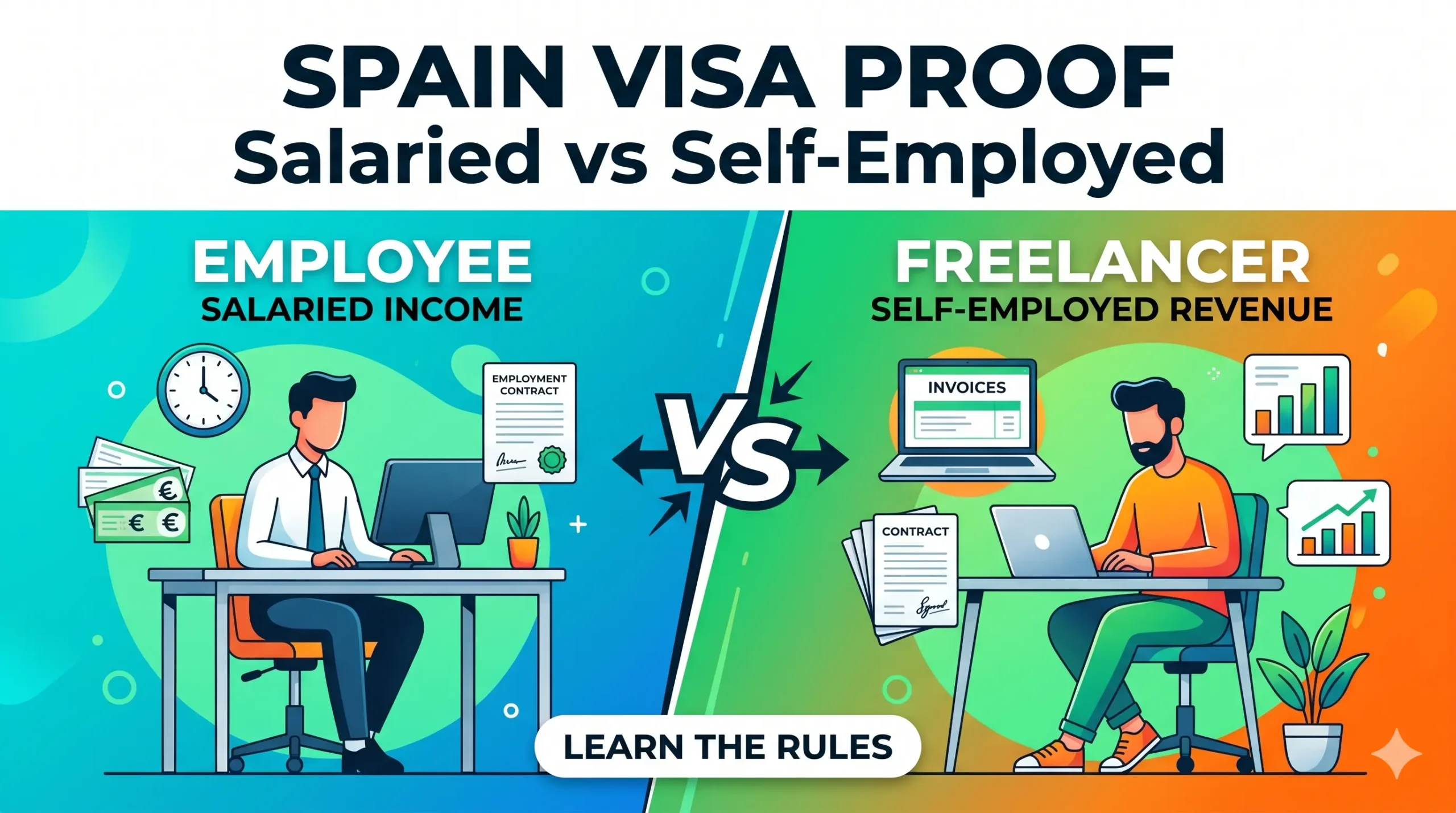
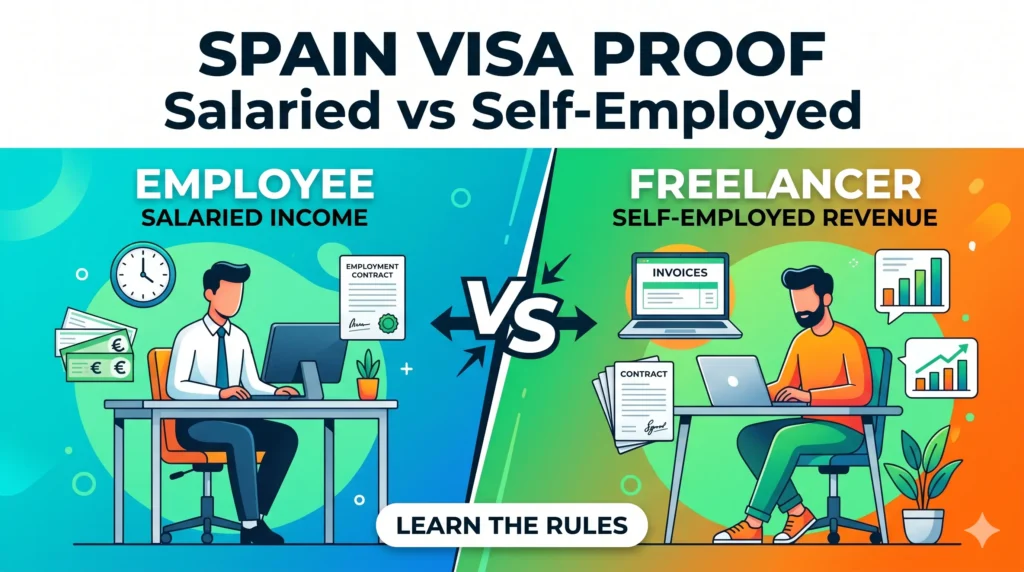
The NLV is designed exclusively for individuals who possess purely passive income or massive cash savings. “Salaried” in the context of the NLV generally refers to pensions or formal sabbaticals, while “Self-Employed” means you are a silent partner or shareholder collecting passive dividends. If you do not fit these specific definitions, you must rely entirely on the savings route. Understanding the exact documents needed to prove this nuanced difference is the most critical part of the Spanish Visa Application Guide: Required Documents.
Understanding the IPREM Calculation
The Spanish government determines your required income based on an economic indicator called the IPREM (Indicador Público de Renta de Efectos Múltiples). For a Non-Lucrative Visa, the main applicant must prove they have an annual income (or liquid savings) equivalent to 400% of the IPREM.
As of the current budget extensions through 2026, the baseline IPREM is €8,400 per year. This means the primary applicant must show exactly €33,600. If you are bringing a spouse or children, you must add 100% of the IPREM (€8,400) for every single dependent. This math is non-negotiable. If you fall short by fifty euros, you will be rejected.
| Applicant Type | IPREM Requirement | Annual Amount Required (Euros) | Monthly Equivalent |
| Main Applicant | 400% | €33,600 | €2,800 |
| First Dependent (Spouse) | 100% | €8,400 | €700 |
| Second Dependent (Child) | 100% | €8,400 | €700 |
| Total for Family of Three | 600% | €50,400 | €4,200 |
Proving Solvency as a Salaried Employee
Since you cannot actively work on the NLV, applying as a “salaried” employee requires you to prove to the Spanish consulate that your active salary is either stopping completely or transitioning into a passive format.
The Sabbatical and Termination Letters
If you are taking a gap year to live in Spain and you intend to return to your job, you must provide a formal sabbatical letter. This letter must be printed on official company letterhead, signed by a human resources executive, and explicitly state that you have been granted an unpaid leave of absence. Crucially, the letter must state that you are strictly forbidden from performing any remote work for the company while residing in Spain.
If you are simply quitting your job to retire early or live on savings, the consulate will demand a formal termination letter proving that your active income stream has officially ceased. Because these corporate documents are issued in English, you must have them professionally translated before your appointment. You can use RushTranslate to quickly secure a highly accurate, certified translation of your human resources letters. RushTranslate ensures the bureaucratic phrasing regarding your sabbatical is perfectly conveyed in Spanish, preventing the consular officer from misinterpreting your employment status.
Pension and Annuity Income
If your “salary” is actually a government pension, military retirement, or a private corporate annuity, you are in the strongest possible position for the NLV. Consulates love pensions because they are guaranteed, passive, and lifetime-backed.
You must provide your official benefits verification letter. If the letter states you receive $3,500 a month for life, and that amount exceeds the €2,800 monthly IPREM requirement, your financial proof is essentially complete. Again, this critical letter must be perfectly legible to the Spanish authorities. Sending your federal pension letters through RushTranslate guarantees that complex governmental financial terms are translated accurately, ensuring your lifetime income is recognized without delay.
Proving Solvency as a Self Employed Business Owner
This is where the vast majority of expats face devastating rejections. If you own a Limited Liability Company (LLC) or an S-Corporation, you cannot simply print out your business bank statements and hand them to the consulate.
The Passive Shareholder Requirement
If you own a business, the consulate assumes you are actively managing it, which violates the NLV rules. To survive this scrutiny, you must undeniably prove that you are a silent partner or a passive shareholder. You must prove that your business operates entirely without your daily managerial input and that your income is derived strictly from passive dividends.
You achieve this by having your Certified Public Accountant (CPA) write a highly specific, notarized letter. The letter must explicitly state that your company is managed by other W-2 employees or local directors, that you hold zero day-to-day operational duties, and that your income is classified strictly as shareholder dividends.
Authenticating Tax Returns and CPA Letters
To back up the CPA letter, you must provide your personal and business tax returns (such as a Schedule K-1 in the United States) clearly showing dividend distributions rather than active self-employment income.
These dense financial documents are notoriously difficult to translate accurately. You should rely on RushTranslate to process your CPA letters and tax returns. Because RushTranslate provides professional, certified translations, they can handle the complex financial terminology required to convince a skeptical consular officer that your self-employment is genuinely passive. Getting this translation right is the absolute key to unlocking your visa, allowing you to eventually navigate the local compliance structures detailed in Foreign Income Reporting in Spain: What Residents Need to Know.
The Ultimate Backup: The Pure Savings Route
If you do not have a pension, and you cannot convince the consulate that your business income is purely passive, your only remaining option is the pure savings route.
Liquid Asset Requirements
The Spanish consulate allows you to satisfy the IPREM requirement entirely with liquid savings. If you are a solo applicant, you must show a minimum of €33,600 sitting in a standard checking or savings account.
These funds must be immediately accessible. Consulates will rarely accept real estate equity, volatile cryptocurrency portfolios, or locked retirement accounts (like a 401k that penalizes you for early withdrawal) as proof of immediate liquid solvency. You must provide three to six months of original, stamped bank statements showing the funds have been sitting securely in your account. You can use RushTranslate to provide a certified translation of your banking portal summaries, ensuring the consulate clearly understands your liquid net worth.
Merging Solvency with Health Insurance
When you rely heavily on savings, the consulate’s primary fear is that you will run out of cash, suffer a medical emergency, and become a massive financial burden on the Spanish public healthcare system. Therefore, your proof of financial solvency is inextricably linked to your proof of private medical insurance.
To alleviate the consulate’s fears and secure your approval, you must purchase a flawless private health policy. You should utilize Innoinsure to secure a localized Spanish health policy natively. Because Innoinsure designs policies specifically to meet stringent Spanish visa requirements, their certificates explicitly state that you have zero co-payments (sin copagos) and no waiting periods.
By presenting a native Spanish policy from Innoinsure, you immediately prove to the consulate that your medical expenses are completely covered from day one, deeply reinforcing your overall financial solvency profile. This strategic integration is heavily aligned with the advice detailed in Health Insurance in Spain: Options for Residents, Students, and Families. Furthermore, because Innoinsure issues the documents natively in Spanish, you completely bypass the exorbitant cost of translating a massive forty-page foreign insurance booklet, keeping your relocation budget intact.
Formatting and Authenticating Your Financial Proof
Having the right money is useless if your paperwork is formatted incorrectly. The Spanish bureaucracy runs on ink, stamps, and formal authentication.
The Apostille Requirement
Your financial letters—specifically your notarized CPA letter proving passive business ownership, or your official government pension letter—must carry an international authentication stamp known as the Hague Apostille.
A local notary stamp is not enough; the Apostille must be issued by the Secretary of State or a federal authority. Without this specific stamp, the Spanish consulate will treat your financial declarations as meaningless pieces of paper. You can review the exact, frustrating sequence of securing this international authentication in Apostille for Spain: Which Documents Need It and How to Get One.
Sworn Translations versus Certified Translations
While you can use agile, certified services like RushTranslate for your bank statements, tax returns, and general business correspondence to speed up your preparation, you must pay close attention to the specific rules of your regional consulate.
Certain highly sensitive documents, such as your Apostilled background check or a federally Apostilled pension letter, may require a translation executed specifically by a Traductor Jurado (a Sworn Translator registered directly with the Spanish Ministry of Foreign Affairs). Navigating the difference between a standard certified translation and a Sworn Translation is a massive bureaucratic hurdle deeply explained in How to Translate Documents for Spain: Sworn Translators (Traductor Jurado) Guide.
By meticulously organizing your passive income streams, utilizing native services like Innoinsure to bulletproof your medical solvency, and ensuring every letter is perfectly translated and Apostilled, you can defeat the notorious administrative hurdles of the Non-Lucrative Visa. Once approved, you can finally focus on the practical realities of your move, such as Opening a Bank Account in Spain: Step-by-Step for Foreigners and securing a secure local hub, which you can research in Best Low-Fee Bank Accounts in Spain for New Residents.
References
Primary sources (official)
- Ministerio de Asuntos Exteriores, Unión Europea y Cooperación (MAEC) – Non-Lucrative Visa Requirements: https://www.exteriores.gob.es/Consulados/washington/en/ServiciosConsulares/Paginas/Consular/Visado-de-residencia-no-lucrativa.aspx
- Agencia Tributaria – IPREM and Tax Interest Rates: https://sede.agenciatributaria.gob.es/Sede/en_gb/ayuda/manuales-videos-folletos/manuales-practicos/irpf-2024/guia-principales-novedades/otras-cuestiones-interes.html
Other helpful sources
- Portal de la Administración General del Estado – Extranjería: https://administracion.gob.es/
- Ministerio de Inclusión, Seguridad Social y Migraciones: https://www.inclusion.gob.es/en
Disclaimer
The information provided in this guide is exclusively for educational and informational purposes and does not constitute official legal, immigration, or financial advice. The specific income thresholds determined by the IPREM, the strict rejection policies regarding active remote work on the Non-Lucrative Visa, and the required formatting for CPA and sabbatical letters are highly dynamic and subject to the discretionary enforcement of individual Spanish consular officers. While we strive to ensure absolute accuracy, you should always consult a registered Spanish immigration lawyer (abogado de extranjería) and verify the exact documentary requirements with the specific consulate handling your jurisdiction before applying.