Why You Still Need a Spanish Number: Banks, Padron, and Delivery Codes
Ah, the sweet relief of landing in Spain! You’ve got your bags, maybe a few basic Spanish phrases, and your trusty phone with its home country SIM card. You probably think, "Great, I'm connected!" But let me tell you, my friend, that feeling of security is fleeting. It won't be long before you hit a wall trying to do something as simple as opening a bank account or receiving a package, all because your phone number starts with a non-Spanish country code. This guide is going to walk you through the absolute necessity of getting a Spanish number, why your international one is a bureaucratic headache waiting to happen, and how services like Airalo can bridge the gap in those crucial first days.
Disclosure: This post may contain affiliate links. We may earn a commission at no extra cost to you if you make a purchase through these links. Read full disclosure.
The Administrative Maze: Why a Foreign Number Just Won't Cut It
When you move to Spain, you're not just changing your address; you're entering a whole new administrative ecosystem. And in this system, your phone number is often the key that unlocks, or unfortunately, locks out, essential services. The assumption is always that you have a local number, and the systems are simply not built to accommodate international ones for critical communications.
Banking and Financial Services
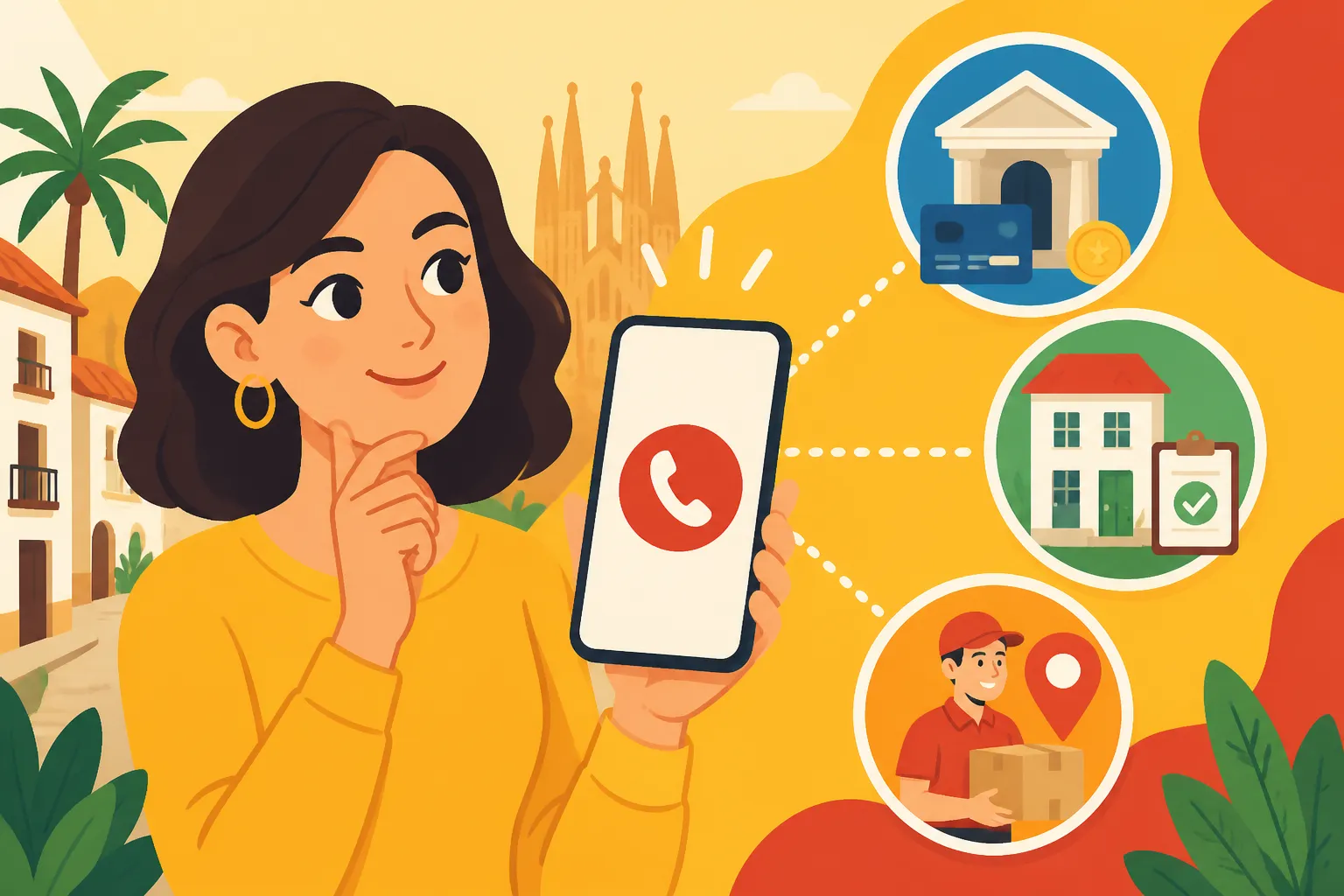
This is arguably the most infuriating hurdle you'll face. You simply cannot open a bank account in Spain without a local phone number. Period. I remember trying to use my old UK number when I first arrived, thinking it would be fine for a temporary measure. Ha! The bank clerk just looked at me with a bewildered expression, like I'd asked them to accept a pigeon as collateral. Most Spanish banks, for security reasons and due to regulatory requirements, rely heavily on two-factor authentication (2FA) via SMS. This means every time you want to log into your online banking, make a transfer, or sometimes even pay with your card online, a code is sent to your registered phone number.
Imagine this: you've finally set up your shiny new Spanish bank account. You're trying to transfer money to pay your rent or set up a direct debit, and the bank app demands a verification code. But that code is being sent to your old international number, which might have patchy signal, be incurring roaming charges, or simply not be recognized by the Spanish SMS system as a valid recipient for these crucial financial alerts. It’s a recipe for instant stress, delayed payments, and potentially frozen accounts if suspicious activity is detected and they can't reach you. You can read more about the challenges in our guide on Opening a Bank Account in Spain: Step‑by‑Step for Foreigners. Trust me, don't even try to navigate Spanish banking without a local number.
Empadronamiento and Official Registrations
Ah, the padrón. If you've been in Spain for more than five minutes, you've probably heard this word whispered in hushed, slightly exasperated tones. Registering at your local town hall (your empadronamiento) is one of the foundational steps for becoming a resident. It's how the local government knows you live in their municipality, which then unlocks access to public healthcare, school enrollment for kids, and countless other administrative processes.
Guess what they ask for on the padrón form? A Spanish phone number. While it might not always be strictly mandatory to have a Spanish number for the initial registration itself, it's almost always requested, and sometimes even implicitly required depending on the Ayuntamiento (town hall) and the staff member you encounter. More importantly, this number then becomes your official contact for municipal communications. If they need to reach you about your registration, a local service, or even something unexpected, they'll call that number. Having an international number here creates a barrier, making you harder to reach and potentially delaying critical paperwork. To get a full grasp of this vital step, check out Empadronamiento in Spain: How to Register Your Address.
Healthcare Appointments and Communications
Navigating the Spanish healthcare system can be confusing enough as an expat, even if you’re perfectly healthy. When you finally get your tarjeta sanitaria (health card) or register with a private insurer, you'll find that all communication happens via local channels. Your centro de salud (health center) or hospital will use your registered Spanish number for everything from appointment reminders via SMS to calling you if a doctor needs to reschedule or discuss test results.
Imagine you've been waiting weeks for an appointment with a specialist. The day before, the clinic tries to send an SMS reminder or call to confirm, but your international number either doesn't receive the text or goes straight to voicemail after incurring a hefty roaming charge. You miss the reminder, miss the appointment, and then have to go through the whole booking process again. It's not just about convenience; it's about being able to access vital services without unnecessary delays or miscommunication. For tips on booking, our guide on How to Book GP Appointments in Spain: Apps, Phones, and Walk‑ins can be a lifesaver.
Everyday Life in Spain: More Than Just Calls and Texts
Beyond the official paperwork, a Spanish number seamlessly integrates you into the rhythm of daily life. It’s about more than just making calls; it’s about participating in the social and commercial fabric of the country.
Delivery Services and Online Shopping
If you're anything like me, you'll quickly discover the joy (and sometimes frustration) of online shopping and home deliveries in Spain. Whether it’s your latest Amazon.es order, a grocery delivery from Mercadona, or something from a local boutique, couriers will need to contact you. And they will call a Spanish number.
Here’s the typical scenario: your package is out for delivery. The driver arrives, can't find your apartment immediately, or the interfono (intercom) isn't working. What do they do? They call your phone. If it’s an international number, they simply won't. They’ll mark it as "delivery attempted – recipient not available," and you'll spend the next few days trying to track down your parcel, often needing to pick it up from a Correos office or a local pickup point. Some services even send a one-time delivery code to your phone that you need to give the driver. No local number, no code, no delivery. It’s incredibly frustrating and entirely avoidable. Getting your deliveries on time is surprisingly liberating. If you want to know more about the postal service, check out How to Use Correos in Spain: Mail, Parcels, and Pickups.
Connecting with Locals and Emergency Contacts
In Spain, WhatsApp isn’t just an app; it’s practically a way of life. From coordinating dinner plans with friends to chatting with your landlord, arranging a plumber, or connecting with your child's school, almost all casual and semi-formal communication happens via WhatsApp. Giving out your international number to new friends or professional contacts can feel awkward and often leads to them simply not adding you, as it complicates things for them.
Beyond social circles, a local number is crucial for emergency contacts. Your landlord, your kid's school, your employer, or even a new friend might need to reach you quickly. Having a reliable, local point of contact provides peace of mind for both you and those around you. It helps you fit in socially and ensures you’re reachable when it matters most, integrating you into Spanish Customs, Etiquette, and Social Life.
Job Searching, Studies, and Professional Networking
For anyone looking to work or study in Spain, a local phone number is non-negotiable. When you put together your Spanish-style CV, every employer will expect a local contact number. It’s often the first thing they’ll look for. Listing an international number can immediately signal that you’re not fully established in Spain, potentially putting you at a disadvantage, or simply making it more difficult for them to reach you for an interview.
Recruitment agencies, which are often key players in the Spanish job market, also rely heavily on local numbers for their candidate databases and quick communications. Similarly, if you’re enrolling in a university or language school, they’ll use a Spanish number for important announcements, administrative queries, and student support. Your journey to Finding a Job in Spain: CV, Interviews, and Networking will be significantly smoother with a local number.
Your Options for Getting a Spanish Number (and Why Airalo is a Game-Changer)
So, you're convinced. A Spanish number is vital. Now, how do you get one? You've got a few routes, each with its pros and cons, but there's a fantastic temporary solution that can make your arrival infinitely smoother.
Traditional SIM Cards: Prepaid vs. Contract
This is the most common way to get a local number. You'll head to a phone shop or even a supermarket, and you'll be faced with two main choices:
- Prepaid (Tarjeta Prepago) SIM Cards: These are great for initial setup. You buy the SIM, top it up with credit, and buy data/call bundles as needed.
- Pros: Easy to get (often just need your passport, though sometimes they ask for NIE), no long-term commitment, good for short stays or while you're getting your official documents in order. You won't face credit checks.
- Cons: Can be more expensive per GB of data in the long run, need to remember to top up regularly (or your number might expire!), and if you're a heavy data user, it can get costly. Some networks might throttle speeds on prepaid plans.
- Brands: Major players like Movistar, Vodafone, Orange, and smaller ones like Yoigo, MásMóvil, Pepephone, Lebara, and Lycamobile all offer prepaid options.
- Contract (Contrato) SIM Cards: These are your typical monthly plans.
- Pros: Generally better value for money, especially for data, usually include unlimited calls/SMS, and are set up with direct debit from your bank account.
- Cons: You will need your NIE/TIE, a Spanish bank account, and often a credit check. There's usually a minimum contract period (e.g., 12 or 24 months), and cancelling early can incur fees. Not ideal if you're not planning a long-term stay or don't have all your admin sorted yet.
The biggest challenge with these traditional SIMs, especially contract ones, is that they require you to have other paperwork sorted first, like your NIE and a bank account. It's a bit of a chicken-and-egg situation! More details on this can be found in Mobile Phone Plans in Spain: Prepaid vs Contract for Foreigners.
The eSIM Revolution: Flexibility and Convenience
This is where digital solutions really shine, especially for new arrivals. An eSIM is essentially a digital SIM card embedded in your phone, meaning you don't need a physical plastic card. You can download and activate a plan directly.
- What is an eSIM? It's a small chip in your phone that allows you to activate cellular plans from different carriers without needing to swap out physical SIM cards. Many newer phones support eSIMs.
- Benefits: Instant activation (often before you even land!), no need to find a physical store, you can switch plans easily, and manage multiple numbers/data plans on one device. This is a game-changer for digital nomads and frequent travelers.
- Drawbacks: Not all phones are eSIM compatible (check your device!), and while many eSIMs offer data plans, they don't always come with a local phone number for calls and SMS. This is crucial for banking and official communication.
This is precisely why Airalo is such a fantastic tool for expats coming to Spain. While Airalo typically provides data-only eSIMs (though some do include a number, check the specific package!), it's your absolute best friend for those critical first days and weeks. You can buy an Airalo Spain eSIM or a regional European one before you even leave home, activate it as soon as you land, and have instant, affordable data.
Imagine this: you land at Madrid-Barajas, switch on your phone, and BAM! You have internet. No scrambling for airport Wi-Fi, no immediate hunt for a SIM card shop. You can use your Airalo data to:
- Navigate public transport or book a taxi.
- Translate on the fly.
- Research the nearest phone shop that sells physical SIMs.
- Contact your Airbnb host or real estate agent via WhatsApp (using your home country number for now, but with Airalo data to power it).
- Even book your initial cita previa (appointment) for your NIE or padrón online.
Airalo isn't necessarily your long-term Spanish number solution for the banking and official SMS side of things, but it is the ultimate transition tool. It ensures you’re connected and empowered to sort out all the other vital steps without being cut off from the digital world. It's the silent hero that gets you through that initial, often stressful, phase. Get connected instantly upon arrival with Airalo and take one huge logistical headache off your plate!
Making Airalo Work for You in Spain
The beauty of Airalo for expats is its strategic role. You purchase a data package for Spain (or Europe-wide) from their app while you're still in your home country. Once you arrive, you simply activate it. This immediately gives you internet access on your phone, powered by a local network (like Movistar or Orange, but through Airalo's partnerships).
While you’ll still need to get a physical SIM card from a Spanish provider later to secure that elusive local phone number for banking SMS and administrative contacts, Airalo ensures you're not stranded without connectivity in the interim. You can use it to find your way around, communicate through messaging apps, look up information, and basically keep your life running while you deal with the Spanish bureaucracy. It’s like having a reliable tour guide and research assistant rolled into one, allowing you to breathe a little easier and not feel the intense pressure of finding a physical SIM immediately. Think of Airalo as your reliable digital data bridge, giving you the time and connectivity to make informed decisions about your long-term Spanish mobile plan.
Practical Steps and Avoiding Pitfalls
Getting your Spanish number isn't a race, but it should be a priority. Here’s how to approach it strategically to minimize stress.
Prioritizing Your Number Acquisition
It is wise for new arrivals to get an eSIM data plan, like those offered by Airalo, as their absolute first step. This gives you immediate internet access from the moment your plane touches down, which is invaluable for navigation, communication, and simply staying sane. Once you're settled in your accommodation, make it a priority to visit a phone shop (like Movistar, Vodafone, Orange, or one of the many MVNOs) to get a physical Spanish SIM card. For this initial SIM, a prepaid option is usually the easiest route, as it typically only requires your passport for purchase. This prepaid SIM will give you that all-important Spanish phone number for administrative tasks. After you have your NIE and a bank account set up, you can then consider upgrading to a contract plan if it makes more financial sense for your usage. It is highly recommended to prioritize this during your Spain Relocation Checklist: First 30 Days for New Residents.
Essential Documents for a Contract SIM
If you decide to go for a contract SIM (which most long-term residents eventually do for better value), be prepared. You will almost certainly need:
- Your NIE/TIE: The Foreigner Identification Number (NIE) or Foreigner Identity Card (TIE) is critical. Without it, securing a contract is nearly impossible.
- Your Passport: For identification.
- Proof of Address: Sometimes a certificado de empadronamiento or a recent utility bill in your name.
- Spanish Bank Account Details: For setting up direct debits.
You can see how this creates a dependency: you need a number for the bank, and a bank for the contract number! This is exactly why Airalo data is so useful early on. You can use its reliable connectivity to research and complete applications for your NIE and bank account, getting you closer to that permanent contract plan. Consider What to Bring to Your First Doctor Visit in Spain (Documents Checklist) notes about essential documents, as these often overlap for various administrative processes.
Understanding Spanish Phone Contracts and Terms
Before signing up for a long-term contract, read the fine print – or better yet, get a Spanish-speaking friend to help you.
- Permanence Clauses (Cláusula de Permanencia): Many contracts come with a minimum commitment period, typically 12 or 24 months. Breaking this early can result in hefty fines.
- Data Limits: While many plans offer generous data, be clear on what happens if you exceed it – some providers slow your speed, others charge extra.
- Roaming: Within the EU, roaming is free (Roam Like At Home). If you travel outside the EU frequently, check international call and data rates carefully.
- Bundles: Often, providers offer discounts if you bundle mobile, fiber internet, and even TV packages together. This can be great for saving money on your Internet in Spain: Choosing Fiber, Mobile, and Bundles and other utilities, but ensure you understand the full package.
| Feature | Prepaid SIM (Physical) | Contract SIM (Physical) | eSIM (Data only, e.g., Airalo) |
|---|---|---|---|
| Local Number? | Yes (for calls/SMS) | Yes (for calls/SMS) | Usually No (primarily data, check package details) |
| Data Access | Buy bundles/top-ups | Monthly plan | Pre-purchased package, instant |
| Setup Speed | Relatively quick (buy & go) | Can take days/weeks (paperwork, checks) | Instant (download & activate) |
| Required Docs | Passport (sometimes NIE/TIE) | NIE/TIE, Passport, Spanish Bank Account | Phone compatible with eSIM, payment method |
| Cost | Higher per GB, flexible | Lower per GB, fixed monthly | Varies by package, often competitive |
| Commitment | None | Usually 12-24 months | None (pay-as-you-go data packages) |
| Ideal For | Initial local number, short stays | Long-term residency, best value | Immediate data upon arrival, seamless transition |
Getting connected in Spain is more than a convenience; it's a fundamental step towards integrating into your new life. While the bureaucracy might try your patience, having that local number will unlock so many doors, from banking to social connections. And remember, for those crucial first moments, a reliable eSIM like Airalo is an expat's secret weapon, ensuring you're always connected and ready to tackle the next adventure Spain throws your way.
Disclaimer
The information provided in this guide is for general informational purposes only and does not constitute professional advice. While we strive to keep the information up-to-date and accurate, regulations and procedures in Spain can change rapidly. Always consult official government sources, a gestor, or relevant professionals for the most current and specific advice pertaining to your individual situation. Using an eSIM like Airalo provides data connectivity, but a physical SIM with a Spanish number will eventually be required for specific administrative and financial processes that rely on local SMS verification.