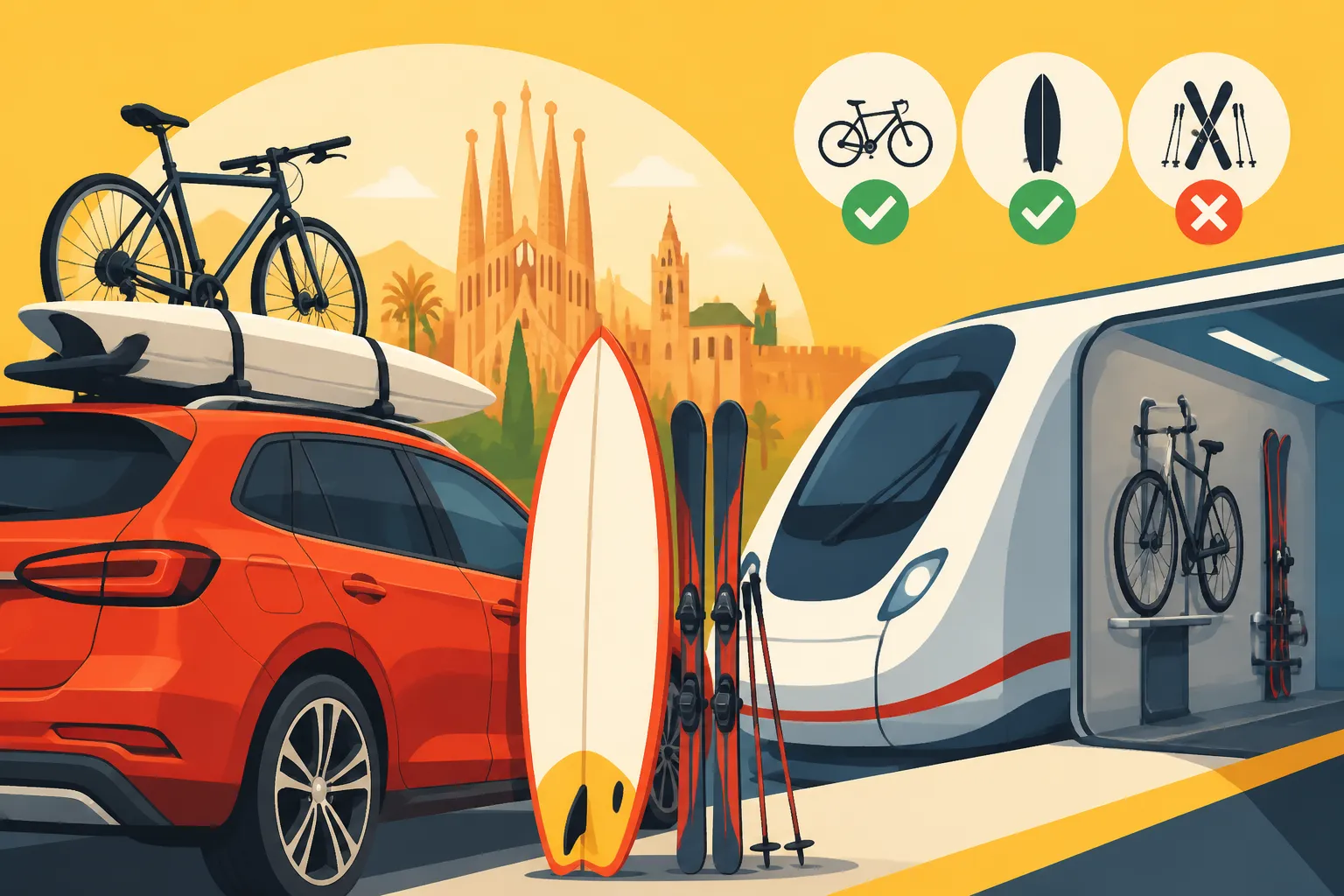
Travelling With a Bike, Surfboard, or Skis in Spain: Transport Rules
Oh, the joy of living in Spain! Glorious sunshine, amazing food, and endless opportunities for outdoor adventures. But let's be real, the moment you decide to bring your beloved bike, surfboard, or skis along for the ride, that's when a tiny bead of sweat might start trickling down your brow. Navigating Spain's transport system with oversized sports equipment can feel like trying to solve a Rubik's Cube blindfolded, with each company having its own set of baffling rules and hidden fees. But don't you worry, my friend, because this guide, with a little help from savvy tools like Omio, is here to demystify it all and help you get your gear from A to B without losing your sanity (or your surfboard).
Disclosure: This post may contain affiliate links. We may earn a commission at no extra cost to you if you make a purchase through these links. Read full disclosure.
Navigating Spain with Your Gear: The Initial Hurdles
Anyone who's moved to Spain knows that the administrative side of life can be a bit… unique. This extends to public transport, especially when you're lugging something larger than a standard suitcase. The rules aren't always crystal clear, and what one bus driver accepts, another might vehemently reject. It's a journey, not just a trip, and understanding the nuances is key.
Why Oversized Luggage is a Headache in Spain
Let's face it, Spanish infrastructure wasn't always designed with a giant bike box or a 9-foot surfboard in mind. Public transport, particularly trains and urban buses, often has limited space. You might find yourself on a packed regional train, trying to Tetris your snowboard into a tiny luggage rack, only to realize there's no way it's going to fit. This isn't just an inconvenience; it can lead to stressful confrontations with staff, potential fines, or even being denied boarding. The rules are in place for safety, yes, but for us expats who just want to enjoy the mountains or the coast, it can feel like a personal affront. It’s enough to make you wish you’d just bought a cheap Decathlon bike at your destination, but we know your gear is special.
Moreover, the sheer variety of transport providers, each with its own specific regulations, means that a "one-size-fits-all" approach simply won't work. What's perfectly acceptable on a local Cercanías train might be strictly forbidden on a high-speed AVE. You can't just assume the rules are consistent; that's a recipe for travel day disaster. This is where a platform like Omio really shines, letting you compare different modes of transport (trains, buses, even flights) side-by-side to see which might be feasible, though you'll still need to check specific baggage policies directly. It helps you get a birds-eye view before diving into the individual company's labyrinthine rules.
Pre-Planning is Your Best Friend
Honestly, if there's one piece of advice I can drill into you, it's this: plan, plan, and then plan some more. Spontaneity is wonderful for choosing which tapas bar to hit, but not for transporting a bike across Spain. The golden rule is to check the specific policy of each transport company you plan to use, for each leg of your journey, well in advance. This isn't just about reading the website; sometimes a quick phone call to their customer service can save you a world of grief.
Think about the dimensions and weight of your packed gear. Most companies will list maximum allowances, and you'd be surprised how strict they can be. For bikes, this often means partial disassembly (removing wheels, pedals) and packing it into a special bag or box. Surfboards almost always require a dedicated board bag, and skis will need a ski bag. Don't skimp on the packing material either; your gear is going to be tossed around more than a bocadillo in a school playground. Consider the actual value of your equipment and whether it warrants extra insurance, either through your travel insurance or an add-on from the transport provider. A little foresight here goes a very long way in preventing headaches and ensuring your adventure starts on the right foot.
Train Travel with Bikes, Surfboards, and Skis
Train travel in Spain can be beautiful and efficient, but it's often the trickiest option for bulky sports equipment due to strict space regulations. Renfe is the national operator, but other players like Ouigo and Iryo are now on the scene, adding more options and, naturally, more rules to decipher.
Renfe Rules for Oversized Sporting Equipment
Renfe, Spain's national railway company, has different rules depending on the type of train you're taking. This is super important!
- Cercanías (Commuter Trains) and Media Distancia (Regional Trains): These are often the most flexible.
- Bikes: On Cercanías, bikes are usually allowed for free, often with dedicated spaces (look for the bike symbol!). However, during peak hours, they might be restricted, especially in big cities like Madrid or Barcelona. On Media Distancia trains, you can generally bring a bike for free, but it must be properly folded or disassembled and packed in a bike bag, with maximum dimensions usually around 120x90x40 cm. Some trains might have specific bike hooks. If your bike isn't foldable or dismantled, it often counts as special luggage and may require a fee.
- Surfboards/Skis: These are typically allowed as "special luggage" (equipaje especial). They usually need to be carried in a proper bag, and the sum of their three dimensions (length + width + height) must not exceed 250 cm, with the longest side not exceeding 120 cm. If they exceed these, they might be refused or require an additional specific fee.
- AVE (High-Speed Trains), Avant (Mid-Distance High-Speed), and Larga Distancia (Long-Distance): These are far stricter.
- Bikes: Generally, bikes must be disassembled (wheels removed) and placed in a bike bag. The bag's maximum dimensions usually can't exceed 180 cm (length + width + height), with the longest side no more than 120 cm. This applies to most AVE, Avant, and Long-Distance trains. If your bike doesn't fit these requirements, it simply won't be allowed.
- Surfboards/Skis: Similar to bikes, these must be carried in appropriate bags. The sum of dimensions rule (max 250 cm, longest side max 120 cm) usually applies here too. If your gear is bigger, you're out of luck.
- The Golden Ticket: For any of these trains, it's crucial to specify your intention to carry special luggage when booking, if possible. Some trains have limited capacity for oversized items, and you might need to purchase a specific "equipaje especial" ticket or confirm space. Without it, you risk refusal. You can find detailed information on the Renfe website or by asking at a station.
Omio is brilliant for seeing all your train options quickly, but always, always double-check the fine print on Renfe's own site or by calling them before you hit 'book' for your gear. For more specifics on booking trains, check out our guide on How to Buy AVE Train Tickets in Spain and Save Money. You'll be surprised how much those little details can change your travel day.
Other Train Operators: Ouigo and Iryo
The introduction of new high-speed operators like Ouigo and Iryo has brought more competition but also more distinct rules regarding luggage.
- Ouigo: This French low-cost operator tends to be very strict on luggage. Your standard ticket usually includes one cabin bag and one hand luggage. For anything beyond that, you'll need to purchase an "additional luggage" option. For oversized sports equipment like bikes, surfboards, or skis, you must declare it and pay a fee. It needs to be disassembled and packed appropriately within certain dimensions (often quite restrictive) or it won't be allowed. Their policy is generally less forgiving than Renfe's more regional services.
- Iryo: Spain's new private high-speed rail operator, Iryo, often includes more generous luggage allowances than Ouigo, but "special baggage" still usually incurs an extra fee and needs to adhere to specific size limits. They often have dedicated spaces, but you need to book them in advance. Bikes must be folded or disassembled and placed in a bike bag, and surfboards/skis in their respective bags, typically within the Renfe-like 250 cm sum of dimensions.
When you're looking at different carriers on Omio, remember that while the platform gives you the routes and prices, the nitty-gritty on bulky sports gear often requires an extra click or call to the operator. These details are rarely visible at the initial search stage, so be diligent! Comparing the different options, even without the gear factored in, can give you a head start, so make sure to read our tips on High-Speed Trains in Spain (AVE): Routes, Booking, and Savings to see what routes these different companies cover.
Bus Travel: The Often-Overlooked Option for Bulky Items
When it comes to transporting oversized sports equipment in Spain, buses are often a dark horse. While they might not be as fast as AVE trains, many bus companies tend to be more accommodating for items like bikes, surfboards, and skis, albeit usually for an additional fee. This is often because they have more flexible cargo hold space underneath the passenger compartment.
General Bus Company Policies (ALSA and Regional Operators)
Spain has a robust network of bus companies, with ALSA being the largest and most recognizable, offering routes across the entire country. However, there are many excellent regional operators too, like Avanza Bus, Hife, or Auto Res, especially for smaller towns or specific provinces.
- ALSA: As a rule of thumb, ALSA generally allows sports equipment as "special luggage" (equipaje especial), but it must be declared and paid for separately. This typically means:
- Bikes: They need to be disassembled (front wheel removed, pedals turned inwards, handlebars parallel to the frame) and packed in a bike bag or box. There's a specific fee for bikes, usually a flat rate per journey, which can range from €10-€20 depending on the route and distance.
- Surfboards: These must be in a proper surfboard bag. ALSA usually specifies a maximum length, often around 180-200 cm, but this can vary. Again, there's an additional fee, similar to bikes.
- Skis/Snowboards: These also require a ski/snowboard bag. They fall under the "special luggage" category and incur a fee.
- Regional Operators: Smaller, regional bus lines might have slightly different rules, but the general principle is the same: items must be properly packed, declared, and you'll likely pay an extra fee. Some very local buses might be even more flexible, especially if the bus isn't full, but never assume.
It's absolutely essential to add this special luggage during the booking process online, or at least call their customer service or visit a bus station counter well in advance. Turning up on the day with an undeclared surfboard is a gamble you probably won't win. While Omio simplifies finding and booking your bus tickets, the crucial step for your surfboard or skis is adding that 'special luggage' or 'bulto especial' option during or after your booking. Omio can show you all the routes and operators, which is half the battle, but always confirm the gear specifics directly with the bus company. Don't forget to check out our deep dive into Intercity Buses in Spain: Networks, Booking, and Tips to get the full picture of bus travel.
Packing Your Gear for Bus Transport
Just because buses are often more accommodating doesn't mean you can throw your gear in without a care. Proper packing is paramount, not only to protect your valuable equipment but also to ensure it's accepted by the bus company.
- Bikes: A good quality bike bag is a must. Remove the front wheel (and often the rear, depending on the bag), pedals, and turn the handlebars. Protect delicate parts like the derailleur with extra padding. Clearly label your bag with your name and contact information.
- Surfboards: Invest in a sturdy board bag, ideally one with good padding. Fins should be removed if possible, or heavily padded if not. Secure any loose straps. Longboards can be particularly challenging due to length restrictions, so always measure first!
- Skis/Snowboards: A padded ski or snowboard bag is non-negotiable. Bindings should be protected, and poles bundled securely within the bag.
- Label Everything: Seriously, put your name, phone number (with international dialing code), and destination on every piece of luggage. It sounds basic, but in the chaos of a busy bus station, it's a lifesaver.
- Arrive Early: Give yourself plenty of time before departure to declare your special luggage, pay any fees, and supervise its loading into the cargo hold. Sometimes the bus driver or station staff will direct you where to place it.
So, don't just book your ticket through Omio and assume your bike will magically appear on the bus; take that extra step! A little proactive communication and thoughtful packing will ensure your gear makes it safely to its destination, ready for your next adventure.
Flying with Your Equipment Within Spain
For longer distances within Spain, especially if time is of the essence, flying might seem like the obvious choice. However, when it comes to oversized sports equipment, this option often comes with the steepest price tag and the most stringent regulations. You'll typically be dealing with low-cost carriers like Ryanair and Vueling, or the national airline, Iberia.
Airline Specific Rules and Fees
Each airline has its own policy for sports equipment, and they rarely make it cheap or simple. You usually pay per item, per flight segment, and these fees can often rival the cost of your actual passenger ticket!
- Ryanair & Vueling (Low-Cost Carriers): These airlines are notorious for their strict baggage rules and extra fees.
- Bikes: Almost always require specific bike boxes or bags, with exact dimension and weight limits. They must be substantially disassembled (pedals removed, handlebars turned, front wheel removed, sometimes even the rear). The fee can be significant, often €60-€80 per flight.
- Surfboards: Must be in a board bag, with maximum length usually around 200-220 cm, and strict weight limits. Fees are similar to bikes.
- Skis/Snowboards: Must be in a ski/snowboard bag. Again, expect a specific fee per set.
- Key Takeaway: You must book and pay for your sports equipment online in advance. Trying to add it at the airport will result in much higher fees and could lead to refusal if space is limited.
- Iberia (National Carrier): While often a bit more flexible or generous than low-cost carriers, Iberia still charges for sports equipment and has rules.
- Bikes: Require a bike box/bag, disassembled. Fees are typically lower than low-cost carriers if it counts as your checked baggage allowance (and you have one), but if it's additional, it can be €45-€75.
- Surfboards: In a bag, with length limits usually around 250-300 cm, depending on the aircraft. Again, fees apply.
- Skis/Snowboards: In a bag, generally counting as one piece of special baggage.
- Key Takeaway: Always check Iberia's specific sports equipment page. They sometimes offer slightly better conditions for larger items but never for free.
While platforms like Omio can show you flight options and prices, remember that the cost and rules for sports equipment are always an add-on, booked directly with the airline. The flight price you see initially will not include your oversized gear. Always click through to the airline's own website to get the definitive current policy and pricing before making your decision. For more general advice on domestic air travel, check out our guide on Domestic Flights in Spain: When They Beat the Train.
The Art of Flying with Sports Gear
Successfully flying with your prized possessions requires meticulous preparation and a dose of patience.
- Invest in Quality Bags: This isn't the time to skimp. A high-quality, padded bike case, surfboard bag, or ski bag is your first line of defense against damage. Consider hard cases for bikes if your budget allows.
- Document Everything: Before packing, take photos of your equipment, especially any pre-existing minor damage. This can be crucial if you need to file a claim later.
- Protect Vulnerable Parts: For bikes, use pipe insulation or bubble wrap on frame tubes, forks, and chainstays. Remove disc rotors or pad them heavily. For surfboards, nose and tail protectors are a must.
- Remove Loose Items: Detach anything that can fall off or get caught. For bikes, remove lights, GPS units, and water bottles. For surfboards, remove fins (if removable) and leash.
- Weigh and Measure: Double-check your packed item's weight and dimensions against the airline's exact limits. Airlines are very strict, and being over can mean huge unexpected fees or even refusal.
- Arrive Early: Give yourself ample time at the airport. Checking in oversized luggage takes longer, often at a separate counter. The last thing you want is to be rushing and stressed, increasing the chance of errors.
- Check for Fragile Tags: Ask the check-in agent to apply "fragile" stickers to your bag. While not a guarantee, it can sometimes encourage more careful handling.
- Consider Shipping: For extremely valuable or heavy items, sometimes using a specialized shipping service (e.g., SendMyBag, Luggage Forward) can be more cost-effective and less stressful than flying with it. Compare prices and convenience before you commit.
Renting a Car or Driving Your Own: The Ultimate Freedom (with caveats)
If flexibility and door-to-door convenience are your top priorities, and you're travelling with oversized sports equipment, driving is often the best solution. Whether you rent a car or use your own, it offers unparalleled freedom compared to public transport's restrictions.
Car Rental Considerations for Oversized Gear
Renting a car in Spain can be a straightforward process, but if you're planning to transport a bike, surfboard, or skis, you need to think a bit more strategically about your vehicle choice and any necessary accessories.
- Vehicle Size Matters: A compact car simply won't cut it. You'll need to book an SUV, a minivan, or a station wagon (familiar in Europe as a 'familiar' or 'combi'). Don't just assume; check the boot dimensions online or specify your luggage needs when booking. If you're going to a beach, for example, consider what you'd typically pack for a day, and then double it for your gear. For general car rental tips, check out Renting a Car in Spain: Requirements, Insurance, and Driving Tips.
- Roof Racks: This is the big one. Most standard rental cars do not come with roof racks. You'll need to explicitly request one from the rental company, and it will almost certainly be an additional fee. It's crucial to book this well in advance, as they have limited stock. Also, verify that the roof rack is suitable for your specific gear (bike carriers, surfboard pads, ski mounts). Sometimes it's easier to bring your own portable soft roof rack if allowed by the rental company (always check!).
- Extra Charges & Insurance: Rental companies might have clauses about transporting sports equipment. Ensure you understand their insurance policy regarding damage to the car caused by your equipment, or theft of items from the roof rack. It's often not covered by basic insurance.
- Cleaning Fees: If your muddy bike or sandy surfboard makes a mess of the rental car's interior, you might face a hefty cleaning fee upon return. Bring old towels or protective sheets to line the boot.
For cars, while Omio might not directly handle your surfboard strapped to the roof, it can be a fantastic resource for finding the best car rental deals from various providers across Spain. You can then contact the specific rental company directly to arrange for roof racks or a larger vehicle suitable for your gear.
Driving Your Own Vehicle in Spain
If you're lucky enough to have your own car in Spain, you already have a significant advantage in terms of flexibility and avoiding extra fees. However, there are still some important legalities and practicalities to consider.
- Roof Rack Legality: In Spain, if any item loaded onto your roof rack extends beyond the back of your vehicle (even slightly, common with surfboards or long skis), you must display a square red and white striped V-20 warning sign at the furthest point of the load. Not having this can result in a significant fine. The load also cannot exceed 10% of the vehicle's length (or 15% for indivisible loads).
- Secure Loading: It sounds obvious, but ensure your gear is absolutely securely fastened. Loose items on a roof rack are a danger to yourself and others, and a target for theft. Use high-quality straps and multiple tie-down points.
- Visibility: Your load must not obstruct your view, the vehicle's lights, license plates, or mirrors.
- Fuel Consumption: Be aware that a loaded roof rack significantly increases drag, leading to higher fuel consumption. Factor this into your budget.
- Theft Prevention: If you're stopping overnight, always remove valuable equipment from roof racks and store it securely inside, if possible. Spanish cities, while safe, are not immune to opportunist thieves.
Ultimately, driving your own vehicle gives you the freedom to choose your routes, stop when you want, and bring exactly what you need. It’s the closest thing to truly hassle-free travel with your beloved sports gear, provided you follow the rules of the road and pack correctly.
Spanish Transport Rules for Oversized Sports Equipment: A Quick Summary
To make things a little clearer, here's a quick reference table. Remember, these are general guidelines, and always check with the specific operator for the most up-to-date and precise information.
| Transport Type | Bikes (Packed) | Surfboards (Bagged) | Skis/Snowboards (Bagged) | Typical Cost | Key Considerations |
|---|---|---|---|---|---|
| Renfe Trains | Disassembled (bag: max 180cm sum, longest 120cm) | Max 250cm sum of dimensions, longest max 120cm | Max 250cm sum of dimensions, longest max 120cm | Free to €15 | Varies by train type (Cercanías most flexible, AVE strictest). Book "special luggage." |
| Ouigo / Iryo | Disassembled (bag: strict limits) | Strict length/weight limits | Strict length/weight limits | €10-€20+ | Very strict. Book "additional/special luggage" online. Confirm dimensions. |
| ALSA Buses | Disassembled (bag/box) | Max ~180-200cm length (check specific route) | Standard ski/snowboard bag | €10-€20 | Must declare & pay as "equipaje especial" when booking. Arrive early. |
| Domestic Flights | Bike box/bag, heavily disassembled, strict limits | Board bag, max ~200-220cm length, strict weight limits | Ski/snowboard bag, strict weight limits | €45-€80+ | High fees. Must book as "sports equipment" online in advance. Very strict. |
| Rental Car | Fits inside or on roof rack | Fits inside or on roof rack | Fits inside or on roof rack | Varies | Choose large vehicle. Book roof rack in advance. Cleaning fees. |
| Own Car | Fits inside or on roof rack | Fits inside or on roof rack | Fits inside or on roof rack | Free | V-20 sign for overhangs. Secure loading. Fuel consumption. Theft risk. |
Ready for Your Next Spanish Adventure?
Traveling around Spain with your bike, surfboard, or skis doesn't have to be a monumental feat of logistical engineering. It definitely requires a hefty dose of patience and meticulous planning, but with the right approach, you can make it work. The key, as always, is to understand the rules before you travel and prepare your gear accordingly.
By knowing your options, comparing different transport methods, and always checking the specific small print for oversized luggage, you'll be well on your way to enjoying all the incredible outdoor activities Spain has to offer. With a smart tool like Omio, you can compare routes, prices, and even see which options make the most sense for your oversized gear before you dive into the nitty-gritty of each operator's policies.
Remember, Spain is a country that embraces outdoor living, and with a little effort, your gear can be right there with you.
Ready to explore? Head over to Omio and start planning your next Spanish adventure with all your beloved gear in tow!
Disclaimer
The information provided in this guide is for general informational purposes only and is subject to change. Transport policies for oversized sports equipment can vary significantly by company, route, and time of year. Always verify the most current rules, dimensions, weight restrictions, and fees directly with the specific train, bus, or airline operator before making your travel arrangements. We cannot be held responsible for any inconvenience or costs incurred due to changes in policies or misinterpretations of rules.