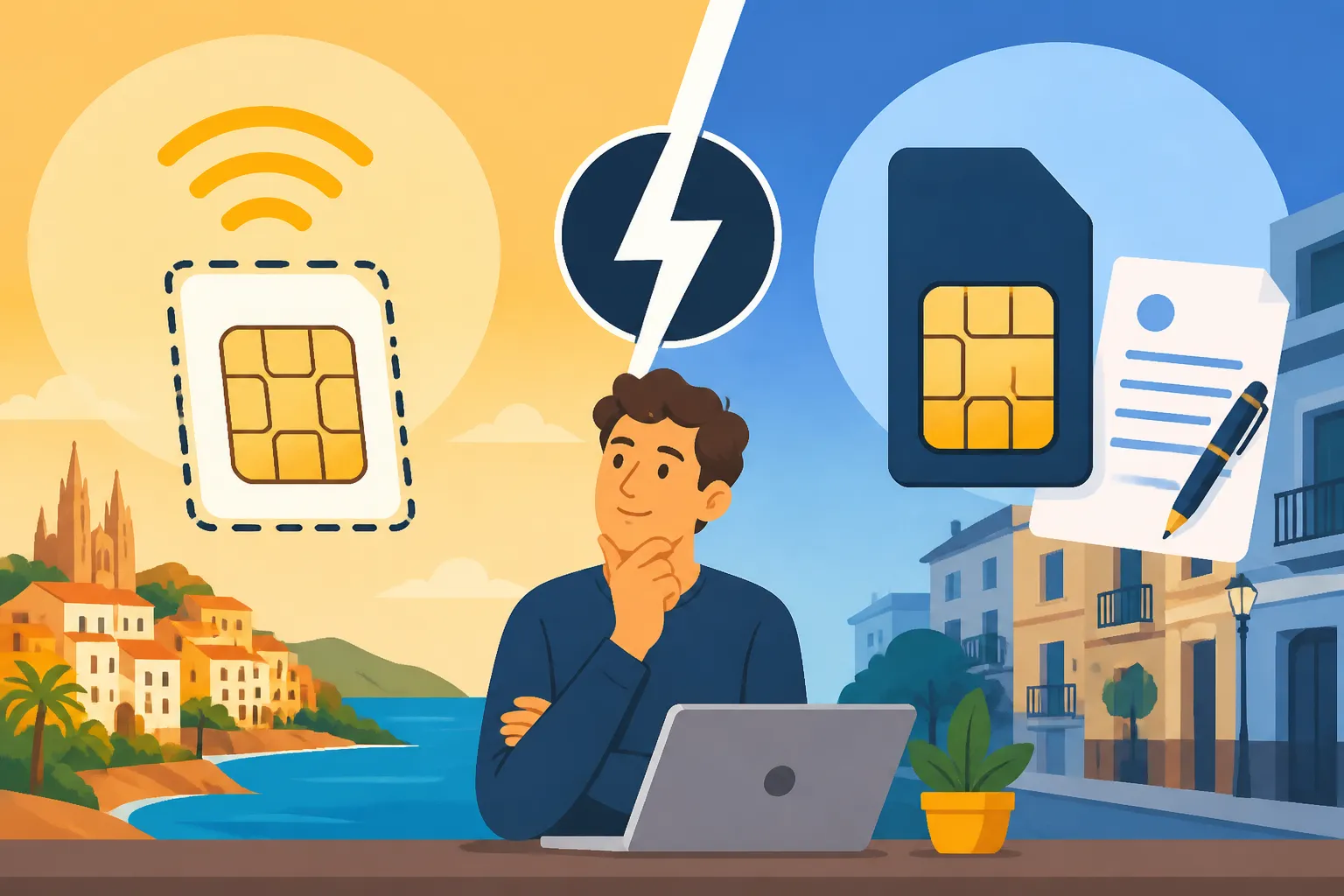
eSIM vs Spanish Contract SIM for Digital Nomad Visa Holders
Arriving in Spain as a digital nomad, you’re often hit with a whirlwind of excitement and, let’s be honest, a good dose of administrative overwhelm. One of the first, most pressing needs is always reliable internet connectivity – not just for work, but for finding your way around, talking to loved ones, and tackling that endless to-do list. This guide is going to walk you through the nitty-gritty of keeping connected, specifically weighing up the convenience of an eSIM against the longer-term commitment of a traditional Spanish contract SIM, offering practical advice to get you online the moment you land.
Disclosure: This post may contain affiliate links. We may earn a commission at no extra cost to you if you make a purchase through these links. Read full disclosure.
The Digital Nomad's Connectivity Conundrum in Spain
When you first land in Spain, often with a fresh Digital Nomad Visa in hand, the joy of a new beginning is palpable. But very quickly, practicalities set in. Your phone is your lifeline: maps, translation apps, contacting landlords, booking citas previas (appointments) for vital paperwork, and, of course, staying in touch with clients and family back home. This immediate need for reliable internet is universal, yet the path to getting it in Spain can be surprisingly convoluted.
The Immediate Need for Connectivity Upon Arrival
Imagine stepping off the plane at Madrid-Barajas or Barcelona-El Prat. You're tired, maybe a little disoriented, and all you want to do is get to your accommodation, grab a coffee, and let everyone know you've arrived safely. But wait, your phone doesn't have data. Or perhaps your home plan has exorbitant roaming charges. Suddenly, finding a taxi, navigating the metro, or even just translating a sign becomes a high-stress situation. This isn't just about social media; it's about basic functionality and peace of mind in a new country.
Many of us have been there, desperately searching for airport Wi-Fi that's either slow, unreliable, or requires an inconvenient signup process. You need to download essential apps, confirm an address, or even just respond to that urgent work email that landed while you were airborne. Having a functioning internet connection from the moment your plane touches down isn't a luxury; it's a necessity for a smooth transition. Without it, you're immediately facing an uphill battle against the small, everyday hurdles that can quickly turn into major frustrations. This is precisely where a flexible, instant solution like an eSIM can save your sanity and set the tone for a much calmer arrival.
Bureaucracy Blues: Why Spanish SIM Cards Aren't Always Instant
Now, let's talk about the traditional path: getting a Spanish SIM card. You might think, "Easy, I'll just pop into a phone shop." And while prepaid SIMs are indeed easier to get than contract ones, even they come with some hurdles. For a proper contract SIM – the kind that often offers the best value for money and the most comprehensive service – you're going to hit a wall of bureaucracy that new arrivals just aren't equipped for.
To get a contract SIM card in Spain, providers typically require a Spanish bank account (which itself requires a NIE), a Número de Identificación de Extranjero (NIE) number, and often proof of a long-term Spanish address. If you've just arrived on your Digital Nomad Visa, you likely won't have your physical TIE card yet, let alone a permanent NIE or a fully functional Spanish bank account. This can feel like a classic "chicken and egg" situation: you need a phone to get the paperwork done, but you need the paperwork done to get a decent phone plan. Many expats find themselves stuck in this loop, unable to access the best local deals right away. For a deeper dive into these essential IDs, check out our guide on NIE, TIE & Empadronamiento: Essential IDs and Registrations in Spain.
The process can involve multiple visits to different offices, long waiting times, and conversations in Spanish that can be challenging if your language skills aren't yet up to par. It's a fundamental part of Spanish Bureaucracy for Daily Life: Padrón, IDs, and Local Services, but it's rarely swift or painless. This is a significant pain point for digital nomads who need to hit the ground running, relying on robust internet from day one for their livelihood. The delay in obtaining a long-term local SIM often forces new arrivals to rely on expensive roaming or subpar temporary solutions, undermining the very flexibility that a digital nomad lifestyle champions.
Diving Deep into eSIMs for Digital Nomads
The landscape of mobile connectivity has seen some amazing innovations, and for digital nomads, the eSIM is truly a game-changer, especially in a country like Spain where getting things set up can take time. It's designed for flexibility, ease, and immediate access, making it an ideal companion for those of us who are always on the move or in the midst of settling into a new place.
What Exactly is an eSIM and How Does It Work?
So, what is an eSIM? The simplest way to explain it is that it's a digital SIM card. Unlike a traditional SIM, which is a tiny physical chip you insert into your phone, an eSIM is built directly into your device. Instead of swapping physical cards, you simply download a "profile" from a carrier onto your phone. This profile contains all the necessary network information, allowing your device to connect to a mobile network. Think of it like this: your phone already has the hardware, and the eSIM is the software that tells it which network to use.
The activation process is incredibly straightforward. Once you purchase an eSIM plan online, you typically receive a QR code or a manual activation code. You scan the QR code with your phone's camera, follow a few prompts, and voilà! – your phone is connected to the network. There's no fumbling with tiny plastic cards, no searching for that elusive SIM tray tool, and no worrying about losing your home country's SIM. This means you can purchase and activate an eSIM plan before you even leave your home country, or moments after you land, giving you instant connectivity without the need to find a local phone store. It's a truly hassle-free experience that bypasses the need for physical interaction and documentation typically associated with traditional SIM cards.
The Unbeatable Advantages of eSIMs for New Arrivals
For digital nomads touching down in Spain, the advantages of using an eSIM are nothing short of revolutionary. This technology provides a bridge over the initial connectivity gap, offering immediate solutions to those pressing communication needs.
Instant Connectivity
The most compelling benefit of an eSIM is its ability to provide instant connectivity. Imagine landing in Spain, switching off airplane mode, and immediately having access to data. No queues at a phone shop, no language barriers to navigate when explaining what you need, and absolutely no paperwork beyond the initial online purchase. With an eSIM, you can buy a data package for Spain (or even a regional Europe-wide plan) days or weeks before your flight. Then, as soon as you arrive, you activate it with a few taps on your phone.
This instant access means you can use your maps app to find your way from the airport, call a taxi via an app, use WhatsApp to tell your host you’ve landed, or even translate a crucial sign on the metro platform. For digital nomads, whose work often depends on constant communication and access to online resources, this isn't just convenient; it's essential. Companies like Airalo specialize in offering these immediate, hassle-free eSIM solutions, allowing you to focus on settling in rather than scrambling for internet access. Airalo's diverse range of country-specific and regional plans means you can often get several gigabytes of data for a reasonable price, providing that crucial buffer during your first days or weeks.
Flexibility and Cost Control
Another massive perk of eSIMs, especially for the transient nature of digital nomad life, is the unparalleled flexibility and control over your spending. Traditional contract SIMs lock you into monthly payments and often long-term agreements. But with an eSIM, you're typically buying data packages for a set amount of data and a specific duration (e.g., 5GB for 30 days). Once it runs out, you simply top up with another package, or switch to a different provider if you find a better deal.
This pay-as-you-go model is perfect for those initial weeks or months in Spain while you're still figuring out your long-term plans and dealing with bureaucracy. You're not tied down, and you can easily manage your data usage and costs. If you travel outside Spain to another European country, you can often buy a regional eSIM plan that covers multiple countries, keeping you connected across borders without needing new physical SIMs. This is incredibly useful for digital nomads who might explore the Schengen area during their stay. Airalo, for example, offers numerous global and regional eSIM plans, which means you can effortlessly transition from a Spanish plan to a European plan, or even an individual country plan if you take a quick trip to Portugal or France. This flexibility ensures you're always getting the right amount of data for your immediate needs without overcommitting.
Dual SIM Benefits
Most modern smartphones that support eSIM technology also offer dual SIM functionality. This means you can use your home country's physical SIM card (or another eSIM) simultaneously with your new Spanish eSIM. This is a subtle but incredibly powerful advantage for expats and digital nomads.
With dual SIM, you can keep your original phone number active to receive important calls or texts from your bank, family, or other services back home, without incurring huge roaming data charges. Meanwhile, your Spanish eSIM handles all your data needs locally, providing affordable internet access. For instance, you could use your main physical SIM for occasional calls or SMS that require your home number, and rely on your Airalo eSIM for all your data usage – navigating, working, and communicating via data-driven apps like WhatsApp. This setup ensures you remain connected to both your old life and your new life seamlessly, avoiding the headache of constantly swapping physical SIM cards or missing crucial notifications from either side of the world. It's truly the best of both worlds, offering continuous access while maintaining cost efficiency and convenience.
Potential Downsides and Considerations for eSIMs
While eSIMs offer fantastic benefits for digital nomads, they're not entirely without their considerations. Knowing these potential downsides helps you make an informed decision and prepare accordingly.
One key aspect is that most eSIM plans, particularly those designed for short-term travel or initial arrival, are data-only. This means they typically don't come with a local Spanish phone number for calls and SMS. While this isn't a huge issue for data-reliant communication through apps like WhatsApp, Telegram, or Skype, it can become a minor hurdle for certain administrative tasks in Spain. Many official services, appointment booking systems (cita previa), or even local businesses might require a local Spanish number for contact or verification. For example, if you need to call a government office, book a doctor's appointment through a regional health app, or set up certain utility services, having a Spanish phone number is often expected, or even mandatory. This is something you'll want to factor in if your goal is full integration into the local system right away.
Another consideration is device compatibility. While many newer smartphones (from the iPhone XR/XS onwards, and a good number of Android flagships) support eSIMs, older models might not. Before you commit to an eSIM plan, it's crucial to check if your specific device is compatible. A quick online search for "eSIM compatibility [your phone model]" should give you a definitive answer. Relying on an eSIM only to find your phone doesn't support it would certainly add to the stress of your arrival! Furthermore, while activating an eSIM is generally straightforward, it does require an initial internet connection (usually Wi-Fi) to download the profile. If you arrive somewhere with no public Wi-Fi and haven't pre-downloaded your eSIM, you could be briefly stuck. However, this is easily mitigated by activating your Airalo eSIM before you even board your flight. Lastly, topping up your eSIM plan often relies on the provider's app or website, which means you'll need data to manage your data, a small but important detail to remember if you're running low.
Navigating Spanish Contract SIM Cards: The Long-Term Play
While eSIMs are fantastic for immediate needs and initial flexibility, eventually, as a digital nomad settling into Spain, you might start looking at local contract SIM cards. These offer a different set of advantages, particularly once you've crossed some of those initial bureaucratic hurdles.
The Perks of a Local Contract SIM
Once you've navigated the initial maze of Spanish bureaucracy and secured your NIE and perhaps even a local bank account, a Spanish contract SIM card starts to look very appealing. The primary benefit is often a significantly better value for money, especially if you're a heavy data user. Contract plans typically offer larger data allowances, often unlimited, combined with unlimited national calls and SMS, at a lower per-gigabyte cost compared to prepaid or many eSIM data-only options. For a digital nomad relying heavily on consistent, high-volume internet, this can translate to considerable savings over time.
Beyond cost, a contract SIM provides you with a stable, local Spanish phone number. This might seem like a small detail, but it's incredibly important for integrating into Spanish life. You'll need a local number for everything from setting up utilities for your apartment, making appointments with your local centro de salud (health center) – crucial for understanding the Spain Healthcare System for Expats: Public vs Private – to opening a proper Spanish bank account, and even receiving delivery notifications. Many online forms and service providers in Spain are simply not set up to accept foreign phone numbers, and trying to use a non-Spanish number can create frustrating roadblocks. Having a contract also means you generally don't need to worry about topping up or running out of credit unexpectedly, providing a level of reliability and peace of mind that can be invaluable when managing your life and work abroad. For a complete guide to essential services, see our article on Setting Up Your Life in Spain: Utilities, Internet, and Essentials.
The Bureaucratic Gauntlet: What You Need for a Contract SIM
Alright, so you’ve decided you’re in Spain for the long haul, and that tempting contract SIM with unlimited data is calling your name. But before you get too excited, let's talk about the gauntlet you'll need to run. This is where many digital nomads, fresh off the plane, discover why an eSIM like Airalo is such a lifesaver for the initial weeks. Getting a contract SIM in Spain is less about convenience and more about proving your established presence here.
Firstly, you're going to need your NIE number. Not just the temporary one from your visa application, but ideally a more permanent one associated with your residency. Then, many providers will want to see your TIE card (Tarjeta de Identidad de Extranjero), which is your physical residency card. Even if you have your NIE, waiting for the TIE appointment and card production can take weeks or even months after you initially apply for your Spain Digital Nomad Visa: Requirements, Documents, and Timeline. This delay immediately pushes back your ability to get a contract SIM.
Secondly, a Spanish bank account is almost always a requirement. This is because contract SIMs operate on a direct debit system (domiciliación bancaria). Setting up a bank account itself requires your NIE, and sometimes other proof of address, creating a circular dependency that can make you want to pull your hair out. For guidance on this, check out Opening a Bank Account in Spain: Step-by-Step for Foreigners. You'll also typically need a proof of address (e.g., your empadronamiento certificate or a rental contract in your name). The entire process can be frustrating, involving multiple documents, waiting periods, and often requires a decent level of Spanish or a helpful friend/gestor to navigate the customer service desks. This multi-step process for a contract SIM contrasts sharply with the immediate, no-fuss activation of an Airalo eSIM, highlighting its utility as an initial solution.
Major Spanish Providers and Their Offerings
Once you're ready to tackle the bureaucracy and secure a contract SIM, you'll find a competitive market in Spain with several major players and a growing number of budget-friendly virtual operators. Understanding their offerings can help you make the best choice for your long-term needs.
The "big three" traditional operators are Movistar, Vodafone, and Orange. These are the giants, owning most of the network infrastructure. They offer comprehensive packages that often include not just mobile data, calls, and SMS, but also home fiber internet, TV, and sometimes even streaming subscriptions bundled together. While they can be slightly more expensive, they often boast the widest coverage, especially in rural areas, and have physical stores across the country where you can get in-person support (though be prepared for a Spanish-speaking experience). Their customer service can be hit or miss, as with any large company, but they offer stability and a full suite of telecommunication services.
In recent years, a strong contingent of "low-cost" or "virtual mobile operators" (MVNOs) has emerged, operating on the networks of the big three but offering much more competitive prices. These include popular choices like MásMóvil, Pepephone, O2 (owned by Movistar), Simyo (owned by Orange), and Lowi (owned by Vodafone). These MVNOs typically focus on mobile-only plans, offering generous data allowances (often with options for truly unlimited data) and unlimited national calls at significantly lower monthly rates. They are particularly popular among expats and younger residents due to their straightforward pricing and online-first customer service models. While their coverage relies on the network they piggyback on, it's generally very good in urban and semi-urban areas. When choosing, consider not just the price and data, but also any international call allowances, roaming options within the EU (which are usually included due to EU regulations), and the ease of managing your account. For more details on choosing a plan, see Mobile Phone Plans in Spain: Prepaid vs Contract for Foreigners.
Spanish Pay-As-You-Go SIMs: A Middle Ground
For many new arrivals, especially those not quite ready to commit to a long-term contract but needing more than what their home country's roaming offers, Spanish pay-as-you-go (or prepaid) SIMs present a viable middle ground. They bridge the gap between instant, data-only eSIMs and the bureaucratic hurdles of contract plans.
Prepaid SIMs: Faster Access, Fewer Requirements
The appeal of a Spanish prepaid SIM card is undeniable when you're fresh off the plane and still navigating the maze of Spanish administrative tasks. Unlike contract plans, which demand a NIE, a Spanish bank account, and sometimes even a TIE card, prepaid SIMs are significantly easier to acquire. Often, all you need is your passport or national ID card from your home country. Most phone shops, and even some larger supermarkets or convenience stores, can sell you a prepaid SIM on the spot. This ease of access means you can walk into a store, present your ID, pay a small fee for the SIM card itself (which usually comes with a small initial credit or data bundle), and walk out with a functioning Spanish phone number within minutes.
This immediate access to a local number is a huge advantage for many everyday situations. You can use it for local calls, receive SMS messages, and crucially, for those instances where a Spanish phone number is expected or required for booking appointments (citas previas), signing up for loyalty programs, or even receiving delivery notifications. It provides a more integrated communication solution than a data-only eSIM, without the long-term commitment or stringent documentation requirements of a contract. Many providers offer various prepaid bundles that include data, calls, and SMS, allowing you to choose a package that fits your initial usage patterns and budget. It's a stepping stone that provides more localized communication than an eSIM, while sidestepping the deep dive into Spanish bureaucracy required for a contract.
Limitations of Prepaid Options
While Spanish prepaid SIM cards offer a welcome reprieve from bureaucracy, they do come with their own set of limitations that are worth considering, particularly for digital nomads who rely heavily on connectivity and cost efficiency.
Firstly, prepaid plans can often be more expensive per gigabyte of data compared to their contract counterparts. While the initial bundles might seem attractive, frequent top-ups for high data usage can quickly add up, making them less economical in the long run. If you're constantly on video calls, uploading large files, or streaming content for work, you might find yourself topping up more often than you'd like, chipping away at your budget. This is a crucial point for understanding the Cost of Living in Spain: Realistic Budgets and Savings Tips.
Secondly, managing prepaid credit requires frequent monitoring and manual top-ups. You have to keep an eye on your data and credit balance and remember to recharge it before it runs out. While most providers offer apps or online portals for this, it's an extra mental load that contract plans largely eliminate through automatic billing. Running out of data or credit at a critical moment – perhaps when navigating to an important appointment or during a client call – can be incredibly frustrating.
Lastly, while a prepaid SIM gives you a local Spanish number, it might not always come with the best network perks or customer service compared to contract plans. Some prepaid options might have slightly slower speeds during peak times, or less comprehensive roaming benefits if you plan on frequent travel within the EU. While they are certainly a practical interim solution, they typically don't offer the same stability, long-term cost-effectiveness, or robust service ecosystem that a fully-fledged contract provides. For those who prioritize seamless, uninterrupted connectivity and predictable costs, these limitations can become a significant drawback over time.
The Verdict: When to Choose What
Deciding between an eSIM, a Spanish prepaid SIM, or a full contract SIM boils down to your immediate needs, your timeline in Spain, and your comfort level with local bureaucracy. Each option has its sweet spot, and understanding when to deploy each can save you a lot of headache and money.
Initial Arrival & Settling In: The Undeniable Supremacy of eSIMs
For those crucial first days and weeks in Spain, there's really no beating an eSIM for sheer convenience and immediate relief. You've just arrived, perhaps on your shiny new Digital Nomad Visa, and you're already juggling unpacking, figuring out the public transport, and probably trying to find the best tapas bar. The last thing you need is to worry about how you're going to get online.
This is precisely where an eSIM, particularly from a reliable provider like Airalo, shines as your absolute hero. You can purchase and activate your plan before you even leave home. This means the moment your plane lands, you switch off airplane mode, and bam! – you have data. Instant access to maps, translation apps, WhatsApp to message your accommodation host, and essential services is invaluable. You bypass the need to hunt for a phone store, navigate language barriers, or present any official Spanish documentation. It's truly a plug-and-play solution for digital nomads. Think of it as your reliable co-pilot for those challenging first few weeks, ensuring you're connected for all your vital tasks while you slowly chip away at your Spain Relocation Checklist: First 90 Days. For the seamless transition into your new life, there's simply no better initial choice than an Airalo eSIM.
Long-Term Residency: Transitioning to a Contract SIM
As a digital nomad, once you've truly settled into Spain – meaning you've secured your NIE, applied for your TIE, and ideally opened a Spanish bank account – the landscape shifts. At this point, the initial flexibility of an eSIM gives way to the long-term benefits of a local Spanish contract SIM.
The transition usually makes sense after you've been in Spain for a couple of months and have a stable address and bank details. Contract plans often offer far more data, frequently unlimited, at a lower monthly cost than constantly topping up a prepaid SIM or renewing shorter-term eSIM packages. For someone working remotely full-time, requiring consistent, high-bandwidth internet, the cost savings and reliability of a contract are substantial. Moreover, having a permanent Spanish phone number is essential for deeper integration into the administrative and social fabric of the country. It's often required for everything from registering with your local centro de salud for Finding Doctors in Spain: Appointments, Referrals, and Language Tips, to setting up home internet, or even just getting a local discount card.
Switching to a contract SIM is a natural progression from temporary to established residency. It demonstrates your commitment to living and working in Spain, and in return, you unlock better rates and more comprehensive services. While the initial hurdles can be a pain, the long-term rewards for a digital nomad planning an extended stay are well worth the effort.
Hybrid Approach: Leveraging Both for Optimal Connectivity
For the savvy digital nomad, the smartest strategy often involves a hybrid approach, leveraging the strengths of both eSIMs and traditional Spanish SIMs. This allows you to enjoy immediate, flexible connectivity upon arrival while seamlessly transitioning to a more cost-effective and integrated solution for your long-term stay.
You start with an Airalo eSIM. Purchase a regional or Spain-specific data package before you even fly. This ensures you have instant internet access from the moment you land, taking the stress out of initial navigation, communication, and urgent work tasks. It’s your reliable connectivity safety net during those chaotic first weeks while you’re busy with everything from unpacking to getting your How to Get a Spanish Health Card Tarjeta Sanitaria: Step-by-Step appointment.
Once you’ve got your NIE, TIE, and a Spanish bank account sorted – which, let's be realistic, could take a few weeks or even months – then you can consider getting a local Spanish contract SIM. This will provide you with a permanent local number, likely better long-term rates for unlimited data and calls, and full integration into the Spanish telecom ecosystem.
But here’s the clever bit: you don't necessarily have to ditch your eSIM entirely. Many modern phones support dual SIM functionality (one physical SIM, one or more eSIMs). You could keep your Spanish contract SIM as your primary number for local calls and unlimited data, and maintain a flexible Airalo eSIM for international travel outside of Spain. This way, if you take a weekend trip to Portugal or a workcation in Italy, you can activate a regional Europe eSIM with Airalo without needing to change your primary Spanish SIM or incur hefty roaming charges. This hybrid model offers the best of both worlds: immediate relief and flexibility, followed by integrated long-term value, all while keeping your options open for future adventures.
Comparison Table: eSIM vs. Spanish SIM Options
To make this decision a bit clearer, here’s a quick overview comparing the key aspects of eSIMs, Spanish Prepaid SIMs, and Spanish Contract SIMs for digital nomads in Spain.
| Feature | eSIM (e.g., Airalo) | Spanish Prepaid SIM Card | Spanish Contract SIM Card |
|---|---|---|---|
| Ease of Acquisition | Extremely easy (online purchase, instant activation) | Easy (passport/ID, physical store visit) | Difficult (NIE, TIE, Spanish bank account, proof of address) |
| Connectivity Upon Arrival | Instant (can activate before landing) | Requires physical purchase in Spain | Not feasible for immediate arrival |
| Data Cost (per GB) | Moderate to High (variable packages, good for short-term) | Moderate (can be more expensive than contract long-term) | Low (best value for high/unlimited data) |
| Local Spanish Number | Generally No (data-only) | Yes | Yes |
| Calls & SMS | Primarily via apps (WhatsApp, Skype) | Included in bundles or pay-as-you-go | Unlimited national calls/SMS often included |
| Commitment | Very Flexible (short-term packages) | Flexible (no contract, top-up as needed) | Long-term (typically 12-24 months) |
| Required Documents | None (besides payment details) | Passport/National ID | NIE, TIE, Spanish Bank Account, Proof of Address |
| Best For | Immediate arrival, short-term stays, flexibility, travel | Initial weeks/months, basic local communication | Long-term residents, heavy data users, full integration |
Disclaimer
Please remember that while I strive to provide accurate and up-to-date information, the world of immigration, visa requirements, and telecommunications in Spain can change rapidly. Always cross-reference the information with official government websites (like the Spanish Ministry of Foreign Affairs, European Union and Cooperation, or the specific telecom provider websites) or consult with a qualified immigration lawyer or gestor for the most current and personalized advice relevant to your specific situation. This guide is for informational purposes only and does not constitute legal or professional advice.