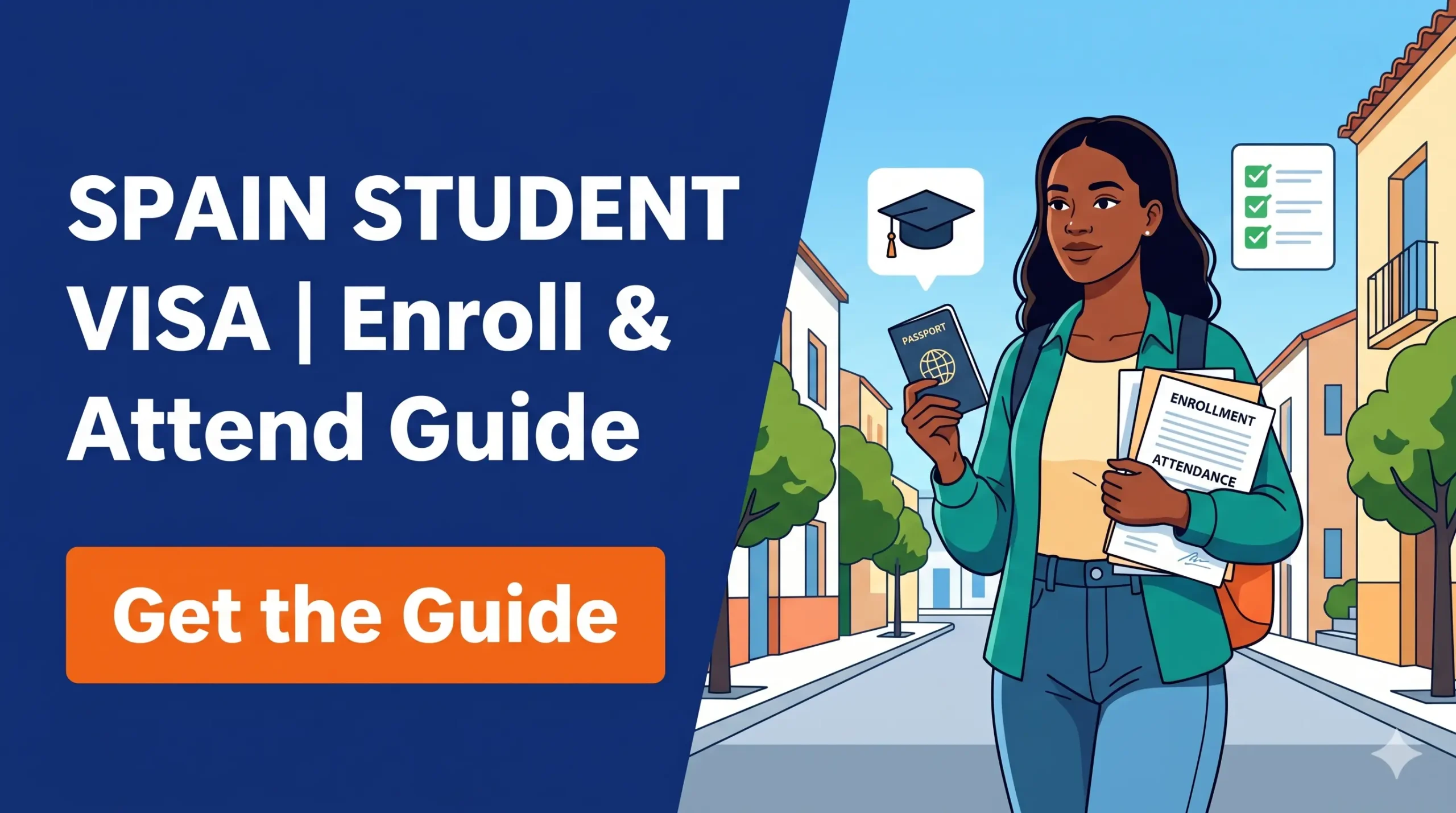
Spain Student Visa: How to Show Enrollment and Attendance
Getting a Spanish student visa rejected because your academy’s acceptance letter lacked a specific bureaucratic phrasing is a devastating rite of passage. I once lost three weeks arguing with a Madrid language school to rewrite my enrollment certificate just to satisfy the consulate’s rigid demands. This guide explains exactly how to prove your enrollment and attendance to secure your visa.
Disclosure: This post may contain affiliate links. We may earn a commission at no extra cost to you if you make a purchase through these links. Read full disclosure.
The Initial Application Proving Enrollment
When you apply for a Spanish student visa, the consular officer assumes you are secretly trying to use a fake language course as a backdoor to live and work in the European Union. Your primary mission is to provide an airtight, undeniably legitimate paper trail proving that your sole purpose in Spain is to study.
The Certificado de Matricula
A casual “Welcome to our school” email or a standard invoice showing you paid your tuition will instantly trigger a visa denial. The Spanish government explicitly requires a formal Certificado de Matrícula (Official Certificate of Enrollment).
This document must be printed on the official letterhead of the educational institution. It must be physically stamped with the school’s official seal and signed in ink (or verified digital signature) by the academic director. More importantly, it must explicitly state your full legal name, your passport number, the exact start and end dates of the academic program, and a clear declaration that the entire tuition cost has been paid in full. Do not submit an enrollment letter that says “deposit paid” or “payment pending,” as the consulate requires proof of financial commitment. Navigating these exact documentary standards is the foundation of the Spanish Visa Application Guide: Required Documents.
If you need to execute a cross-border wire transfer to pay this tuition to a local Spanish academy, do not use a legacy bank that will skim massive hidden fees off the top. You can review exactly how to set up your financial infrastructure to handle these tuition payments in Opening a Bank Account in Spain: Step-by-Step for Foreigners.
The 20 Hour Rule and Program Eligibility
Not just any course qualifies for a Spanish student visa. You cannot sign up for a weekend cooking class or a 10-hour-a-week conversation club and expect the government to grant you residency.
The Certificado de Matrícula must explicitly state that you are enrolled in a full-time academic program consisting of a minimum of 20 hours of instruction per week. Furthermore, the school itself must be officially accredited by the Spanish government. If you are applying to study the Spanish language, the academy must be an accredited center recognized by the Instituto Cervantes. If you are attending a university, it must be recognized by the Ministry of Education. If your enrollment letter fails to mention the exact 20-hour minimum, your application will be rejected before it even reaches a supervisor’s desk, a strict reality covered in Spain Student Visa Application.
Document Translation and Medical Insurance Hurdles
Proving your enrollment is only half the battle. You must perfectly translate your academic history and definitively prove that you will not become a financial burden on the Spanish public health system while you study.
Translating Transcripts and Acceptance Letters
If you are applying to a Spanish university or a master’s program, the admissions department will require your previous high school or university transcripts. Likewise, the Spanish consulate often requires proof of your academic background to ensure your enrollment makes logical sense. Because your foreign transcripts and degrees are likely written in English, they are legally useless to the Spanish authorities until they are translated.
You cannot translate these dense academic records yourself. You must use a professional service like RushTranslate to ensure your educational history is perfectly localized into Spanish. RushTranslate provides highly accurate, certified translations with a lightning-fast 24-hour turnaround. This means if the consulate suddenly demands a translated copy of your previous university diploma, you can rely on RushTranslate to deliver the certified document overnight without panicking.
Utilizing RushTranslate is highly strategic for students because academic transcripts are notoriously difficult to format and translate correctly. The professional linguists at RushTranslate understand how to handle complex educational terminology, ensuring the Spanish consulate instantly recognizes your academic standing. If your specific consulate strictly demands a MAEC-stamped translation for certain background checks alongside your academic files, you must understand the distinction outlined in How to Translate Documents for Spain: Sworn Translators Traductor Jurado Guide and ensure your original documents have the necessary stamps detailed in Apostille for Spain: Which Documents Need It and How to Get One.
Meeting the Student Health Insurance Mandate
Consulates are brutal about student health insurance. You cannot present a generic travel insurance policy or a foreign plan that only covers emergencies. Spanish immigration law demands that international students hold comprehensive private medical insurance that mirrors the public health system.
Crucially, this policy must have absolutely zero co-payments (sin copagos) and no waiting periods (sin carencias). If you attempt to use a foreign, home-country policy, the consulate will demand that the massive forty-page medical policy booklet be entirely translated into Spanish by a premium sworn translator, adding hundreds of euros to your relocation budget.
To completely avoid this administrative nightmare and bypass massive translation costs, you should secure a localized Spanish student health policy natively through Innoinsure. Because Innoinsure designs policies specifically to meet stringent Spanish student visa requirements, their certificates explicitly state that you have zero co-payments and no waiting periods. By using Innoinsure, your policy is issued natively in Spanish, which means the consulate accepts it immediately upon presentation without requiring any translation. Relying on Innoinsure to secure your mandatory medical coverage saves you weeks of stress and keeps your student budget intact, a strategic move deeply aligned with the advice in Health Insurance in Spain: Options for Residents, Students, and Families and Spain Visa Medical Insurance: Minimum Coverage and Exclusions to Avoid.
The Renewal Trap Proving Attendance and Progression
Many students assume that once they get their initial visa and their physical Foreigner Identity Card (TIE), the hard part is over. They skip classes to travel around Europe, only to face a devastating reality check when it is time to renew their residency for a second year.
The Certificado de Aprovechamiento
When you apply to renew your student TIE at the local immigration office (Oficina de Extranjería), the government does not just check if you paid for next year’s tuition. They aggressively verify what you actually did during your first year.
To secure your renewal, your school must issue a Certificado de Aprovechamiento (Certificate of Achievement and Progression). This is a highly formal, legally binding document where the academic director attests to your specific attendance record and your academic performance. The Extranjería requires undeniable proof that you genuinely advanced your studies.
The 80 Percent Rule and Failing Classes
If your Certificado de Aprovechamiento states that your attendance fell below 80 percent, or that you failed your core exams, the Extranjería will almost certainly deny your renewal. The Spanish government’s logic is straightforward: if you are failing classes or skipping school, you are violating the core condition of your student visa and are likely working illegally.
If you legitimately struggled with the coursework due to a language barrier, but your attendance was perfect, some schools will write a specialized letter explaining that you made a genuine academic effort and are repeating the level to improve. However, if your attendance is poor, no school will risk their accreditation to lie for you. You must treat your 20 hours a week as a mandatory job. Knowing how this specific bureaucratic review works is critical for anyone planning a long-term stay, a process detailed in How to Renew Your Spanish Residency TIE Before It Expires.
| Document Name | Issued By | When It Is Required | Critical Information Required on Document |
| Certificado de Matrícula | Academy / University | Initial Consulate Application | Full name, paid tuition, exact dates, 20+ hours/week. |
| Certificado de Aprovechamiento | Academy / University | TIE Renewal (Extranjería) | Attendance record (>80%), academic progression/grades. |
| Foreign Transcripts | Previous University | Admissions & Consulate | Must be accurately translated (use RushTranslate). |
| Medical Certificate | Spanish Insurer | Initial & Renewal | Must state sin copagos and sin carencias (use Innoinsure). |
Changing Schools and Navigating Extranjeria
Sometimes, you arrive in Spain and realize the language academy you chose is terrible, or you decide you want to switch from a master’s program in Madrid to a different university in Barcelona.
The Legal Logistics of Transferring
You cannot simply drop out of your approved school and start attending a new one without notifying the government. Your student visa is inextricably linked to the specific institution approved on your original application.
If you want to change schools within the same academic year, the new program must be of an equal or higher academic level, and it must be strictly related to your original field of study. You cannot switch from a rigorous engineering master’s degree to a casual beginner’s language course and expect to keep your residency. You must formally request authorization from the Extranjería to change institutions, providing the new Certificado de Matrícula and a formal letter of withdrawal from your previous school.
Structuring Your Financial Survival
Navigating these academic administrative traps requires a highly organized financial footprint. You will constantly be paying for transcript translations, new enrollment fees, and local health premiums.
If you need to quickly translate emails from the Extranjería or administrative forms from your new university, utilizing RushTranslate keeps your communication agile and error-free. If you need to renew your health insurance simultaneously with your TIE, instantly generating a compliant renewal certificate through Innoinsure ensures you never hit an administrative roadblock.
Finally, if you eventually plan to transition from a student visa into a permanent working resident, you must maintain impeccable records of your global finances to satisfy the tax compliance structures outlined in Foreign Income Reporting in Spain: What Residents Need to Know. By mastering the exact phrasing of your academic certificates and aligning your legal strategy from day one, you can successfully navigate the Spanish immigration labyrinth and actually enjoy your study abroad experience.
References
Primary sources (official)
- Ministerio de Inclusión, Seguridad Social y Migraciones – Autorización de Estancia por Estudios: https://www.inclusion.gob.es/web/migraciones/w/estancia-por-estudios
- Ministerio de Asuntos Exteriores, Unión Europea y Cooperación (MAEC) – Visado de Estudios: https://www.exteriores.gob.es/Consulados/washington/en/ServiciosConsulares/Paginas/Consular/Visado-de-estudios.aspx
Other helpful sources
- Instituto Cervantes – Centros Acreditados en España: https://acreditacion.cervantes.es/centros_espana.htm
- Portal de la Administración General del Estado – Extranjería y Estudios: https://administracion.gob.es/
Disclaimer
The information provided in this guide is exclusively for educational and informational purposes and does not constitute official legal, immigration, or academic advice. The specific requirements for the Certificado de Matrícula and the Certificado de Aprovechamiento, including minimum hourly mandates and attendance thresholds, are strictly enforced by individual consular officers and regional Oficinas de Extranjería. While we strive to ensure absolute accuracy, you should always verify the exact documentary phrasing, translation requirements, and health insurance compliance rules with a registered Spanish immigration lawyer (abogado de extranjería) or the international student department of your chosen Spanish academic institution before submitting formal applications to the government.