Divorce and Spanish Residency: What Happens to Your Permit?
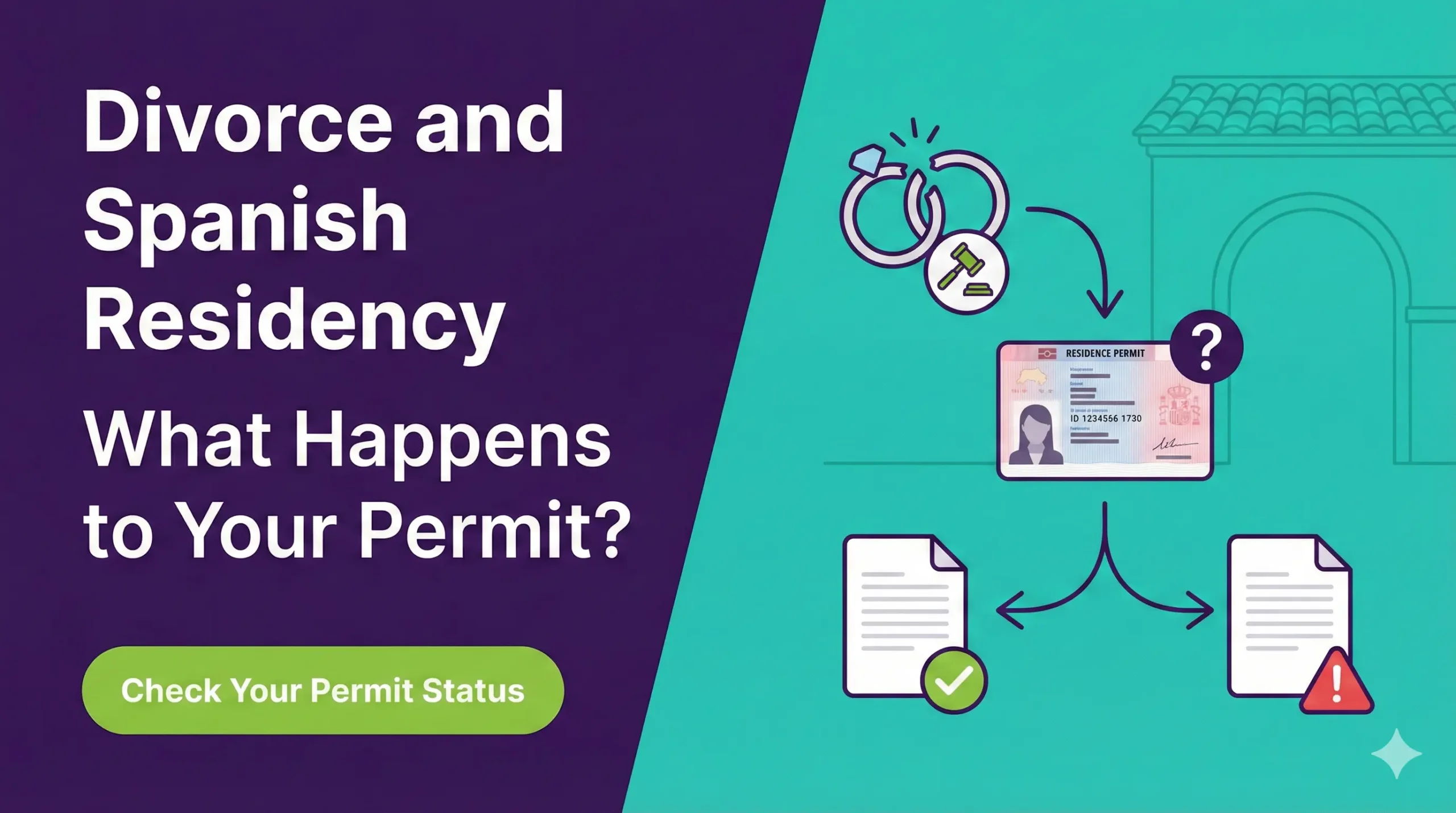
Divorce does not automatically trigger deportation, but it initiates a strict administrative countdown. If you hold a residency card tied to your ex-spouse, you must notify immigration authorities within one month. This comprehensive guide explains the “3-Year Rule” for keeping your card, the detailed process for switching to an independent work permit, and the new “Second Chance” pathways available in 2026 for those who miss their deadlines.
Disclosure: This post may contain affiliate links. We may earn a commission at no extra cost to you if you make a purchase through these links. Read full disclosure.
The Critical First Step: The Notification Imperative
The single most common mistake expats make post-divorce is silence. Many assume that because their TIE card (Tarjeta de Identidad de Extranjero) has an expiration date of 2028, they are safe until then.
This is a dangerous misconception.
Your right to reside was based on a marriage or registered partnership. Once that link is broken, the legal basis for your card vanishes unless you take specific administrative action.
The 1-Month Deadline
Under Article 9 of Royal Decree 240/2007, you are legally obligated to notify the Oficina de Extranjería (Immigration Office) of your change in marital status.
- The Rule: You must report the divorce within 1 month of the judgment becoming final (Sentencia firme) or the official cancellation of your registered partnership.
- How to Notify: This is usually done by submitting a formal letter or standard notification form (EX-00 or a generic Escrito de Presentación) along with your divorce decree or cancellation certificate to the immigration office in your province.
- The Consequence of Silence: If you fail to notify them, you are in breach of immigration law. While they might not deport you immediately, the issue will explode when you try to renew your card or apply for permanent residency. They will see the divorce date, calculate that you didn’t notify them, and could deny your renewal for “concealment of changes” or levy a fine of up to €500.
Scenario A: Keeping Your Current Card (The “Community” Regime)
This is the best-case scenario. It allows you to retain your existing Family Member of an EU Citizen Card (Tarjeta de Familiar de Comunitario). Read our guide on Spain Spouse/Partner Residency: Marriage vs Registered Partnership to know about partner residency status. You do not need to apply for a new visa, retake biometric fingerprints immediately, or prove you have a high-paying job. You simply maintain your progress toward the 5-year Permanent Residency.
To retain this card, you must meet one of the following criteria listed in Article 9.4.
1. The 3-Year Rule
This is the most common “save” for expats. You retain your residency rights if:
- Your marriage or registered partnership (Pareja de Hecho) lasted at least 3 years in total.
- AND at least 1 year of that time was spent living together in Spain.
Example: You married your Spanish partner in 2022 in New York. You moved to Madrid together in 2023. You divorce in 2026.
- Result: The marriage lasted 4 years. You lived in Spain for 3. You meet the criteria. You can keep your card until it expires, and then renew it independently.
2. Children and Custody
Even if the marriage lasted only 6 months, you keep your residency if:
- You have custody of the couple’s children (by mutual agreement or court order).
- OR You have visitation rights with the minor children, and the court rules that these visits must take place in Spain.
This provision prevents a parent from being deported away from their child. Note that the child must be residing in Spain for this to apply.
3. Vulnerable Situations
You are protected if you have been a victim of gender violence or human trafficking during the marriage.
- Proof: This is strictly regulated. You usually need a definitive court ruling, a protection order, or a report from the Public Prosecutor indicating signs of gender violence. A simple police report without further judicial backing is sometimes insufficient for long-term residency retention, so legal counsel is vital here.
Action Required: Even if you meet these rules, you still need to notify the immigration office. You aren’t asking for a new card; you are informing them that you are now keeping your card under “Article 9.” You submit your notification with proof (e.g., the marriage certificate showing dates or the custody ruling).
Scenario B: Modification to Independent Permit (The “General” Regime)
If you have been married for less than 3 years, have no children, and don’t qualify for the vulnerability exceptions, you lose your right to the Community Card.
You must now “modify” your status from the Community Regime (easy mode) to the General Regime (hard mode). Effectively, you must qualify for residency on your own merits, just like any other non-EU foreigner.
The 3-Month Window
You have 3 months from the date of the divorce decree (or partnership cancellation) to submit your modification application. If you miss this window, you technically fall into irregular status (though the new Second Chance Arraigo discussed later might help).
You have three main options for modification, depending on your economic situation:
Option 1: Modification to Work Permit (Cuenta Ajena)
If you are currently employed, this is your safest and easiest path.
- The Form: EX-03.
- The Fees: Model 790-062 (paid by the employer) and 790-052 (paid by you).
- The Big Benefit: Since you are modifying an existing residence, the “National Employment Situation” (Labor Market Test) does not apply. You do not need to prove that no Spaniard could do your job.
- Requirements:
- An employment contract for at least 1 year.
- Salary must be at least the Minimum Wage (SMI).
- The employer must have no debts with Social Security or Hacienda.
- Note: If you have been working for less than 9 months, you might face stricter scrutiny regarding your “integration.”
Option 2: Modification to Self-Employed (Cuenta Propia)
If you are a freelancer (Autónomo) or want to start a business.
- The Form: EX-07.
- Requirements:
- Business Plan: You likely need to submit a viable business plan if you are starting new. If you are already working as an Autónomo (which you were allowed to do on your Community Card), you submit your tax returns (Declaración de la Renta and quarterly IVA forms) to prove the business is real and profitable.
- Income: You must show the business generates enough profit to support you after expenses.
Option 3: Modification to Non-Lucrative (No Lucrativa)
If you do not work but have significant savings or passive income.
- The Form: EX-01.
- The Difficulty: This is harder than the initial Non-Lucrative Visa (NLV).
- Requirements:
- You generally cannot work.
- Financial Means: You must prove you have 400% of the IPREM. In 2026, the IPREM is around €600, meaning you need to show roughly €2,400 per month or €28,800 in savings.
- Private Health Insurance: You must buy a full-coverage private policy.
Validity: These modified permits are usually issued for 1 year initially, then renewed for 2 years, and then 2 years again until you reach the 5-year mark for permanent residency.
The Special Case: “Pareja de Hecho” Breakups
If your residency was based on a registered civil partnership (Pareja de Hecho) rather than marriage, the “divorce” rules apply similarly, but the trigger is different.
The Cancellation Trap
- The Trigger: The clock starts ticking the moment you officially cancel the registration at the Registry of Civil Unions (Registro de Uniones de Hecho).
- Regional Differences: In Madrid, simply ceasing to live together (changing your Empadronamiento) is grounds for the administration to dissolve the partnership ex officio. In Catalonia, you usually need to sign a deed before a notary to dissolve it.
- The Danger: Many couples break up, move apart, but forget to cancel the registry. Years later, when the foreigner applies for citizenship or renewal, the authorities see that the couple lived at different addresses for 3 years. They may accuse the applicant of “fraud of law” for maintaining a residency based on a relationship that clearly ended years ago.
- Best Practice: Cancel the registry formally as soon as the relationship ends to avoid accusations of fraud, then immediately notify Extranjería and apply for modification.
The Divorce Process for Foreigners in Spain
Before you worry about the visa, you have to worry about the divorce itself. Understanding the Spanish legal process is vital because the date on your divorce decree controls your immigration deadlines.
1. Jurisdiction: Can we divorce here?
Yes, if you reside in Spain, Spanish courts have jurisdiction, even if you were married in the US, UK, or Latin America.
2. Types of Divorce
- Mutual Agreement (Mutuo Acuerdo): The “happy” path. You share one lawyer. You sign a Convenio Regulador (Regulatory Agreement) detailing asset division and custody.
- Timeline: Fast. Can be done in 3-4 months. If there are no minor children, you can even divorce before a Notary (express divorce) in a matter of weeks.
- Contested (Contencioso): The “battle” path. Each spouse has their own lawyer and procurator. You fight over assets or custody in court.
- Timeline: Slow. Can take 8 months to 2 years.
- Immigration Impact: While the divorce is pending, you are technically still married. You generally keep your Community Card status until the final judgment is issued.
3. The “Exequatur” Nightmare (Foreign Divorces)
If you travel back to your home country (e.g., Texas) to get divorced, Spain does not automatically recognize that ruling.
- The Problem: You walk into the Spanish immigration office with a Texas divorce decree. They will likely reject it because it hasn’t been “validated” in Spain.
- The Solution: You must file for Exequatur, a legal process where a Spanish judge verifies the foreign ruling conforms to Spanish law.
- Timeline: Recognition takes 3-6 months. Enforcement (getting assets/custody) can take 12+ months.
- Strategy: If you live in Spain, it is almost always faster and cheaper to divorce in Spain than to divorce abroad and then process an Exequatur.
Financial Implications and Alimony
Divorce often changes your financial profile, which directly impacts your ability to modify your residency (especially to Non-Lucrative).
- Pensión Compensatoria (Alimony): If the divorce leaves one spouse economically destitute compared to the other, the judge may order alimony. This counts as “income” for immigration purposes.
- Pensión de Alimentos (Child Support): This is for the children. It does not count as income for the spouse’s residency application (e.g., NLV), but it reduces the financial burden of the paying spouse.
Housing:
If you have children, the judge will often award the use of the family home to the custodial parent, even if the other parent owns it. This can solve the “proof of accommodation” requirement for your residency modification.
The “Second Chance” Arraigo (New for 2026)
What if you messed up? What if you divorced two years ago, didn’t notify anyone, and now your card is expired?
In the past, you would have become an irregular immigrant (undocumented). However, Spain’s recent immigration reforms (RD 1155/2024 and updates) introduced the Arraigo de Segunda Oportunidad (Second Chance Roots).
What is it?
It is a residency permit for those who had a residence authorization in the past but lost it or failed to renew it.
Requirements
- You must have held a valid residence permit (like the Community Card) in the past.
- You must have contributed to Social Security (worked) for a certain period during your legal stay.
- You must not have a criminal record.
This is a massive safety net. If you missed the 3-month modification window and fell into irregularity, you might be able to “resurrect” your legal status through this pathway without leaving Spain.
Citizenship and Long-Term Residency
Permanent Residency (5 Years)
If you retained your card under the 3-Year Rule, you can apply for the Permanent Residence Card (Tarjeta de Residencia Permanente) after 5 years of total legal residence.
- Documentation: You must submit the divorce decree when you apply for the permanent card to prove you were eligible to keep your previous card during the interim period.
Citizenship
- The Loss of Privilege: Spouses of Spanish citizens can apply for citizenship after 1 year. However, you must be married at the time of application. If you divorce before applying, you lose this privilege and revert to the general rule (10 years for most, 2 years for Ibero-Americans).
- Strategy: If your marriage is rocky but not dangerous, and you are close to the 1-year mark, consider applying for citizenship before initiating divorce proceedings. Once the application is submitted, a subsequent divorce generally does not invalidate the application, provided you were legally married at the time of submission (though this is a grey area—consult a lawyer).
Common FAQs
Q: Can my ex-spouse cancel my residency card?
A: No. Your ex-spouse cannot call the police and have your card revoked. Residency is granted by the Spanish government, not your husband or wife. However, they can inform the Foreigners’ Office that you are divorced, which might trigger an investigation if you haven’t notified them yourself.
Q: What if I move to another EU country after divorce?
A: The Spanish “Community Card” is only valid for residence in Spain. If you divorce and move to France, you must start from scratch under French immigration rules. You cannot “transfer” the divorced status permit easily.
Q: Does “separation” count as divorce?
A: Legal Separation (Separación Legal) triggers the same notification requirements as divorce. However, “de facto separation” (just sleeping in different beds) does not legally trigger the notification clock, though it stops the “cohabitation” time from accumulating for the 3-Year Rule.
Conclusion
Divorce is the end of a relationship, not necessarily the end of your life in Spain. The system is designed to allow integrated residents to stay, provided they follow the rules.
The golden rule is transparency. Do not hide your breakup from the government. If you meet the 3-year requirement, notifying them is a mere formality. If you don’t, modifying your permit is a hassle—requiring job contracts or business plans—but it is far better than becoming undocumented.
Once you have secured your independent status, you are truly free—both personally and administratively. If you are moving to a new apartment as part of the separation, remember to update your address immediately. Check our guide on Empadronamiento in Spain: How to Register Your Address to handle that step.
References
Primary sources (official)
- Boletín Oficial del Estado (Royal Decree 240/2007): Article 9 regarding retention of rights after divorce or annulment.https://www.boe.es/buscar/act.php?id=BOE-A-2007-4184
- Portal de Inmigración: Instructions for modifying from Family Member of EU Citizen to General Regime (Form EX-03).https://www.inclusion.gob.es/web/migraciones/vivir-en-espana/familiares-de-ciudadanos-de-la-union-europea
- Ministry of Justice: Information on Exequatur (Recognition of foreign judgments).https://www.mjusticia.gob.es/es/ciudadania/tramites/reconocimiento-ejecucion
- Sede Electrónica (Forms): Download EX-00, EX-03, and EX-19 forms.https://sede.administracionespublicas.gob.es/pagina/index/directorio/modelos_extranjeria
Other helpful sources
- Balcells Group: Detailed guide to retaining residency after divorce (“The 3-Year Rule”).https://balcellsgroup.com/losing-residency-after-divorce/
- Lexmovea: 2026 Guide to Modification from Community to General Regime.https://lexmovea.us/services/modification-community-regime-to-general-regime/
- Parainmigrantes: Video explanation of the notification deadlines and fines.https://www.parainmigrantes.info/divorcio-y-tarjeta-comunitaria/
Disclaimer
The information provided in this article is for educational and informational purposes only and does not constitute legal advice. Notification deadlines, modification fees (e.g., Tasa 790-062), and salary thresholds for 2026 are subject to change. We strongly recommend consulting with a qualified immigration lawyer to handle the notification and modification of your permit to avoid fines or extinction of residency.