Understanding Spain’s Daily Rhythm: Siesta and Late Nights
Finding yourself standing in front of a locked pharmacy at 3:00 PM while nursing a headache is a rite of passage for every newcomer in Spain. I remember my first week in Seville, wandering the sun-bleached streets in total disbelief that an entire city could seemingly vanish into thin air just when I needed to run errands. This guide breaks down the unique Spanish clock so you can stop fighting the rhythm and start living it.
Disclosure: This post may contain affiliate links. We may earn a commission at no extra cost to you if you make a purchase through these links. Read full disclosure.
The Spanish Timetable: A Shock to the System
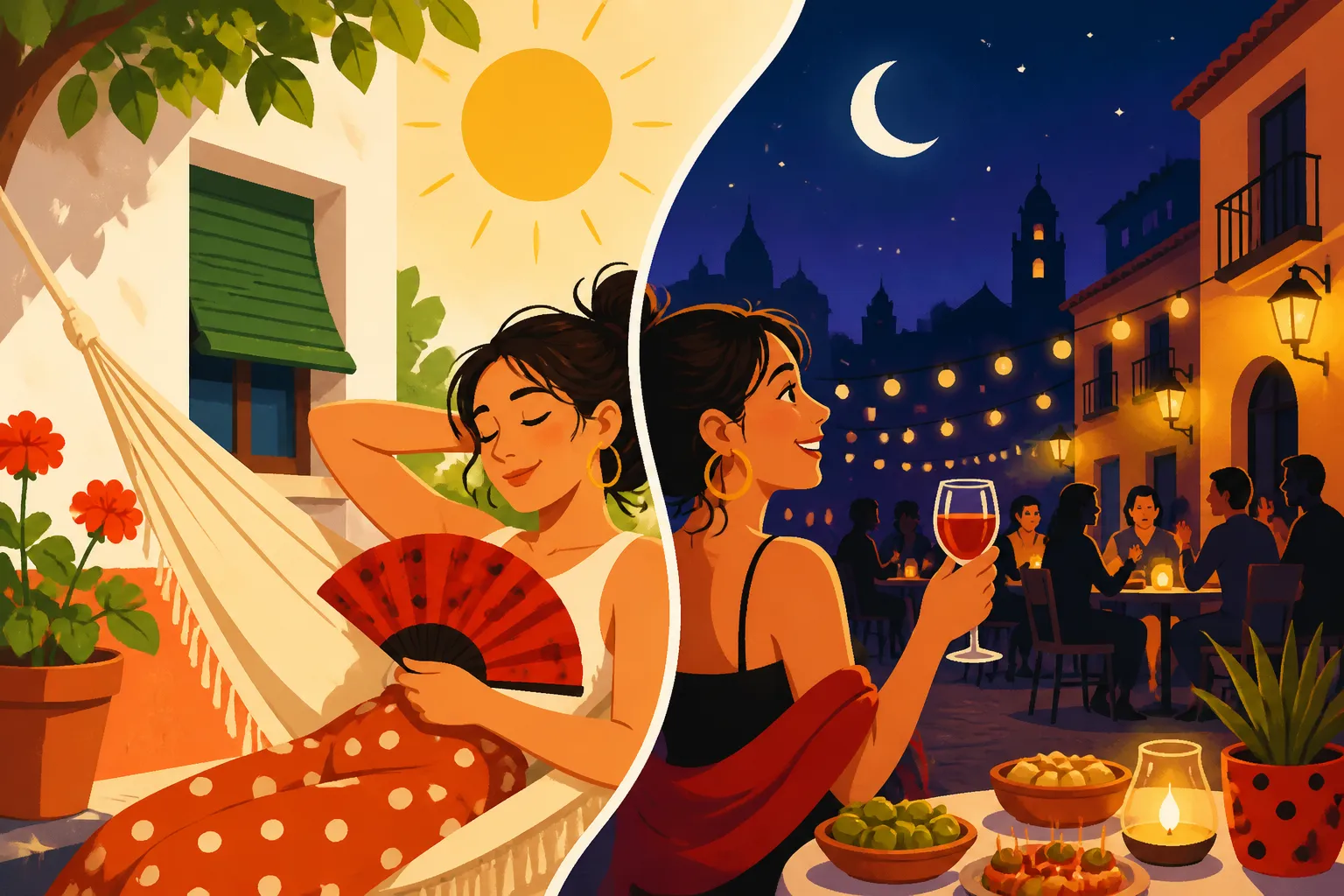
The Spanish daily rhythm is not just a quirk of the culture; it is a fundamental restructuring of time that often leaves tourists and new expats feeling perpetually out of sync. While most of the Western world operates on a linear 9-to-5 trajectory, Spain functions on a bifurcated schedule. This means the day has two distinct peaks of activity, separated by a long, quiet trough in the afternoon. Understanding this is the first step toward avoiding the frustration of "Cerrado" (closed) signs.
Why Everything Happens Later
One of the most common questions I get from friends visiting is why Spaniards eat dinner at an hour when most people are heading to bed. To understand this, you have to look at the sun and history. Technically, Spain is in the wrong time zone. Geographically, it should be on Greenwich Mean Time (GMT), aligned with Portugal and the UK. However, in 1940, the time zone was shifted to match Central European Time. This means the sun rises later and sets later than it "should," pushing the entire day’s activities toward the evening hours.
Living here, I quickly realized that the heat also dictates the tempo. In the summer months, particularly in the south, the afternoon sun is genuinely oppressive. It is not just "warm"; it is a physical barrier to productivity. By pushing activities into the late evening, Spaniards take advantage of the only pleasant hours of the day. When you use tools like Omio to plan your cross-country trips, you will notice that even transport schedules reflect this, with a noticeable lull in regional services during the peak heat of the afternoon.
The Concept of the Split Shift (Jornada Partida)
The "Jornada Partida" is the structural backbone of the Spanish workday and the source of most expat confusion. Most traditional businesses open around 9:00 AM or 10:00 AM, run until 1:30 PM or 2:00 PM, and then shut down completely until 4:30 PM or 5:00 PM. They then stay open until 8:00 PM or 9:00 PM. This is not a "long lunch"; it is a split shift that allows workers to return home, eat a substantial meal with family, and avoid the worst of the midday sun.
For those of us used to a quick sandwich at our desks, this four-hour gap feels like a massive waste of time. However, I have learned that this is when the "real" life happens. It is the time for the main meal of the day and for resting. If you are staying in a residential area you found via Booking.com, you will notice the sudden silence that descends on the neighborhood at 2:30 PM. It is a collective exhale that the country takes before the second half of the day begins.
Decoding the Siesta: Myth vs. Reality
The word "siesta" is famous worldwide, but its modern application is often misunderstood by those who haven't lived here. If you come to Spain expecting to see everyone tucked into bed at 3:00 PM, you might be surprised. The siesta is less about sleeping and more about the "sacred" right to stop working during the hottest part of the day.
Do People Actually Sleep in the Afternoon?
The short answer is: not as often as they used to. In major cities like Madrid or Barcelona, the commute is too long for most office workers to go home for a nap. However, the concept of the siesta remains vital. Even if people aren't sleeping, they are disconnected. They are in a restaurant, a park, or at home. The pace slows down significantly.
I have found that the traditional siesta is more prevalent in smaller towns and among the older generation. If you are exploring hidden gems through GetYourGuide tours in rural Andalusia, you will find that the streets truly do empty out. It is considered slightly rude to call someone’s house or expect a business response during these hours. It is a period of protected privacy. You can read more about how this affects daily interactions in my guide on Spanish Social Customs: Greetings, Kisses, and Personal Space.
Impact on Business Hours and Shopping
This afternoon closure affects everything from boutiques to hardware stores. Only large international chains or "supermercados" in city centers tend to stay open all day (horario ininterrumpido). If you are planning a day of shopping, you must do it between 10:00 AM and 2:00 PM, or wait until after 5:00 PM. I cannot tell you how many times I have stood outside a cobbler or a dry cleaner at 3:30 PM, cursing my lack of planning.
This schedule also impacts how you should plan your sightseeing. Many smaller museums and historic sites follow the traditional split schedule. It is essential to check Opening Hours in Spain: What’s Different (Siesta, Holidays, Sundays) before you head out, or you may find yourself with several hours to kill in a deserted neighborhood.
Navigating Meal Times: From Desayuno to Cena
If you try to eat lunch at noon and dinner at 6:00 PM in Spain, you will find yourself eating alone in empty restaurants that are clearly only open for tourists. The Spanish culinary clock is rigid, and it is built around five distinct eating moments.
The Mid-Morning Break and Late Lunches
Breakfast (desayuno) is usually light—a coffee and maybe a piece of toast (tostada). The real "fuel" comes during the "almuerzo" around 11:00 AM. This is when you will see bars packed with workers having a small sandwich (bocadillo) or a pastry. It is a vital social break. For a deep dive into how to navigate these morning rituals, check out Spanish Coffee Culture: How to Order Like a Local.
Lunch (comida) is the king of meals, typically served between 2:00 PM and 4:00 PM. This is the time to look for the "Menú del Día," a fixed-price three-course meal that is the most economical way to eat well in Spain. For more on this, see What Is a ‘Menú del Día’ and How Does It Work?. If you try to show up at a local spot for lunch at 1:00 PM, the kitchen might not even be fired up yet.
Surviving Until the 10 PM Dinner
The long gap between a 3:00 PM lunch and a 10:00 PM dinner is bridged by the "merienda"—an afternoon snack. This is when children get a snack after school and adults might have a coffee and a sweet treat. Without the merienda, you will likely find yourself "hangry" by 7:30 PM, a time when most restaurant kitchens are still firmly closed.
Dinner (cena) is lighter than lunch and rarely starts before 9:00 PM. In the summer, it is common to see families with small children sitting down to eat at 11:00 PM. This was one of the hardest adjustments for me as an expat. The trick is to embrace the tapas culture. Instead of a full sit-down meal, you can graze your way through the evening. You can find more tips on this in Spanish Bar and Café Etiquette for Newcomers.
| Meal | Typical Time | Description |
|---|---|---|
| Desayuno | 7:30 AM – 9:00 AM | Quick coffee, toast, or galletas. |
| Almuerzo | 10:30 AM – 11:30 AM | Mid-morning social break, small sandwich. |
| Comida | 2:00 PM – 3:30 PM | The main, heavy meal of the day. |
| Merienda | 5:30 PM – 7:00 PM | Afternoon snack to bridge the gap. |
| Cena | 9:30 PM – 11:00 PM | Lighter evening meal, often shared plates. |
Socializing and the Late-Night Culture
In Spain, the night is not just the end of the day; it is a second beginning. The streets that were ghostly quiet at 4:00 PM suddenly explode with life at 9:00 PM. This late-night culture is deeply ingrained in the social fabric and is accessible to everyone, from toddlers to great-grandparents.
The After-Work Tapas Crawl
Between 8:00 PM and 10:00 PM, the "paseo" occurs. This is the traditional evening stroll where people dress up and walk through the main streets or plazas. It naturally leads into the pre-dinner drinks and tapas. You don't just "go to a bar"; you move from one to another, having a small bite and a drink at each.
This is the best time to experience the local atmosphere. If you are staying in a central apartment booked via Booking.com, this is the time to head out and simply follow the crowds. The noise level will rise, the "terrazas" (outdoor seating) will fill up, and the city will feel its most vibrant. For safety tips while navigating these crowded night spots, refer to Staying Safe in Spain: Practical Safety Tips for New Residents.
Nightlife and the "Madrugada"
For those who want to go beyond dinner, the Spanish night is incredibly long. Bars stay open until 2:00 AM or 3:00 AM, and "discotecas" (clubs) often don't even open their doors until midnight, peaking around 4:00 AM. The "madrugada" (the early hours of the morning) is a recognized time of day here.
It is perfectly normal to see people heading home as the sun comes up, stopping for churros and chocolate on the way. This isn't just for students; you will see a wide range of ages out late. If you are planning to attend a major event, you should check Spain's Biggest Festivals: A Year-Round Calendar to see how the local schedule shifts even later during party seasons.
Practical Strategies for Adjusting Your Internal Clock
Adjusting to this rhythm takes time and a bit of a psychological shift. You cannot force Spain to run on your schedule; you have to let the Spanish schedule run you.
Managing Logistics and Bookings
When you are booking tours or activities, pay close attention to the timing. A tour that starts at 4:00 PM might be very hot and lead you through a city that feels "closed." it is often better to book morning tours or very late afternoon ones through GetYourGuide to ensure you are seeing the city when it’s actually alive.
Similarly, when using Omio to book trains or buses, remember that arriving in a new city at 3:00 PM might mean you can't find an open place to eat or easily check into a smaller guesthouse where the owner might be taking their own break. Always communicate your arrival time clearly if it falls during the midday lull.
Seasonal Variations in the Daily Rhythm
The rhythm changes with the seasons. In the winter, the afternoon closures might be slightly shorter, and dinner might move up to a "daring" 8:30 PM. But in the summer, the schedule stretches to its limits. The midday break might last until 6:00 PM, and the streets don't truly cool down until midnight.
If you are a new resident, the best advice I can give is to adopt the "siesta mindset." Even if you don't sleep, use that 2:00 PM to 5:00 PM window to read, catch up on life, or stay indoors. Don't try to run errands. You will only end up hot, tired, and frustrated. By resting in the afternoon, you gain the energy to enjoy the spectacular Spanish evenings, which are truly the highlight of living in this country.
Regional Health Systems in Spain: How Coverage Differs by Comunidad
While the daily rhythm is a national characteristic, the way health and administrative systems support your life can vary depending on where you settle. If you are struggling with the lifestyle adjustment and need support, knowing how your local region handles services is vital. Each "Comunidad Autónoma" has its own health authority, and while the 2:00 PM lunch is universal, the way you book an appointment or access a clinic during these hours can differ. For a breakdown of these regional nuances, see Regional Health Systems in Spain: How Coverage Differs by Comunidad.
Disclaimer
This guide is intended for informational purposes and reflects the personal experiences of the author. While every effort has been made to provide accurate and up-to-date information regarding Spanish customs and schedules, regional variations exist, and business hours may change without notice. Always verify specific times with local providers.