Shipping a Car to Spain: Registration, ITV, and the Matriculacion Cost
You have found the perfect flat in Valencia, the removal van is booked, and now you are staring at your car wondering whether to bring it. Then you hear the words “matriculación”, “ITV” and “homologación,” and the whole idea starts to feel like a second relocation. This guide explains how to ship a car to Spain, register it on Spanish plates and budget for the full process.
Disclosure: This post may contain affiliate links. We may earn a commission at no extra cost to you if you make a purchase through these links. Read full disclosure.
Should You Ship Your Car to Spain at All
I shipped my own car down from the north of Europe years ago. It was a stubborn decision. I loved that car, it had low mileage, and selling it at home felt like losing money. Looking back, it was the right call for me, but only because I went in with my eyes open. Before you book anything, run through the honest questions below.
The honest maths of keeping your car
The cost of bringing a car to Spain is not just the transport. You pay to move it, then you pay to make it legally Spanish. That second part covers paperwork, technical inspection, possible modifications, a registration tax, local road tax, new plates and Spanish insurance. On a newer car the matriculation tax alone can be a serious line item. On an older car the paperwork can still eat days of your life.
Compare that total against selling at home and buying in Spain. The Spanish used car market is large, cars come with a Spanish ficha técnica already, and you skip the inspection and homologation stage completely. For a modest, older hatchback, selling and buying locally often wins. For a well-kept newer car, a classic, a specialist vehicle, or a car you simply cannot replace, shipping makes more sense.
Think about the car’s resale value in Spain too. A left-hand-drive European car with a standard spec is easy to sell later. A right-hand-drive car or a North American model is legal to drive once registered, but buyers are few, so you may be stuck with it for the long term. For a wider view of the import rules, see Bringing a Car to Spain: Import Rules and Common Costs.
Right-hand-drive and US-spec cars: the extra hurdles
If you are coming from the UK or Ireland, your car is right-hand drive and was built for left-hand traffic. Spain drives on the right, so the headlights dip the wrong way for Spanish roads and would dazzle oncoming drivers. They must be adjusted or replaced before the car passes its Spanish inspection. The rear fog light position and the speedometer display may also need attention. None of this is impossible, but it adds workshop time and cost, and you should get a quote before you commit to shipping.
Cars from the United States and Canada face a bigger hill. They were never built to European type approval, so there is usually no European Certificate of Conformity. That means an individual homologation process with a technical report from an accredited laboratory, and often changes to lighting, indicators and sometimes emissions equipment. I have friends in Málaga who did it with a classic American pickup and loved the result, but they budgeted months, not weeks.
If either of these describes your car, get two numbers before you decide: the shipping quote and a homologation and modification estimate from a Spanish specialist. Only then compare against selling.
How to Ship a Car to Spain: Methods, Ports, and Movers
Once you decide the car is coming, the next question is how it travels. This is where a lot of people overpay, simply because they ring one company and accept the first figure they hear.
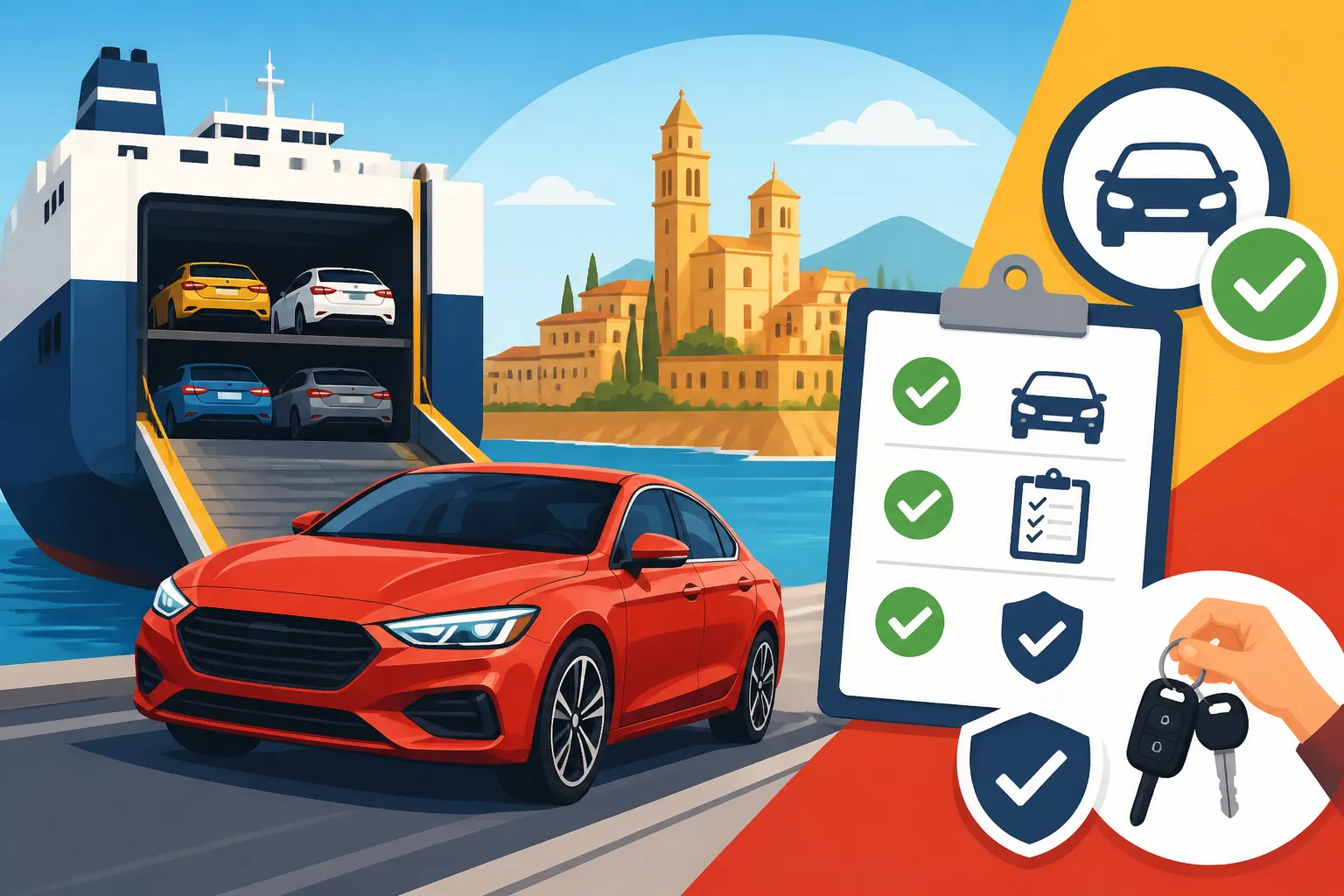
RoRo, container, or truck
There are five realistic ways to get a car into Spain, and the right one depends on where you are coming from and whether the car travels alone or with your household goods.
| Method | How it works | Best for | Watch out for |
|---|---|---|---|
| Roll-on roll-off | The car is driven onto a specialist vessel and parked in its deck | Long sea routes where the car travels on its own | You usually cannot pack personal belongings inside the car |
| Shared container | Your car shares a container with other cars or goods | Overseas moves where you want more protection than RoRo | Departure waits until the container fills |
| Sole container | Your car has its own container, often with household goods | Combining the car with your furniture in one shipment | Higher cost, but one customs process for everything |
| Road car transporter | The car rides on an open or enclosed truck across Europe | Moves from within the EU or the UK | Enclosed transport costs more but protects classics |
| Driving it yourself | You drive down, often with a ferry crossing | Shorter European moves and owners who enjoy the trip | Fuel, tolls, overnight stops and wear on the car |
Driving yourself is the cheapest-feeling option, and from France, Germany or the Benelux countries it is often the most practical. From the UK, many people take the ferry to northern Spain and drive from there. From overseas, you will be choosing between RoRo and a container, and the decision usually hinges on whether you want to bundle the car with your furniture.
Spanish ports and routes
Where the car lands matters, because you or a transporter will have to collect it. Spain’s main cargo ports for vehicles and containers include Valencia, Barcelona, Algeciras, Bilbao, Santander, Vigo and Cádiz. Valencia and Barcelona handle a large share of container traffic on the Mediterranean side. Algeciras is the big gateway in the south, near Gibraltar and the Costa del Sol. Santander and Bilbao are the natural arrival points for ferries from the UK and work well if you are heading to the north coast or Madrid.
A practical tip from my own move: choose the port closest to where you will register the car, not the one with the cheapest sea leg. Customs clearance happens at or near the port of arrival, and if you need a customs agent to present documents in person, distance turns into real cost. If you are moving to Alicante, landing in Valencia is far easier than landing in Bilbao.
Also ask the shipping company whether the quote is port-to-port or door-to-door. Port-to-port means you or someone you hire collects the car at the terminal, deals with storage fees if you are late, and drives it away. Door-to-door covers the last leg too. The difference sounds small on paper but makes a big difference when you are also unpacking boxes in a new flat.
Using Sirelo to compare car shipping and removal quotes
This is where I wish I had been smarter the first time. I rang one company, accepted their quote, and later discovered a neighbour had moved a similar car on the same route for considerably less. Comparison is everything in this market, because prices vary hugely between movers depending on their routes, their container fill and whether they already have a truck heading your way.
Sirelo is a comparison platform built for exactly this. You describe your move once, including the car, the origin and the destination in Spain, and Sirelo puts your request in front of international removal companies that cover the route. The movers then send you their own quotes, and you can compare them side by side alongside reviews from other customers. Because many removal firms combine car transport with household goods, Sirelo is especially useful if you want one company to handle both. Check Sirelo’s own pages for how the service works and which movers cover your route.
When the quotes arrive, read them line by line. Look for whether customs clearance is included, whether port fees and terminal handling are listed, what insurance is offered and on what valuation, and whether delivery to your door is part of the price. For a detailed breakdown of what to watch for, see Comparing International Removal Quotes for Spain: Line Items That Hide Costs. Insurance deserves its own attention too, and Moving Insurance for Shipments to Spain: Coverage, Valuation, and Claims covers how claims actually work. If you have not requested quotes yet, start with Sirelo before you sign anything with a single provider.
Customs and Tax Before Registration
The car has landed. Now Spain wants to know where it came from and whether any tax is owed before it can be registered. The answer depends almost entirely on whether the car is coming from inside or outside the European Union.
EU cars vs non-EU cars
Moving a car between EU countries means no customs duty, because the EU is a single customs territory. You still face the Spanish registration tax, and in some cases VAT. A car that counts as new under EU rules owes VAT in Spain, while a used car bought privately normally does not. Cars from outside the EU, including the UK after Brexit, go through customs, which can mean import duty and import VAT unless you qualify for relief.
| Step | Car from an EU country | Car from outside the EU |
|---|---|---|
| Customs declaration | Not required | Required, through the DUA customs document |
| Import duty | Not applicable | Payable unless transfer of residence relief applies |
| VAT | Only if the car counts as new under EU rules | Import VAT unless relief applies |
| Proof of type approval | Certificate of Conformity usually available | Often individual homologation needed |
| Spanish registration tax | Payable unless exempt | Payable unless exempt |
| ITV inspection | Required | Required |
If you are coming from Britain, the post-Brexit change catches many people out, so read Moving to Spain from the UK After Brexit: Customs, Costs, and ToR Relief before your car leaves Dover or Portsmouth.
Change of residence exemption
This is the single most valuable piece of paperwork in the whole process. If you are genuinely moving your residence to Spain, you can usually bring your personal car without paying import duty and, separately, without paying the Spanish registration tax, provided you meet the conditions.
The core condition is that you owned and used the car in your previous country of residence for at least six months before the move. You also need to show that you lived outside Spain for a minimum continuous period before moving, and that you are now registering as a Spanish resident. After the exemption is granted, you cannot sell, lend or transfer the car for a set period, and doing so can trigger the tax you avoided.
The evidence matters. Keep the original foreign registration document, the purchase invoice, proof of insurance in your name in your old country, and anything else showing the car was really yours and really used there. The exemption from the registration tax is requested from the Agencia Tributaria, while customs relief for non-EU cars is handled through the customs process. For the full document trail, see Cambio de Residencia Exemption: The Paperwork That Waives Import Duty and The Six-Month Ownership Rule: Proving Your Goods Qualify for Duty Exemption.
One warning from experience: the exemption assumes you are already on your way to being a resident. You will need your NIE and usually your empadronamiento before you can file. If the car lands before your paperwork is ready, it can sit at the port while you chase appointments. See Getting Your NIE and Padron Before Your Container Lands: The Sequencing Problem for how to get the order right.
The matriculación tax: how IEDMT is calculated
When people talk about the “matriculación cost,” they usually mean the Impuesto Especial sobre Determinados Medios de Transporte, known as IEDMT. It is a one-off tax paid when a vehicle is first registered in Spain, and for imported cars it applies even though the car has been registered elsewhere before.
It is calculated in two parts. First comes the taxable value. For used cars, the Agencia Tributaria publishes official tables of average vehicle prices by make and model, plus depreciation tables that reduce that value according to the car’s age. Your car’s taxable base is the table value adjusted for age, not what you paid for it. If your model is not in the tables, the value has to be established another way, which can involve a valuation.
Second comes the rate, which depends on the car’s official CO2 emissions. Cars are placed into emission bands, with the cleanest cars in the lowest band and the most polluting in the highest. Some autonomous communities can adjust the rates within limits, and the Canary Islands, Ceuta and Melilla have their own tax arrangements. So the same car can produce a different bill depending on where you register it.
The tax is self-assessed and filed online using Modelo 576, or the exemption is requested using Modelo 05 if you qualify for change of residence relief. You will normally need a digital certificate or Cl@ve access, plus the technical data from the ITV stage, to complete the form. Many people hand this part to a gestor, and honestly, the first time round I did too. See How to Choose a ‘Gestor’ for Housing Paperwork in Spain for what to look for.
The ITV Inspection for Imported Cars
The ITV, or Inspección Técnica de Vehículos, is the Spanish roadworthiness inspection. For an imported car it does two jobs at once: it checks the car is safe, and it issues the Spanish technical documentation the car needs for registration.
Homologation, the COC and the ficha técnica
Every car registered in Spain has a ficha técnica, the technical card that records its specifications. For an imported car, the ITV station issues this card based on proof that the car meets European standards.
If your car was built for the European market, the easiest proof is the Certificate of Conformity, or COC, which the manufacturer issues. Some cars come with one in the glovebox paperwork. If yours does not, you can usually request one from the manufacturer or its national representative, though this takes time and sometimes costs money. With a valid COC, the ITV can generally issue the ficha técnica after inspection.
If there is no COC, which is common for cars built for North American, Asian or other non-European markets, you need individual homologation. This means a technical report from an accredited laboratory confirming the car meets Spanish and EU requirements, sometimes after modifications. It is the slowest and most expensive part of the process for non-European cars, so get advice from a specialist homologation service before you ship.
What happens on ITV day
ITV stations operate under regional authority, run by public companies or licensed private operators depending on the region, and you book an inspection online or by phone. Tell them clearly that this is an import inspection for a foreign car, because it is a different appointment type from a routine periodic check.
On the day, expect to bring your passport or residence card, your NIE, the foreign registration document, the COC or homologation report, and any customs documents. The inspectors check identification first, matching the chassis number on the car to your documents. Then comes the standard mechanical inspection: brakes, suspension, steering, lights, emissions, tyres, seatbelts, and the general condition of the body.
If the car passes, you leave with the ficha técnica, which you need for the registration tax and the DGT. If it fails, you receive a report listing the defects and a window to fix them and return. In my case the car failed the first time on a tired number plate light. Embarrassing, but a quick fix. Take it seriously, though, because a fail on lighting alignment or emissions can mean a proper workshop visit.
Modifications right-hand-drive cars need
Here is where right-hand-drive owners need to plan. A car built for left-hand traffic has headlights that throw their beam towards the left verge. On Spain’s right-hand roads that beam lands in the eyes of oncoming drivers. The ITV station will not accept this for permanent registration, so the headlights must be adjusted if the units allow it, or replaced with units designed for right-hand traffic.
Beyond the headlights, the rear fog light may need to be moved or added on the correct side, depending on the car. The speedometer must display kilometres per hour, which most modern cars do already through a dual display or a settings menu. Some inspectors will also look at mirror coverage. The steering position itself is not a problem; right-hand-drive cars can be registered and driven legally in Spain.
Get the work done by a garage that knows ITV requirements before your inspection date. A good local workshop in Spain is often cheaper than doing it before you leave, and they will know exactly what the local ITV station expects.
Registering at the DGT: Spanish Plates Step by Step
The Dirección General de Tráfico, or DGT, is Spain’s traffic authority. Registration takes place through its provincial offices, the Jefaturas Provinciales de Tráfico, and this is the final stage where the car gets its Spanish plates and its permiso de circulación, the vehicle registration certificate.
Documents checklist
Before you book anything at Tráfico, gather the full set. Missing a single paper sends you home to start the appointment hunt again. Bring originals and copies of:
- Your passport, plus your TIE residence card or EU registration certificate
- Your NIE
- Your certificado de empadronamiento, showing your address in the province
- The foreign registration document for the car
- The purchase invoice or other proof of ownership
- The ficha técnica issued by the ITV station
- Proof that the registration tax was paid through Modelo 576, or the exemption granted through Modelo 05
- Proof of payment of the local road tax for the current period
- Customs documents if the car came from outside the EU
- Proof of payment of the DGT registration fee
- The completed DGT application form
If any of your documents are in a language other than Spanish, check whether the DGT office requires a sworn translation. Foreign registration documents from some countries are accepted readily; others raise questions.
The registration process in order
The order of steps matters, because each one produces a document the next one needs. This is the sequence that has worked for me and for most people I know:
- Confirm your NIE and empadronamiento are in place, and ideally your residence documentation.
- Clear customs at the port if the car is from outside the EU, using the DUA declaration and claiming transfer of residence relief if eligible.
- Obtain the Certificate of Conformity or arrange individual homologation.
- Have any required modifications done, such as headlight changes on a right-hand-drive car.
- Book and pass the ITV import inspection to receive the ficha técnica.
- File Modelo 576 to pay the registration tax, or Modelo 05 to request the change of residence exemption.
- Pay the local road tax, the Impuesto sobre Vehículos de Tracción Mecánica, at your ayuntamiento.
- Pay the DGT registration fee online.
- Book an appointment at your provincial Tráfico office, or have a gestor submit the file.
- Receive your Spanish registration number and permiso de circulación.
- Have Spanish plates made at an authorised plate supplier using your new registration document.
- Update your insurance to the Spanish registration and fit the new plates.
Road tax, insurance and plates
The local road tax, known as IVTM or simply the impuesto de circulación, is set by each ayuntamiento and based on the car’s fiscal horsepower. It is paid every year, and the first payment is required before registration. Some councils let you pay online, others need a visit to the tax office.
Insurance is compulsory from the moment the car is on Spanish roads. While the car is on foreign plates, check carefully that your existing policy covers you in Spain for the time you need. Once the car has Spanish plates, you will need a policy registered to the new number. For what the minimum cover actually includes and how to compare providers, see Car Insurance in Spain: Minimum Coverage and What to Compare.
Plates are made by authorised suppliers, often small workshops or car accessory shops, which will ask to see your new permiso de circulación before they print anything. It usually takes minutes. Keep the foreign plates, because some home authorities want them returned or the old registration formally cancelled.
Do not forget your driving licence while you are dealing with the car. Depending on your country, you may need to exchange it within a set period of becoming resident. See Exchanging a Foreign Driver’s License in Spain: Eligibility and Steps.
Budgeting the Full Matriculación Cost
When people ask me “what does matriculación cost,” the honest answer is that it is not one number. It is a stack of separate charges paid to different people at different stages. Laying them out makes the total less frightening and much easier to plan.
Cost components at a glance
| Cost component | Who you pay | How the amount is set |
|---|---|---|
| Car transport | Your mover or shipping company | Distance, method, route and whether the car travels with household goods |
| Port and terminal fees | Port operator or shipping agent | Handling charges and storage days at the terminal |
| Customs duty and import VAT | Spanish customs | Car value and origin; waived if transfer of residence relief applies |
| Certificate of Conformity | Manufacturer or its representative | Set by the manufacturer |
| Individual homologation | Accredited laboratory or specialist | Complexity of the car and modifications needed |
| Modifications | Your workshop | Parts and labour, for example headlights on a right-hand-drive car |
| ITV import inspection | ITV station | Station tariff for import inspections |
| Registration tax IEDMT | Agencia Tributaria | Official table value adjusted for age, times the CO2 band rate; exempt under change of residence |
| Local road tax IVTM | Your ayuntamiento | Fiscal horsepower and the council’s own tariff |
| DGT registration fee | DGT | Official fee for vehicle registration |
| Plates | Authorised plate supplier | Supplier’s price |
| Gestor fees | Your gestor | Their professional fee for the work they handle |
| Insurance | Your insurer | Driver profile, car and cover level |
The two items that swing the total most are the transport and the registration tax. Transport you can control by comparing quotes, which is exactly why I send everyone to Sirelo. The registration tax you can sometimes control through the change of residence exemption, which is why that six months of ownership evidence is worth guarding carefully. For running costs once the car is legal, see Car Costs in Spain: Insurance, Taxes, Maintenance, and Fuel.
Realistic timelines and where delays come from
On a smooth day, with an EU car, a COC in hand and appointments available, registration can be wrapped up in a few weeks after arrival. In practice, the delays come from the same predictable places every time.
Appointments are the first. Extranjería for your residence card, the ayuntamiento for the padrón and Tráfico for registration can all have waiting lists, especially in Madrid, Barcelona and the coastal hotspots. Booking early and checking for cancellations helps. A gestor can often submit to Tráfico without you needing an appointment slot at all, which alone can justify their fee.
The second source of delay is missing or mismatched documents. A purchase invoice under a different name from the registration document, a COC with the wrong chassis number, or a translation the office will not accept can each stop the file. Check every document against the car before it ships.
The third is homologation for non-European cars, which can take far longer than anything else on the list. If your car needs individual homologation, start talking to a specialist before shipping, not after the car lands.
To fit all of this into your wider move, see An International Move to Spain: The 12-Week Planning Calendar, which helps you slot the car into the same timeline as your furniture, NIE and padrón.
Your next step: compare car shipping quotes with Sirelo
If you take one thing from my experience, let it be this: decide early, gather your ownership evidence, sort your NIE and padrón, and then get several shipping quotes rather than one. The paperwork side follows a fixed path that every importer walks. The transport side is where the price differences are biggest and where a quick comparison pays off most.
Sirelo lets you describe your car and your move once and receive quotes from international movers that cover your route, with customer reviews to help you judge who to trust. If you are also shipping household goods, ask the movers you find on Sirelo whether they can combine the car with your furniture, because one coordinated shipment usually means one customs process and fewer headaches at the port. Request your quotes through Sirelo, compare them line by line, and you will start your Spanish driving life with more money left for the first tank of fuel and a long lunch somewhere with a view.
Disclaimer
This article is for general informational purposes only and does not constitute professional advice. Laws, prices and regulations vary by location and change over time. Consult a qualified professional for guidance on your specific situation.