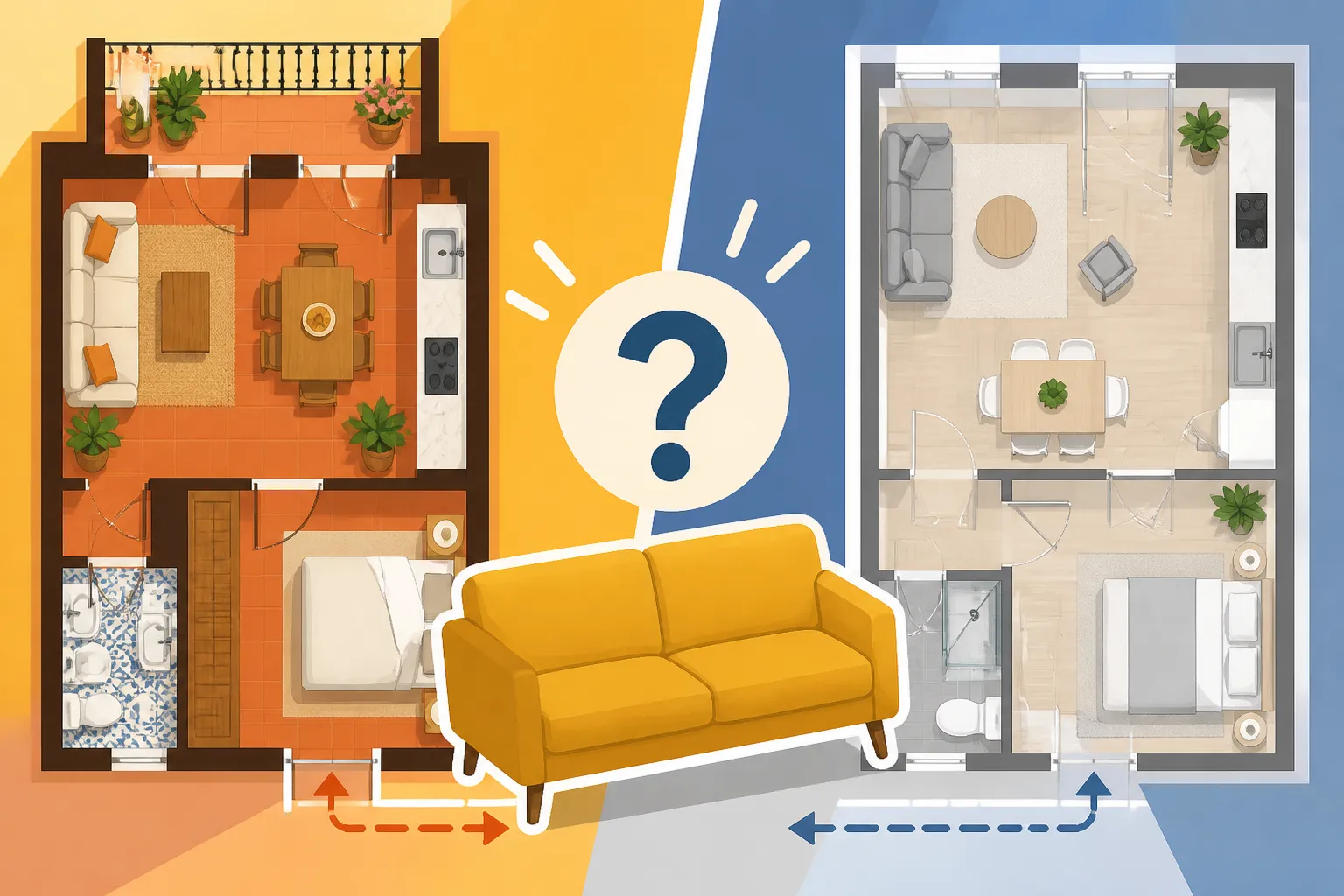
Will Your Furniture Fit? Spanish Apartment Layouts vs Northern European Homes
One of the biggest eye-openers when you first step into a Spanish apartment after years in a Northern European home is often the sheer difference in scale and design. What once seemed like a perfectly normal-sized sofa or wardrobe in your previous life might suddenly feel like a behemoth, destined to get stuck in the doorway. This guide is here to walk you through these subtle yet significant differences in apartment layouts, help you manage your expectations, and show you how to navigate the logistical maze of bringing your life – and your beloved furniture – to Spain, especially with the help of specialized moving solutions like Sirelo.
Disclosure: This post may contain affiliate links. We may earn a commission at no extra cost to you if you make a purchase through these links. Read full disclosure.
The Great Expectations vs. Spanish Reality: Why Your Sofa Might Not Fit
Moving to Spain is an exciting adventure, full of sunshine, new culinary delights, and a wonderfully vibrant culture. But for many of us, the practicalities hit hard, and one of the most surprising challenges often revolves around our furniture. You’ve painstakingly packed up your life, ready to embrace your new Spanish home, only to discover that your cherished possessions might not quite fit through the door, literally. This isn't just about measurement; it’s about fundamentally different architectural philosophies.
The Architectural Legacy: From Grand to Practical
Spanish architecture, particularly in urban areas and older buildings, often prioritizes a more compact and enclosed living space compared to the sprawling, open-plan designs prevalent in much of Northern Europe. Think about the historic city centers of places like Seville, Barcelona, or even the older parts of Madrid. Buildings are often tall, narrow, and built around internal courtyards, designed to maximize natural light and airflow in a hot climate, but not necessarily for moving oversized items.
Historically, homes were built with practical considerations for daily life and climate, not for furniture that needed to make a grand statement. Spaces were typically divided into many smaller rooms, with narrower hallways and more modest door frames. Even in more modern Spanish constructions, while layouts might be slightly more generous, the fundamental approach to space utilization still tends to be more conservative than, say, a brand-new build in Germany or the UK. This means that a standard three-seater sofa from IKEA in your old country might suddenly look like a small whale trying to squeeze into a goldfish bowl when faced with a Spanish living room and its accompanying entrance points.
Common Northern European Furniture Trends
In countries like the UK, Germany, the Netherlands, or Scandinavia, there’s been a strong trend towards larger, more imposing furniture. Think about the popularity of deep-seated sofas, often modular and expansive, designed to fill a spacious living room. Wardrobes often come as freestanding units, sometimes with triple or quadruple doors, built for generous storage in larger bedrooms. Dining tables can stretch to accommodate eight or ten people, assuming ample dining room space.
These furniture pieces are often chosen to complement larger rooms, wider hallways, and often, homes with more generous external access (think wider stairwells, larger lifts, or even ground-floor access directly from a street or garden). When you're used to these kinds of dimensions, it’s easy to overlook how much they dictate the size of your possessions. Many expats arrive in Spain with these assumptions firmly in mind, only to be met with a rude awakening. It's not just about the footprint of the furniture but also its height and depth – those luxurious deep sofas or tall, ornate wardrobes can become immediate roadblocks.
The Initial Shock: Space and Proportions
That first walk-through of your new Spanish apartment can be a moment of pure bliss, but it can also be a quiet moment of panic. The charming balcony, the rustic tile floors, the warm light – it’s all lovely. But then you start mentally placing your furniture. Where will that huge L-shaped sectional go? Will the antique armoire fit through that door? The reality is, many Spanish apartments, especially those with some character or in desirable urban locations, prioritize efficient use of space.
You might find living areas that feel cozier, kitchens that are perfectly functional but not sprawling, and bedrooms that are just big enough for a bed and a built-in wardrobe (more on those later!). This isn't a criticism; it's a design choice that reflects cultural habits and climate. Spaniards often spend more time outside the home, socializing in plazas, enjoying tapas, or simply taking a stroll. The home, while cherished, often serves a different primary function – a comfortable base, rather than a vast entertainment hub for sprawling furniture. This contrast in spatial philosophy is where the journey of adapting your furniture plan truly begins. Don't worry, many of us have been there, staring blankly at a narrow hallway, wondering how on earth we’re going to get anything in.
Deconstructing Spanish Apartment Layouts: What to Expect
Let's dive into the nitty-gritty of why your beautifully designed Scandinavian sideboard might struggle to find its place in a charming Spanish piso. It's not just about the overall square footage; it's about the specific architectural quirks that can make or break your furniture moving plan. Understanding these nuances upfront can save you a world of headaches and potential damage, which is why a well-planned move with a company like Sirelo is so invaluable.
Narrow Hallways and Doorframes: The First Obstacle
This is often the number one culprit for furniture-related angst. Compared to the wide, open entryways common in modern Northern European homes, Spanish apartments frequently feature narrower hallways, tighter turns, and often, smaller doorframes. This isn't just about front doors either; internal doors between rooms can be surprisingly compact.
Imagine this scenario: you've finally found your dream apartment in Valencia, a lovely spot near the Mercado Central. On paper, the living room is a decent size. But when the movers arrive, your glorious, deep sofa from your London flat gets stuck sideways in the building's entrance hall. Even if you manage that, the twisty staircase or the small, old-fashioned elevator (if there is one!) becomes the next challenge. Then, you face the actual apartment door, which might be narrower than what you're used to, and finally, the internal door to the living room, which could be smaller still. It's a series of gauntlets!
These narrow passages and doorways were often built with an eye towards insulation (keeping heat out in summer, warmth in winter) and structural integrity in older buildings. They weren't designed for flat-pack furniture or for the latest oversized, pre-assembled pieces. Even if a piece fits through one door, the next might be the bottleneck. This is where truly understanding the dimensions of all entry points – from the street entrance to the final room – becomes paramount.
Compact Rooms and Built-in Storage Solutions
Many Spanish apartments lean towards more compact, efficiently designed rooms. While they might still offer a comfortable living space, you’re less likely to find vast, empty expanses. This design philosophy often translates into clever, often integrated, storage solutions.
For instance, bedrooms in Spain frequently come with armarios empotrados – built-in wardrobes. These are a blessing and a curse. A blessing because they save space and provide ample storage without needing freestanding units. A curse because if you've already invested in a large, beautiful wardrobe from your previous home, it might now be redundant, or worse, there might simply be no wall space for it. Similarly, kitchens often feature custom cabinetry that perfectly fits the space, leaving little room for additional freestanding pantry units or large island carts you might be accustomed to.
The living areas might be designed for smaller, more intimate seating arrangements rather than vast sectionals. This means your furniture choices need to be more deliberate and proportionate to the room. It’s a good idea to consider the overall aesthetic and flow of the apartment. Will a giant piece of furniture dominate the room and make it feel cramped, or can you find pieces that enhance the space without overwhelming it? This is also a perfect opportunity to reassess your needs. Perhaps that massive dining table isn't necessary if you plan to enjoy most meals al fresco or at smaller tapas bars with friends.
Kitchens and Bathrooms: Function Over Grandeur
When it comes to kitchens and bathrooms, the Spanish approach often emphasizes function and durability over opulent size or lavish features. Kitchens, particularly in city apartments, are typically smaller and highly efficient. They'll have all the essentials – hob, oven, fridge, often a washing machine – but usually with less counter space and storage than you might be used to from a large Northern European kitchen.
This can impact your plans for large freestanding appliances, additional kitchen islands, or extensive pantry units. You might find that your American-style double-door fridge simply won't fit into the designated space, or even through the kitchen door itself! Similarly, bathrooms are usually compact, with showers being more common than large bathtubs, especially in apartments. Again, the focus is on efficient use of space and practicality.
If you’re planning to bring your own large appliances, paying meticulous attention to their dimensions, as well as the dimensions of your new Spanish kitchen, is non-negotiable. Don't forget to consider voltage differences too – Spain uses 230V, 50Hz, which is generally compatible with most European appliances but might require adapters or transformers for others. Understanding these specificities well in advance is crucial, and a professional moving service like Sirelo can provide invaluable advice on these common pitfalls, helping you make informed decisions about what to bring and what to replace.
The Practical Implications for Your Prized Possessions
So, you've grasped the general concept that Spanish apartments often have a different footprint. But what does that really mean for the specific items you've lovingly collected over the years? Let's get down to the brass tacks of which pieces of furniture commonly become sources of stress and what considerations you'll need to make.
Large Sofas and Sectionals: A Common Dilemma
This is perhaps the most frequent source of woe for expats moving to Spain. Your sprawling, comfortable, L-shaped sofa that was the centerpiece of your living room back home? It might not even make it past the building's entrance. Northern European furniture stores often sell sofas that are deep, long, and sometimes come as one solid, un-disassemblable unit.
In Spain, many sofas are designed to be more compact, with shallower depths, shorter lengths, and often, legs that can be easily removed. Modular sofas are becoming more popular everywhere, but even then, the individual sections can be bulky. The key issue isn't just whether it fits into the room, but how it gets there. Think about tight stairwells in apartment blocks, narrow elevator doors (if you’re lucky enough to have one!), and the often-angled entryways into flats. A sofa that’s too long can get stuck on a bend in a staircase, or simply be too deep to maneuver through a standard 70-80cm wide doorway, especially if the hallway leading to it is also narrow.
A good professional moving company, like those found through Sirelo, will ask about these kinds of items specifically. They might suggest professional disassembly and reassembly or even require external lifting equipment (like a grúa or furniture hoist) if the piece is truly massive and the internal access is impossible. These solutions come with extra costs, so knowing whether your sofa is a candidate for such measures beforehand is vital for budgeting and planning. Often, it's more cost-effective to sell the giant sofa and invest in a new, perfectly sized one in Spain.
Bulky Wardrobes and Storage Units
Another frequent offender is the freestanding wardrobe, especially those ornate, solid wood pieces that can be very heavy and difficult to dismantle. As we discussed, many Spanish bedrooms already have built-in wardrobes, which are incredibly practical but leave no space for your imposing antique armoire. Even if there isn't a built-in wardrobe, the wall space in Spanish bedrooms can be surprisingly limited once a bed is placed, especially if there are windows or balconies to consider.
Similarly, large bookcases, display cabinets, or extensive modular shelving units from your previous, more spacious home might simply overwhelm a smaller Spanish living room or study. The trend in Spain is often towards more minimalist, space-saving furniture, or again, custom-built shelving that maximizes vertical space without taking up too much floor area.
When assessing your wardrobes and storage units, consider:
- Dimensions: Not just width and height, but depth. Can it realistically be maneuvered through all entry points?
- Disassembly: Can it be fully dismantled into manageable pieces? If not, it becomes a single, large, unwieldy item.
- Redundancy: Is it truly needed, or will the apartment's existing built-in storage make it obsolete?
If you decide to bring these larger items, ensure your chosen mover is aware of their size and any special handling requirements. This pre-planning is exactly where a service like Sirelo shines, connecting you with movers who are experienced in navigating these unique challenges in Spain.
Appliances and White Goods: Voltage and Dimensions
While perhaps not "furniture," large appliances like refrigerators, washing machines, and dishwashers deserve a special mention. Beyond the physical dimensions and the challenge of getting them into the apartment, there's the critical consideration of electrical compatibility.
Spain operates on a 230V, 50Hz electrical system. If you're moving from another European country, your appliances will likely be compatible. However, if you're coming from North America (120V, 60Hz) or certain other regions, your appliances will absolutely require a voltage transformer, which can be expensive, heavy, and potentially problematic for high-wattage items. Moreover, even with a transformer, the frequency difference (50Hz vs 60Hz) can affect motors in appliances, potentially shortening their lifespan or causing them to run less efficiently.
Then there are the dimensions. Spanish kitchens often have specific recesses for appliances. A standard European-sized fridge or dishwasher will likely fit, but a large American-style fridge-freezer, especially the wider models, may simply not fit into the designated kitchen space, or through the narrow kitchen doorway. Washing machines are often placed in kitchens, utility cupboards, or on balconies (galerías), so check for water hookups and drainage in these specific spots.
Before you even consider shipping large appliances, meticulously check:
- Voltage and frequency requirements against Spain's standards.
- Exact dimensions of your appliances.
- Exact dimensions of the available spaces and all doorways/hallways in your new Spanish home.
Sometimes, despite the initial cost, purchasing new appliances in Spain is the simpler and safer option, guaranteeing compatibility and fitting dimensions. For guidance on budgeting for these kinds of costs, checking resources like "Cost of Living in Spain: Realistic Budgets and Savings Tips" can be incredibly helpful.
Strategies for a Smooth Transition: Adapting Your Furniture Plan
Alright, we've laid out the potential pitfalls. Now, let's talk solutions. Moving to Spain doesn't have to be a nightmare of jammed sofas and incompatible appliances. With a bit of foresight and the right approach, you can ensure a much smoother transition for your home and your belongings.
Measure Twice, Move Once: The Golden Rule
This might sound like a no-brainer, but you’d be surprised how many people gloss over this critical step. Before anything leaves your old home, or before you even commit to bringing certain items, you must measure everything. And I mean everything.
Here’s a checklist of what to measure:
- Your existing furniture: Length, width, and crucially, depth and height. For sofas, note if legs are removable. For wardrobes, can they be fully disassembled?
- Your new Spanish home:
- Main entrance: Building door, gate, any communal hallway width.
- Elevator: If applicable, check door width, depth, and internal height.
- Stairwells: Width, height clearance, and especially the dimensions of any landings or turns. This is often the trickiest part!
- Apartment front door: Width and height.
- Internal doorways: To the living room, bedrooms, kitchen, bathroom – every single door.
- Room dimensions: Particularly critical for large items like beds, sofas, and dining tables.
- Appliance recesses: If your kitchen has specific spots for a fridge or dishwasher, measure these precisely.
Create a simple floor plan of your new place with these measurements marked out. You can even use painter's tape on the floor or cardboard cutouts to simulate furniture placement. Don’t rely solely on online floor plans; they often don't include crucial doorway or hallway widths. If you're still abroad, ask your rental agent or landlord to send you detailed measurements, ideally with photos. This meticulous approach will help you determine which items are definite keepers, which are definite no-gos, and which might require special handling. This is a foundational step, much like completing your "Spain Relocation Checklist: First 30 Days for New Residents."
Downsizing and Decluttering: A Fresh Start
Honestly, moving internationally is the perfect excuse for a ruthless declutter. Do you really need every single piece of furniture you own? Given the potential costs and complexities of shipping oversized items, this is an excellent opportunity to shed unnecessary baggage and embrace a more minimalist lifestyle, or at least one better suited to your new Spanish home.
Consider the following:
- Emotional vs. Practical Value: Is that old armchair truly irreplaceable, or does it just hold sentimental value that can be preserved in photos?
- Cost vs. Replacement: Factor in the shipping cost for a bulky item. Would it be cheaper to sell it and buy a similar (or better) piece in Spain?
- Fit and Functionality: Even if it can be shipped, will it actually fit comfortably and functionally in your new space, or will it dominate the room and make it feel cramped?
- Duplicate Items: Do you really need two sets of everything if your new place is smaller?
Selling or donating items you no longer need can offset some of your moving costs and significantly reduce the volume and weight of your shipment. This not only saves you money but also reduces stress and the likelihood of items getting damaged trying to force them into a space they simply don’t belong in. Think of it as liberating your future self!
Professional Moving Services: Your Best Ally
When facing the unique challenges of moving internationally, especially when dealing with differing architectural styles and furniture dimensions, a professional moving service isn't just a luxury; it's often a necessity. This is precisely where a platform like Sirelo becomes your absolute best ally.
Instead of trying to coordinate multiple vendors, decipher obscure local regulations, and worry about the specific equipment needed to navigate Spain's charming but sometimes tricky apartment buildings, you can leverage Sirelo's expertise. Sirelo connects you with reputable, experienced international moving companies who understand the nuances of relocating to Spain. They can provide quotes tailored to your specific needs, whether you're shipping a full container or just a few carefully selected pieces.
These professionals aren't just about loading boxes; they offer a comprehensive service. They can advise on what items are likely to cause problems, suggest appropriate packing methods for delicate or unusual pieces, and even arrange for specialized equipment like external furniture hoists if internal access is deemed impossible. This foresight and capability are invaluable, transforming a potentially nightmarish logistical puzzle into a much smoother, more predictable process. Remember, a cheap move isn't always the best move, especially when your most valuable possessions are on the line. Trusting a proven service like Sirelo can save you money and headaches in the long run.
Why Planning Your Move with Sirelo is a Game-Changer
When you're trying to figure out how to transport your life across borders, especially to a country with distinct architectural characteristics like Spain, you quickly realize it's not just about finding a van. It's about logistics, expertise, and peace of mind. That’s where Sirelo truly distinguishes itself for expats. They don't just move boxes; they provide a comprehensive service designed to tackle the specific challenges of international relocation to Spain.
Expert Assessment and Tailored Solutions
One of the biggest advantages of using a platform like Sirelo is gaining access to movers who offer expert pre-move assessments. This isn't just someone glancing at your furniture; it's a detailed evaluation of your inventory, combined with an understanding of your destination in Spain.
Imagine a mover, facilitated by Sirelo, conducting a virtual or in-person survey. They'll ask about those problematic items – the oversized sofa, the solid wood wardrobe, the American-sized fridge. They’ll inquire about the access to your new Spanish apartment: Is it on the fifth floor of an old building with no elevator? Are the stairs narrow? Is there a balcony that might allow for a furniture hoist? This level of detail allows them to propose tailored solutions. They might recommend disassembling certain pieces, specifically packaging delicate items for narrow passages, or planning for external lifting equipment, also known as a grúa, which is quite common in Spanish cities for moving large items into upper-floor apartments. Without this expert assessment, you might arrive in Spain only to find your most treasured pieces literally stuck on the street, leading to last-minute panic and unexpected costs. Sirelo helps you avoid that nightmare by connecting you with professionals who see these issues coming a mile away.
Handling Logistics for Awkward Items
Spain’s urban landscape, with its charming but often compact buildings, can pose unique challenges for moving companies. Maneuvering large items through tight stairwells, narrow doorways, and sometimes even busy pedestrian streets requires skill, specialized equipment, and careful planning. Sirelo-affiliated movers are well-versed in these logistical hurdles.
They have the experience to:
- Coordinate external hoists: If your sofa absolutely won't fit through the door, they can arrange for a grúa to lift it directly to your balcony or window, providing the safest and most efficient solution.
- Disassemble and reassemble furniture: Many complex furniture pieces (especially from Northern European brands like IKEA or similar large retailers) can be taken apart and put back together. Professionals know how to do this correctly, ensuring your items remain intact.
- Navigate urban environments: Driving larger moving trucks through historic city centers can be complex, often requiring special permits or navigating pedestrian zones. The companies found through Sirelo are experienced in these local regulations, ensuring a smooth delivery process right to your door.
This specialized logistical expertise saves you immense stress. Trying to coordinate these elements yourself, especially in a new country and a new language, can be overwhelming. Relying on the proven network of movers found on Sirelo means you’re working with people who have done this countless times before and know how to get the job done efficiently and safely. This ensures your valuable possessions arrive ready for their new life in Spain.
The Peace of Mind of a Seamless Relocation
Ultimately, choosing to plan your move with Sirelo is about investing in peace of mind. Relocating internationally is a monumental task, filled with bureaucratic hurdles (like figuring out your NIE, TIE, and Empadronamiento), language barriers, and countless details to manage. Adding the stress of whether your furniture will actually make it into your new home can push anyone to their limit.
Sirelo simplifies the entire process by:
- Providing transparency: You get multiple quotes from reputable movers, allowing you to compare services and costs clearly.
- Offering reliable partners: The movers on Sirelo’s platform are vetted, meaning you’re not just picking a name out of a hat. You're getting companies with a track record of successful international moves.
- Saving time and effort: Instead of spending hours researching and contacting individual moving companies, Sirelo streamlines the search, connecting you with qualified professionals quickly.
Knowing that the complex task of transporting your belongings is in capable hands frees you up to focus on other crucial aspects of settling into Spain, such as exploring your new neighborhood, getting your utilities set up, or even just enjoying a well-deserved tinto de verano. A smooth, stress-free move, facilitated by Sirelo, allows you to start your expat life in Spain on the right foot, with your home feeling truly like home from day one. When you're thinking about moving your furniture, think Sirelo.
Buying New vs. Shipping Old: Weighing Your Options
This is a crossroads many expats face. Do you hold onto your cherished furniture, or do you start fresh in Spain? There’s no single right answer, and the best choice depends on a blend of practical, financial, and emotional factors.
The Cost of Shipping vs. Replacing
Financially, shipping large, bulky items internationally can be surprisingly expensive. The cost is usually determined by volume (cubic meters), weight, and distance. For a full container, it might make sense, but for just a few oversized items, the cost per item can quickly escalate. This is especially true if special handling, disassembly, or external hoists are required at either end.
To get a realistic picture, you need to:
- Get a detailed quote for shipping: Use a service like Sirelo to get comparative quotes for your specific inventory. Make sure these quotes include all potential charges like customs clearance, port fees, and delivery to your final apartment, including any special equipment.
- Research replacement costs in Spain: Look at furniture stores in Spain. What would a comparable sofa, bed, or wardrobe cost? Consider a range of options from budget-friendly (IKEA, Conforama) to mid-range (El Corte Inglés, smaller local stores) to high-end. Remember to factor in delivery and assembly costs for new purchases.
- Factor in customs duties and taxes: While personal effects are often exempt, there are rules and processes. Make sure you understand these, possibly consulting a local gestor (administrative consultant) if needed. This is key to understanding the true cost.
Sometimes, a quick calculation reveals that selling your old furniture and using that money to buy new pieces in Spain is the more financially sound decision. This is especially true for items like beds (where Spanish mattress sizes, e.g., matrimonio 135x190cm or 150x200cm, can differ from what you’re used to), or large appliances.
Furnishing Your Spanish Home Locally
Opting to furnish your home in Spain opens up a world of possibilities and can be a fantastic way to immerse yourself in local culture and style. You’ll find a wide array of options to suit various budgets and tastes.
- Large retailers: IKEA, Conforama, JYSK, and Maisons du Monde are popular choices, offering modern and functional furniture. IKEA, in particular, has a strong presence and offers many flat-pack solutions that are easy to transport and assemble, a stark contrast to bulky pre-assembled items.
- Department stores: El Corte Inglés offers a more upscale selection, often with good quality and design.
- Local furniture shops: Many towns and cities have independent furniture stores (mueblerías) that offer a range of styles, from traditional Spanish to contemporary. These can be great for finding unique pieces that truly fit the local aesthetic.
- Second-hand options: For budget-conscious expats or those seeking vintage finds, look to online marketplaces like Wallapop, Facebook Marketplace groups, or local charity shops and mercadillos. This is a sustainable and often more affordable way to furnish your home. You can find more tips in "Furnishing a Home in Spain: Stores, Delivery, and Budget Tips."
Buying locally means your furniture will almost certainly be designed with Spanish apartment dimensions in mind, making delivery and installation much smoother. It also gives you the chance to infuse your new home with a distinctly Spanish feel, rather than simply replicating your old one.
The Emotional Value of Your Belongings
While the financial and practical aspects are crucial, don't underestimate the emotional connection you have to your belongings. Some pieces of furniture aren't just wood and fabric; they're imbued with memories, family history, or simply represent your personal style. For some, bringing a cherished family heirloom or a beloved piece of art is non-negotiable, regardless of the cost or logistical challenges.
If an item holds significant emotional value, then it might be worth the extra expense and effort to ship it. This is where a service like Sirelo becomes invaluable, as they can help you find movers who specialize in handling delicate or high-value items with the care they deserve. They understand that some things are more than just cargo.
However, it's also worth considering if a truly oversized item will actually bring you joy if it makes your new Spanish home feel cramped or awkward. Sometimes, the best way to honor a memory is to let go and create new ones in your beautifully adapted Spanish space. It's a personal decision, but one best made with a clear understanding of all the implications, both practical and emotional. Planning ahead, possibly by getting a few quotes for shipping (via Sirelo) and comparing them to replacement costs, allows you to make an informed choice that balances your heart and your budget. For other important considerations when planning your move, check out "Shipping Personal Belongings to Spain: Customs and Timing."
Disclaimer
Please remember that while this guide provides general advice and insights based on common expat experiences in Spain, individual circumstances can vary greatly. Architectural styles, apartment dimensions, and local regulations can differ between cities and regions within Spain. Always conduct your own thorough research, obtain specific measurements for your new home, and consult with professional moving companies (like those found through Sirelo) and legal or administrative advisors for personalized advice regarding your specific move and items. Laws and regulations, especially concerning imports and residency, are subject to change.