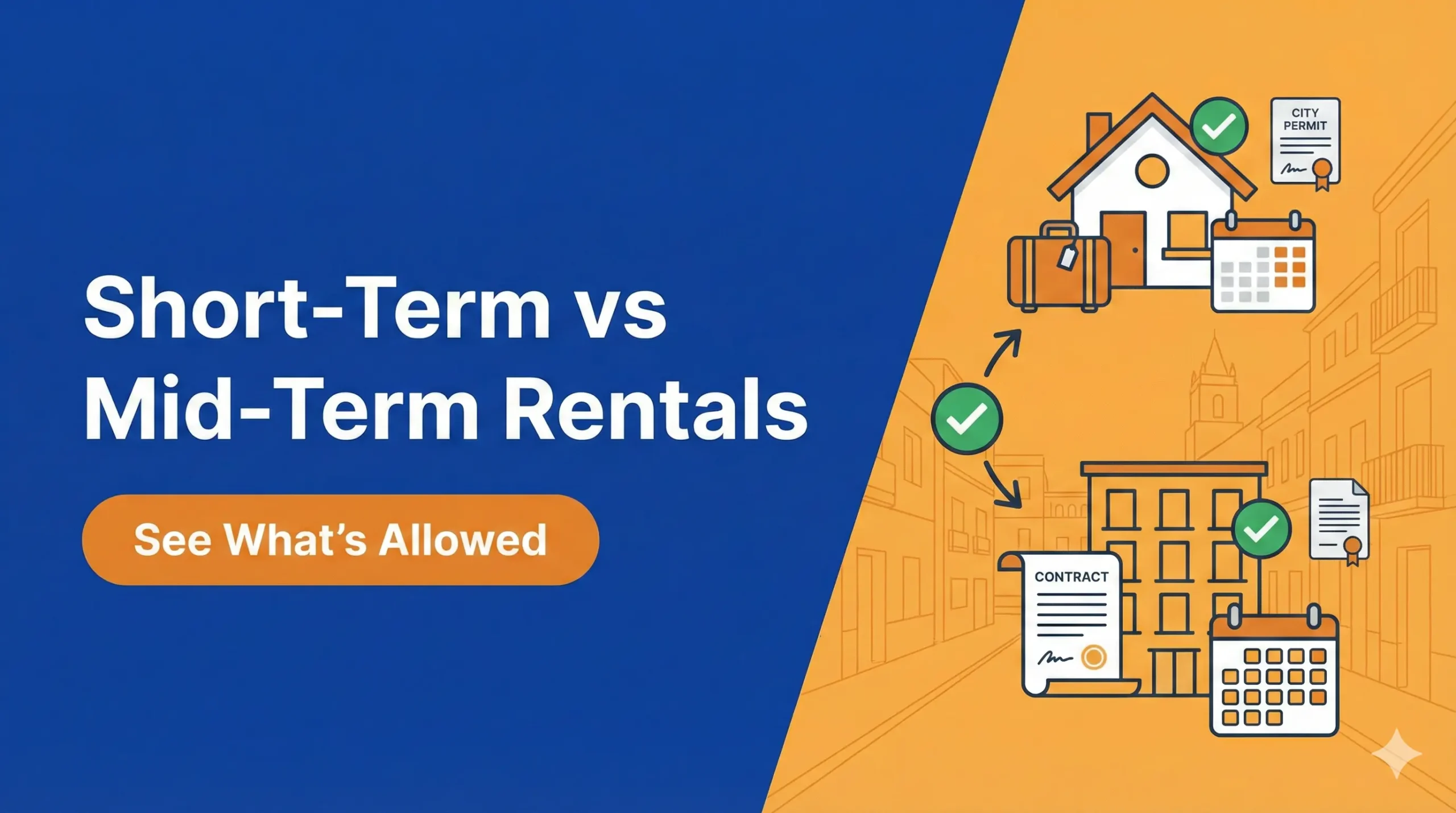
Short‑Term vs Mid‑Term Rentals in Spain: What’s Allowed
Navigating the Spanish rental market requires distinguishing between tourist rentals, which need licenses, and mid-term seasonal contracts, which are governed by specific clauses in the LAU. This guide explains the legal differences, tenant rights, and why choosing the wrong contract type can cost you thousands or leave you unprotected.
Disclosure: This post may contain affiliate links. We may earn a commission at no extra cost to you if you make a purchase through these links. Read full disclosure.
Defining the Categories: Time Matters
In Spain, the intended use of the property and the duration of the stay determine the legal category of the rental. It is not enough to simply say “I am renting for three months.” The law looks at why you are renting.
Short-Term Rentals (Viviendas de Uso Turístico)
These are commonly known as “Airbnb-style” rentals.
- Duration: Typically days or weeks, up to 31 days.
- Purpose: Leisure, tourism, or holiday.
- Regulation: Governed by Regional Tourism Laws, not the national rental law (LAU).
- Requirement: Mandatory Tourist License (Licencia Turística).
Mid-Term Rentals (Alquiler de Temporada)
These are the “grey area” that is currently booming.
- Duration: Typically 32 days to 11 months.
- Purpose: Work, study, medical treatment, or temporary relocation where the tenant has a permanent home elsewhere.
- Regulation: Governed by the LAU (Urban Leases Act), specifically Article 3 (Use other than housing).
- Requirement: Proof of temporary cause (Causa de temporalidad). No license is generally needed, though some regions are introducing registries.
Long-Term Rentals (Vivienda Habitual)
- Duration: 1 year or more (with rights to extend).
- Purpose: Permanent residence.
- Regulation: Governed by the LAU, specifically Article 2.
- Requirement: Grants the tenant powerful rights regarding eviction protection and rent caps.
Understanding these definitions is the first step. If you are searching for a home, you must be able to identify which contract is being offered to you. For a broader overview of how to spot these listings online, refer to our guide on Finding Long-Term Rentals in Spain: Best Websites and Strategies.
The Short-Term Tourist Rental: A Regulatory Minefield
Short-term rentals have faced the harshest crackdown in Spanish history. In an effort to curb over-tourism and solve the housing crisis, cities like Barcelona, Madrid, and Valencia have imposed strict limitations.
The Tourist License Requirement
You cannot legally rent out an apartment for days or weeks without a tourist license. This license number must be visible in any online advertisement (Airbnb, Booking.com).
- The Freeze: Many cities have issued a moratorium on new licenses. In Barcelona, the city council has announced plans to eliminate all tourist apartments by 2028.
- The Fines: Operating without a license is considered a “very serious infraction.” Fines can range from €6,000 to €600,000 depending on the region.
Tenant Obligations in Tourist Rentals
If you are the guest, your obligations are minimal, but strict.
- Passport Registration: By law, the host must register the passport details of every guest over the age of 14 with the police (Guardia Civil or Policía Nacional) within 24 hours of arrival. This is part of the strict Hospederías record-keeping.
- Tourist Tax: In regions like Catalonia or the Balearic Islands, you must pay a nightly tourist tax (Tasa Turística) per person.
Why You Cannot “Live” in a Tourist Rental
A tourist rental is not designed for residency. You cannot register on the Padrón (municipal census) at a tourist apartment. Without the Padrón, you cannot access healthcare, get a TIE residency card, or enroll children in school. If you are moving to Spain to live, booking an Airbnb for three months is fine for a landing pad, but it is a dead end for administrative settlement. You will eventually need to transition to a residential contract to complete steps like Empadronamiento in Spain: How to Register Your Address.
The Mid-Term Seasonal Contract: The Loophole Explained
This is the most critical section for expats. Due to the strict rent controls imposed on long-term rentals by the new Housing Law, landlords have flooded the market with Seasonal Contracts (Alquiler de Temporada).
What is a Seasonal Contract?
A seasonal contract is a lease for “use other than permanent housing.” It is regulated by the LAU, but it is exempt from the strict tenant protections found in standard housing contracts.
- No Rent Caps: The landlord can set the price freely and raise it as much as they want after the contract ends.
- No Extension Rights: Unlike a standard contract which allows tenants to stay for 5 to 7 years, a seasonal contract ends on the exact day written in the clause. You have no right to renew.
- Agency Fees: While landlords must pay agency fees for long-term rentals, tenants often still pay the fees for seasonal rentals (though this is legally contested in some interpretations, it remains common practice).
The “Causa de Temporalidad”
To be legal, a seasonal contract must justify why it is temporary. It is not enough to just say “11 months.” The contract must explicitly state the reason for the temporary stay and the tenant must have a permanent residence elsewhere.
- Valid Causes:
- Study program (University/Master’s).
- Temporary work assignment or internship.
- Medical treatment.
- House renovations at the primary residence.
- Digital Nomads testing a city (grey area).
If a landlord offers you an 11-month seasonal contract for your permanent home just to avoid rent control laws, this is considered fraud of law (fraude de ley). You can sign it, move in, and then legally challenge it to be recognized as a standard long-term contract. However, this requires legal action.
To spot if you are being pushed into one of these contracts unfairly, check the “Duration” clause carefully against the advice in Renting in Spain: Contracts, Deposits, and Tenant Rights.
Comparison of Rights: Short vs Mid vs Long Term
The following table highlights the massive differences in your rights depending on the contract type.
| Feature | Short-Term (Tourist) | Mid-Term (Seasonal) | Long-Term (Housing) |
| Primary Law | Tourism Regulations | LAU (Article 3) | LAU (Article 2) |
| License Required | YES (Mandatory) | No (Usually) | No |
| Maximum Duration | ~31 Days | 11 Months (Typical) | 5 Years (Renewable) |
| Deposit (Fianza) | Variable / Platform rules | 2 Months (Legal min) | 1 Month (Legal min) |
| Rent Controls | None | None | Yes (In Stressed Zones) |
| Agency Fees | Commission in price | Tenant often pays | Landlord must pay |
| Eviction Protection | Low (Police eviction) | Low (End of contract) | High (Strict process) |
| Padrón (Census) | No | Sometimes (Depends on duration) | Yes (Mandatory) |
The Deposit Difference
One of the tell-tale signs of a seasonal contract is the deposit.
- Long-Term: The legal deposit (fianza) is strictly one month’s rent.
- Mid-Term/Seasonal: The legal deposit is two months’ rent.
If you are looking at a listing for an 11-month stay and they ask for two months of deposit, it is a seasonal contract. This higher entry cost is something you must factor into your initial savings. To see how these upfront costs affect your overall relocation budget, review the Cost of Living in Spain: Monthly Budget Guide for Expats.
Regional Variations: Barcelona and Madrid
Spain is a decentralized country, and regional governments have significant power over housing and tourism.
Barcelona (Catalonia)
Catalonia is the strictest region.
- Tourist Rentals: No new licenses are being issued. The city aims to revoke all existing licenses by late 2028.
- Seasonal Rentals: The Catalan government passed a decree attempting to regulate seasonal rentals more strictly, requiring landlords to prove the temporary nature or face heavy fines. If you are renting in Barcelona, expect rigorous checks on your “reason for stay.”
Madrid
Madrid is more permissive but is tightening its belt.
- Tourist Rentals: The city is cracking down on rentals that do not have a private entrance (i.e., tourists cannot use the same hallway as residents). This effectively bans Airbnb in most apartment blocks in the center.
- Seasonal Rentals: Highly prevalent. Landlords prefer them to avoid the 5-year commitment. It is very difficult to find a standard long-term rental in central Madrid without a very strong Spanish employment contract.
Scams and Risks in the Mid-Term Market
The mid-term market is a hotspot for scams because it attracts foreigners who need housing before they arrive but cannot view properties in person.
The “Fake Seasonal” Scam
Scammers know that seasonal rentals often require higher upfront payments (2 months deposit + 1 month rent + agency fee). They create listings for beautiful apartments at mid-range prices, claim they are for “mid-term stays only,” and demand a bank transfer to “reserve” the property.
- Red Flag: If the landlord refuses a video call or cannot provide proof of ownership (like an IBI receipt).
- Prevention: Always verify the existence of the property. Using reputable platforms like Spotahome (which verifies listings) can be safer for mid-term needs, though more expensive.
For a detailed list of red flags to watch for during your search, read How to Avoid Rental Scams in Spain: Red Flags for Newcomers.
Strategies for Negotiating the Right Contract
If you are moving to Spain to live permanently, you should fight for a long-term contract (Vivienda Habitual). Here is how to handle the negotiation:
- Demonstrate Permanence: Provide an indefinite employment contract (contrato indefinido) or proof of university enrollment for 4 years. Show that you are not just passing through.
- Offer Security: Landlords fear non-payment. Offering to pay for Rental Default Insurance (Seguro de Impago) can sometimes convince a landlord to switch from a seasonal offer to a long-term one.
- Check the “Causa”: If you must sign a seasonal contract because you have no other choice, ensure the “cause” listed is accurate. If you are a student, state “studies.” If the contract says “vacation” but you are studying, you could have trouble later if you try to claim residency rights.
Tax Implications for Landlords
If you are an owner looking to rent out your Spanish property, the distinction is equally vital for your tax bill.
- Long-Term: You enjoy a significant tax reduction. You can deduct 50% to 90% of the net rental income from your tax return (IRPF), depending on the zone and the rent price reduction you offer.
- Seasonal/Tourist: You get zero reductions. You pay tax on the full net profit. Additionally, for tourist rentals, you must charge VAT (IVA) if you provide hotel-like services (cleaning, breakfast), which adds complex quarterly filing requirements.
The Future of “Alquiler de Temporada”
The Spanish government has identified the seasonal rental market as a major loophole undermining the Housing Law. In 2026, we expect new national regulations that will create a single digital registry for all short and mid-term rentals.
- The Proposal: Before listing a property on a platform, the landlord will have to obtain a registration number. This number will only be issued if they prove the property is compliant with local laws.
- Impact: This will likely reduce the supply of seasonal rentals and force more properties back into the long-term residential market, theoretically lowering prices but potentially making it harder for digital nomads to find flexible housing.
Conclusion
The distinction between short-term and mid-term rentals in Spain is not just a matter of semantics; it is the difference between a holiday fling and a legal relationship.
- Short-Term (Tourist): Strictly for holidays. Needs a license. Highly restricted.
- Mid-Term (Seasonal): For temporary relocation. No license, but fewer rights. Expensive entry (2 months deposit).
- Long-Term: For living. Maximum protection.
If you are a digital nomad or a student coming for 9 months, the Mid-Term Seasonal Contract is your designated lane. It offers flexibility without the need for a 5-year commitment. However, if you are moving to Spain to build a life, do not let yourself be pushed into a seasonal contract permanently. It leaves you vulnerable to eviction and rent hikes at the end of every term.
Secure your status, know your “causa,” and ensure the contract you sign reflects the reality of your life in Spain. Once you are settled, the next step is ensuring your paperwork matches your living situation; our guide on Spanish Bureaucracy for Daily Life: Padrón, IDs, and Local Services will help you align your new address with the government databases.
References
Primary sources (official)
- Boletín Oficial del Estado (BOE) – Ley de Arrendamientos Urbanos (LAU): https://www.boe.es/buscar/act.php?id=BOE-A-1994-26003
- Ministry of Housing and Urban Agenda (Seasonal Rental Proposals): https://www.mivau.gob.es/
- Agencia Tributaria (Taxation of Rentals): https://sede.agenciatributaria.gob.es/
- Ajuntament de Barcelona (PEUAT – Tourist Licenses): https://ajuntament.barcelona.cat/
Other helpful sources
- Idealista News (Seasonal Contract Analysis): https://www.idealista.com/news/inmobiliario/vivienda
- Fotocasa Life (Rental Guides): https://www.fotocasa.es/fotocasa-life/alquiler/
- El País (Housing Law Updates 2025): https://elpais.com/economia/vivienda/
Disclaimer
The information provided in this article is for educational and informational purposes only and does not constitute legal or real estate advice. Rental laws in Spain, particularly regarding tourist licenses and the regulation of seasonal contracts, are subject to frequent changes by national and regional authorities. We strongly recommend consulting with a qualified lawyer or ‘gestor’ before signing any rental contract or listing a property for rent.