How to Set Up Water Service in Spain If It’s Not Included
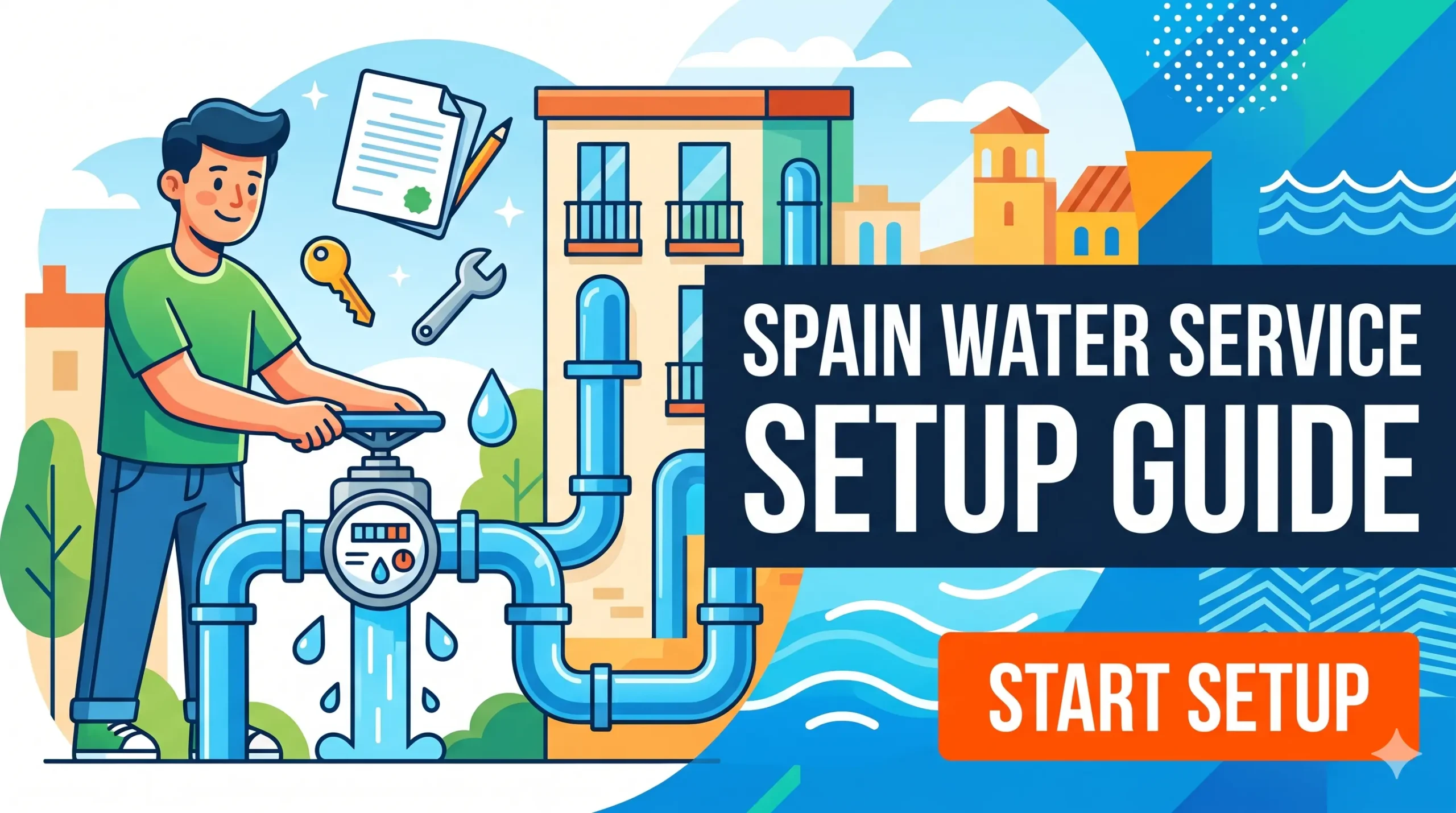
Turning on the tap in your new Spanish apartment only to hear a hollow hiss of air is a terrifying expat initiation. I once spent four unwashed days hauling bottled water up three flights of stairs because I assumed water was automatically connected. This guide explains how to navigate municipal monopolies, change contract names, and get your water flowing immediately.
Disclosure: This post may contain affiliate links. We may earn a commission at no extra cost to you if you make a purchase through these links. Read full disclosure.
Understanding the Spanish Water Monopoly
When you move into a flat in Spain, the utilities are rarely included in your monthly rent. While setting up electricity and broadband allows you to shop around in a liberalized free market, water operates under a completely different, highly rigid system.
You Cannot Choose Your Provider
Unlike other household utilities, water (agua) in Spain is heavily monopolized at the municipal or regional level. You cannot compare rates or choose a “cheaper” water provider. The company that services your address is determined entirely by where your apartment is located.
For example, if you live in the Community of Madrid, your water is exclusively managed by Canal de Isabel II. If you live in Barcelona, you must use Aigües de Barcelona (part of Grupo Agbar), and in Seville, the provider is Emasesa. Because these are localized monopolies, their digital portals and customer service hours vary wildly. Some offer sleek mobile apps, while others require you to book a physical appointment at the local town hall (ayuntamiento). Getting a grip on this regional fragmentation is a core step in understanding your total monthly liabilities, which you can map out by reading Utility Costs in Spain: Electricity, Gas, Water, and Internet.
Cambio de Titular vs. Alta Nueva
The speed at which you get water depends entirely on what the previous tenant or landlord did before you moved in. You will face one of two scenarios:
1. Cambio de Titular (Change of Name): If the water is still actively running but is under the landlord’s or previous tenant’s name, you simply need to execute a cambio de titularidad. This administrative swap is usually free or incurs a very small administrative fee. The water never shuts off during this process; the billing simply shifts to your bank account.
2. Alta Nueva (New Connection): If the previous tenant officially canceled the contract (dar de baja), the water meter has been physically locked or removed. You must request an alta de agua to establish a brand-new connection. This is a massive headache. It can take up to two weeks for a technician to arrive, and the water company will charge a setup fee ranging from 50 to 200 euros depending on the municipality. To ensure you have sufficient liquid capital to cover these sudden, unexpected connection fees, carefully review Renting in Spain: How to Budget for Deposits, Fees, and Utilities.
The Administrative Steps to Connect Your Water
Registering your water supply requires intense bureaucratic coordination. You cannot simply call the water company and give them your name; you must legally prove you have the right to occupy the property.
Required Documents for the Water Board
Whether you are doing an alta or a cambio de titular, the municipal water board will demand a specific stack of documents. If you are doing this online, the portals frequently crash or time out. Having a reliable home internet connection from an expat-friendly provider like Tiekom ensures you can steadily upload these heavy PDF files and translate the dense Spanish legal portals without losing your session.
You will need to provide:
- Your ID: A valid passport, NIE, or TIE card.
- Proof of Occupancy: Your signed Contrato de Arrendamiento (rental lease) or property deeds.
- Meter Reading: The exact physical numbers currently displayed on your water meter (lectura del contador).
- Cédula de Habitabilidad / Boletín de Agua: If you are requesting an alta nueva on a very old or newly renovated flat, the water company may require a technical certificate proving the plumbing is safe.
Often, landlords try to keep the water bill in their name and simply forward you a PDF to pay each month. While this sounds convenient, it removes your legal control over the utility and can lead to massive disputes if there is a sudden leak. To navigate how utility control is legally structured within your lease, deeply review Student Housing in Spain: Options and Typical Contracts. Furthermore, some strict municipal water boards will not activate your account unless you can prove you are officially registered at that address; familiarize yourself with How to Get a Spanish ‘Certificado de Empadronamiento’ Copy to prevent application delays.
Setting Up Direct Debit and Billing
Spanish utility companies do not want you paying by credit card every month. They require a domiciliación bancaria (direct debit). You must provide the water company with an IBAN (International Bank Account Number).
While some regional water companies will accept any European IBAN under SEPA laws, archaic local water boards often reject foreign accounts and strictly require a localized Spanish bank account. Establishing this financial infrastructure quickly is vital to preventing your utilities from bouncing. To set this up efficiently before the first billing cycle hits, read Opening a Bank Account in Spain as a Non-Resident.
If you are forced to wait two weeks for a technician to arrive for an alta nueva, you cannot live in an apartment with dry taps. Veteran expats bypass the heavy lifting of local supermarkets by immediately ordering massive, 5-liter emergency water jugs and basic sanitation wipes directly from Amazon Spain to survive the agonizing gap between move-in day and activation day.
| Process Type | Water Status | Cost | Timeline |
| Cambio de Titular | Water is flowing | Free or very low fee | Instant to 48 hours (Billing transfer only) |
| Alta Nueva | Taps are dry | €50 – €200 setup fee | 5 to 15 days (Requires technician visit) |
Dealing With Hard Water and Apartment Quirks
Once the water is finally flowing, expats face a new, uniquely Mediterranean shock: the aggressive physical quality of Spanish tap water.
Surviving the Cal (Limescale)
While tap water across Spain is entirely safe and heavily regulated for drinking, the coastal regions and southern provinces suffer from extremely “hard” water. Cities like Barcelona, Valencia, and Alicante have tap water packed with high levels of calcium and magnesium, known locally as cal.
Drinking the cal-heavy water straight from the tap has an unpleasant, chalky taste that takes months to get used to. More importantly, this hard water destroys hair, dries out skin, and absolutely ruins household appliances like washing machines and electric kettles.
Do not waste your money constantly buying single-use plastic water bottles. Instead, proactively order a heavy-duty Brita pitcher and replacement filters from Amazon Spain to ensure your drinking water tastes clean. To save your skin and hair, ordering an inline, hard-water filtering showerhead from Amazon Spain is an absolute expat lifesaver. You will also quickly learn that keeping your bathroom glass clean requires specialized chemical descalers. Ordering bulk bottles of Viakal or similar anti-limescale cleaning supplies from Amazon Spain saves you from dragging heavy cleaning chemicals home on the metro.
What to Do If the Pipes Leak
Classic Spanish apartments, especially in the historic centers, feature incredibly old, delicate plumbing hidden behind hollow brick walls. Because the water pressure in these older buildings can fluctuate wildly, pipe bursts are an unfortunately common expat experience. Understanding exactly where your apartment’s main water shutoff valve (llave de paso) is located is your first line of defense; this architectural quirk is often buried in the fine print discussed in Spanish Apartment Sizes: m², Floor Numbers, and Listing Terms Explained.
If your kitchen sink suddenly starts leaking and flooding the floor, you cannot just call the municipal water company. The water company is only responsible for the pipes up to the physical meter; anything inside the walls of the apartment is the landlord’s or tenant’s responsibility. To prevent water damage from leaking down into the neighbor’s flat below—which will instantly trigger a massive fight with the building president—you must understand community liabilities, a dynamic explored in How to Deal With Spanish Building Rules (Pets, Noise, Renovations).
When disaster strikes, you need immediate, private help. Instead of frantically searching for local tradesmen in broken Spanish while water pools around your ankles, rely on a stable mobile data connection from Tiekom to quickly source emergency repair contacts or translate technical plumbing terms on the fly. To ensure you know exactly who to call before an emergency ruins your flat, meticulously review How to Find an English-Speaking Plumber/Electrician in Spain.
References
Primary sources (official)
- Canal de Isabel II (Madrid Water Board) – Gestiones y Trámites: https://oficinavirtual.canaldeisabelsegunda.es/
- Aigües de Barcelona – Trámites de Alta y Cambio de Nombre: https://www.aiguesdebarcelona.cat/es/
Other helpful sources
- Expatica – Setting up utilities in Spain: water, gas, and electricity: https://www.expatica.com/es/living/household/utilities-spain-101411/
- Dave in Spain – Easy Step-by-Step Guide: Setting Up Utilities and Services in Spain for Expats: https://daveinspain.com/setting-up-utilities-and-services-in-spain/
Disclaimer
The information provided in this article is for educational and informational purposes only and does not constitute formal legal, administrative, or financial advice. The Spanish water supply (suministro de agua) is not a liberalized market; it is strictly controlled by municipal and regional monopolies. The exact fees, required documentation (such as the Cédula de Habitabilidad or Boletín de Instalación de Agua), and the timelines for executing an Alta Nueva or Cambio de Titular vary drastically between individual Autonomous Communities and specific local town halls. Always consult directly with your designated regional water supplier to verify current connection tariffs and mandated administrative procedures before moving into a new property.