What to Do If You Lose Your House Keys in Spain
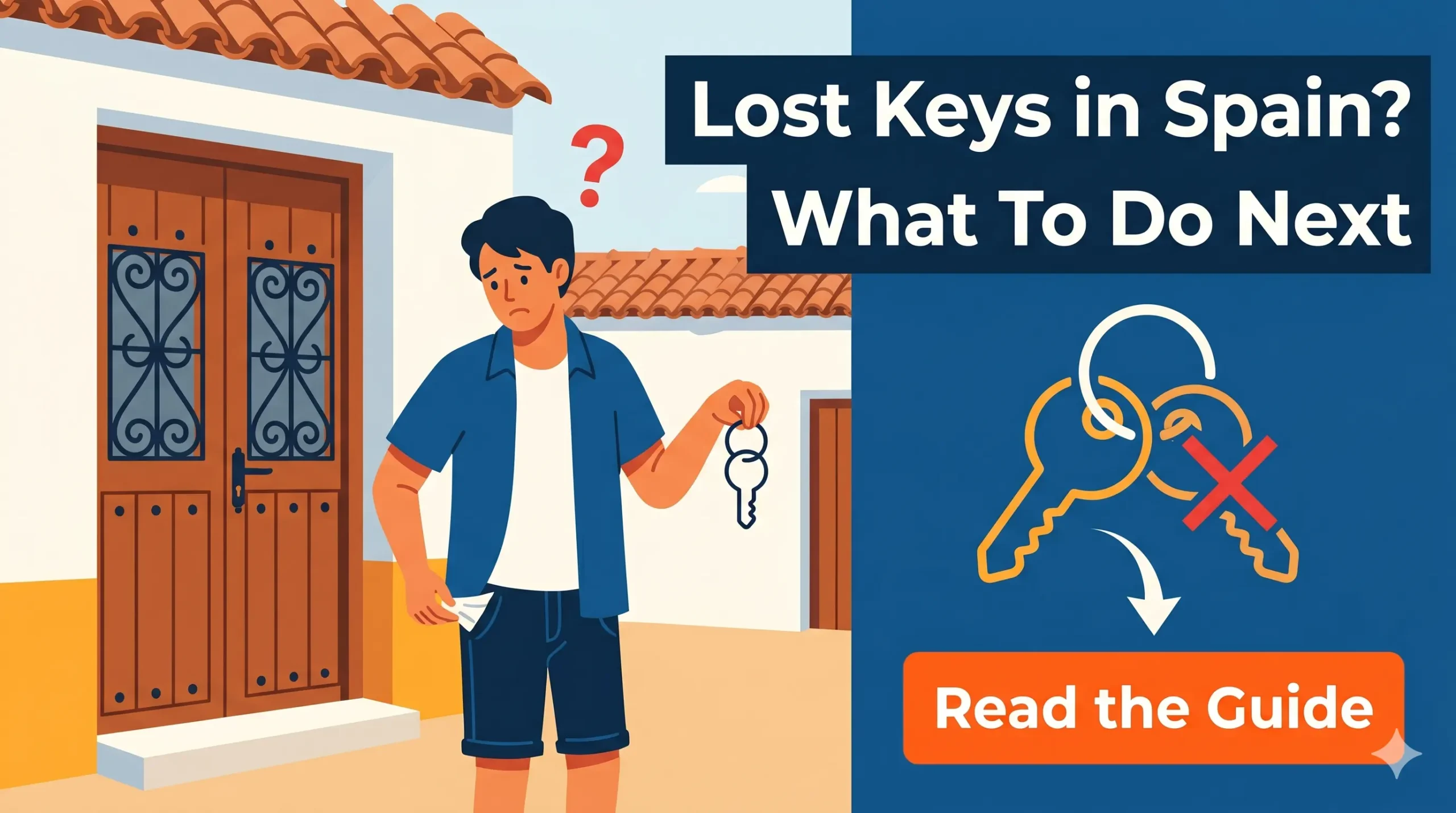
Realizing you left your keys inside a locked Spanish apartment is a uniquely panic-inducing expat nightmare. I once spent four freezing hours sitting on a Madrid staircase waiting for a predatory locksmith to drill my door. This guide explains how to avoid common scams, navigate home insurance policies, and safely regain access to your property without going bankrupt.
Disclosure: This post may contain affiliate links. We may earn a commission at no extra cost to you if you make a purchase through these links. Read full disclosure.
The Immediate Steps When Locked Out
Spanish residential architecture is heavily focused on security. The vast majority of apartments feature heavy, armored doors (puertas blindadas or acorazadas) designed to prevent break-ins. Unfortunately, this means that when you accidentally pull the door shut behind you (cerrar de golpe), regaining entry without the key is exceptionally difficult. Before you panic, you must systematically assess your situation.
The “Keys Left Inside” Dilemma
The most common lockout scenario in Spain does not involve losing your keys in the street; it involves the dreaded llaves puestas por dentro (keys left inside the lock). Many classic Spanish lock cylinders operate on a single-clutch system. This means that if a key is inserted into the keyhole on the inside of the apartment, the lock mechanism is physically blocked.
If you step into the hallway to take out the trash and the wind slams the door shut while your key is still in the inside lock, you are entirely locked out. Even if your roommate comes home with a perfectly valid spare key, they will not be able to insert it from the outside. The door is mathematically jammed. Recognizing this specific mechanical failure immediately saves you the trouble of desperately calling friends who hold your spare key, as the spare will be useless.
Checking for the Spare Key
If your keys are genuinely lost out in the city, or left on the kitchen counter (not actively in the lock), a spare key will solve your problem. Your first point of contact should be the portero (building doorman) if your building has one. While they rarely hold master keys for individual private apartments, they sometimes hold spares if you or your landlord explicitly provided one.
If you are a renter, your next call should be to your landlord (casero). While Spanish law dictates that tenants have the absolute right to change the lock upon moving in to ensure privacy, many expats never bother to do this. Consequently, the landlord or the real estate agency frequently retains a spare copy. To understand the legal power dynamics of your rental agreement and whether the landlord is legally obligated to assist you, deeply review Student Housing in Spain: Options and Typical Contracts.
Contacting Your Insurance or Landlord
If you cannot access a spare, your next step is the most critical: check your seguro de hogar (home insurance). Many expats are entirely unaware that standard Spanish home insurance policies almost universally cover emergency locksmith services. If you accidentally leave your keys inside, lose them, or have them stolen, the insurance company will dispatch a professional to open your door for free.
Here is the vital caveat: you must call the insurance company’s 24/7 emergency assistance line before you hire anyone. They will dispatch their own authorized professional. If you panic, hire a random locksmith, and later send the invoice to your insurance, they will likely refuse to reimburse you.
Because you are stranded in the hallway or out on the street, having a reliable mobile data network like Tiekom is an absolute lifesaver in this moment. You can use your phone to access your email, find your insurance policy number, and call the emergency hotline without desperately hunting for a cafe with public Wi-Fi. If you are renting and unsure if you even have coverage, look back at how you structured your initial move-in costs via Renting in Spain: How to Budget for Deposits, Fees, and Utilities, as tenant insurance is frequently bundled into modern lease agreements.
Hiring a Cerrajero Locksmith in Spain
If you do not have home insurance, or if your policy explicitly excludes lost keys, you will be forced to hire a cerrajero (locksmith) out of pocket. This is where vulnerable expats are most frequently taken advantage of.
Avoiding the Door Sticker Scams
If you look around the doorframe of your apartment building, the elevator, or the streetlamps outside, you will inevitably see dozens of brightly colored, anonymous stickers advertising “Cerrajero 24 Horas” with a phone number. You must absolutely never call these numbers.
These pegatinas (stickers) are notorious fronts for predatory mafias and unregulated operators. They explicitly target desperate, locked-out individuals—especially foreigners who do not speak perfect Spanish. They will arrive, perform unnecessary destructive work on your door, and then hand you an extortionate invoice for 500 to 1,000 euros, demanding immediate cash payment under threat of intimidation. Falling for these sticker traps is one of the most Common Financial Scams Targeting Expats in Spain (and How to Avoid Them).
Finding a Legitimate Professional
To find a trustworthy locksmith, use your phone’s internet connection to search for a professional accredited by the Unión de Cerrajeros de Seguridad (UCES). The UCES is Spain’s national federation of security locksmiths. Professionals registered with the UCES carry an official identification badge (número de placa) and are bound by a strict code of ethics and transparent pricing.
When you call a legitimate locksmith, they will ask you to send a photograph of your door’s lock (escudo) via WhatsApp. Based on this photo, they should be able to provide a firm presupuesto previo (upfront quote) before they even drive to your apartment. When they arrive, they will ask to see your ID to verify you actually live there before they begin working. If your ID is locked inside the house, they will open the door but require you to immediately present the ID once inside.
Average Costs and Weekend Surcharges
The cost of a locksmith in Spain fluctuates wildly based on the time of day, the calendar date, and the specific method required to open the door. If the door is simply pulled shut (cerrada de golpe) and the key is not blocking the mechanism, a skilled locksmith can usually open it cleanly in three minutes using a plastic slip technique.
However, if you turned the key to lock the deadbolt (cerrada con llave) before losing it, the locksmith will be forced to drill and destroy the cylinder, massively increasing the cost. Furthermore, Spanish labor laws dictate heavy surcharges for after-hours work. If you require an apertura de urgencia (emergency opening), expect an immediate fee hike. If you are locked out during the horario nocturno (nighttime) or on a weekend, the price jumps again.
Most dangerously, if you are locked out on a major national or regional bank holiday, the tarifa de festivo applies, which can easily triple the base rate. Understanding when these surprise holidays occur is an essential survival skill detailed in Spanish Work Culture: Hours, Holidays, and Workplace Etiquette.
| Locksmith Scenario | Standard Base Cost | Weekend / Night Surcharge | Holiday Surcharge |
| Door pulled shut (No drilling) | €70 – €100 | €120 – €160 | €180 – €250+ |
| Deadbolt locked (Drilling req.) | €120 – €180 | €180 – €250 | €300 – €400+ |
| New standard cylinder replacement | €50 – €90 | N/A (Parts cost) | N/A (Parts cost) |
| Keys left inside (Single clutch) | €80 – €120 | €140 – €180 | €200 – €300+ |
Security and Prevention After a Lockout
Once the immediate panic is over and you are back inside your apartment, you must take proactive steps to ensure this never happens again, especially if your keys were genuinely lost in the street rather than left on the kitchen table.
Changing the Lock Bombín
If your keys were lost or stolen—and particularly if your ID or any document bearing your home address was in the same bag—you must immediately change your lock. You do not need to replace the entire heavy armored door, nor do you need to replace the exterior metal plating. You only need to replace the internal cylinder, known in Spain as the bombín.
If you hire a locksmith to do this, they will charge you a massive retail markup for the part. However, changing a bombín is incredibly simple. You only need a single screwdriver to remove the long screw on the side of the door, slide the old cylinder out, measure its dimensions, and slide a new one in.
You can easily order a high-security, anti-bumping, anti-drill bombín directly from Amazon Spain for a fraction of the cost the locksmith will quote you. To completely eliminate the terrifying “keys left inside” dilemma moving forward, search Amazon Spain specifically for a cylinder with a doble embrague (dual clutch). A dual-clutch cylinder is a game-changer for expats, as it mathematically guarantees that a spare key will always work from the outside, even if you leave your primary key fully inserted on the inside of the door.
Upgrading Your Home Security
If you are prone to losing physical keys, you should consider upgrading your home access methods entirely. You can purchase a discreet, heavy-duty key lockbox from Amazon Spain and secure it to a hidden railing on a trusted friend’s balcony or a secure location at your office, ensuring you always have a physical backup that cannot be lost.
Alternatively, many expats are modernizing their Spanish apartments by installing smart locks. These devices fit over your existing deadbolt on the inside of the door and allow you to unlock your apartment using your smartphone, a fingerprint, or a digital keypad.
Keep in mind that smart locks require a constant, stable internet connection to alert your phone of security events and grant remote access. Using a dedicated, expat-friendly provider like Tiekom for your home fiber connection ensures your smart door never drops offline while you are away. Budgeting for these proactive security upgrades is a vital part of managing your long-term overhead, a concept explored deeply in Cost of Living in Spain: Budgeting for Expats.
Finally, when you do have to pay for unexpected emergency expenses like a new lock or a late-night locksmith, they will universally demand immediate payment via cash, Bizum, or direct transfer. Ensuring you have an agile digital banking setup ready to execute these instant local payments is crucial. To master this localized financial infrastructure, review Opening a Bank Account in Spain as a Non-Resident. If a roommate or a landlord generously covered the initial emergency fee for you while you were locked out, relying on modern digital transfer tools rather than high-fee legacy banks ensures you can repay them instantly and fairly, a strategy covered in Sending Money to/from Spain: Comparing Banks vs Transfer Services.
References
Primary sources (official)
- Unión Cerrajeros de Seguridad (UCES) – National Federation of Security Locksmiths: https://uces.es/
- UCES – Encuentra tu cerrajero acreditado: https://uces.es/encuentra-tu-cerrajero/
Other helpful sources
- El Serraller – Llaves puestas por dentro: ¿lo cubre el seguro del hogar?: https://elserraller.com/llaves-puestas-por-dentro-lo-cubre-el-seguro-del-hogar/
- Grupo Cerrajero – Recomendaciones de UCES para evitar abusos en la factura: https://www.grupocerrajero.com/recomendaciones-de-union-de-cerrajeros-de-seguridad-para-evitar-abusos-en-la-factura/
Disclaimer
The information provided in this article is for educational and informational purposes only and does not constitute formal legal, security, or financial advice. Home insurance (seguro de hogar) policies vary dramatically between providers; always review your specific policy documents to confirm emergency locksmith coverage limits and protocols before requesting assistance. Pricing for independent locksmith services in Spain is unregulated and subject to extreme variation based on the municipality, the time of day, and the specific holiday calendar. Always demand a written quote (presupuesto previo) before allowing any technician to begin destructive work on your property.