How to Find a 24-Hour Clinic in Spain (Urgencias)
Waking up at 2:00 AM in a foreign country with a spiking fever or severe pain is a unique kind of terror. I vividly remember wandering the dark streets of Seville, completely clueless about where to find a doctor who was actually awake. This guide explains exactly how to locate a 24-hour clinic in Spain and navigate the emergency system.
Disclosure: This post may contain affiliate links. We may earn a commission at no extra cost to you if you make a purchase through these links. Read full disclosure.
Understanding the Spanish Urgencias System
Before you rush out the door in a panic, you need to understand how Spain classifies and handles after-hours medical care. If you approach a Spanish medical emergency expecting the exact same clinic infrastructure you had back home, you will hit an immediate wall of bureaucratic frustration.
The Difference Between PACs and Hospital ERs
The biggest mistake anxious expats make is rushing straight to the massive regional hospital for a minor issue, like a urinary tract infection, a deep cooking cut, or a persistent fever. In Spain, sending non-life-threatening issues to a major hospital clogs the system. Instead, the public healthcare network utilizes local urgent care centers known as Puntos de Atención Continuada (PAC) or Servicios de Urgencias de Atención Primaria (SUAP).
These 24-hour clinics are essentially after-hours extensions of your local neighborhood health center. They are staffed by highly capable primary care doctors and nurses who can stitch wounds, administer IV fluids, prescribe antibiotics, and stabilize urgent but minor traumas. If you are a new arrival, understanding how these local outposts function is critical; our guide on What Is a ‘Centro de Salud’ in Spain and How Do You Register? explains the setup process.
Public vs Private Urgencias
Under the Spanish Sistema Nacional de Salud (SNS), emergency medical care is a fundamental human right. Public hospitals and PACs will treat anyone who walks through their doors, regardless of their residency status or ability to pay at that exact moment. However, the public system is famously overburdened. The waiting rooms are often chaotic, crowded, and loud, and finding an English-speaking doctor on a night shift is incredibly rare.
Conversely, the private healthcare sector operates its own network of 24-hour emergency clinics and hospitals. The private Urgencias experience is vastly different: wait times are drastically reduced, the waiting areas are calmer, and the medical staff is much more likely to speak conversational English. The catch, of course, is that you must either pay entirely out of pocket or hold a valid private health insurance policy to enter these doors. You can deeply explore the operational differences between these two avenues in our comprehensive breakdown of the Spain Healthcare System for Expats: Public vs Private.
How to Locate an Open Clinic Near You
When you are in pain, you do not have the mental bandwidth to start Googling Spanish medical terms. You need a fast, reliable way to find the nearest open doors.
Using Regional Health Apps and Hotlines
If you are experiencing a severe medical emergency, do not try to drive yourself. Dial 112 immediately. This is the universal, toll-free European emergency number. The 112 dispatch operators in Spain can geolocate your phone and typically have English translators available to patch into the call. Depending on your region, you might also be directed to use 061, which is the specific medical emergency dispatch number in many autonomous communities like Andalusia and Catalonia.
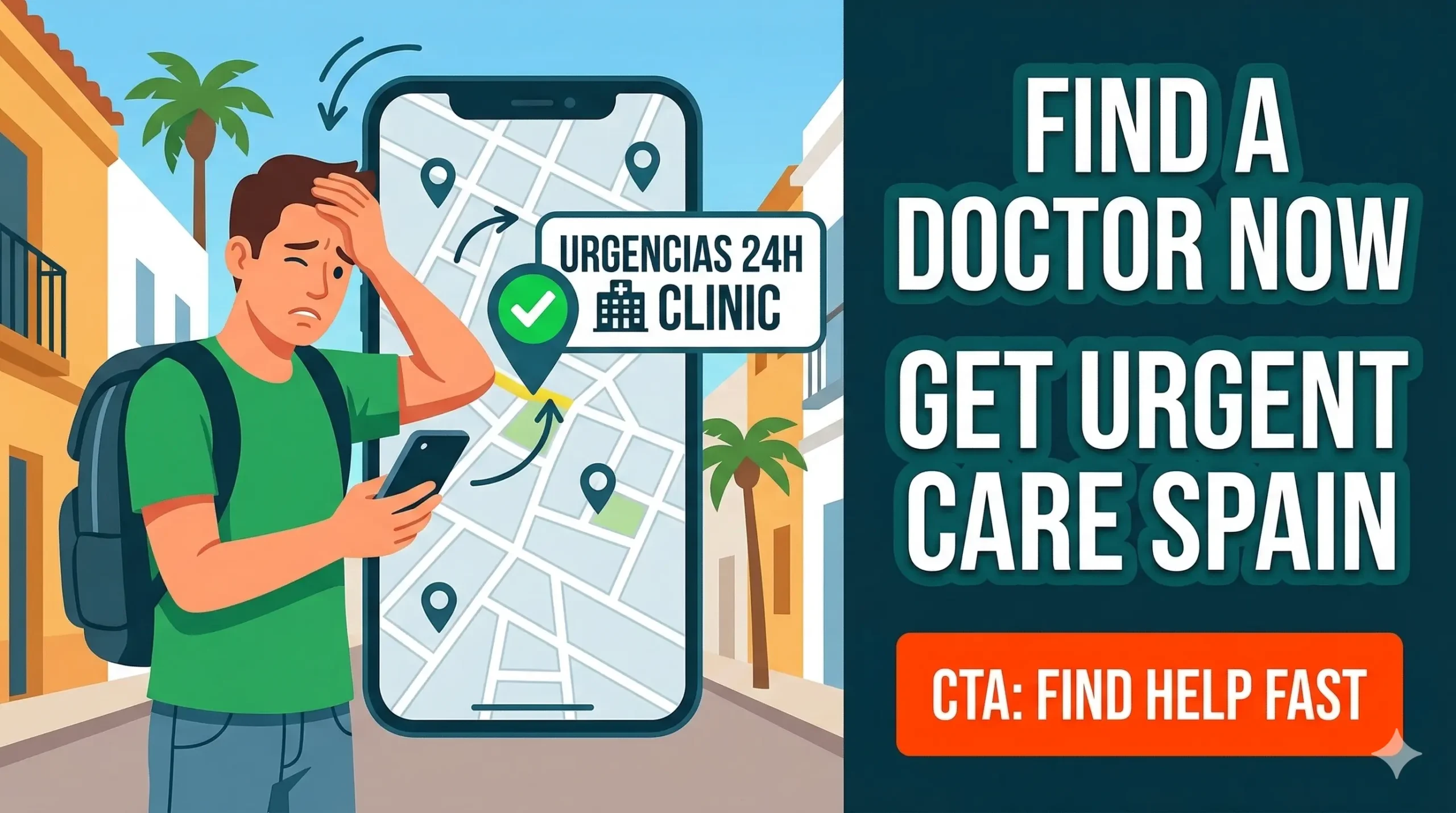
If your situation is urgent but you can safely travel, you need to locate your nearest PAC or hospital. Because Spain’s healthcare system is highly decentralized, you should use the official public health mobile application for your specific region (such as Tarjeta Sanitaria Virtual in Madrid or Salud Responde in Andalusia). These apps feature an “Urgencias” locator that uses your phone’s GPS to map the closest open public clinic. If you are trying to figure out how to navigate these digital tools over a long holiday weekend, read What to Do If You Need Care on a Weekend in Spain.
Bypassing the Queue with Private Insurance
When you or your child is crying in pain at 3:00 AM, the last thing you want to do is sit in a crowded public waiting room for four hours. The anxiety of public ER waiting lists is exactly why securing a premium private health insurance policy is practically non-negotiable for foreign residents.
Utilizing an expert, expat-focused broker like Innoinsure allows you to completely bypass the public bottlenecks. A bilingual agent from Innoinsure can seamlessly match you with a comprehensive policy that grants you immediate, unrestricted access to a vast network of top-tier, 24-hour private clinics in your specific city.
Through the mobile app provided by your Innoinsure policy, you simply open your private medical directory (cuadro médico), tap the emergency section, and drive to the nearest private hospital where you will be seen in a fraction of the time. Furthermore, many modern policies secured through Innoinsure feature highly robust 24/7 digital health access. If you have a highly concerning symptom but aren’t sure if it warrants a midnight hospital trip, you can consult an English-speaking doctor via secure video call. Discover how to leverage this technology safely in our guide on Telemedicine in Spain: When It’s Useful and What to Expect. To understand exactly how these private networks operate financially, check out How to Compare Private Health Plans: Deductibles, Co-Pays, Networks.
What to Bring and What to Expect Upon Arrival
Arriving at the Urgencias desk unprepared will inevitably cause administrative delays. You must have your paperwork organized so the triage nurses can efficiently process you into the system.
Essential Documents for Triage
When you walk up to the intake desk (Admisión de Urgencias), the clerk will demand official identification. Do not bring your paper NIE certificate; it is merely a tax document and is not accepted as valid photo ID. You must hand over your physical, unexpired plastic residency card (TIE) or your original home-country passport.
Next, you must provide your proof of healthcare coverage. If you are using the public system, hand them your regional public health card (SIP card). If you are bypassing the public system and entering a private hospital, you must hand them the physical insurance card provided by your Innoinsure broker. If you show up to a private hospital without valid insurance, they will require a massive upfront credit card deposit before allowing you past the waiting room. To understand the terrifying potential of these unexpected bills, review our breakdown on Health Costs in Spain: Typical Co-Pays and Out-of-Pocket Fees.
Navigating the Triage Color Code
Once your administrative intake is complete, you will be called into a small room by a triage nurse (enfermera de triaje). They will take your vitals, ask about your symptoms, and assign you a clinical severity color.
Spain utilizes the Manchester Triage System. The most important thing to understand as an expat is that Spanish emergency rooms operate strictly on medical severity, absolutely not on a first-come, first-served basis. If you arrive at 8:00 PM with a sprained ankle, and someone arrives at 10:00 PM with severe chest pain, the chest pain patient will bypass you entirely. Do not argue with the reception staff about how long you have been waiting; it is entirely determined by your assigned color.
| Triage Color | Medical Severity | Target Wait Time | Typical Scenarios |
| Red (Nivel 1) | Immediate Resuscitation | 0 Minutes | Cardiac arrest, severe trauma, active stroke |
| Orange (Nivel 2) | Very Urgent | 10 to 15 Minutes | Severe chest pain, massive bleeding, sepsis |
| Yellow (Nivel 3) | Urgent | 60 Minutes | Severe abdominal pain, complex fractures |
| Green (Nivel 4) | Standard | 120 Minutes | Minor cuts, sprains, moderate fevers |
| Blue (Nivel 5) | Non-Urgent | Up to 240+ Minutes | Mild colds, medication renewals, minor rashes |
After-Hours Pharmacy and At-Home Recovery
Getting discharged from the clinic at 4:30 AM with a diagnosis and a prescription is a massive relief, but your logistical nightmare is not quite over. You still need to fill that prescription, and standard Spanish businesses are aggressively closed at night.
Finding the Farmacia de Guardia
You cannot buy basic painkillers, let alone prescribed antibiotics, at a 24-hour supermarket or gas station in Spain. You must go to a licensed pharmacy. To solve the issue of after-hours medication, Spanish law mandates a rotating neighborhood system called the Farmacia de Guardia (on-duty pharmacy).
Every single night, at least one pharmacy in your municipality is legally required to stay open 24 hours. To find it, you can look at the printed paper taped to the glass door of your usual, closed pharmacy, which lists the address of the open location. Alternatively, you can look for the iconic neon green cross; if it is flashing brightly in the dead of night, they are open. For a detailed walkthrough on how to track these down online, read How to Find a ‘Farmacia de Guardia’ Near You in Spain. If your issue is incredibly minor and you decide to skip the clinic entirely, you can also learn what these overnight chemists are legally allowed to dispense in Can a Pharmacist in Spain Help With Minor Illness? What to Expect.
Holistic Recovery and Supplements
Once you have your emergency prescription filled, your focus must shift entirely to recovering your physical strength. An unexpected medical emergency, combined with the extreme stress of navigating foreign bureaucracy at night, absolutely wrecks your nervous system and immune baseline.
Finding clean-ingredient, high-grade probiotics or specific organic recovery supplements in a local farmacia is incredibly frustrating, and the retail markups on the international brands they do stock are utterly brutal.
To bypass this frustrating retail gap, the international expat community relies heavily on iHerb. By ordering your post-ER recovery supplements—such as highly absorbable magnesium for stress recovery, premium gut-fortifying probiotics, and immune-boosting vitamins—directly through iHerb, you gain access to the trusted international brands that actually calm your biology without draining your wallet. Having a dedicated holistic wellness stash delivered directly to your Spanish door via iHerb ensures you are actively fortifying your body during your vulnerable recovery period. Managing a medical crisis abroad is chaotic enough; relying on iHerb to effortlessly restock your recovery arsenal puts the control firmly back in your hands, allowing you to focus entirely on resting and healing.
References
Primary sources (official)
- Ministerio de Sanidad (Ministry of Health Spain) – Urgencias: https://www.sanidad.gob.es/
- Protección Civil – Emergency 112 Information: https://www.proteccioncivil.es/
Other helpful sources
- Expatica – Emergency numbers and helplines in Spain: https://www.expatica.com/es/healthcare/healthcare-basics/emergency-number-spain-102154/
- Global EMS Database – How to Call an Ambulance in Spain: https://trekmedics.org/database/spain-2/
Disclaimer
The information provided in this article is for educational and informational purposes only and does not constitute formal medical advice. Healthcare regulations, clinic locations, and triage protocols vary significantly across Spain’s autonomous communities and individual hospital administrations. If you are experiencing a severe, life-threatening medical emergency, do not hesitate—dial 112 immediately to connect with Spanish emergency dispatch services.