Furniture Delivery in Spain: Common Fees and Scheduling Tips
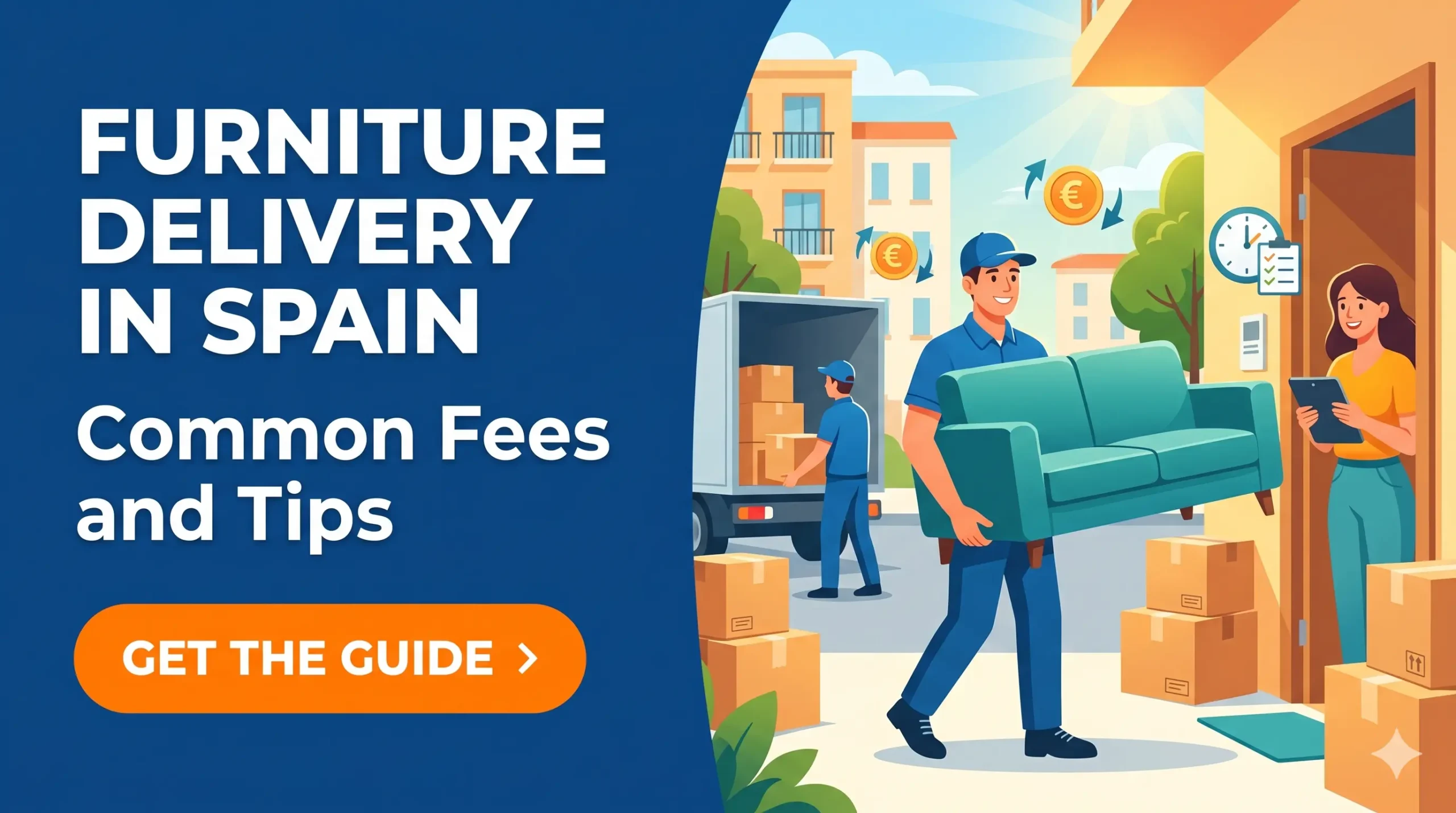
Ordering a beautiful sofa only to watch the delivery drivers dump it on the sidewalk and drive away is a uniquely humiliating expat initiation. I once spent three hours dragging a massive wardrobe up four flights of narrow stairs because I fundamentally misunderstood the local delivery terms. This guide explains Spanish furniture delivery fees, scheduling realities, and how to avoid curbside disasters.
Disclosure: This post may contain affiliate links. We may earn a commission at no extra cost to you if you make a purchase through these links. Read full disclosure.
The Reality of Spanish Delivery Terminology
When you shop for furniture in your home country, you generally assume that if you pay for delivery, the workers will bring the item directly into your living room. In Spain, this is an incredibly dangerous assumption that catches nearly every foreigner off guard.
Curbside Delivery vs Inside the Home
The default, baseline delivery option for almost all budget furniture stores and online outlets in Spain is entrega a pie de calle (curbside delivery). This means exactly what it sounds like: the driver will pull up to your building, unload the massive, 80-kilogram mattress or flat-pack bookshelf onto the public pavement, hand you a digital tablet to sign, and immediately drive away. You are entirely responsible for getting it through the front door, down the hallway, into the elevator, and into your apartment. If you have just signed a lease and are outfitting an empty flat—a highly stressful process detailed in Renting an Apartment in Spain: A Guide for Expats—this curbside reality can completely ruin your move-in day.
To avoid this nightmare, you must explicitly look for and select the subida a domicilio or entrega dentro del domicilio (inside delivery) option at checkout. This premium service almost always carries an extra fee, usually ranging from 20 to 60 euros depending on the total weight and volume of the order. If you cannot secure inside delivery for a heavy purchase, I highly recommend ordering a heavy-duty folding hand truck from Amazon Spain a few days before the delivery date. Having a proper utility cart on hand makes hauling heavy, awkward boxes from the sidewalk to your elevator infinitely more manageable.
The Assembly Trap
Getting the furniture into your living room is only half the battle. The next hurdle is the actual construction. Unless you are buying from a high-end, premium boutique, Spanish furniture deliveries rarely include assembly by default. The service of putting the furniture together is known as montaje.
If you want the delivery crew to actually build your new dining table or wardrobe, you must select delivery with montaje. This often doubles your total delivery fee. Furthermore, drivers who are only contracted for subida a domicilio will flat-out refuse to assemble anything, no matter how much cash you offer them as a tip on the spot, because their daily route schedules are impossibly tight and tracked by GPS.
If you choose to skip the assembly fee to save money, be prepared for a massive DIY project. Spanish flat-pack instructions can be notoriously vague. Before your furniture arrives, you should order a comprehensive electric drill and toolkit from Amazon Spain. Trying to assemble an entire bedroom suite with the tiny, flimsy Allen wrench provided in the box will leave you with blistered hands and wobbly furniture. Taking the time to properly assemble your furniture ensures your domestic setup is durable, which ultimately saves you replacement costs down the line—an important factor when managing your long-term Cost of Living in Spain.
Navigating Narrow Streets and Historic Buildings
Spain’s architectural charm is a visual delight, but it is an absolute logistical nightmare for furniture delivery teams.
The Elevator Problem and Staircase Surcharges
If you live in a historic neighborhood like Madrid’s Malasaña or Valencia’s Ruzafa, your apartment building might feature an incredibly narrow, winding staircase and a tiny elevator (ascensor) barely large enough for two people, let alone a three-seater sofa.
When you select subida a domicilio, the delivery company explicitly assumes that the item will safely fit inside your elevator. If the delivery team arrives and discovers that the sofa cannot clear the elevator doors, they will evaluate the stairs. If the stairs are too tight, they will simply refuse the delivery, leave the item on the street, or take it back to the warehouse while charging you for a failed delivery attempt.
Even if the item technically fits up the stairs, many transport companies apply a strict “staircase surcharge” (recargo por escaleras). They might charge an additional 10 to 15 euros for every single floor they have to manually carry a heavy item. To prevent this, you must measure your elevator doors, the internal cabin dimensions, and the tightest corner of your stairwell before you buy. I always use a digital laser measure bought off Amazon Spain to get exact millimeter readings of my doorframes so I know exactly what will fit before I click “purchase.”
Hoists and Municipal Permits
If you are buying a massive, non-modular piece of furniture that absolutely will not clear your stairwell, you have one final, incredibly expensive option: an exterior hoist (grúa). The delivery company will park a truck equipped with an industrial crane underneath your balcony and literally lift the sofa through your exterior living room window.
This is not a spontaneous, day-of decision. Deploying a grúa requires a municipal permit from the local town hall (ayuntamiento) to temporarily block the street or sidewalk. You, or the delivery company acting on your behalf, must apply for this permit weeks in advance, and you must pay municipal taxes for occupying the public thoroughfare. Dealing with this level of bureaucratic friction is a recurring theme in Spain, similar to the agonizing delays expats face when waiting for utility connections, a nightmare process we outline in Best Internet Providers in Spain for Expats. Because dealing with municipal crane permits is so exhausting, many veteran expats simply opt to order modular, flat-pack furniture that easily breaks down into smaller, manageable boxes.
Scheduling and the Flexible Spanish Clock
When you finally select your delivery date, you will quickly discover that the Spanish logistics industry operates on incredibly ambiguous timelines.
Ambiguous Delivery Windows
Very few logistics companies in Spain will give you a specific delivery hour. Instead, you will receive an automated text message stating that your delivery will arrive “between 9:00 and 18:00.”
You are expected to be physically present in your apartment during this entire nine-hour window. If you leave to buy a quick coffee and the truck arrives during those ten minutes, you will receive a “failed attempt” notification, and you will have to reschedule the delivery for the following week, often paying a stiff penalty fee.
Because you are essentially held hostage in your own home for an entire day, having a reliable internet connection to work remotely or stream movies while you wait is absolutely vital. I use Tiekom for my home fiber optic broadband because their connection is incredibly stable, allowing me to comfortably work from my kitchen table all day without dropping a video call while I wait for the logistics company to finally ring the buzzer. While waiting, you can even use that time productively to organize your administrative life, such as reviewing your latest household expenses, a task decoded in Understanding Utility Bills in Spain.
Managing Communication with Drivers
The delivery driver will almost always call you approximately 10 to 15 minutes before they arrive at your building. This phone call is critical. If you do not answer, they will assume you are not home and simply drive to their next stop to save time.
You must have a working Spanish phone number with reliable signal strength to receive this call, as drivers rarely, if ever, dial foreign country codes. Furthermore, they will rapidly ask for complex directions or building access codes in rapid-fire Spanish. I rely on Tiekom for my mobile data plan precisely for this reason. Their mobile coverage is flawless, meaning I never drop a call when a frantic delivery driver is trying to navigate the confusing one-way streets of my neighborhood. If your Spanish is still developing, you can use your Tiekom mobile data to quickly load a translation app and communicate basic directions. If you ordered highly expensive furniture on a store financing plan, you must physically be there with proper local identification to sign the final manifest, a bureaucratic requirement explained in Getting an NIE for Employment or Study: Practical Overview.
Consumer Rights and Dealing with Disputes
The 14-Day Right of Withdrawal
Sometimes the furniture arrives, the delivery crew performs flawlessly, and you simply hate the item. It looks completely different in your living room than it did online. Under Spanish and European consumer law, if you purchased the furniture online or over the phone, you are heavily protected by the derecho de desistimiento (right of withdrawal).
You have 14 calendar days from the moment the furniture is delivered to your door to cancel the purchase and request a full refund, without having to provide any justification. However, there is a massive catch regarding delivery fees. While the store must refund the cost of the furniture and the initial standard delivery cost, you are legally responsible for paying the return shipping costs to send the heavy sofa back to their warehouse, unless the store’s specific policy explicitly offers free returns.
Returning massive furniture through private couriers is a logistical nightmare. This is why many expats prefer to buy smaller household goods and accent pieces directly from Amazon Spain, as their return logistics are incredibly streamlined and they often provide prepaid return pickup labels.
Damaged Goods and Official Complaints
If the delivery drivers damage your walls while hauling a heavy wardrobe up the stairs, or if you open the box and discover the furniture is shattered, you must act instantly. Never sign a digital delivery tablet without inspecting the external boxes. If you see physical damage to the packaging, you must force the driver to write “Caja Dañada” (Damaged Box) on the digital manifest before you sign it.
If you sign the tablet without noting the damage, the company will legally claim you broke the item while assembling it yourself. You generally have 24 to 48 hours to report hidden damage to the retailer. Knowing your rights when buying heavy household items is just as crucial as knowing your warranty periods for expensive electronics, a topic heavily covered in Buying Appliances in Spain: Energy Labels and Warranty Basics.
If the retailer refuses to replace the damaged furniture, you can file a formal complaint with the Oficina Municipal de Información al Consumidor (OMIC). Navigating these consumer disputes often requires providing proof of purchase and clean banking statements to prove the transaction, which is why having your local finances legally organized is crucial, an administrative hurdle covered in Opening a Bank Account in Spain: Step-by-Step for Foreigners. Finally, if you are discarding old, broken furniture or large boxes to make room for your new deliveries—perhaps you are replacing an old, inefficient electric radiator, a system analyzed in Spanish Apartment Heating: What Systems You’ll Commonly Find—you cannot legally leave the junk on the street. You must follow the strict municipal disposal protocols detailed in How to Use Spain’s Recycling ‘Punto Limpio’ Facilities.
| Delivery Term | Spanish Translation | What It Actually Means | Typical Cost |
| A pie de calle | Curbside Delivery | Dropped on the sidewalk outside your building. You carry it up. | Free / Base Rate |
| Subida a domicilio | Inside Delivery | Brought inside your apartment (must fit in elevator/stairs). | €20 – €60+ |
| Recargo por escaleras | Staircase Surcharge | Extra fee per floor if there is no elevator available. | €10 – €15 per floor |
| Con Montaje | With Assembly | The delivery crew will unbox and build the furniture. | €30 – €100+ |
| Grúa | Exterior Hoist | A crane lifts the furniture through your balcony window. | €200 – €400+ |
References
Primary sources (official)
- Ministerio de Derechos Sociales, Consumo y Agenda 2030 – Derechos del consumidor en compras online: https://www.consumo.gob.es/es/consumo/compras-online
- Centro Europeo del Consumidor en España – Derecho de desistimiento: https://portal-cec.consumo.gob.es/es/informacion-general/compras-online/derechos-del-consumidor
Other helpful sources
- Organización de Consumidores y Usuarios (OCU) – Problemas con la entrega de compras online: https://www.ocu.org/consumo-familia/derechos-consumidor/consejos/como-reclamar-problemas-compras-online
- OCU – Garantías y devoluciones: https://www.ocu.org/consumo-familia/derechos-consumidor/consejos/devoluciones-compras
Disclaimer
The information provided in this guide is exclusively for educational and informational purposes and does not constitute official legal or consumer protection advising. Spanish consumer laws, the 14-day derecho de desistimiento, and municipal regulations regarding exterior hoist (grúa) permits are subject to frequent updates. While we strive to ensure absolute accuracy regarding best practices, you should always thoroughly read the fine print of your specific retailer’s delivery policies, explicitly confirm whether assembly and inside delivery are included in your final invoice, and consult official consumer protection agencies (such as the OMIC) if you believe a retailer is unlawfully denying a valid return or damage claim.