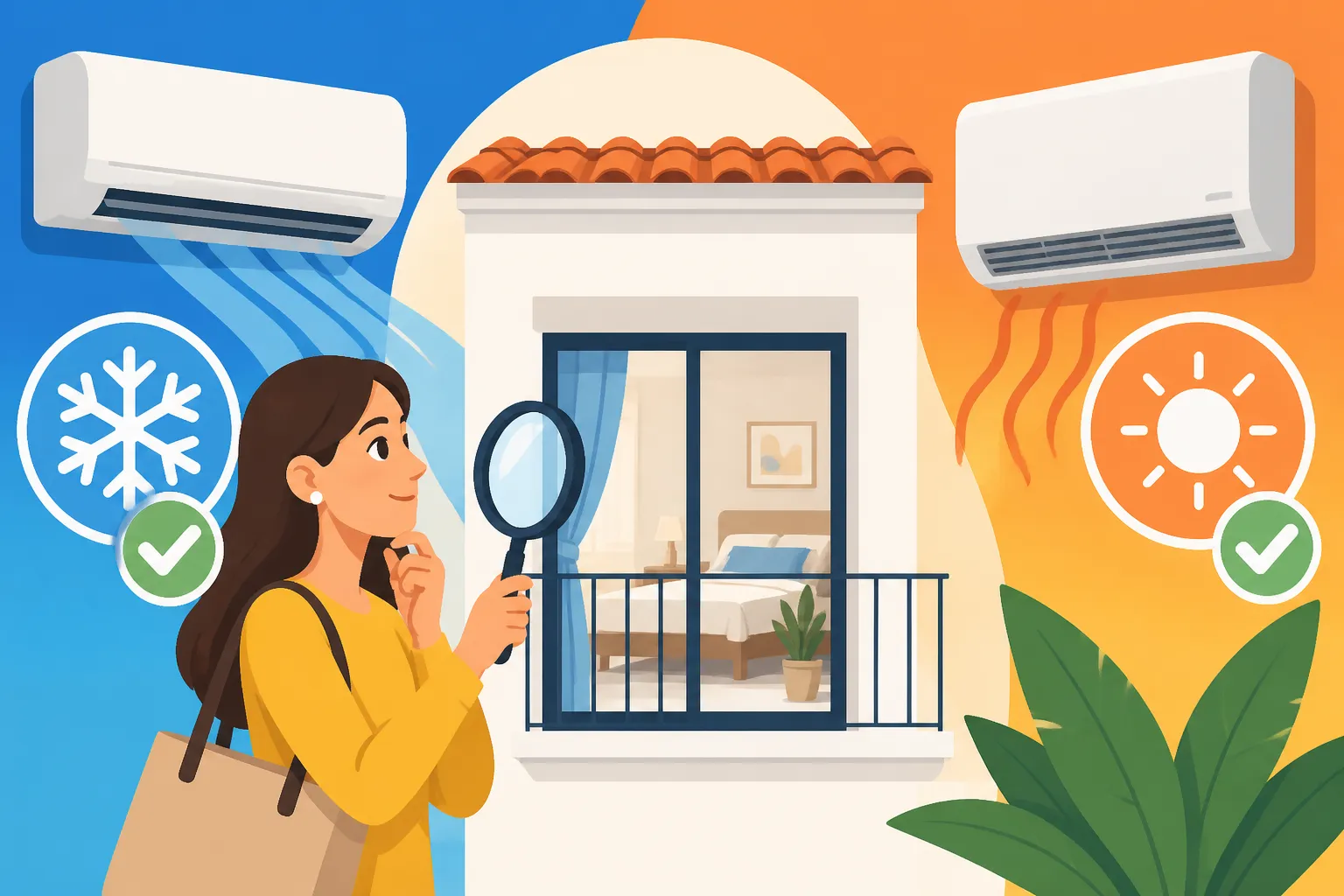
Air Conditioning and Heating in Spanish Accommodation: What to Verify
Oh, the joy (and sometimes, pure agony!) of finding the perfect place to stay in Spain, whether you're here for a whirlwind holiday or setting up your new expat life. One of the biggest shocks for many newcomers, after battling the NIE appointment system, is discovering that not all Spanish homes or holiday rentals are created equal when it comes to climate control. You might picture endless sunshine, but both sweltering summers and surprisingly chilly winters can catch you off guard if your accommodation isn't properly equipped. This guide will walk you through everything you need to know about air conditioning and heating in Spanish properties, helping you verify what you're getting before you even arrive, and why platforms like Booking.com are your absolute best friend in this quest.
Disclosure: This post may contain affiliate links. We may earn a commission at no extra cost to you if you make a purchase through these links. Read full disclosure.
The Reality of Heating and Air Conditioning in Spain
Let's be real, many of us arrive in Spain with visions of endless sunshine and balmy nights. And while Spain does deliver on that front for much of the year, it also experiences extreme heat waves in summer and surprisingly cold, damp winters, especially inland or further north. The expectation versus reality when it comes to indoor climate control can be a rude awakening, and it’s a frustration many expats and tourists share.
Why Temperature Control is a Big Deal Here
Believe me, you do not want to be in a Spanish apartment in August with just a flimsy fan, praying for a breeze, or huddled under three blankets in January, watching your breath fog in the air. Spain’s climate is diverse. Cities like Seville or Córdoba can hit scorching temperatures well over 40°C (104°F) in summer, making effective air conditioning a non-negotiable for comfort, and even safety, particularly if you have young children or health considerations. Conversely, places like Madrid, many parts of Castilla y León, or even coastal areas like the Costa Brava, experience winter temperatures that dip surprisingly low, often with a biting humidity that makes it feel even colder. Proper heating is essential, not just a luxury. Many older buildings, with their thick stone walls, can actually hold the cold in winter, just as they excel at keeping out the summer heat, but without a dedicated system, you're at the mercy of the elements. Heatwaves in Spain: Health Precautions for Expats is something you definitely want to read for summer.
Common Types of Heating Systems in Spain
Spanish heating isn't always what you're used to. Forget central heating with radiators in every room as a standard. While newer builds or renovated properties might have it, older homes can be a mixed bag.
- Radiadores Eléctricos (Electric Radiators): These are very common, especially in older apartments. They can be portable or wall-mounted. They're often cheaper to install than gas central heating, but they can be very expensive to run, especially if you're trying to heat an entire home. You might find just one or two in a larger property.
- Calefacción por Gas Natural (Natural Gas Heating): This is the holy grail for many, offering efficient, consistent heat through radiators. It's more common in larger cities and newer buildings. If a listing mentions "calefacción de gas natural," that's usually a good sign for winter comfort.
- Bombas de Calor (Heat Pumps / Reversible Air Conditioning): This is a fantastic solution as it provides both heating and cooling from the same unit. Many modern air conditioning units have a "heat pump" function. It's energy-efficient and increasingly popular. This is often described as "aire acondicionado con bomba de calor" or "aire acondicionado frío/calor."
- Estufas (Stoves/Heaters): You might encounter wood-burning stoves (chimeneas) in rural properties, or smaller portable gas or paraffin heaters (estufas de butano/parafina). While charming, they require more effort, constant monitoring, and aren't always the safest or most efficient for a whole house.
Common Types of Air Conditioning in Spain
When the mercury rises, good air conditioning is a lifesaver. Again, don't assume every place has it, especially outside of major cities or coastal hotspots.
- Aire Acondicionado Split (Split-System AC): This is the most common and effective type. It involves an outdoor unit connected to one or more indoor units (splits). Each indoor unit cools a specific room. Look for listings that specify how many "splits" there are – a single unit in the living room won't do much for your bedroom on a scorching night.
- Aire Acondicionado Centralizado (Centralized AC): Less common in residential rentals, but found in some newer, higher-end properties or commercial spaces. This system distributes cool air through ducts to the entire property. It's the most comfortable and consistent but also more complex and expensive.
- Aire Acondicionado Portátil (Portable AC): These units are standalone and can be moved between rooms. They vent hot air out through a hose, usually placed in a window. While better than nothing, they are generally less powerful, noisier, and less efficient than split systems. Don't rely on these for serious heat relief in large spaces.
- Ventiladores de Techo (Ceiling Fans): Excellent for circulating air and providing a gentle breeze, often sufficient for milder temperatures or in conjunction with AC. However, on their own, they are rarely enough to combat a Spanish summer heatwave.
Understanding these different systems is your first step. Now, how do you verify what your potential accommodation actually has?
Decoding Accommodation Listings: What to Look For
This is where your inner detective comes into play, and where a platform like Booking.com becomes an indispensable tool. You can't just glance at a photo and assume. You need to scrutinize the details, read between the lines, and leverage the platform's features to ensure your comfort.
Key Terms and Icons to Spot
When you're browsing listings on Booking.com or other platforms, specific keywords and icons are your clues. These are the things that should be clearly stated, but sometimes you have to dig.
- Aire Acondicionado: This is the general term for air conditioning. Good, but you want more detail.
- Bomba de Calor / Frío/Calor: This indicates a reversible unit that provides both heating and cooling. This is often the most efficient and reliable system to have.
- Calefacción: General term for heating. Again, dig deeper. Is it electric, gas, or a heat pump?
- Radiadores: Implies a radiator system, most likely electric or gas.
- Climatización: A broader term that often means climate control, suggesting both heating and cooling are available, possibly via a central system or heat pumps.
- Ventiladores: Fans. Be wary if this is the only thing mentioned for summer.
- Chimenea: Fireplace. Cozy, but typically not a primary heat source for an entire home.
Many platforms, and Booking.com is great at this, use clear icons for "Air conditioning" and "Heating" in their amenities section. Always click on the "Show all amenities" or similar link to get the full breakdown. Don't assume an icon means it's sufficient for your needs; it just means some form exists.
How to Verify Information Before You Book
This is the critical step. Just seeing "Air conditioning" or "Heating" listed isn't enough. You need to ensure it's effective for the entire property, especially if you're traveling with family or staying for an extended period. Booking.com offers several features that are invaluable here.
Firstly, use the filters. On Booking.com, you can specifically filter for "Air conditioning" and "Heating." This immediately narrows down your search to properties that at least claim to have these amenities.
Secondly, read the descriptions carefully. Does it say "Air conditioning in living room" or "Air conditioning in all bedrooms"? This distinction is huge! A single unit in the main living space won't provide comfort throughout a multi-room apartment, especially at night. Similarly, for heating, does it mention central heating or just "electric radiators"? If it doesn't specify how many electric radiators, you might be in for a cold surprise.
Thirdly, and this is perhaps the most important, read the recent reviews. Other guests are your best source of unbiased information. Look for comments like:
- "The air conditioning was powerful and cooled the whole apartment quickly." (Good sign!)
- "Only one AC unit in the living room, so bedrooms got quite hot." (Red flag!)
- "Heating was excellent, very cozy even in winter." (Another good sign.)
- "The electric heaters were not enough to warm the place in January." (Big red flag!)
Booking.com also allows you to ask questions directly to the property host. If the description is vague, don't hesitate to message them. Ask specific questions:
- "Is the air conditioning available in all bedrooms?"
- "What type of heating system is installed, and are there heaters in every room?"
- "Is the heating/AC included in the price, or are there extra charges based on usage?" (Some places have coin-operated AC or charge for excessive use, which can be an unexpected cost).
By combining these methods, particularly utilizing Booking.com's robust filter and review system, you can build a much clearer picture of what to expect.
Asking the Right Questions
Sometimes, the information isn't readily available, or you need more specific reassurances. Direct communication is key. When you send a message through Booking.com's platform to the host, keep your questions clear and concise.
Consider this table of questions and what you're looking for in the answer:
| Question to Ask | What You're Looking For | Red Flags |
|---|---|---|
| "Is air conditioning available in all bedrooms, or just the living area?" | Confirmation of cooling in private sleeping spaces, especially for summer. | "Only in the living room," "We provide fans," "It's an older building." |
| "What type of heating system is it (gas, electric, heat pump), and are there units in all rooms?" | Details on efficiency and coverage for winter comfort. | "Electric radiators," "One small heater," "It's generally not very cold." |
| "Are there any additional charges for using the heating or air conditioning?" | Clarification on potential hidden costs. | "Usage is metered and charged extra," "Only X hours of free AC per day." |
| "Is the air conditioning/heating available year-round?" | Some properties might only activate AC in summer and heating in winter. | "Only from June to September," "Heating isn't on until November." |
| "Can you provide a photo of the thermostat or AC unit?" | Visual confirmation of the system and its controls. | Reluctance to provide photos, vague explanations. |
By being proactive and using Booking.com's messaging system, you empower yourself to make an informed decision and significantly reduce the chance of a "cold" (or hot!) surprise upon arrival.
Your Options When Accommodation Falls Short
Despite your best efforts and careful checking on platforms like Booking.com, sometimes things just don't go to plan. Maybe the AC is weaker than described, or the heating unit is broken. It happens. But you're not entirely powerless.
Immediate Steps Upon Arrival
First things first, don't panic. Take a deep breath.
- Document the Issue: As soon as you discover a problem with the heating or AC, take photos or videos. Show the thermostat not working, or an AC unit clearly malfunctioning. If it's just inefficient, document the indoor temperature versus the outdoor temperature if possible.
- Contact the Host/Property Manager: Reach out immediately. Use the messaging system on Booking.com or the contact details provided. Clearly explain the issue. Be polite but firm. Sometimes, they might not even be aware of a problem.
- Be Specific: Instead of saying "the AC isn't working," say "the AC unit in the master bedroom is blowing warm air" or "the living room electric radiator is not turning on."
- Request a Solution: Ask what steps they will take to fix it. Will they send a technician? Provide an alternative heater/fan? Offer a different room or property?
Often, these issues can be resolved quickly. A tripped circuit breaker, a remote control with dead batteries, or a simple instruction confusion can be the culprit. Give them a reasonable amount of time to respond and act.
When to Escalate Issues
If the host is unresponsive, unhelpful, or unable to resolve the issue in a timely manner, it's time to escalate.
- Contact Booking.com Support: This is where booking through a reputable platform like Booking.com really pays off. They have customer service teams dedicated to mediating disputes. Provide them with all your documentation (photos, messages with the host, booking details). Explain the situation clearly and what resolution you're seeking (e.g., a partial refund, assistance with finding alternative accommodation).
- Understand Your Rights: As a consumer, you have certain rights. If a key advertised amenity is not provided or is non-functional, the accommodation is not as described. Keep copies of all communication.
- Consider Alternative Accommodation (Last Resort): If the situation is unbearable and no resolution is in sight, you might need to find another place to stay. This is a big step and should be taken after exhausting other options and ideally with guidance from Booking.com support. Remember to keep receipts for any alternative accommodation to support a claim for reimbursement.
This whole process can be stressful, but platforms like Booking.com provide a layer of protection and support that you wouldn't get if you booked directly with an unknown individual. For general consumer protection, it's good to know your Consumer Rights in Spain: Refunds, Warranties, and Disputes.
Temporary Solutions and Local Hacks
While you wait for a resolution, or if the situation is simply "not great but manageable," here are some local hacks to make your stay more comfortable:
- For Heat:
- Close Blinds/Shutters (Persianas): Spaniards are experts at keeping heat out. Close all blinds and shutters during the day, especially on sun-facing windows. This makes a huge difference.
- Open Windows at Night/Early Morning: As soon as the sun sets and the temperature drops, open windows to create a cross-breeze and let cooler air in. Close them tightly before the sun starts to heat things up again.
- Cold Showers/Wet Towels: Take cool showers, or place a damp towel over yourself or near a fan.
- Hydrate: Drink plenty of water!
- For Cold:
- Layer Up: Wear multiple layers of clothing, even indoors. A manta (blanket) is your best friend.
- Slippers/Warm Socks: Spanish floors can be very cold. Protect your feet.
- Hot Drinks: Tea, coffee, or a caldo (broth) can warm you from the inside.
- Use the Sun: If there's winter sunshine, open blinds and curtains to let the sun warm the room, then close them as soon as the sun moves off that window to trap the heat. Spanish Apartment Heating: What Systems You’ll Commonly Find gives more context.
These aren't perfect solutions, but they can help you get by if your heating or AC isn't quite up to scratch, especially if you verified diligently on Booking.com and still ran into an unforeseen snag.
Planning Your Stay: Seasonal Considerations for Heating and AC
Understanding the seasonal realities of Spain is crucial for setting your expectations and making the right booking choices. The ideal setup for a July stay is vastly different from a December visit.
Summer: Surviving the Heat
Spanish summers, especially inland and in the south, are hot. We're talking seriously hot, sometimes for weeks on end. You might love the sun, but you'll want a cool retreat.
- Non-Negotiable AC: For June, July, and August, and often into early September, I would strongly advise against booking accommodation without proper air conditioning. And by "proper," I mean split-system AC, ideally in both living areas and bedrooms. Portable units are usually not enough.
- Coastal vs. Inland: Coastal areas might have a sea breeze, but humidity can make it feel even warmer. Inland cities like Madrid, Seville, Zaragoza, or Córdoba experience dry, intense heat that can be brutal. Proper AC is even more critical here.
- Check AC Coverage: As mentioned, always verify if AC is in all main rooms, especially sleeping areas. A single unit in the living room means sweaty nights elsewhere.
- Nighttime Temperatures: Evenings can stay warm well into the night, making sleep difficult without cooling.
When you use Booking.com, filtering by "Air conditioning" is your first step. Then, meticulously read the descriptions and reviews, focusing on summer guests' experiences. Look for mentions of the AC's effectiveness during peak heat. Heatwaves in Spain: Health Precautions for Expats is a must-read for anyone visiting during summer.
Winter: Staying Warm
Just as summer is about escaping the heat, winter is about finding warmth. Spain is not always warm and sunny in winter. Far from it!
- Heating is Essential: For stays from November through March, particularly outside the warmest Canary Islands, reliable heating is a must. Don't underestimate the Spanish chill.
- Dampness and Humidity: Many older Spanish homes are built for summer heat, meaning they can be damp and feel very cold in winter. This isn't just about air temperature; it's about the feeling of cold radiating from walls and floors.
- Efficiency Matters: If only electric radiators are offered, budget for potentially high electricity bills. Gas central heating or a heat pump (from an AC unit) will be more efficient and comfortable.
- Check for Coverage: Ensure heating units are present in bedrooms and not just the main living area.
Again, Booking.com's filters for "Heating" will narrow your search. Pay close attention to descriptions about the type of heating and any notes from reviewers about winter stays. Stories of being "chilly" or "needing extra blankets" are warning signs. Spanish Apartment Heating: What Systems You’ll Commonly Find will give you a deeper dive into the types you might encounter.
Shoulder Seasons: Be Prepared for Anything
Spring (April-May) and Autumn (September-October) are often glorious in Spain, but they can be unpredictable. You might experience heatwaves in May or a surprising cold snap in October.
- Flexibility is Key: Ideally, your accommodation will have both heating and air conditioning (i.e., a reversible bomba de calor unit). This gives you the flexibility to adapt to changing temperatures.
- Early/Late Season Risks: If you're visiting in early spring or late autumn, don't assume you won't need heating. Similarly, late spring can sometimes feel like summer has arrived early, making AC very welcome.
When browsing Booking.com for shoulder season travel, prioritize listings that explicitly state "frío/calor" or "bomba de calor" as their climate control method. This dual functionality offers the best peace of mind, no matter what surprises the Spanish weather decides to throw your way.
Making an informed choice about your accommodation's air conditioning and heating capabilities is crucial for a comfortable stay in Spain, whether short-term or long-term. By leveraging the detailed information, filters, and review sections available on platforms like Booking.com, and knowing the right questions to ask, you can avoid common pitfalls and ensure your time in Spain is memorable for all the right reasons – not for shivering or sweating!
Disclaimer
This article is for general informational purposes only and does not constitute professional advice. Laws, prices and regulations vary by location and change over time. Consult a qualified professional for guidance on your specific situation.