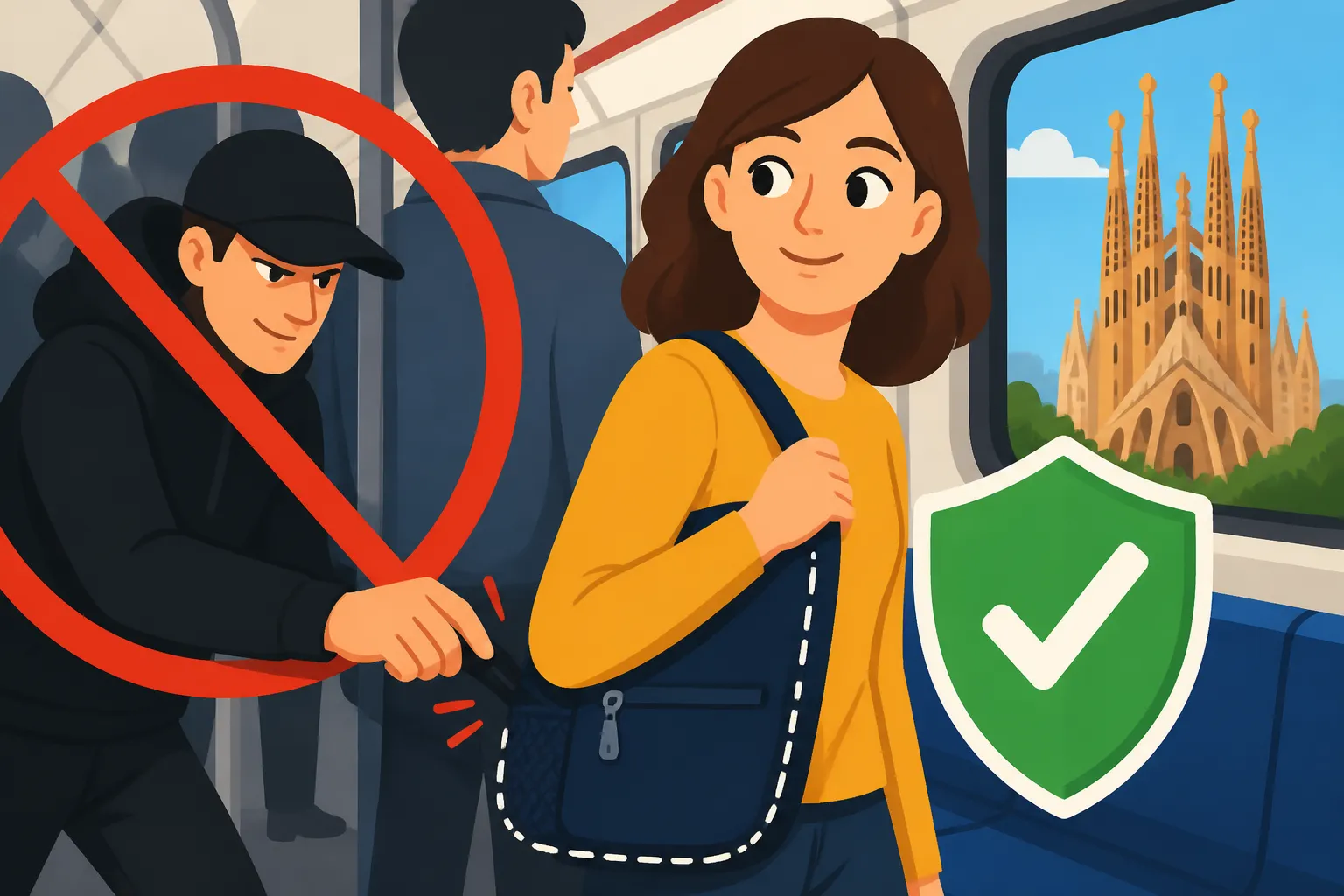
How to Avoid Pickpockets on the Barcelona Metro
Picture this: you step off at Liceu, reach for your phone to check the way to La Boqueria, and your pocket is empty. A friendly crowd brushed past you two stops earlier, and now your morning is about cancelling cards instead of eating jamón. This guide explains how pickpockets work the Barcelona Metro, how to ride without becoming a target, and what to do if it happens anyway.
Disclosure: This post may contain affiliate links. We may earn a commission at no extra cost to you if you make a purchase through these links. Read full disclosure.
Why the Barcelona Metro Is a Pickpocket Magnet
The first time my wallet disappeared in Barcelona, I was embarrassed more than angry. I had lived in big cities before and thought I was street smart. That is how most of us get caught. Barcelona’s pickpockets are not opportunists who got lucky. Many of them work in teams, ride the same lines every day, and can pick out a jet-lagged visitor before the train doors open.
The metro, run by TMB, is clean, frequent and easy to use. Those same qualities make it ideal for thieves. Carriages fill quickly, doors open and close on a tight schedule, and the busiest stations sit right below the places every visitor goes. If you plan to spend time across the city, see Getting Around Spanish Cities: Metro, Bus, Tram, and Bikes for how the network fits together.
The Stations and Lines Where Thieves Work Hardest
Pickpocketing can happen anywhere on the network, but it clusters where tourists clump together, where people are confused, and where there are a lot of transfers. The green L3 line deserves special attention because it links Las Ramblas, Plaça de Catalunya, Passeig de Gràcia and the Montjuïc side of the city. The red L1 and the blue L5 also see heavy tourist traffic, and the L5, with the L2, carries crowds to Sagrada Família.
| Station | Lines | Why it is risky | What to do there |
|---|---|---|---|
| Catalunya | L1, L3 | Huge transfer hub, long tunnels, crowds coming up from Las Ramblas | Keep your phone away while walking between platforms |
| Liceu | L3 | Directly under Las Ramblas, packed with visitors heading to La Boqueria | Move your bag to your front before the train arrives |
| Drassanes | L3 | Busy with people coming from the port and cruise terminal area | Do not count cash or check maps on the platform |
| Passeig de Gràcia | L2, L3, L4 | Casa Batlló and La Pedrera crowds, long transfer corridors | Stay alert on escalators and in narrow passages |
| Sagrada Família | L2, L5 | Visitors looking up at the basilica or at their phones | Put your phone away before you go down the stairs |
| Barceloneta | L4 | Beach crowds carrying towels, bags and phones loosely | Bring only what you need for the beach |
| Sants Estació | L3, L5 | Travellers with luggage arriving by train | Keep a hand on your suitcase and your day bag |
| Espanya | L1, L3 | Montjuïc, Magic Fountain and trade fair crowds | Watch the doors when the train empties after events |
None of this means you should avoid these stations. You will use most of them, and you should. It means these are the places where you switch from relaxed tourist to careful commuter for a few minutes.
The Tricks You Will Actually See
The methods are surprisingly repetitive. Once you recognise them, you will start spotting them, which feels strange and a little satisfying.
- The door snatch. You are standing by the door looking at your phone. As the warning sound plays and the doors start to close, someone grabs the phone and steps out onto the platform. The doors close and you are stuck inside, watching them walk away.
- The crowd sandwich. Two or three people press against you as you board, often pretending to rush or to be confused about which direction the train goes. While you are squeezed, a fourth person works on your bag or back pocket.
- The turnstile jam. Someone stops suddenly in front of you at the barrier or at the top of an escalator. You bump into them, and an accomplice behind you takes advantage of the moment.
- The helpful stranger. Someone points out a “stain” on your jacket, asks for directions with a big open map, or drops coins near your feet. The distraction lasts a few seconds, and that is all they need.
- The jacket or newspaper cover. A folded coat or newspaper is held over the arm, hiding the hand that slides into your bag.
- The backpack zip. You wear your backpack in a crowded carriage, and someone behind you opens the small front pocket where many people keep their wallet or passport.
A detail that surprises newcomers: many pickpockets in Barcelona look like tourists themselves. They may carry shopping bags or a camera, dress neatly, and speak several languages. Do not judge by looks. Judge by behaviour, such as someone standing unusually close in a half-empty carriage, or a group that boards, does not settle, and gets off at the next stop. For more on the wider city, see Avoiding Pickpockets in Spain’s Tourist Areas.
Preparing Before You Tap In
Most of the work of avoiding pickpockets happens before you go underground. A few decisions about what you carry, where you stay and how you plan your day reduce your risk far more than nervously holding your bag on the train.
What to Carry and Where to Keep It
Think in layers. What you need in the next ten minutes goes in a secure but reachable place. What you need only in an emergency goes deep and out of sight. Your passport usually belongs in the hotel safe, with a photo or photocopy on your phone and in your email.
- Phone: Front trouser pocket, or a zipped inner jacket pocket. Never the back pocket and never loose in an open tote bag.
- Transport ticket: Keep your T-casual or Hola Barcelona card in a separate pocket so you do not open your wallet at the turnstile.
- Cards: Bring one card for the day and leave a backup at your accommodation. If one gets taken, you are not stranded.
- Cash: Carry a small amount for the day. For a sense of balance between cash and cards, see How Much Cash Should You Carry When Traveling in Spain?.
- Bag: A crossbody bag with a zip that faces your body is better than a backpack. If you use a backpack, carry it on your front once you go down the stairs.
Phone lanyards and cases that clip to your bag strap look a bit dorky, but they work very well against the door snatch. I started using one after a friend lost her phone at Catalunya, and I have never looked back. If you are staying in shared accommodation, How to Keep Valuables Safe in Spanish Hostels covers how to secure the things you leave behind.
Choosing Your Base and Routes Wisely
Where you sleep shapes how much time you spend in the riskiest stations. If your accommodation is right off Las Ramblas, you will pass through Liceu or Catalunya several times a day. That is not a reason to rule the area out, but you should know what you are signing up for. Neighbourhoods such as Gràcia or parts of the Eixample give you good metro access with fewer tourist crowds on the platforms. See What’s the Best Area to Stay in Barcelona? to compare districts.
When you browse properties on Booking.com, open the map view and check which station is actually the nearest, not just the distance to the centre. A place that is a short walk to a quieter station on the L4 or L5 can make your daily trips much calmer than one right above a major interchange.
Timing helps too. Rush hours on weekday mornings and early evenings bring commuters into the same trains as tourists, and that press of bodies is exactly what thieves need. Popular attractions also create crowd waves at opening time. Booking timed-entry tickets for places like Sagrada Família or Park Güell through GetYourGuide or the official venue sites lets you pick a slot outside the busiest times, so you travel on emptier trains and do not need to carry cash for tickets. How to Avoid Crowds at the Sagrada Família has more ideas for timing that visit.
Arrival day is a classic danger point. You are tired, carrying everything you own, and checking your phone for directions. If you are coming in by train from another Spanish city, a platform such as Omio lets you compare train and bus arrivals, so you can aim for a time when the metro from Sants is less packed. Arriving by plane brings its own decisions, and How to Get From Barcelona Airport to the City Center walks through the options, including the L9 Sud metro line and the Aerobús.
Riding the Metro Step by Step
Once you are underground, a short routine makes a big difference. It quickly becomes automatic.
At the Turnstile and on the Platform
- Before you reach the barrier, take out your transport card and put your wallet away. Never stand at the turnstile digging through a bag.
- As you pass the barrier, keep a little space between you and the person ahead. If someone stops suddenly in front of you, step to the side instead of pushing forward.
- On escalators, keep your bag in front of you and your hand on it. Stand on the right, out of the walking lane, where fewer people brush past.
- On the platform, stand with your back to a wall or pillar if you can, away from the platform edge and away from the people who drift through the crowd without waiting for a train.
- Check your route on the overhead signs or a station map rather than your phone. If you must use your phone, step back against the wall and hold it with both hands.
- When the train arrives, let the first wave of people board. If a group pushes in very aggressively around you, wait for the next train. Trains on central lines come frequently, so you lose very little time.
Inside the Carriage
Once you are inside, move away from the doors and further into the carriage if you can. The space near the doors sees the most movement and the most door snatches. Hold the pole or strap with one hand and keep the other hand on your bag or phone pocket.
Keep your phone out of sight, especially in the last seconds before each stop. If you want to scroll, do it seated, away from the doors, and with a firm grip. Listen for the automatic announcements, which in several languages warn passengers about pickpockets on the network. When you hear one, take it as a reminder to check your belongings.
Watch for the classic signs: someone standing very close when there is plenty of space, a person whose hands are hidden under a coat or bag, or a group that splits up and positions itself around one passenger. If you feel uncomfortable, simply move to another part of the carriage or get off at the next stop and wait for the next train. You owe nobody politeness when your gut tells you something is wrong. Saying a loud, clear “¡No!” or “¡Cuidado!” often makes a pickpocket give up, because attention is the last thing they want.
When you leave the train, check your pockets as you step onto the platform, not halfway down the street. If something is missing, you want to know immediately. For a broader overview of keeping yourself safe in the city, see Staying Safe in Spain: Common-Sense Tips for Travelers.
What to Do If You Are Pickpocketed Anyway
Even careful people get caught. Thieves are skilled, and one second of distraction is enough. If it happens, try not to spend your energy on self-blame. Focus on limiting the damage and getting the paperwork done.
The First Hour After a Theft
- Stay on the platform or in the station for a moment, take a breath, and check every pocket and bag compartment. Make a list of exactly what is missing.
- Tell metro staff or station security. They may not recover your items, but they can point you to help and note the incident.
- Block your bank cards right away through your bank’s app or emergency phone line. See How to Report Lost or Stolen Bank Cards in Spain Quickly for the steps.
- If your phone was taken, use your phone manufacturer’s tracking service from a friend’s device or a laptop to lock it and erase it if needed. Change the password for your email and banking apps.
- If your passport is gone, contact your country’s embassy or consulate in Spain. What to Do If You Lose Your Passport in Spain explains how replacement and emergency travel documents usually work.
- If you feel threatened, were hurt, or the theft turned violent, call 112, the general emergency number. Emergency Numbers in Spain: 112 and When to Use It explains when to use it.
Filing a Police Report in Barcelona
In Catalonia, the main police force for this kind of crime is the Mossos d’Esquadra. You will need a police report, called a denuncia, for insurance claims, for replacing documents and sometimes for your bank. There are Mossos stations across the city, including in the central tourist areas, and many have staff who are used to helping visitors in English and other languages.
The Mossos also offer an online option to start the report, after which you go to a station to sign and confirm it. Bring your ID or a copy of your passport, your accommodation address, a list of stolen items with any serial numbers or phone IMEI numbers you can find, and a rough time and station where the theft happened. A few Spanish phrases help even if the officer speaks English:
- “Me han robado.” Someone has robbed me.
- “Quiero poner una denuncia.” I want to file a police report.
- “Fue en el metro, en la estación (station name).” It was on the metro, at (station name) station.
- “Me robaron la cartera, el móvil y el pasaporte.” They took my wallet, phone and passport.
Ask for a copy of the denuncia and keep it safe, both on paper and as a photo. Your insurer will almost certainly want it, and some policies set a short deadline for reporting a theft, so check your policy as soon as you can. Travel Insurance for Trips to and Within Spain covers what travel policies typically include for stolen belongings.
Once you have dealt with the practical side, give yourself a break. Have a coffee, sit in a quiet square in Gràcia, and remember that this happens to many visitors and does not have to ruin the trip. The city is still worth enjoying. If you need ideas to get back on track, see How to Spend 48 Hours in Barcelona.
Disclaimer
This article is for general informational purposes only and does not constitute professional advice. Laws, prices and regulations vary by location and change over time. Consult a qualified professional for guidance on your specific situation.