How to See Roman Ruins in Spain (Mérida and Beyond)
You stand in Mérida’s Roman theatre at midday in July, the stone radiating heat, and realise you should have started at opening time. Spain has some of the finest Roman remains outside Italy, but they are scattered and unevenly connected. This guide covers Mérida in depth, then the other major sites, with practical routes, tickets and timing.
Disclosure: This post may contain affiliate links. We may earn a commission at no extra cost to you if you make a purchase through these links. Read full disclosure.
Why Mérida Deserves More Than a Day Trip
I first went to Mérida expecting a single impressive theatre and a quick lunch. I stayed three nights and still missed things. Augusta Emerita, as the Romans called it, was founded as a settlement for veteran soldiers and became the capital of the province of Lusitania. Today it is the capital of Extremadura, a calm, walkable city where Roman stones turn up in car parks, under banks and beside apartment blocks.
The ruins are not in one tidy archaeological park. They are spread across the town, which is part of the charm and part of the frustration. The whole ensemble is a UNESCO World Heritage Site. For the wider picture of the country’s listed places, see Spain’s UNESCO World Heritage Sites: A Visitor’s Guide.
The Theatre and Amphitheatre Complex
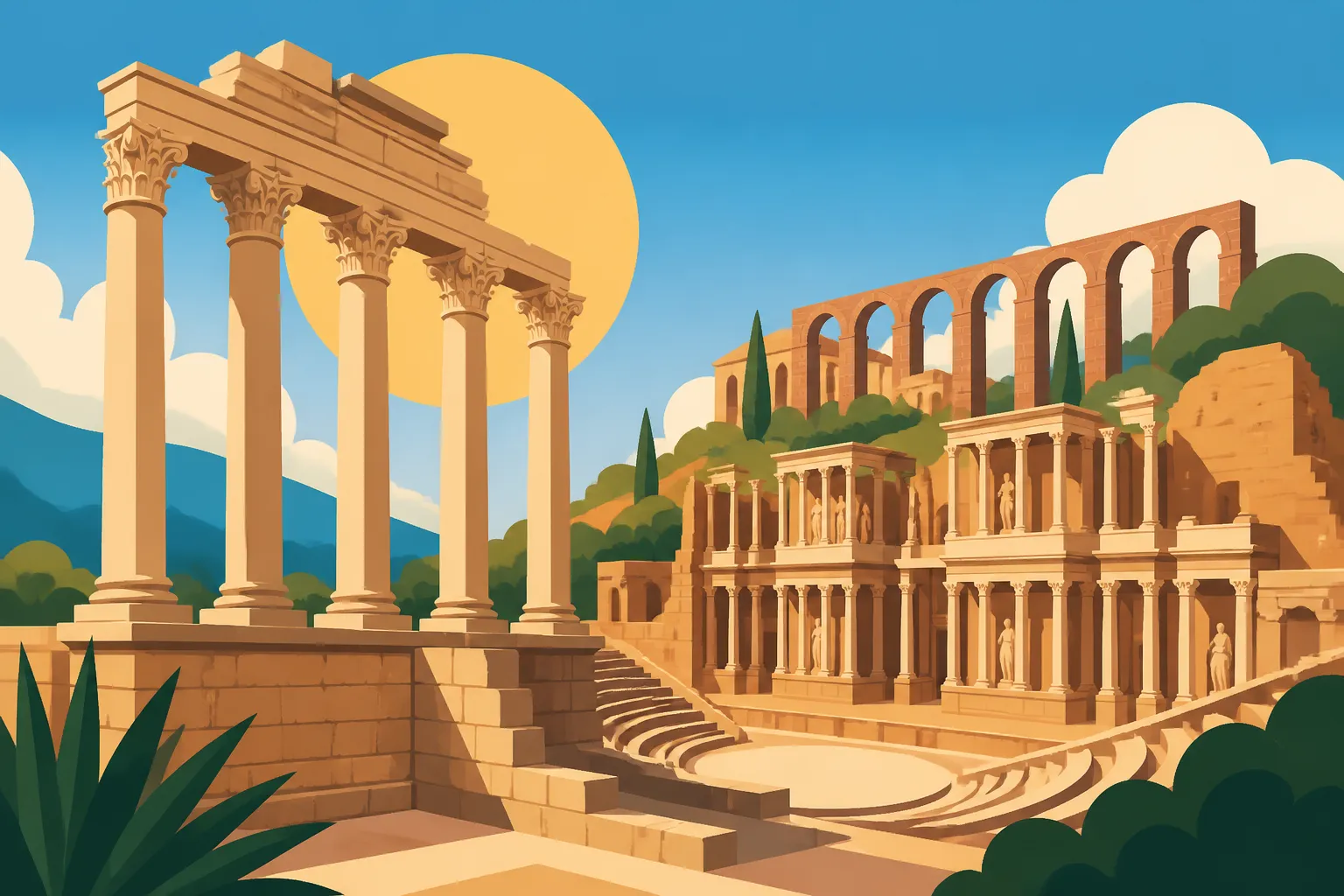
The theatre is the image on every postcard: a semicircle of seating facing a two-tier stage front of columns and statues, the scaenae frons. Walk onto the stage, look up at the stands, and try to picture a full house. In summer the space still works as intended, because the International Classical Theatre Festival of Mérida stages plays there on warm evenings. Watching Greek tragedy under the stars in a Roman theatre is one of those experiences I recommend to everyone, Spanish speaker or not.
Right next door is the amphitheatre, where gladiator fights and animal shows took place. It is rougher and less restored than the theatre, but you can walk through the vaulted passages and stand in the arena. Go early. By late morning in summer there is almost no shade, and the stone holds the heat well into the evening.
The surrounding gardens hold the remains of Roman houses with mosaic floors, so leave time to wander rather than rushing straight back to the exit.
The Rest of Augusta Emerita
Once the headline sites are done, the city keeps rewarding you:
- The Temple of Diana sits in the middle of the old town, its columns framed by later buildings that were built into and around it.
- The Puente Romano over the Guadiana River is still a pedestrian bridge, and walking its length at sunset is free and memorable.
- The Acueducto de los Milagros stands in a park on the edge of town, tall granite and brick piers with storks nesting on top.
- The Circus, used for chariot races, is a long open field with an interpretation centre that helps you imagine the scale.
- The Casa del Mitreo and the Columbarios hold domestic mosaics and funerary remains, a little outside the centre.
- The Alcazaba, an Islamic fortress, was built partly from Roman material and gives a view of the bridge.
The National Museum of Roman Art
Do not skip the Museo Nacional de Arte Romano. The building, designed by the architect Rafael Moneo, uses huge brick arches that echo Roman construction, and it is full of statues, mosaics and everyday objects found in the city. Below it is a crypt with an excavated stretch of Roman road and houses.
Here is the practical point: the museum is a state museum and runs separately from the city’s combined monument ticket. Check its own website for opening days and any free-entry slots. Our guide How to Find Free Museum Days in Spanish Cities explains how these schemes usually work across the country.
Planning Your Mérida Visit Step by Step
Mérida is easy once you are there and slightly awkward to reach. Extremadura is one of the less connected regions of Spain, and the rail service is not high-speed in the way Madrid to Seville is. I have done it by train, by bus and by rental car, and each has a place.
Getting There
From Madrid you can take a train or a long-distance bus, and from Seville the bus is often the more practical public option. Timetables change, so compare them close to your date. Omio is handy here because it lists trains and buses side by side, which matters on routes where the bus is the better choice. For the bigger picture on why this region is slower to reach, see Reaching Extremadura and Rural Spain: Where the Rail Network Thins Out.
If you want to add Cáceres, Trujillo or the Roman bridge at Alcántara, a car becomes very useful. Read Renting a Car in Spain: Requirements, Insurance, and Driving Tips before you book, especially if you are coming from outside the EU.
A Simple Order of Visit
This is the sequence I now use when I take friends:
- Buy the combined monument ticket at the first ticket office you reach, usually at the theatre and amphitheatre entrance, and confirm which sites it includes.
- Visit the theatre and amphitheatre as soon as they open, while the stone is still cool.
- Cross the road to the National Museum of Roman Art in the late morning, when the heat outside builds.
- Have a long lunch in the old town near the Temple of Diana.
- Rest through the hottest hours, then visit the Alcazaba and walk the Roman bridge in the late afternoon.
- On a second morning, cover the Circus, the Los Milagros aqueduct and the Casa del Mitreo.
Where to Stay and When to Go
Staying in the old town means you can walk everywhere, return to your room in the afternoon and head out again in the evening. Booking.com lists plenty of small hotels and apartments around the Plaza de España; filter by location and air conditioning rather than price alone. If you are building a wider trip through the region, see Where to Stay in Extremadura and Rural Castile.
Spring and autumn are the most comfortable seasons. Summer brings the theatre festival but also serious heat, so plan for shade, water and a hat, and read How to Hike Safely in Spain’s Summer Heat, whose advice applies just as well to a day among exposed ruins.
Roman Ruins Beyond Mérida
Mérida is the headline, but Roman Hispania stretched across the whole peninsula. The following sites are the ones I send people to most often, grouped so you can fit them into a realistic trip.
Tarragona on the Catalan Coast
Tarraco was the capital of a large Roman province, and Tarragona wears that history well. The amphitheatre sits right above the Mediterranean, so you get gladiator history and a sea view at the same time. In the old town you can walk through the vaulted passages of the Roman circus, climb the Praetorium tower and follow sections of the city walls.
Just outside town, the aqueduct known as the Pont del Diable, the Devil’s Bridge, stands in a wooded valley, and you can walk along its top. In spring, the Tarraco Viva festival brings re-enactments and talks. Tarragona works as a day trip from Barcelona by regional train, and the archaeological ensemble of Tarraco is also a UNESCO site.
Itálica Near Seville
Itálica, in the town of Santiponce just outside Seville, was the birthplace of the emperors Trajan and Hadrian. Its amphitheatre was one of the largest in the Roman world, and you can walk its underground passages. The streets of the later city are laid out in a grid, with houses named after the mosaics found in them, such as birds and planetarium designs.
There is little shade, so morning visits are best. Local buses from Seville reach Santiponce, and GetYourGuide offers guided half-day tours that combine transport with a guide, which suits travellers who want context without planning logistics. For more ideas from the same base, see What Are the Best Day Trips From Seville?.
Segovia and the Castilian Heartland
Segovia’s aqueduct is perhaps the most recognisable Roman structure in Spain: a towering line of granite arches built without mortar, cutting straight through the city. It is free to see and you can walk underneath it at any hour. Segovia makes an easy day trip from Madrid, and How to Visit Segovia From Madrid by Train walks through the connection. If you are pairing it with medieval Toledo, see Toledo and Segovia: Historic Cities Near Madrid.
Other Sites Worth the Detour
- Baelo Claudia sits on Bolonia beach near Tarifa, a seaside town with a forum, temples, a theatre and the tanks used to make garum, the famous fish sauce.
- Lugo in Galicia has Roman walls that still encircle the old town completely, and you can walk the full circuit on top for free.
- Cartagena has a Roman theatre uncovered beneath the old town, with a museum that guides you into the seating.
- Zaragoza, once Caesaraugusta, has small museums built around its forum, river port, baths and theatre.
- Las Médulas in León shows the landscape left by Roman gold mining, red peaks and tunnels that are now a UNESCO site.
- Empúries on the Costa Brava combines Greek and Roman remains beside the sea.
- Sagunto, near Valencia, has a Roman theatre below a hilltop castle.
- Córdoba has a Roman bridge over the Guadalquivir and the columns of a Roman temple near the town hall.
For a broader overview of these and other sites, see Roman and Ancient Spain: Sites and Ruins to Visit.
Comparing the Main Roman Sites
The table below is the one I would have liked before my first trip. It is not a ranking; each site suits a different kind of traveller.
| Site | Region | Highlights | Easiest Base | Best For |
|---|---|---|---|---|
| Mérida | Extremadura | Theatre, amphitheatre, National Museum of Roman Art, Roman bridge, aqueduct | Mérida old town | The most complete Roman city experience |
| Tarragona | Catalonia | Seaside amphitheatre, circus vaults, walls, Devil’s Bridge aqueduct | Tarragona or Barcelona | Combining ruins with a beach town |
| Itálica | Andalusia | Huge amphitheatre, mosaic houses, street grid | Seville | A half-day trip from a major city |
| Segovia | Castile and León | Monumental aqueduct in the city centre | Segovia or Madrid | A quick, free, spectacular stop |
| Baelo Claudia | Andalusia | Forum, theatre, fish-salting tanks on the beach | Tarifa | Ruins plus a swim |
| Lugo | Galicia | Complete Roman walls you can walk on | Lugo | A relaxed walk in green Spain |
| Cartagena | Murcia | Theatre beneath the old town with a museum | Cartagena | A compact urban visit |
| Las Médulas | Castile and León | Roman gold-mining landscape and tunnels | Ponferrada | Hiking and scenery |
Choosing a Route
If you have a week and love Roman history, I would combine Madrid, Segovia and Mérida, then drop down to Seville for Itálica. If you are based in Barcelona, Tarragona and Empúries pair naturally. In the south, Baelo Claudia and Itálica can be linked through Andalusia, though Baelo Claudia is far easier with a car.
Tickets, Guides and Making Sense of Stones
Ruins can feel like piles of rock unless you know what you are looking at. A good guide, an audio guide or a bit of reading beforehand changes everything. Many sites have interpretation panels in Spanish and English, and some offer free entry to EU citizens; check each site’s official page for current conditions, because rules differ between state-run, regional and municipal sites.
Booking a guided tour through GetYourGuide can make sense at the bigger sites where you want a story told well. At smaller places such as Lugo’s walls or Segovia’s aqueduct, wandering on your own is perfectly satisfying. For background on how Roman Hispania fits into Spain’s later history, see History, Art, and Architecture in Spain.
Practical Kit for Ruin Days
Ruins are hard on feet and on bodies in the heat. My standard list:
- Comfortable shoes with grip, since Roman paving is uneven and polished smooth in places.
- A refillable water bottle, sun hat and sunscreen.
- A charged phone with offline maps and a few site plans downloaded in advance.
- Some cash for small cafés near out-of-town sites.
- A light layer for museum air conditioning and cool spring evenings.
Take your time. The best moments I have had at Roman sites in Spain were not the famous photo spots but quiet ones: sitting on the upper rows of Mérida’s theatre as the evening light turned the stage gold, or walking Lugo’s walls on a misty morning with nobody else in sight.
Disclaimer
This article is for general informational purposes only and does not constitute professional advice. Laws, prices and regulations vary by location and change over time. Consult a qualified professional for guidance on your specific situation.