How to See Gaudí’s Buildings in Barcelona in One Day
Most visitors land in Barcelona with a dream of seeing Antoni Gaudí’s whimsical creations, only to find themselves overwhelmed by massive crowds, sold-out tickets, and the sheer logistical nightmare of crossing the city. This guide solves that frustration by providing a meticulously timed, one-day itinerary that maximizes your time at the core masterpieces while avoiding common tourist traps.
Disclosure: This post may contain affiliate links. We may earn a commission at no extra cost to you if you make a purchase through these links. Read full disclosure.
Planning Your Gaudí Marathon: Strategy and Logistics
The biggest mistake I see newcomers make is assuming they can simply walk up to the Sagrada Família or Park Güell and buy a ticket. Those days are long gone. Barcelona has become one of the most visited cities in Europe, and Gaudí’s works are the crown jewels. If you do not book your entry times at least two weeks in advance—especially for a one-day sprint—you will likely spend your afternoon staring at a "Sold Out" sign.
When planning your day, you must think of the city in terms of its geography. The Gaudí sites are not clustered in one single "Gaudí District." They are spread from the hills of Carmel down to the heart of the Eixample. To see them in a single day, you need a linear path that minimizes back-and-forth travel. Start early, ideally at the first entry slot of the day, to beat the heat and the heaviest tour groups.
While you can navigate the official websites for each individual monument, it is often easier to use GetYourGuide to book skip-the-line tickets or combined tours. This consolidates your bookings into one app, which is a lifesaver when you are trying to stay on a tight schedule. Having your QR codes ready to scan prevents that frantic searching through your email while a grumpy security guard waits at the gate.
The Golden Rule of Pre-Booking
The sequence of your bookings is the most critical part of the strategy. You should aim for a "9:00 AM – 11:30 AM – 3:30 PM" rhythm. This allows for a two-hour window at the major sites, with transit and lunch buffered in between. If you miss your window at the Sagrada Família by even fifteen minutes, they are notoriously strict about denying entry. This isn't just about punctuality; it's about the city's capacity management laws that keep these fragile UNESCO sites from being overwhelmed.
Prioritizing Your Must-Sees
Since you only have one day, you cannot see everything. You have to make the hard choice between going inside every building or admiring some from the exterior. For a high-impact day, I recommend going inside the Sagrada Família and Park Güell, and then choosing one of the two houses on Passeig de Gràcia (Casa Batlló or La Pedrera) for an interior tour. The other can be appreciated from the street, which is an architectural marvel in its own right.
The Essential Gaudí Morning: Sagrada Família and Park Güell
Your day must begin at the Sagrada Família. There is something truly spiritual about being inside the basilica when the morning sun hits the eastern stained-glass windows. The "cool" blues and greens of the Nativity side illuminate the nave in a way that feels like you’re walking through a deep-sea forest. By midday, the sun shifts, and the "warm" reds and oranges of the Passion side take over. Seeing that transition is worth the early alarm.
After the basilica, you need to head north to Park Güell. Many people try to walk this, but as a local, I’m telling you: don't. It is a steep, uphill climb that will drain your energy before lunch. Instead, take the bus or a quick taxi. Park Güell was originally intended to be a luxury housing estate, but it failed commercially and became the world’s most famous public park. The "Monumental Zone"—the part with the famous mosaic lizard and the serpentine bench—requires a timed entry ticket.
Navigating the Sagrada Família Details
When you are inside the Sagrada Família, don't just look up at the ceiling. Look at the columns. Gaudí designed them to mimic trees, branching out as they reach the roof to support the weight of the massive stone canopy. If you have booked a tower visit, I recommend the Nativity Tower. It offers a closer look at the intricate fruit-topped pinnacles and a view over the older part of the city. For more tips on managing the sheer volume of people here, check out How to Avoid Crowds at the Sagrada Família to ensure your experience remains peaceful.
The Magic of Park Güell’s Trencadís
The technique Gaudí used for the mosaics in Park Güell is called trencadís, which involves using shards of broken ceramic and glass. It was a revolutionary form of recycling at the time. When you are in the park, make sure to walk up to the "Calvary" point—the three crosses at the highest point of the hill. Many tourists skip this, but it provides a 360-degree view of Barcelona, with the Sagrada Família poking out from the city grid like a giant sandcastle. If you are still feeling your way around the city's general layout, reading Barcelona for First-Time Visitors: What to See and Skip can help you understand where these landmarks sit in relation to the rest of the town.
| Site | Recommended Time | Best Entry Slot | Signature Feature |
|---|---|---|---|
| Sagrada Família | 2 – 2.5 Hours | 09:00 AM | Stained Glass Forest |
| Park Güell | 1.5 – 2 Hours | 11:30 AM | Salamander/Dragon |
| Casa Batlló | 1 – 1.5 Hours | 03:30 PM | Dragon Back Roof |
| La Pedrera | 1 – 1.5 Hours | 05:00 PM | Warrior Chimneys |
Afternoon Architectural Gems: Passeig de Gràcia
By the time you finish Park Güell, you’ll be ready for lunch. I suggest taking the V19 bus down to the Eixample district or the Gràcia neighborhood. Avoid eating inside the Park Güell zone or right next to the Sagrada Família; the quality is often lower and the prices are geared toward tourists. Instead, find a small bodega for some authentic tapas. Understanding the local rhythm is key here, so take a look at Spanish Meal Times and Dining Etiquette Explained so you don't show up for dinner when the kitchen is closed.
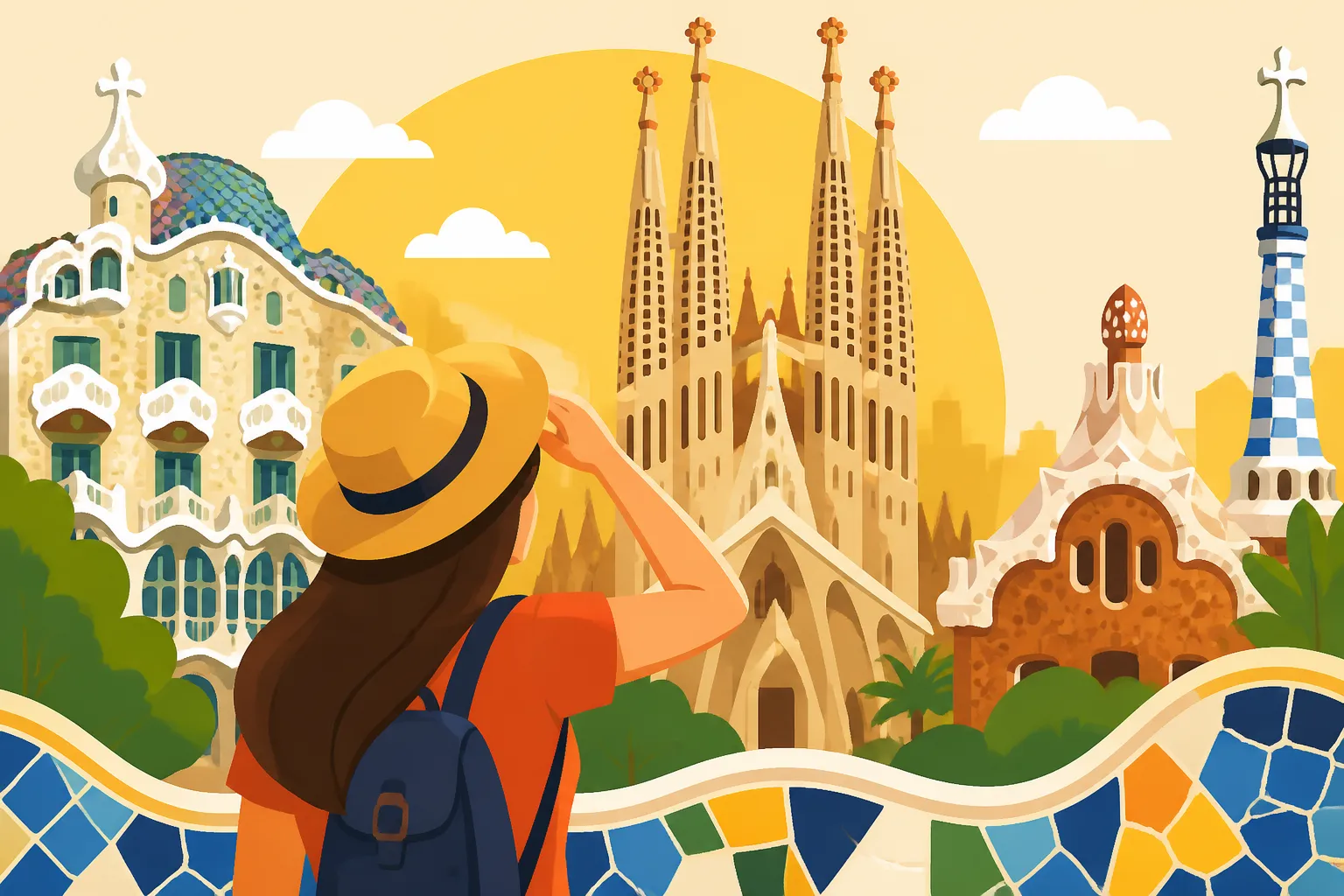
Once refueled, head to Passeig de Gràcia. This is Barcelona’s most glamorous avenue, and it hosts two of Gaudí’s residential masterpieces: Casa Batlló and Casa Milà (popularly known as La Pedrera). These two buildings represent Gaudí at the height of his "Naturalist" phase, where he moved away from straight lines and embraced the organic curves of the sea and the mountains.
Casa Batlló: The House of Bones
Casa Batlló is often called the "House of Bones" because of its skeletal balconies. The facade is covered in a mosaic of colors that resemble a calm sea or the scales of a fish. The roof is the real showstopper; it is designed to look like the arched back of a dragon, with the colorful tiles representing scales and a four-armed cross representing the sword of Saint George (Sant Jordi), the patron saint of Catalonia.
La Pedrera: The Stone Quarry
Just a few blocks up the street is Casa Milà. It earned the nickname "La Pedrera" (The Quarry) because of its rough, wave-like stone exterior. Unlike Casa Batlló, which was a renovation of an existing building, La Pedrera was built from the ground up. The highlight here is the rooftop, where the chimneys are designed as "Guardians" or "Warriors." They are not just decorative; they were a functional solution to ventilation that Gaudí turned into art. If you are traveling from another city for this one-day trip, checking Omio for train schedules into Passeig de Gràcia station can save you significant transit time.
Logistics: Getting Around and Staying Fueled
Barcelona is a walkable city in theory, but when you are trying to see four major monuments in eight hours, you need to use the transit system efficiently. The Metro is excellent, but the buses actually offer better views and often drop you closer to the entrance of Park Güell. If you are staying in the city for more than a day, I recommend finding a central hotel through Booking.com—specifically in the Eixample or near Plaça de Catalunya—so you have a central hub to return to.
For those arriving from the airport to start their day, knowing the route is essential. You can find detailed instructions in How to Get From Barcelona Airport to the City Center to avoid wasting your first hour in a confused haze at the terminal. Once in the city, the T-Casual card is your best friend for ten rides on any public transport.
Choosing Between the Houses
If you are truly short on time or budget, you might wonder which house to go inside. Casa Batlló is more "magical" and colorful, making it a favorite for families and photographers. La Pedrera is more "architectural" and provides a deeper look at how people actually lived in these Gaudí spaces, including a preserved apartment from the early 20th century. If you only have time for the exterior, at least walk by both. They are only three blocks apart.
Eating Between Masterpieces
Don't fall for the "Menu del Dia" posters right on the main drag of Passeig de Gràcia unless you’ve checked the reviews. Walk one or two blocks into the side streets of the Eixample. You will find better quality and more locals. If you are worried about the etiquette of ordering, How to Order Tapas in Spain Without Overdoing It is a great primer to help you navigate the counter-service culture.
For those who are squeezing Barcelona into a larger Spanish itinerary, you might be coming in via the high-speed rail. Using the How to Use the Renfe App to Plan Train Travel in Spain guide will help you manage your tickets so you can arrive at Sants Station early enough to drop your bags and head straight to the Sagrada Família.
Common Pitfalls and How to Avoid Them
The most common pitfall is underestimating the "Barcelona Pace." Everything takes a little longer than you think—the metro wait, the security line, the time spent staring in awe at a ceiling. If you try to do five or six things, you will end up seeing nothing. Stick to the "Big Four" (Sagrada Família, Park Güell, Casa Batlló, and La Pedrera) and you will have a much more fulfilling day.
Another mistake is forgetting to stay hydrated. Barcelona’s sun can be brutal, especially in the exposed areas of Park Güell. There are public water fountains (font de canaletes) all over the city where the water is perfectly safe and cold. Keep a reusable bottle in your bag.
Finally, be aware of your surroundings. Like any major tourist city, pickpockets operate near the major Gaudí sites. Keep your bag in front of you and don't get distracted by "street performers" or people offering to take your photo for free. If you are still in the planning phase and wondering if one day is enough, you might want to read How Many Days Do You Need in Barcelona to see if you can squeeze in a second day for the beaches or the Gothic Quarter.
If your schedule is tight and the official sites are sold out, checking GetYourGuide often reveals last-minute availability through tour operators who have pre-purchased blocks of tickets. It can be a life-saver for the disorganized traveler. Similarly, if you are coming from out of town, Omio is the most reliable way to compare bus vs. train prices to ensure you get into the city at the crack of dawn.
For those who want to stay close to the action, Readers who want to stay close to the action often look at Booking.com for apartments in the Gràcia neighborhood. It feels like a village within the city and is perfectly positioned between the mountain-side Park Güell and the downtown houses. For a more luxury experience, What's the Best Area to Stay in Barcelona breaks down the pros and cons of each neighborhood in detail.
Disclaimer
This guide is intended for informational purposes only. While we strive to provide the most accurate and up-to-date information regarding opening hours, ticket prices, and transit routes in Barcelona, these details are subject to change by the local authorities and monument management. Always verify specific times and booking requirements on official websites or through your chosen booking platform before your visit. We are not responsible for any disruptions to travel plans due to closures, strikes, or sold-out events.