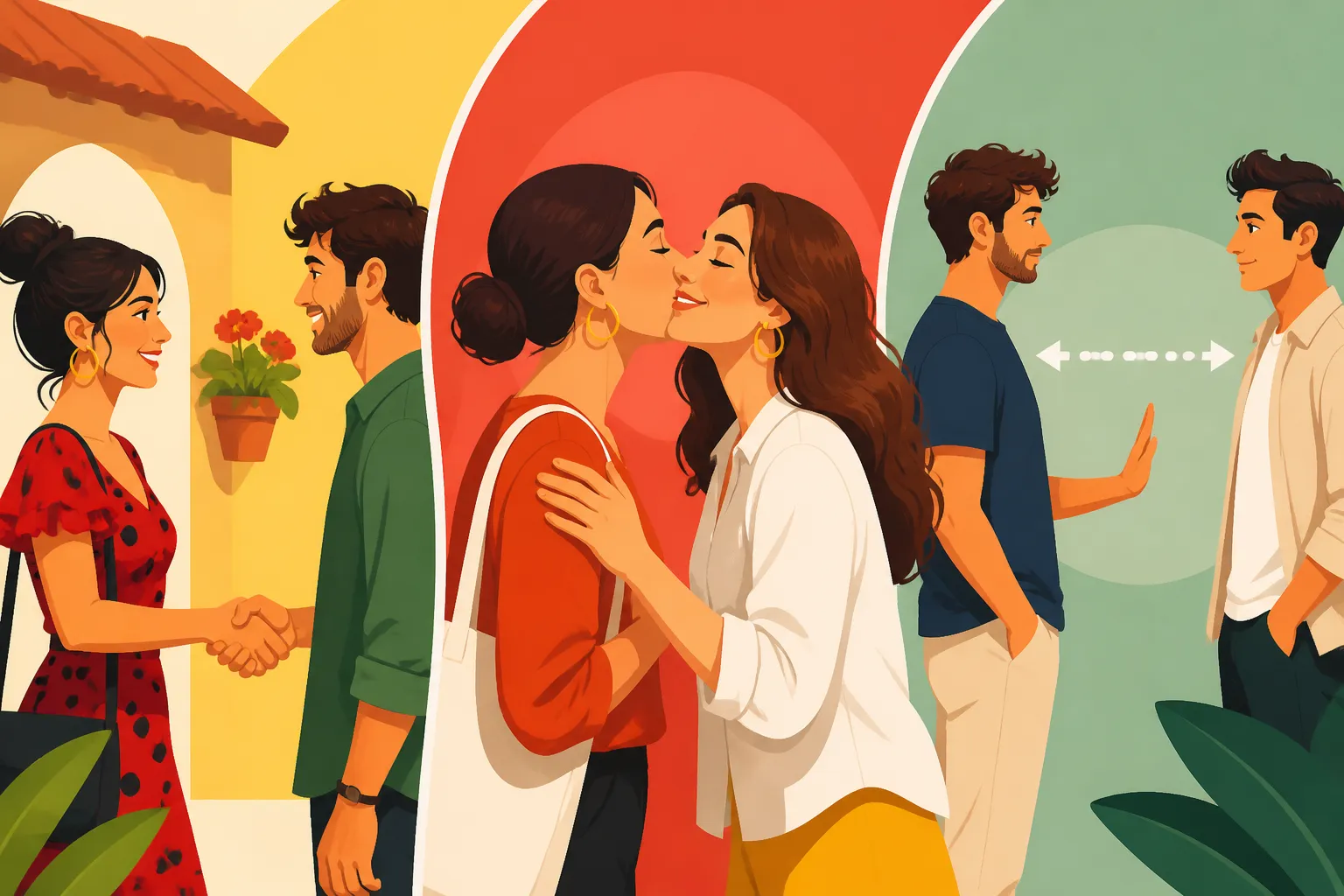
Spanish Social Customs: Greetings, Kisses, and Personal Space
One of the most paralyzing moments for a newcomer in Spain is the split-second hesitation when meeting someone new, wondering whether to offer a hand, a hug, or a face-full of air-kisses. I still remember the burning embarrassment of my first week in Seville, when I accidentally head-butted a new colleague because I leaned the wrong way during a greeting. This guide solves the social anxiety of navigating Spanish physical boundaries, greetings, and the nuanced rules of personal space so you can blend in like a local.
Disclosure: This post may contain affiliate links. We may earn a commission at no extra cost to you if you make a purchase through these links. Read full disclosure.
The Art of the Spanish Greeting
The physical nature of Spanish greetings is often the first "culture shock" hurdle for those arriving from more reserved societies. In Spain, a greeting is rarely just a verbal "hello." It is an active, tactile event that signals your relationship with the other person and your willingness to engage in the local social fabric. Understanding the mechanics of these interactions prevents the awkward "dance of doubt" that many foreigners perform during their first few months in the country.
The Double Kiss or Dos Besos
The double kiss, known as dos besos, is the standard greeting between women and between men and women. It is important to clarify immediately that these are not "kisses" in the traditional sense of lips touching skin. Instead, you touch your right cheek to their right cheek and make a soft kissing sound in the air, then repeat on the left side. It is a choreographed gesture of warmth and acknowledgment.
When you are introduced to someone in a social setting, even if you have never met them before, the dos besos is expected. If you are using Booking.com to find a charming guesthouse in a small town, do not be surprised if your host greets you this way upon arrival. It is a sign of hospitality. However, the order is crucial: always go to your right first. Leaning to the left will lead to the aforementioned "head-butt" or an accidental kiss on the lips, which is a guaranteed way to make things very awkward very quickly.
In professional environments, the rules soften slightly. During a first-time business meeting, a firm handshake is often the safer bet, especially in corporate sectors like law or finance. However, as soon as a professional relationship becomes friendly, the dos besos often takes over. For a deeper dive into these nuances, you might find our guide on How to Greet People in Spain: Handshake or Kiss? particularly useful for your first few networking events.
Men Greeting Men
The rules for men greeting other men are distinct and carry their own set of silent signals. Traditionally, two men who do not know each other well will stick to a firm handshake. It is direct, professional, and establishes a boundary of mutual respect. You will see this everywhere from construction sites to high-rise offices in Madrid.
As a friendship develops, the handshake often evolves into the abrazo. This is a quick, vigorous hug accompanied by a couple of firm pats on the back. It is a display of "confianza" or trust. You will see groups of friends meeting in plazas, performing a hybrid handshake-into-hug that looks almost like a practiced routine. Men generally do not give the dos besos to other men unless they are family members or very close, long-term friends, though this is slowly changing among younger, more progressive generations in urban centers.
If you are traveling through different regions using Omio to book your train or bus tickets, you may notice subtle variations. In the south, people tend to be even more tactile and quick to embrace, while in the north, the initial handshake might persist a little longer before the "hug stage" of friendship is reached. For more on these social interactions, check out Spanish Etiquette for Expats: Greetings, Invitations, and Daily Life.
Group Greetings and the Hola a Todos Trap
Walking into a room full of people can be an intimidating experience in Spain. If you are joining a group of ten people at a bar for tapas, the "correct" way to greet them can feel like a logistical nightmare. Should you go around the table and give twenty kisses and ten handshakes?
The reality is a mix of both. If it is a small, intimate group, you are generally expected to greet everyone individually. However, in larger gatherings, it is perfectly acceptable to give a warm, enthusiastic "¡Hola a todos!" (Hello everyone!) accompanied by a general wave. If you are the guest of honor or the new person being introduced, your host will usually facilitate the individual greetings.
Do not be the person who stands silently in the corner; the Spanish social scene rewards those who are vocal and present. Learning a few Spanish Slang and Everyday Expressions for Visitors can help you break the ice during these group introductions. Once the initial "hola" is out of the way, the conversation usually flows rapidly, and the physical barriers drop almost instantly.
Navigating Personal Space and Touch
One of the most significant adjustments for expats is the "radius" of personal space. In many English-speaking cultures, we maintain a "bubble" of about an arm's length. In Spain, that bubble is significantly smaller. If someone is talking to you and you find yourself constantly stepping backward to maintain your "space," you are likely signaling—unintentionally—that you are cold, disinterested, or even rude.
The Bubble Radius and Proxemics
In Spain, standing close to someone during a conversation is a sign of engagement and interest. It is common for people to stand close enough that you can feel the heat of the conversation. This can feel intrusive at first, but it is rarely meant as an aggressive move. It is simply the "natural" distance for a Spanish social interaction.
This closeness extends to physical touch during the conversation itself. It is entirely normal for a Spaniard to touch your arm, pat your shoulder, or even grab your hand briefly to emphasize a point while they are speaking. This is not flirting; it is a linguistic tool used to ensure they have your full attention. If you are on a tour booked through GetYourGuide, your local guide might do this frequently as they passionately explain the history of a cathedral or a monument.
If you find this level of contact overwhelming, the best strategy is not to jump back, but to slowly acclimate. Observe how locals interact with each other; you will see that touch is a constant, rhythmic part of their communication.
Queuing and Crowded Spaces
The Spanish approach to queues (lines) is a masterclass in organized chaos. If you walk into a busy bakery or a local fish market, you might not see a straight line. Instead, you will see a cluster of people. The secret is to ask, "¿Quién es el último?" (Who is the last one?). The person who arrived just before you will raise their hand or nod. You are now "after" them, regardless of where you actually stand in the room.
In these crowded spaces, such as a packed metro car or a busy "Chiringuito" on the beach, the concept of "personal space" effectively vanishes. People will brush past you, lean over you to reach for a napkin, or stand shoulder-to-shoulder without a second thought. There is a high level of tolerance for physical proximity that can feel claustrophobic to those used to more "breathing room."
However, there is a specific etiquette to this. If you accidentally bump into someone, a quick "perdón" or "disculpe" is all that is required. The key is to remain relaxed. If you stiffen up and act annoyed by the lack of space, you will find the experience much more stressful than it needs to be. For practical advice on managing these busy environments, see Spanish Bar and Café Etiquette for Newcomers.
Physicality in Public and the Siesta Rhythm
The way Spaniards move through public spaces is also tied to the time of day. During the morning rush or the evening paseo (stroll), the streets are alive with physical energy. Families walk arm-in-arm, and teenagers clump together in large, tactile groups. The street is an extension of the living room.
Then, there is the afternoon lull. Understanding Why Do Shops in Spain Close in the Afternoon? is essential for navigating the physical rhythm of the country. Between 2:00 PM and 5:00 PM, the frenetic energy of the morning evaporates. This is the time for a long, slow lunch and, yes, sometimes a rest. The social expectation during these hours is one of quiet and reduced physical activity. If you are out in the streets during this time, you will notice a marked shift in how people occupy space—everything becomes slower and more deliberate.
| Context | Primary Greeting | Physical Boundary | Key Etiquette Tip |
|---|---|---|---|
| New Social Meeting | Dos Besos (Women/Mixed) | Close | Always lean to your right first. |
| Business Meeting | Firm Handshake | Moderate | Wait for the local to initiate a kiss. |
| Close Friends | Abrazo (Hug) | Very Close | Expect back-pats and arm-touching. |
| Busy Bar/Market | Verbal ("¿Quién es el último?") | Intimate/Crowded | Identify the "last person" in the queue. |
| Family Gathering | Kisses/Hugs for all | No boundaries | Greet elders first with a kiss on both cheeks. |
The Daily Rhythm and Social Etiquette
Beyond the physical greeting, the way you spend time with people in Spain is governed by deep-seated traditions. Social life in Spain isn't just about the "event"—the dinner or the drink—it’s about the ritual surrounding it.
The Sobremesa
If there is one social custom you must embrace to truly understand Spain, it is the sobremesa. This refers to the period of time spent sitting at the table after a meal has finished, talking, drinking coffee or a digestif, and simply enjoying the company. In many countries, once the plates are cleared, the check is requested. In Spain, requesting the check immediately after the last bite is considered almost tragic.
The sobremesa can last anywhere from thirty minutes to several hours. It is where the real bonding happens. If you have used GetYourGuide to book a private cooking class or a food tour, pay close attention to this part of the experience. It’s the time when stories are told and friendships are solidified. If you are hosting, never rush your guests away from the table. If you are a guest, do not be the first to stand up. For more on how to handle these long dining sessions, read Spanish Meal Times and Dining Etiquette Explained.
The Spanish Minute and Punctuality
Punctuality in Spain is a frequent source of frustration for expats. There is a general rule of thumb: for professional appointments and formal events (like a wedding or a doctor's visit), you should be on time. For social gatherings—meeting friends for drinks, a dinner party at someone's house, or a night out—"on time" usually means 15 to 30 minutes late.
If you tell a Spaniard to meet you at 8:00 PM at a bar, and you arrive at 7:55 PM, you will likely be waiting alone for a while. This is not meant as a sign of disrespect; it is a cultural understanding that schedules are flexible and life happens. However, if you are the one arriving late, a simple "Lo siento, me he liado" (Sorry, I got caught up) is usually all the excuse needed. Understanding this "social buffer" is key to Making Friends in Spain as a Foreigner: Social Tips.
Bar and Café Etiquette
The Spanish bar is the heart of the community. It is where people go for breakfast, a mid-morning coffee, a pre-lunch vermouth, and late-night drinks. The etiquette here is informal but specific. In many traditional bars, especially in the south, it is common to see people throwing used napkins on the floor. While this feels wrong to most foreigners, in some old-school establishments, a floor covered in napkins is actually a sign of a popular, high-quality bar.
When ordering, be direct. A simple "Un café solo, por favor" or "Una caña, cuando puedas" is sufficient. You don't need the elaborate "politeness" markers used in English. Also, tipping is not mandatory or expected in the same way it is in North America. Usually, leaving the small change from your bill is more than enough. For a full breakdown on this, see Tipping in Spain: When, Where, and How Much.
If you are using Booking.com to stay in a residential neighborhood, find a local "Taberna" and become a regular. Once the camarero (waiter) recognizes you, the greeting will shift from a formal "Buenos días" to a friendly "Hola, ¿qué tal?" This transition is the first sign that you are moving from "tourist" to "neighbor."
Verbal Manners and Communication Style
Spanish communication is often more direct than what many expats are used to, which can sometimes be misinterpreted as rudeness. In reality, it is a sign of honesty and a lack of pretension.
Tuteo vs. Usted
The Spanish language has two ways of saying "you": the informal tú and the formal usted. In modern Spain, the tuteo (using tú) has become the default in almost all social and many professional situations. Waiters, shopkeepers, and even some bosses will expect to be addressed as tú.
However, usted still holds power when speaking to the elderly or in very formal administrative settings (like the police or a high-ranking government official). When in doubt, start with usted, but if the other person uses tú with you, feel free to switch immediately. Using Ordering Food and Drinks in Spanish: A Practical Phrasebook can give you the right templates to use in these various interactions.
Directness and the Art of Saying No
Spaniards tend to be very direct in their speech. If they don't like a dish, they might say "no me gusta" without the "I'm so sorry, but…" preamble. Similarly, if you ask someone for a favor and they can't do it, they will often give you a blunt "no."
This directness actually makes social life easier once you get used to it. You don't have to guess what people are thinking. However, when you are the one speaking, you don't need to over-apologize for your preferences or your boundaries. A simple, firm statement is respected. If you are struggling with the language barrier, our guide on Spanish Language and Everyday Communication for Visitors offers great tips on how to be direct without being offensive.
Small Talk and Taboos
Small talk in Spain often revolves around food, family, and the weather (specifically how hot it is). Unlike in some cultures where asking about someone's family is considered prying, in Spain, it is a standard way to show interest in someone's life.
There are, however, a few topics to approach with caution. Politics, specifically regarding regional independence movements or the Civil War, can be very polarizing. While Spaniards talk about these things passionately among themselves, as a foreigner, it is usually better to listen and ask questions rather than offer strong opinions until you have a deep understanding of the context. Focus instead on the local culture, and perhaps ask for recommendations for things to do—this is where GetYourGuide can provide inspiration for your next weekend trip.
Social Occasions and Invitations
Being invited to a Spanish home is a significant milestone in an expat's journey. It means you have moved past the "meeting for drinks" phase and into the inner circle.
Bringing Gifts and Hosting
If you are invited to a dinner party or a lunch at someone’s house, never arrive empty-handed. A bottle of good wine, a box of high-quality pastries (pasteles) from a local pastelería, or flowers are the standard offerings. Avoid bringing a dish of food unless specifically asked, as the host likely has a very specific menu planned.
When you arrive, expect to be given a tour of the house. This is a common custom and a way for the host to make you feel at home. During the meal, be prepared for a loud, lively environment where multiple people talk at once. This is not considered rude; it is a sign of a "viva" (lively) and successful party.
The "Who Pays?" Dance
When out at a bar or restaurant with friends, the "check dance" is a common ritual. In some groups, people prefer to "pagar a escote" (split the bill equally). In others, people take turns buying rounds (rondas). If someone says "Te invito," it means they are paying for you, and you should not fight them too hard over the bill. Simply thank them and make a mental note to pay for the next round.
If you are traveling with a group and using Omio to coordinate your trips, it's often easier to use an app to track shared expenses, but in the moment at a restaurant, trying to calculate exactly who ate what down to the cent is often looked down upon as "tacaño" (stingy). It is better to be generous and let the costs even out over time.
Spain Social Customs Disclaimer
The information provided in this guide is intended for general informational purposes only and reflects common social practices in Spain. Social norms can vary significantly by region, age group, and individual preference. This guide does not constitute legal or professional advice. While we strive to keep the information up to date, cultural nuances evolve, and readers are encouraged to observe local behaviors and exercise personal judgment in social situations.