Traveling Around Spain: Trains, Buses, Flights, and Car Hire
You’ve landed at Madrid-Barajas with a loose plan: Seville, Granada, maybe a few days on the coast. Then the questions start. Should you take the train or fly? Which of the high-speed brands should you book? Is the bus a step down? And will the rental desk empty your card? This guide covers how trains, buses, flights, ferries and hire cars fit together in Spain, so you can choose quickly and travel without stress.
Disclosure: This post may contain affiliate links. We may earn a commission at no extra cost to you if you make a purchase through these links. Read full disclosure.
How Spain’s Transport Network Actually Fits Together
My first months in Spain involved a lot of staring at screens. I’d open one app for trains, another for buses and a third for flights, then try to work out why a journey that looked simple on the map turned into a puzzle. Once you understand the logic of the network, the puzzle gets much easier. Spain is not hard to travel around. It is just organised differently from what many of us grew up with.
Thinking in Hubs and Spokes
Madrid sits at the centre of almost everything. The high-speed rail lines spread out from the capital like spokes on a wheel: south to Córdoba, Seville and Málaga; north-east to Zaragoza and Barcelona; east to Valencia and Alicante; north-west towards Galicia; and north towards Valladolid and beyond. Journeys along a spoke are usually fast and frequent. Journeys between spokes can be slow, awkward, or routed back through Madrid.
In practice, Madrid to Seville is a smooth, comfortable ride. Barcelona to Seville is a much longer journey, and depending on the day it can make sense to fly. The same pattern shows up on smaller trips. Getting from Granada to Valencia, for example, often takes more planning than the distance would suggest.
Barcelona works as a second hub for Catalonia and the Mediterranean corridor. Seville and Málaga play a similar role in Andalusia, and Bilbao does so for the Basque Country. When you sketch an itinerary, find which hub each destination hangs off. That one habit will save you hours of searching. For a broader overview of the regions you’ll be moving between, see Spain’s Regions and Where to Go: A Traveler’s Overview.
Matching the Mode to the Trip
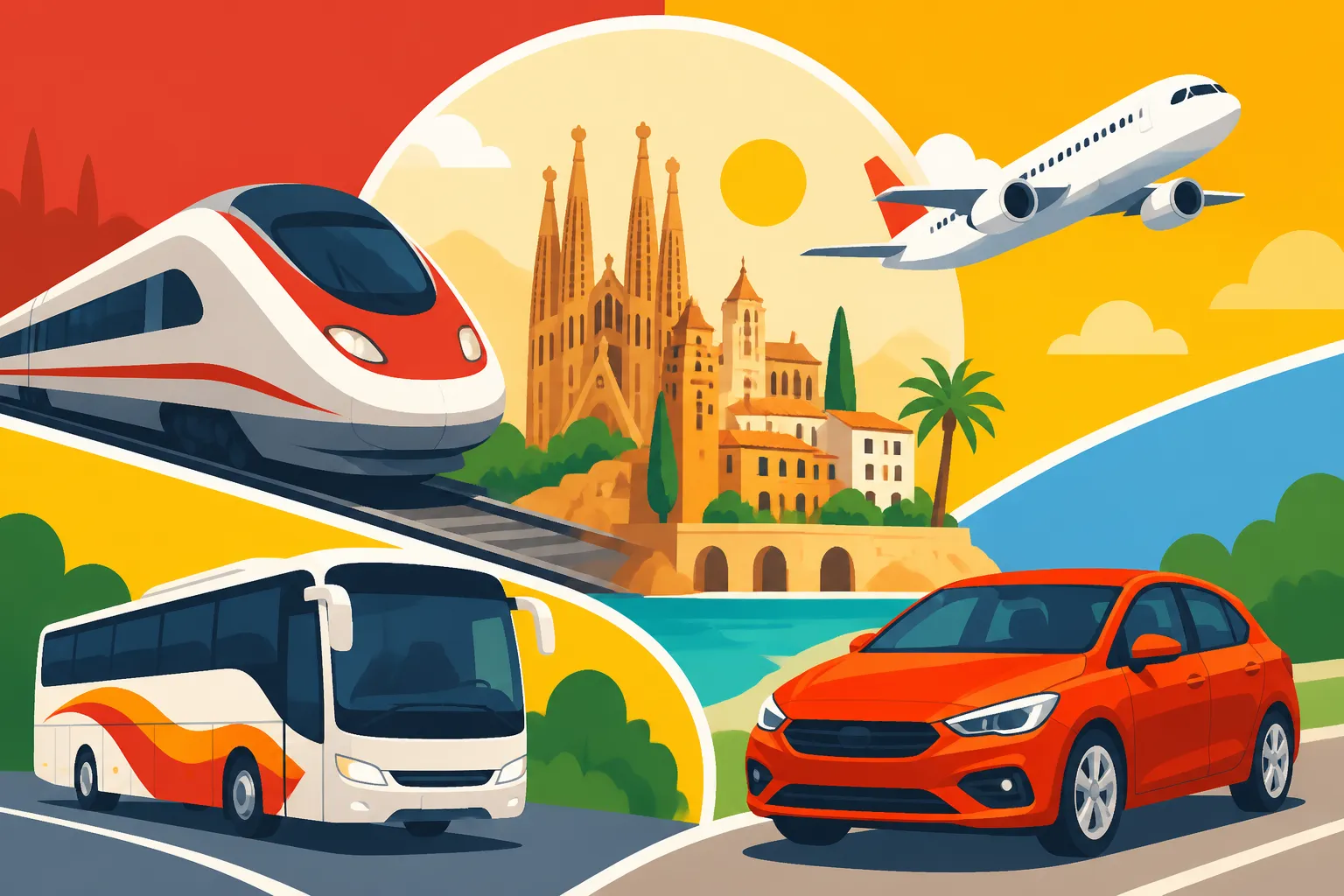
There is no single best way to get around Spain. Each mode has its own strengths. The table below is the mental cheat sheet I wish someone had handed me in my first week.
| Mode | Best For | Weak Spots | Booking Style |
|---|---|---|---|
| High-speed train | City to city along the main lines, especially Madrid-based routes | Cross-country links between lines, small towns | Advance booking pays off, fares move with demand |
| Regional and commuter trains | Day trips, suburbs, short hops near big cities | Slower, fewer services in rural areas | Often bought on the day at stations or machines |
| Long-distance bus | Towns without rail, cross-country routes, tight budgets | Longer journey times, less legroom | Online or at the bus station, sometimes on board |
| Domestic flight | Long diagonals across the country, islands | Airport transfers, baggage fees, security time | Book early, check bag rules carefully |
| Ferry | Balearic and Canary hops, bringing a car to the islands | Weather, longer crossings | Advance booking in summer and on holidays |
| Hire car | Rural areas, white villages, coastal road trips, national parks | City parking, low-emission zones, tolls on some routes | Compare total cost including insurance and deposit |
Most good Spanish itineraries mix these modes. A typical first trip might be a high-speed train from Madrid to Seville, a bus to Ronda, a short car hire through the white villages and a flight home from Málaga. Each leg uses whatever works best for that stretch. The Traveling Spain on a Budget: Practical Money-Savers guide shows how that mix can also keep your total spend down.
High-Speed Trains in Spain
The high-speed network is a source of national pride, and it deserves to be. The first time I watched the olive groves of Andalusia rush past from a quiet carriage, coffee in hand, I stopped missing airports for good. Getting the booking right takes a little know-how, though, because the market has changed a lot.
Choosing Between Renfe, Ouigo, Iryo and Avlo
On the busiest corridors you now have several operators. Renfe is the state operator and runs the classic AVE services, plus Alvia trains that can run on both high-speed and conventional track. Avlo is Renfe’s low-cost high-speed brand. It is stripped back, with tighter rules on luggage and extras. Ouigo, linked to the French rail operator, also runs a no-frills model. Iryo, part-owned by Italy’s Trenitalia, competes with a more polished onboard offer at a range of price points.
How do you choose? Start with the shape of your trip. If you’re carrying a big suitcase and want flexibility, a standard Renfe fare or a flexible fare from a competitor may suit you better than the cheapest base ticket. If you’re travelling light and your plans are fixed, the low-cost brands can be excellent value. Read what each fare includes, such as cabin bags, seat selection and changes, and check the operator’s own website for current fare conditions. For a side-by-side breakdown, see Renfe vs Ouigo vs Iryo vs Avlo: Spain’s High-Speed Competition Compared.
Comparison sites help a lot here. Omio is handy when you want to see trains from different operators, and buses on the same route, in one search. It shows you departure times you might otherwise miss because you only checked one operator’s site. I still check the operator directly before paying, mainly to read the fare rules in full. For route-by-route detail on the main lines, see High-Speed Trains in Spain (AVE): Routes, Booking, and Savings.
Station Day: Security, Boarding and Seats
Spanish high-speed travel feels a little like flying, and nobody warned me about that before my first trip. At major stations, your luggage goes through an X-ray scanner before you reach the platform. Boarding often closes a few minutes before departure, so turning up at the last second is a real risk. The upside is that once you’re through, everything is calm and organised.
The big cities also have more than one main station. In Madrid, most southern and eastern services use Atocha (officially Puerta de Atocha – Almudena Grandes), while many northern services use Chamartín (Clara Campoamor). In Barcelona, nearly everything long-distance runs through Sants. Always check which station is printed on your ticket.
Here is the routine I follow on every high-speed trip:
- Check the departure station and train number on your ticket the night before.
- Arrive with enough margin to pass luggage screening without rushing.
- Find your train on the departure boards, which list the operator, destination and platform.
- Join the boarding queue when the platform opens and have your ticket ready, either printed or on your phone.
- Find your carriage number on the platform signs or the train itself, then your assigned seat.
- Store large bags in the racks at the end of the carriage and keep valuables with you.
Seats are assigned on most high-speed services, so you won’t need to fight for a spot. On longer routes, the café car is a pleasant place to stretch your legs. If a train is badly delayed, the operator may owe you compensation under its own terms. Keep your ticket and booking reference until you’ve checked.
Regional, Commuter and Slower Trains
High-speed trains get the attention, but the slower network is where you find Spain’s day trips, sleepy junctions and coastal towns. It works differently, and once you learn its habits it opens up a whole extra layer of the country.
Cercanías and Rodalies Around the Big Cities
Cercanías are Renfe’s commuter rail networks around cities such as Madrid, Valencia, Seville, Málaga, Bilbao and others. In Catalonia the equivalent is called Rodalies. These trains link airports, suburbs and nearby towns, and they are often the cheapest and simplest way to reach places just outside a major city. From Málaga, for example, the commuter line runs along the coast towards Torremolinos and Fuengirola. From Madrid, Cercanías lines reach places like Alcalá de Henares and El Escorial.
Tickets are usually bought at station machines or ticket windows, and some cities let you use contactless or local transport cards. You generally don’t need to book days ahead, which makes these trains ideal for spontaneous outings. Just keep the ticket until you exit, because many stations have barriers on the way out.
One small quirk to be ready for: service patterns can change at weekends and during works, and announcements may only be in Spanish or a regional language. If the platform suddenly empties, ask someone. Spaniards are usually happy to help a lost traveller, especially if you open with a polite “Perdone”. For more detail, see Regional and Local Trains in Spain (Cercanías and Media Distancia).
Media Distancia and Where the Rail Thins Out
Media Distancia trains cover medium-distance regional routes, such as the lines through rural Castile, Extremadura or inland Andalusia. They are slower than high-speed trains and sometimes rattle a bit. They are also scenic, relaxed and a good way to see the country people actually live in. A ride through the sierras with your face pressed to the window is one of my favourite cheap pleasures in Spain.
The catch is frequency. Some routes have only a handful of departures a day, so missing one can wreck an afternoon. Plan these legs around the timetable rather than the other way round, and check the return times before you set off. Some regional services need a reserved seat and others don’t. The ticket purchase screen will usually make that clear.
Some parts of Spain are poorly served by rail. The northern coast, parts of Galicia and some routes between big cities in the north are slower or less direct than you might expect. For one of the most common trips, see Madrid to Bilbao: Why There’s No AVE Yet and What to Book Instead. Where trains run out, buses usually take over, and they do it well.
Long-Distance Buses
I’ll admit I resisted Spanish buses at first, picturing cramped seats and endless stops. Then I took a coach from Málaga to Ronda through mountain scenery that no train could match, and changed my mind. Buses are a core part of the Spanish network, not a fallback.
When the Bus Beats the Train
Buses tend to win on three kinds of trip. The first is reaching towns with no railway station, or with a station far from the centre. The second is cross-country routes where rail would send you back through Madrid. The third is when you’re watching every euro. Granada to Córdoba, Seville to Cádiz-area towns and many links along the Costa Blanca are all cases where the bus is often the most practical choice.
ALSA is the biggest name in the sector and runs a dense network. FlixBus competes on many long routes, often with aggressive pricing and online-only booking. Plenty of regional operators also cover particular provinces. Comfort varies by operator and coach type, and some long routes offer premium seating with extra space. For a direct comparison, see ALSA vs FlixBus in Spain: Comfort, Price, and Route Coverage.
Journey times are usually longer than by train, so bring snacks, water and a charged phone. Coaches on longer routes often stop for a break at a roadside café, which is a great chance for a quick café con leche and a slice of tortilla. Don’t wander off, though. The driver won’t wait long.
Bus Stations and Booking Habits
Spanish bus stations range from big, organised hubs to a single shelter by a petrol station. In Madrid, Estación Sur handles a large share of long-distance departures. Barcelona Nord is the main hub in Barcelona. Many smaller towns have a modest estación de autobuses near the centre, and in villages the “station” may be a stop outside a bar, where the owner knows the timetable better than any website.
For popular routes in high season, book online ahead of time. For quieter local routes, buying at the station window or even from the driver is often possible. Have the exact departure point confirmed. Some operators use different stops in the same town, and a booking app’s map pin can be a street or two off.
This is the process I use for an unfamiliar bus leg:
- Search the route on a comparison site and on the main operator’s website.
- Note the exact departure stop name and check it on a map.
- Book online if it’s a weekend, holiday or summer departure.
- Arrive early enough to find the right bay, since platforms are not always clearly signed.
- Put large luggage in the hold, and keep your passport and phone with you.
- Confirm with the driver that the coach stops where you’re going before you sit down.
Domestic Flights and Island Hops
Spain is large, and parts of it are islands. Flights and ferries fill the gaps that trains and buses can’t cover, and getting these legs right can make a big trip feel effortless.
When Flying Makes Sense
Domestic flights work best on long diagonal journeys. Think Barcelona to Seville, Bilbao to Málaga or Santiago de Compostela to Valencia, where the train involves a long ride or a change in Madrid. Flights are also the main way to reach the Canary Islands from the mainland. Iberia, Vueling, Air Europa, Ryanair and others all fly domestic routes. In the Canaries, Binter is a key inter-island airline.
The headline fare is only part of the cost. Add the trip to and from the airport, the security time, and especially the baggage charges, which vary a lot between airlines and fare types. A cheap flight can end up costing more than the train once you add a suitcase and two taxi rides. Before you book, work out the total cost of each option. For a breakdown, see Ryanair, Vueling, and Iberia Within Spain: Total Cost With Bags.
Airport transfers deserve their own planning. Madrid-Barajas connects to the city by metro, Cercanías and an express bus. Barcelona-El Prat has rail and bus links. Regional airports vary, and some rely mainly on buses or taxis. Check the last connection time before booking a late-arriving flight. Arriving at midnight with no onward transport is a very lonely feeling.
Ferries to the Balearics and Canaries
Ferries link the mainland with the Balearic Islands from ports such as Barcelona, Valencia and Dénia. They also run between the islands themselves, for example Ibiza to Formentera or Mallorca to Menorca. Baleària and Trasmed are among the operators in the Mediterranean. In the Canaries, Naviera Armas and Fred. Olsen run inter-island routes.
The ferry versus flight decision usually comes down to three things: whether you’re bringing a car, how much time you have, and how much you enjoy being at sea. Overnight ferries can save on a night’s accommodation. Fast ferries on short hops are often more pleasant than airports. In summer and over holiday weekends, book ahead, especially with a vehicle. For island-by-island trade-offs, see Balearic Islands: Ferry vs Flight Priced Out for Each Island.
A practical tip from experience: if you get seasick, pick a seat near the middle of the boat and lower down, and keep your eyes on the horizon. Spanish ferry cafés sell decent sandwiches, but on a choppy crossing you may lose interest in eating. Weather can cause delays or cancellations, so leave some slack if a ferry connects to a flight home.
Car Hire and Driving in Spain
Some of Spain’s best moments happen behind the wheel. You might be winding up to a hilltop village in the Alpujarras, pulling over at a deserted cove in Almería, or crossing the plains of La Mancha with windmills on the horizon. Car hire can also be the most stressful part of a trip if you go in unprepared. This is the area where I hear the most frustration from friends, so let’s take it slowly.
Before You Sign the Rental Agreement
Start with the documents. You’ll need a valid driving licence, your passport or national ID and, in most cases, a credit card in the main driver’s name for the security deposit. Debit cards are accepted by some companies under specific conditions, but plenty refuse them at the desk. Whether you also need an International Driving Permit depends on where your licence was issued. For the details, see Do You Need an International Driving Permit to Drive in Spain?.
Insurance is where costs pile up. A basic rental usually includes the legally required cover, but with a high excess, meaning the amount you pay if the car is damaged. At the desk you’ll often be offered extra cover to reduce that excess. You can accept it, rely on separate excess insurance bought in advance, or use cover through a credit card if your card provides it. Read what each option actually covers, as tyres, windscreens and underbody damage are often treated separately. Check the rental company’s own terms for current figures.
Fuel policy matters too. “Full to full” means you collect the car with a full tank and return it full, which is usually the simplest arrangement. Other policies charge you upfront for a tank of fuel. Comparison platforms can help you filter for the conditions you want. Booking.com, for example, offers car rentals alongside accommodation, which is handy if you’re planning a road trip and booking hotels in the same session. Whichever platform you use, read the supplier’s conditions before paying.
Here is my pickup routine, which has saved me from more than one dispute:
- Read the rental agreement before signing and question any extra you didn’t request.
- Walk around the car with the agent if possible and point out every existing scratch and dent.
- Take a slow video of the exterior, wheels, windscreen and interior, including the fuel gauge and mileage.
- Check that the paperwork, the V-16 emergency light and reflective vest are in the car.
- Ask how the car handles tolls and whether it carries an environmental sticker for low-emission zones.
- Save the company’s breakdown number in your phone before you drive away.
On the Road: Tolls, Fuel, Parking and City Rules
Spain has two main types of fast road. Autovías are toll-free dual carriageways. Autopistas include some toll motorways, marked “peaje” on signs. You can pay tolls at booths by card or cash on most routes. Toll roads are often quieter and smoother, but you can usually plan a toll-free alternative if you’d rather avoid them. For route-planning tactics, see How to Avoid Toll Roads When Driving in Spain.
At petrol stations, “gasolina” is petrol and “gasóleo” or “diésel” is diesel. Check which one your rental takes, ideally by looking inside the fuel cap. Many stations are self-service, and at some you pay at the counter before the pump is unlocked. In rural areas, stations can be far apart and may close early, so don’t let the tank run low on mountain roads.
Cities are where driving gets tiresome. Historic centres have narrow one-way streets, restricted access areas and pricey car parks. Madrid, Barcelona and other cities run low-emission zones (Zonas de Bajas Emisiones), which limit access depending on the vehicle’s environmental classification. My strong advice: pick up your car when you leave a big city and return it before you arrive in the next one. Use the car for the countryside and public transport for the cities. For the full picture on rental rules and driving habits, see Renting a Car in Spain: Requirements, Insurance, and Driving Tips.
Is a Car Worth It for Your Trip?
A car is close to essential for the white villages of Andalusia, rural Galicia, the Picos de Europa, much of Extremadura and remote beaches anywhere. It also makes sense for families with lots of luggage, or for groups where splitting the cost makes it competitive with several train tickets.
A car is usually more trouble than it’s worth for a trip built around Madrid, Barcelona, Seville, Valencia and San Sebastián. Those cities connect well by rail and are best explored on foot and by metro. For city-to-city travel on the main lines, the train is faster, more relaxing, and lets you enjoy a glass of wine with lunch.
There is also a middle option. If you want a day in the countryside without driving, organised day trips can fill the gap. GetYourGuide lists guided excursions from big cities to places such as Toledo, Segovia, Montserrat or the white villages. That can be a sensible choice if you only need rural access once or twice in a city-based trip. Compare the itinerary and inclusions on the listing, and weigh them against a self-guided trip by train or bus.
Getting Around Once You Arrive
Long-distance travel gets you to a city. Local transport decides how much you enjoy being there. Spanish cities are generally compact, walkable and well served by public transport, but each one has its own ticket systems and habits.
Metros, Buses and Trams in the Big Cities
Madrid and Barcelona have large metro networks. Valencia, Bilbao, Seville and Málaga also have metro or light rail lines, and trams run in places like Zaragoza, Alicante and Tenerife. City buses cover the gaps, and night buses keep things moving late, which matters in a country where dinner often starts after nine.
Ticket systems vary. Some cities sell rechargeable cards you top up at machines, some accept contactless bank cards at the barrier, and some offer tourist passes for unlimited travel over a set period. Before buying a tourist pass, compare it honestly with the number of journeys you’ll actually make. In compact centres you’ll walk more than you expect. For city-by-city detail, see Getting Around Spanish Cities: Metro, Bus, Tram, and Bikes.
Etiquette is simple. Let passengers off before you board, stand on the right on escalators in the busier cities, and offer your seat to older passengers. Keep bags in front of you on crowded lines. Pickpocketing is a real issue on busy tourist routes in Madrid and Barcelona.
Taxis, Ride-Hailing and Bikes
Licensed taxis are easy to spot by their city colours and a green light or sign showing they’re free. They run on official meters and fixed tariffs. Ride-hailing apps operate in several cities, though availability and rules differ by region. For airport runs, check whether a fixed fare applies on your route before you get in.
Public bike-share schemes run in many cities, including BiciMAD in Madrid and Valenbisi in Valencia. Some are aimed mainly at residents, so check the sign-up rules for visitors. Electric scooters are common for rent, but local rules on where you can ride and park them are strict and enforced. Cycling along Valencia’s Turia gardens or Seville’s riverside lanes is a lovely way to spend an afternoon.
Walking is still the best way to explore most Spanish old towns. Pack comfortable shoes, since cobblestones and hills are everywhere. In summer, plan your walking for the morning and evening and save the middle of the day for museums, long lunches or a rest.
Planning a Multi-Mode Trip Without Losing Your Mind
The hardest part of travelling around Spain is rarely any single journey. It’s fitting several of them together. A missed connection, a holiday rush or a strike can throw off a carefully planned week. With a bit of structure, you can absorb those shocks.
Booking Tools and Sequencing
I plan big trips in a fixed order: transport skeleton first, accommodation second, activities last. Start by locking in the long legs that sell out or rise in price, such as high-speed trains on popular routes, summer ferries and flights. Then book places to stay that are easy to reach from those stations and ports. Then fill in day trips and local transport. The order matters because a hotel by the station is worth much more once you know which station you’re actually using.
For the transport skeleton, a multimodal search on Omio gives a quick sense of which combinations of train and bus exist on a route, and that’s useful before you commit. For accommodation, Booking.com lets you filter by location and cancellation terms, which helps if your transport plans may still shift. Free cancellation is worth paying a little extra for while your route is still settling, but read what the policy actually allows before you rely on it.
This is the sequence I recommend for building a multi-city route:
- List your must-see destinations and group them by the hub they connect to.
- Order the destinations so that most legs follow a single rail line or a direct bus route.
- Mark the legs that need a flight, a ferry or a car, and price them as whole journeys.
- Book the legs most likely to sell out first, then the flexible ones.
- Book accommodation near the stations, ports or car-hire offices you’ll actually use.
- Leave at least one slack half-day in a longer trip in case a connection fails.
For a broader planning framework, see How to Plan a Multi-City Trip Across Spain.
Strikes, Delays and Holiday Peaks
Strikes happen in Spain, in rail, air and sometimes local transport. They are usually announced in advance, and minimum services are often required by law, though which trains and flights run can change at short notice. Follow the operator’s announcements and the local news in the days before you travel. If your service is cancelled, you may be entitled to a refund or rebooking under the operator’s own terms and EU passenger rights. See Strikes and Cancellations in Spain: Your Rights and Rebooking Options.
Holiday peaks are just as important to plan around. Semana Santa, the August holiday month, Christmas and the long weekends Spaniards call “puentes” all bring fuller trains, busier roads and higher fares. Plenty of Spaniards travel at these times too, so you’re competing with the whole country for seats. Book early, travel at off-peak hours if you can, and expect motorway queues leaving the big cities at the start of a long weekend.
Finally, be kind to yourself. Every expat I know has a story about the wrong station, the bus that never came or the rental car return office that closed at siesta time. These things happen, and they make good stories later. With the basics in this guide, your trip around Spain should involve far more olive groves and mountain views than missed connections, and far more relaxed train rides than frantic sprints.
Disclaimer
This article is for general informational purposes only and does not constitute professional advice. Laws, prices and regulations vary by location and change over time. Consult a qualified professional for guidance on your specific situation.