How to Sign Up for a Public Library Card in Spain
Arriving in Spain and paying a premium for imported English books or spending a fortune on coworking spaces is an expat trap. I once spent fifty euros on two paperbacks before realizing my local neighborhood had a massive, free public library. This guide explains exactly how to navigate the municipal bureaucracy to secure your Spanish library card.
Disclosure: This post may contain affiliate links. We may earn a commission at no extra cost to you if you make a purchase through these links. Read full disclosure.
The Spanish Public Library Network Explained
Unlike the centralized systems you might be used to in Northern Europe or the United States, Spain operates a nested, slightly overlapping web of public libraries. Understanding which building you are walking into will save you a lot of administrative confusion.
Municipal vs Regional Libraries
When you search for a biblioteca pública on your phone, you will likely encounter two different types of institutions. The first is the Biblioteca Municipal, which is funded and operated by your local town hall (ayuntamiento). These are hyper-local, often integrated into larger community buildings, and deeply tied to neighborhood life, a dynamic you can explore further in How to Find Local Community Centers (Centro Cívico) in Spain.
The second type is the Biblioteca de la Comunidad Autónoma or Biblioteca Pública del Estado. These are massive, regional hubs funded by the regional or federal government. They hold significantly larger collections, historical archives, and vast media rooms.
The beauty of the Spanish system is that in most regions (like Madrid or Andalusia), signing up for a card at one of these libraries usually grants you access to the Red de Bibliotecas Públicas (Public Library Network) for that entire region. Your single physical card, known as the carné de biblioteca, becomes a universal pass to dozens of locations across your province.
The True Value of the Carné
Your library card gives you access to physical books, DVDs, and study spaces, but it also functions as a cultural passport. Many regional library networks partner with local museums, theaters, and cultural institutions to offer discounted entry to cardholders. It is the single highest-value piece of plastic you can obtain in Spain, and unlike almost every other administrative process in the country, it is completely free.
Required Documents for Your Library Card
Navigating Spanish bureaucracy is famously headache-inducing, but securing a library card is shockingly straightforward. You just need to show up with the correct paperwork to prove you are a local resident.
Identifying Yourself and Proving Your Address
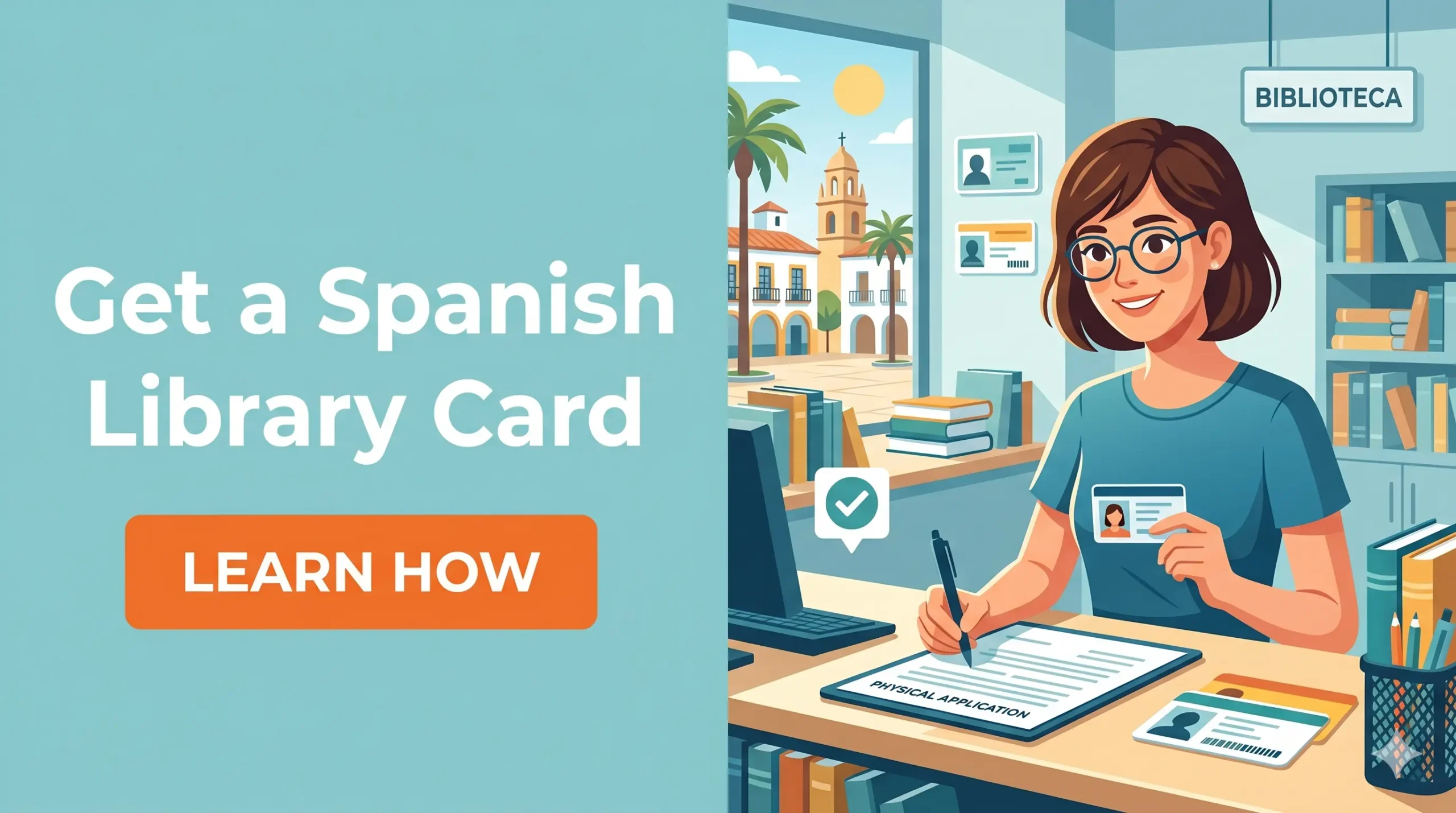
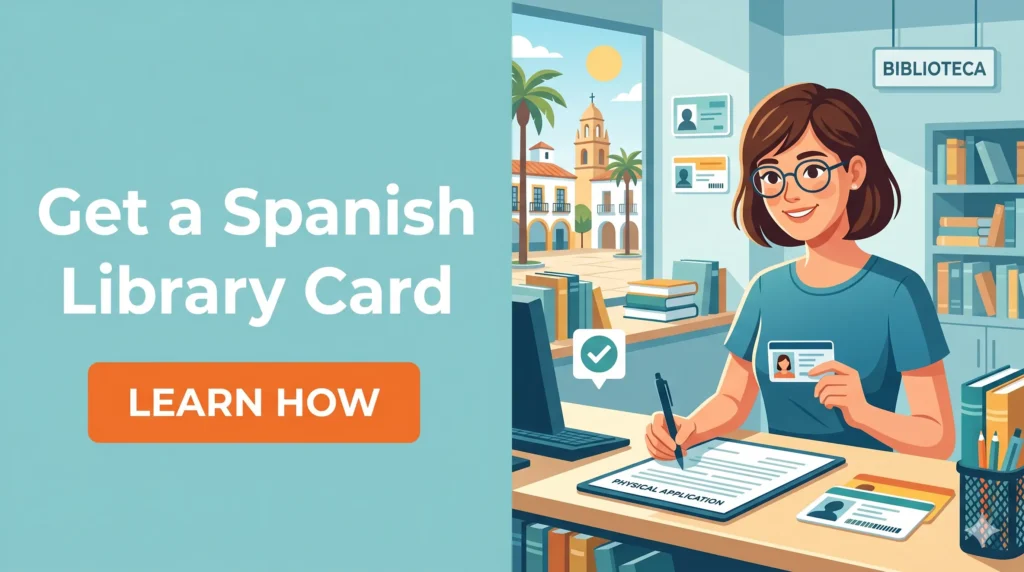
You cannot sign up for a permanent Spanish library card online if you are a newly arrived expat; you must physically visit the circulation desk. When you arrive, you will need to present an official, original photo ID. A physical TIE (Foreigner Identity Card), a green EU citizen certificate paired with a passport, or an original passport will suffice.
Next, you must prove that you actually live in the municipality or region. The gold standard for this is your municipal census certificate. Presenting an updated copy of this document guarantees there will be no pushback at the desk. If you have not yet navigated the town hall to secure this vital piece of paper, you must immediately review How to Get a Spanish ‘Certificado de Empadronamiento’ Copy. In some highly relaxed neighborhood libraries, they might accept a recent utility bill or a signed rental contract with your name on it, but the census document is the only universally accepted proof.
The Physical Application Process
At the mostrador de préstamo (circulation desk), you will ask to fill out the formulario de inscripción (registration form). The form asks for basic demographic data: your name, address, phone number, and email.
Once you hand over the form and your documents, the librarian will input your data into the regional system. In most major cities, they will print your physical plastic card right there on the spot. They will also assign you a numerical PIN (usually the last four digits of your ID or your birth year). Do not lose this PIN; it is the master key to unlocking the digital library network from your apartment.
| Document Type | Is it Mandatory? | Acceptable Alternatives |
| Official Photo ID | Yes | Original Passport, physical TIE, or DNI. |
| Proof of Address | Yes | Certificado de Empadronamiento (Preferred), Rental Contract, or recent utility bill. |
| Application Form | Yes | Provided at the circulation desk; must be filled out in Spanish. |
| Passport Photo | Rare | Only required in very small, localized pueblos that lack digital printing systems. |
Unlocking the Digital Library with eBiblio
The greatest hidden secret of the Spanish library system is eBiblio. It is a completely free, massive digital lending platform available to anyone with an active library card. If you are an expat craving English literature, this platform is an absolute lifesaver.
Navigating E-books and Audiobooks
By downloading the eBiblio app on your smartphone or logging in via your computer, you gain access to thousands of e-books, audiobooks, and international magazines. While the majority of the catalog is in Spanish—which is a fantastic, free tool for language immersion—there is an increasingly large repository of modern English fiction and non-fiction.
However, expats frequently run into a massive technological hurdle: the DRM (Digital Rights Management) format. eBiblio uses Adobe Digital Editions, which is fundamentally incompatible with the standard Amazon Kindle ecosystem. You cannot easily send an eBiblio book to a basic Kindle. To bypass this frustration without resorting to illegal format shifting, veteran expats simply purchase a Kobo or PocketBook e-reader directly from Amazon Spain. These devices natively support the Adobe DRM format, allowing you to borrow and read Spanish library books seamlessly.
Streaming Media and Connectivity Needs
Beyond books, many regional library networks offer free access to eFilm, a streaming service that acts like a free, indie version of Netflix. It is packed with critically acclaimed Spanish cinema, international documentaries, and language-learning videos.
To stream these high-definition movies or download heavy audiobook files, you cannot rely on a weak, buffering Wi-Fi signal. Ensuring your apartment is equipped with a high-speed fiber connection from an expat-centric provider like Tiekom guarantees your media downloads instantly without frustrating dropouts. Setting up this robust digital infrastructure is the cornerstone of a comfortable expat life, deeply detailed in Utility Costs in Spain: Electricity, Gas, Water, and Internet.
Using the Library as a Free Coworking Space
For remote workers and freelancers, a Spanish public library is a financial sanctuary. Paying 200 euros a month for a hot desk at a commercial coworking space is entirely unnecessary when the local government provides beautiful, climate-controlled workspaces for free.
The Culture of the Sala de Estudio
Spanish libraries designate specific rooms as salas de estudio (study rooms) or salas de lectura (reading rooms). You must understand that the cultural etiquette in these rooms is intensely strict. They are dead silent. Unlike an American cafe where people chat and take Zoom calls, a Spanish study room is a sacred space for concentration. You can literally be shushed by the librarian for unzipping a backpack too loudly or having your phone vibrate on a wooden desk.
Because you cannot take business calls or team meetings inside the library, it is best utilized for deep, focused, independent work. If the intense silence makes you anxious, ordering a pair of premium noise-canceling headphones from Amazon Spain allows you to pump in your own white noise or focus music without disturbing the locals. Managing your daily workflow between these silent public spaces and your home office is a crucial balancing act covered in Spain Digital Nomad Visa: Income, Taxes, and Step-by-Step Guide.
Internet Reliability and Siesta Hours
While every public library offers free Wi-Fi (often routed through a municipal network or the RedIRIS system), it comes with a major caveat. Public library Wi-Fi is heavily filtered, often blocking commercial VPNs, and can become agonizingly slow during peak afternoon hours when local university students flood the building.
If you are uploading massive client files or running sensitive remote software, you cannot rely on the free municipal Wi-Fi. Having a robust mobile data plan from Tiekom allows you to securely tether your laptop to your smartphone’s hotspot, completely bypassing the library’s network restrictions.
Furthermore, you must be hyper-aware of the building’s operating hours. While massive regional libraries in Madrid or Barcelona stay open all day, smaller neighborhood branches strictly observe the afternoon midday closure. If you are deep in a workflow, the librarian will aggressively flash the lights at 1:45 PM and force everyone out onto the street until 4:30 PM. To avoid having your workday shattered by the afternoon closure, you must synchronize your schedule with local norms, a survival tactic explored in What to Expect When a Spanish Store Says ‘Cerrado’ (Closed) — Timing Tips and Spanish Work Culture: Hours, Holidays, and Workplace Etiquette.
Registering Children and Building Community
A library is not just a place to hoard books; it is the easiest, lowest-stakes environment to begin integrating your family into the local Spanish neighborhood.
Getting a Card for Your Kids
The process of securing a library card for a minor (carné infantil) is identical to the adult process, but you, as the parent or legal guardian, must sign the authorization form on their behalf. You will need to present your own ID, the child’s ID (if they have one), and your Libro de Familia or translated birth certificate to prove guardianship.
Having their own card gives children a sense of ownership over their integration process. Every public library has a dedicated sección infantil filled with low-level Spanish picture books, graphic novels, and bilingual resources. Spending an hour a week in this section drastically accelerates a child’s language acquisition. If you find that the local municipal library severely lacks English-language books to keep up with their native reading level, you can easily supplement their education by bulk-ordering specific English chapter books via Amazon Spain. Managing these educational logistics is a key component of the transition mapped out in Moving to Spain With Kids: Packing and Settling‑In Checklist.
Socializing and Notice Boards
Finally, libraries serve as physical community hubs. If you are struggling with the isolation of remote work, the corkboard in the lobby of your local library is a goldmine.
You will find flyers for local language exchange groups (intercambios), neighborhood hiking clubs, and independent tutoring services. Many libraries also host free weekly book clubs (clubes de lectura). Joining a Spanish book club, even if your language skills are intermediate, is one of the fastest ways to force yourself to speak and meet locals who live on your exact street. To understand the broader cultural mechanics of breaking out of the expat bubble, thoroughly review How to Make Friends in Spain If You Work Remotely. Whether you need an agile Tiekom data plan to coordinate these new social meetups on WhatsApp or just a quiet, free place to read, the Spanish library network is an indispensable resource for your new life abroad.
References
Primary sources (official)
- Ministerio de Cultura – Red de Bibliotecas Públicas del Estado: https://www.cultura.gob.es/cultura/bibliotecas/nuestras-bibliotecas/bpe.html
- eBiblio Official Portal (Ministerio de Cultura): https://www.ebiblio.es/
Other helpful sources
- Expatica – Education and Lifelong Learning in Spain: https://www.expatica.com/es/education/
- Madrid Public Library Network Requirements (Example): https://www.comunidad.madrid/servicios/cultura/carnes-bibliotecas-publicas
Disclaimer
The information provided in this article is for educational and informational purposes only and does not constitute formal municipal or administrative advice. The requirements for obtaining a carné de biblioteca, acceptable forms of proof of address, and the specific digital lending catalogs available through eBiblio vary significantly between the different Autonomous Communities and municipal town halls (ayuntamientos) across Spain. Always verify exact document requirements and library operating hours directly with your local branch’s circulation desk before attempting to register.