Sunday Shopping in Spain: What’s Open and Where
Opening an empty fridge on a Sunday morning is a harsh expat initiation. I spent my first Sunday in Valencia eating stale crackers because I didn’t realize supermarkets physically lock their doors on the traditional day of rest. This guide breaks down the complex regional laws dictating Spanish Sunday commerce so you never go hungry on a weekend again.
Disclosure: This post may contain affiliate links. We may earn a commission at no extra cost to you if you make a purchase through these links. Read full disclosure.
The Spanish Sunday Closure Law Explained
Why Everything is Closed
Spain operates under the strict Ley de Horarios Comerciales (Law of Commercial Hours). Historically, this framework was designed to protect small, family-owned businesses from being crushed by massive multinational supermarkets. The government recognizes that a local mom-and-pop grocery store cannot afford to staff cashiers seven days a week. By forcing massive retailers like Mercadona, Carrefour, and El Corte Inglés to close their doors on Sundays, the state levels the playing field, ensuring small neighborhood vendors have a fighting chance to survive during the week.
Culturally, Sunday is deeply respected as a day of rest, focusing heavily on family (la familia) and long, multi-hour lunches (sobremesas). It is simply not a day designed for running errands. For a foreigner coming from a 24/7 consumer culture, adjusting to this reality requires a massive shift in how you budget your time. Managing your weekend grocery runs effectively becomes just as critical as managing your monthly utility budgets, a concept we explore deeply in Cost of Living in Spain.
The Tourist Zone Exception
There is a massive, widely utilized loophole in this restrictive commerce law known as the Zonas de Gran Afluencia Turística (ZGAT). The Ministry of Industry, Trade, and Tourism grants this special “high tourist influx” status to specific municipalities. If a city, or a highly trafficked neighborhood within a city, is designated as a ZGAT, large retail stores and shopping malls are legally permitted to open their doors on Sundays and public holidays.
This exception is primarily designed to capture weekend tourist spending. If you live in the historic center of a major coastal town, you might find that the massive international clothing brand or the local mega-supermarket is buzzing with activity on a Sunday afternoon, while just a few kilometers inland, the exact same chain stores are shuttered tight. Understanding if your neighborhood falls into an active ZGAT dictates your weekend routine, which is an important factor to consider when reading Renting an Apartment in Spain: A Guide for Expats.
What is Actually Open on Sundays
Small Convenience Stores
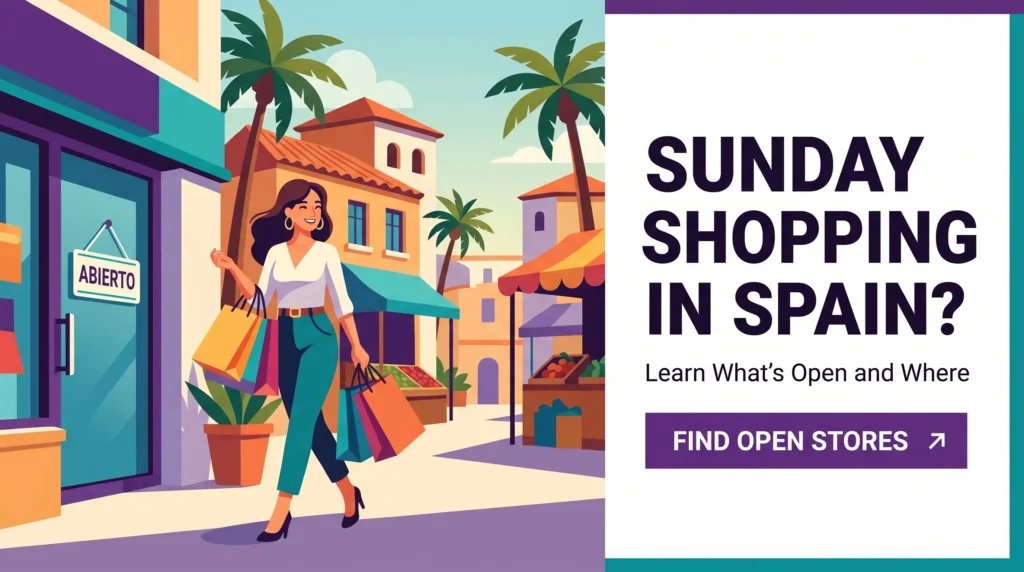
Even in the strictest regions, you will not starve on a Sunday. Spanish law grants commercial exemptions to retail spaces with a total floor space of under 300 square meters. This size exemption is the absolute lifeblood of Sunday survival for unprepared expats.
Across Spain, you will see small, densely packed corner stores labeled Alimentación or Bazar. Colloquially, these are often referred to as “los chinos” because they are traditionally owned and operated by Chinese immigrant families. These shops are absolute lifesavers. They sell everything from emergency toilet paper and bottled water to basic produce, canned goods, and cleaning supplies. They are typically open every single day of the year from early morning until late at night. However, because their electronic inventories can be unpredictable, if you urgently need a highly specific item—like a replacement charger for your laptop—you are much better off relying on Amazon Spain to deliver it directly to you on Monday rather than walking to five different bazares hoping to find a compatible cable.
Bakeries, Pharmacies, and Petrol Stations
Certain essential businesses are always permitted to open on Sundays. Bakeries (panaderías) are a staple of Spanish weekend mornings. You will routinely see lines forming outside bakeries at 10:00 AM as locals buy fresh baguettes and sweet pastries for their Sunday family lunches. However, be aware that many independent bakeries close their doors by 2:00 PM on Sundays and do not reopen in the evening.
Pharmacies operate on a highly structured rotation system. While your local neighborhood pharmacy will likely be closed, there is always at least one Farmacia de Guardia (on-duty pharmacy) open 24/7 in your designated municipal zone. Because finding the currently active on-duty pharmacy requires navigating clunky regional pharmaceutical board websites, having a fast, reliable mobile data plan from Tiekom is essential so you can smoothly load the local map while you are out on the street. Lastly, petrol stations with attached mini-marts are legally permitted to remain open, offering basic snacks, ice, and drinks if you are truly desperate.
Regional Differences in Sunday Shopping Rules
Madrid vs The Rest of Spain
The strictness of the commerce law varies wildly depending on which Autonomous Community you live in. The Community of Madrid is the wild west of Spanish retail. Since 2012, Madrid has operated under a completely liberalized commerce law. Retailers in Madrid can choose to open 24 hours a day, 365 days a year if they wish. Supermarkets, shopping malls, and massive clothing boutiques are almost universally open on Sundays in the capital.
Conversely, regions like Catalonia, the Basque Country, and Galicia enforce the national restrictions aggressively. In Barcelona, outside of specific designated tourist zones, all major supermarkets are strictly closed on Sundays. They are legally allowed a handful of specific “open Sundays” (domingos de apertura) scattered throughout the year, usually during the Christmas shopping rush or at the start of the summer sales (las rebajas). If you are moving between provinces, this sudden shift in retail availability can be incredibly jarring, heavily impacting how you set up your daily life and handle administrative tasks, similar to the hurdles described in Opening a Bank Account in Spain: Step-by-Step for Foreigners.
Coastal Hubs and Seasonal Shopping
In coastal regions like Andalusia, the Balearic Islands, and the Valencian Community, the rules shift drastically based on the season. During the peak summer months (usually from June 15 to September 15), many coastal towns activate their ZGAT status. Suddenly, the massive grocery store down the street from your beach flat is open every Sunday to cater to the massive influx of holidaymakers.
However, the moment mid-September hits, the ZGAT status goes dormant, and the strict Sunday closures return without warning. This seasonal whiplash catches many new expats off guard. During these winter months, adjusting to the quiet Sundays usually involves spending significantly more time indoors. Making sure your apartment is properly equipped for these colder, quieter weekends is vital, a topic we cover extensively in Winter in Spain: What to Expect and Spanish Apartment Heating: What Systems You’ll Commonly Find.
| Region | General Sunday Retail Rule | Key Exceptions |
| Madrid | Fully Liberalized | Almost everything is open 365 days a year. |
| Catalonia | Strictly Closed | Small alimentación stores; specific holiday opening days. |
| Andalusia | Generally Closed | Coastal towns open on Sundays during peak summer months. |
| Valencia | Generally Closed | Designated tourist zones (ZGAT) remain open. |
| All Regions | Open for Essentials | Pharmacies (de guardia), bakeries, and petrol stations. |
Expat Hacks for Surviving Sunday Closures
Mastering Online Delivery and E-commerce
The easiest way to conquer the Spanish Sunday closure is to bypass the physical stores entirely. While local supermarkets will absolutely not deliver your groceries on a Sunday, major e-commerce platforms operate on their own distinct logistical schedules and warehouse networks.
If I realize on a Saturday night that I am completely out of coffee pods, pet food, or heavy laundry detergent, I do not panic about the Sunday closures. Instead, I immediately open the Amazon Spain app. By setting up recurring deliveries or utilizing fast shipping for bulk household essentials through Amazon Spain, you effectively remove the stress of the weekend grocery rush. Furthermore, if you need a heavy household appliance—like a portable air conditioning unit to survive August—relying on Amazon Spain to bring it securely to your door saves you the nightmare of lugging massive boxes home on a crowded Saturday afternoon metro. Understanding how running those heavy appliances impacts your power bill is another logistical hurdle entirely, which is explained thoroughly in Is Air Conditioning Worth It in Spain? Cost and Comfort Guide.
Planning Your Weekly Errands
Surviving in Spain requires proactive, deliberate scheduling. You must treat Saturday morning as your absolute final deadline for major administrative and household tasks. If you need to upgrade your telecom plan, buy hardware, or do a massive grocery haul to feed your family for the week, you have to execute it before Saturday evening.
To manage this shift in lifestyle effectively, you need a flawless internet connection at home to organize your errands. I rely on Tiekom for my fiber optic broadband because the connection is incredibly stable. With Tiekom, I can comfortably plan my weekly grocery lists, manage my digital banking, and set up automated home deliveries without the connection randomly dropping. Furthermore, because Sunday in Spain is culturally designed to be an incredibly quiet day for relaxing at home, having Tiekom internet guarantees you can stream movies in 4K without buffering when everything outside is closed. Automating your home life requires stable connectivity and utilities, a concept we map out clearly in Setting Up Electricity and Gas in Spain. Finally, dealing with local Spanish bureaucracy often requires taking time on your quiet Sunday to read through complex utility invoices, a necessary skill decoded in Understanding Utility Bills in Spain. If you adapt your schedule to the local rhythm, Sundays will transform from a frustrating inconvenience into a genuinely peaceful day of rest.
References
Primary sources (official)
- Boletín Oficial del Estado (BOE) – Ley 1/2004, de 21 de diciembre, de Horarios Comerciales: https://www.boe.es/buscar/act.php?id=BOE-A-2004-21448
- Ministerio de Industria, Comercio y Turismo – Zonas de Gran Afluencia Turística: https://comercio.gob.es/es-es/comercio-interior/Paginas/Zonas-de-Gran-Afluencia-Turistica.aspx
- Consejo General de Colegios Farmacéuticos – Buscador de Farmacias de Guardia: https://www.farmaceuticos.com/farmacias-de-guardia/
Other helpful sources
- Comunidad de Madrid – Libertad de Horarios Comerciales: https://www.comunidad.madrid/servicios/consumo/horarios-comerciales
- Generalitat de Catalunya – Horaris comercials: https://empresa.gencat.cat/ca/treb_ambits_actuacio/emo_comerc/emo_horaris_comercials/
Disclaimer
The information provided in this guide is exclusively for educational and informational purposes and does not constitute official legal or commercial advising. Regional commerce laws, designated Zonas de Gran Afluencia Turística (ZGAT) boundaries, and the specific operating hours of local Farmacias de Guardia are highly dynamic and subject to frequent updates by autonomous community governments and municipal councils. While we strive to ensure absolute accuracy regarding best practices, you should always verify the exact holiday and Sunday opening calendars (calendarios de apertura) directly through your local city hall (ayuntamiento) or the official websites of specific retailers before making travel or shopping plans.