How Long Does a Property Purchase Take in Spain? Typical Timeline
Sitting in a cramped temporary rental while your Spanish property purchase drags into its third month is an agonizing expat reality. I almost lost my dream apartment because a delayed bank appraisal pushed me right past my contract deadline. This guide breaks down the exact property purchase timeline in Spain, explaining every bureaucratic delay so you can plan your move flawlessly.
Disclosure: This post may contain affiliate links. We may earn a commission at no extra cost to you if you make a purchase through these links. Read full disclosure.
Preparing Your Finances and Documentation (Weeks 1 to 4)
The most common mistake foreigners make is searching for properties before they have their administrative house in order. If you find the perfect villa in Alicante but do not have your government paperwork finalized, another buyer will snatch it from you while you wait in an immigration queue.
The NIE and Spanish Bank Account Hurdle
You legally cannot buy a property in Spain without a Número de Identidad de Extranjero (NIE). This is your unique foreigner identification number, and it must appear on the final property deed. Securing a police station appointment to get this piece of paper can take anywhere from a few days to several months, depending on the province. You must prioritize this above all else, a process we outline thoroughly in Getting an NIE for Employment or Study: Practical Overview.
Once you have your NIE, you need a local Spanish bank account. While European SEPA laws technically mean you should be able to pay from a French or German account, Spanish notaries and sellers almost universally demand a banker’s draft (cheque bancario) drawn from a Spanish institution on the day of the sale. Furthermore, if you need a local mortgage, the bank will require you to hold an account with them. Getting this set up without possessing a physical residency card is incredibly frustrating, an obstacle we decode in Opening a Bank Account in Spain: Step-by-Step for Foreigners.
Setting up these early financial and administrative pillars requires constant connectivity. You will be uploading massive PDFs of your foreign tax returns to local banks and booking police appointments via clunky municipal portals. I highly recommend securing an expat-centric telecommunications provider like Tiekom the moment you arrive. Tiekom allows you to set up a Spanish mobile number and data plan using your passport, bypassing the agonizing wait for your NIE and local bank account. Having reliable Tiekom mobile data means you can tether your laptop from a coffee shop and securely manage your financial transfers without relying on unsecured public Wi-Fi.
Securing a Mortgage Pre-Approval
If you need financing, do not wait until you make an offer to approach a bank. Spanish banks are notoriously conservative, especially when lending to non-residents or expats with foreign income. They generally finance a maximum of 80 percent of the property’s value for residents, and only 60 to 70 percent for non-residents.
The bank’s risk department (departamento de riesgos) can take two to three weeks just to pre-approve you. They will demand your last three pay slips, recent tax declarations, and a credit report from your home country. Having your maximum budget strictly defined by a bank saves you from falling in love with a property you physically cannot finance.
Property Search, Negotiation, and the Arras Contract (Weeks 4 to 8)
Once your paperwork is in order, the actual property hunt begins. The Spanish market moves incredibly fast, and handshake agreements do not exist here.
Making an Offer and Legal Checks
When you find a home, you make a verbal or written offer. If accepted, do not hand over a single euro yet. Your independent Spanish property lawyer (abogado) must step in.
Your lawyer will request a Nota Simple from the Property Registry. This vital document proves who actually owns the property and, more importantly, whether there are any massive debts, embargoes, or unpaid community fees attached to it. In Spain, debts stay with the property, not the person. If you buy a house with a 10,000-euro municipal tax debt, congratulations, you now owe the town hall 10,000 euros.
During this intensive legal review phase, you will be constantly scanning, printing, and signing draft contracts. Buying a reliable laser printer and document scanner from Amazon Spain and having it delivered to your temporary rental is an absolute lifesaver. Running to a local print shop every time your lawyer emails you an updated contract draft is exhausting. Keep your Nota Simple and personal identification documents securely locked away; ordering a fireproof document safe from Amazon Spain protects your most vital relocation paperwork from accidental damage while living out of suitcases.
Signing the Contrato de Arras
Once the legal checks clear, you sign the Contrato de Arras (Deposit Contract). This is a legally binding pre-contract that takes the property off the market.
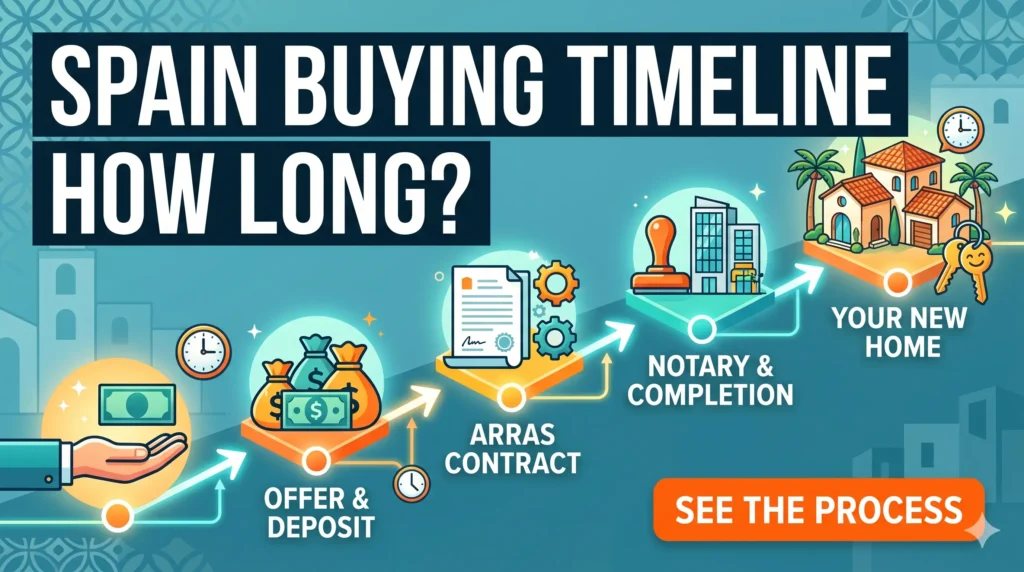
You generally transfer 10 percent of the total purchase price directly to the seller’s bank account. This contract strictly dictates the deadline by which the final sale must occur—usually 30 to 60 days. If you back out, you lose your 10 percent deposit. If the seller backs out, they must legally return your deposit double. Understanding the severe penalties hidden in this document is critical, which we explain entirely in Spanish ‘Contrato de Arras’ Explained: The Property Reservation Contract.
Finalizing the Mortgage and Notary Preparation (Weeks 8 to 12)
With the arras signed and the clock ticking, the most stressful part of the timeline begins. You must finalize your financing before the contract deadline expires.
Bank Appraisals and Mandatory Cooling-Off Periods
Your bank will mandate an official property appraisal (tasación) by an independent company. This takes about one to two weeks. The bank will only lend you money based on the lower of two values: the purchase price or the tasación value. If the appraiser drastically undervalues the home, your mortgage offer will shrink, and you will have to cover the financial gap in cash.
Once the mortgage is fully approved, you trigger the mandatory cooling-off period under the new Spanish Mortgage Law (Ley 5/2019). The bank will send all binding mortgage documents to your chosen Notary. You must physically visit the Notary at least ten days before the final sale to undergo a free consultation. The Notary will quiz you to ensure you actually understand the financial obligations you are taking on. You cannot legally sign the final deed until this 10-day cooling-off period passes.
| Purchase Phase | Typical Duration | Key Milestones | Potential Roadblocks |
| Preparation | 2 to 6 weeks | NIE secured, Bank account open, Mortgage pre-approval | Waiting for police appointments |
| Search & Arras | 2 to 4 weeks | Offer accepted, Nota Simple checked, 10% deposit paid | Hidden debts found on the property |
| Financing & Checks | 3 to 5 weeks | Tasación completed, 10-day Notary cooling-off period | Low appraisal value delaying the loan |
| Closing Day | 1 day | Escritura signed, Banker’s drafts handed over, Keys received | Funds delayed in international transit |
The Final Notary Appointment
Closing day in Spain is highly ceremonial. You, your lawyer, the seller, the real estate agent, and a representative from your bank will all gather around a massive oak table at the Notary’s office. The Notary reads the final deed of sale (escritura pública) aloud in rapid-fire Spanish.
If your Spanish is not flawless, your lawyer will act as your translator. You will hand over the banker’s drafts, sign the massive stack of papers, and the seller will slide the keys across the table. You are now a homeowner in Spain.
Post-Completion Logistics (Week 12 and Beyond)
Receiving the keys is a massive milestone, but the administrative burden does not stop at the Notary’s office. Transitioning the property into your name requires immediate action.
Connecting Utilities and Internet
Your first priority is transferring the essential utilities into your name. You must execute a cambio de titular (change of ownership) for the water, electricity, and gas. Do not cancel the existing contracts, or you will have to pay massive reconnection fees. Ensure the seller provides you with the latest bills showing a zero balance, a bureaucratic dance we map out clearly in Setting Up Electricity and Gas in Spain. You must also familiarize yourself with the complex tariffs on these new bills, which you can decode using Understanding Utility Bills in Spain.
Next, you need to get the apartment online. Because you now own the property, you can finally authorize the installation of permanent fiber optic internet. I highly recommend calling Tiekom to set up your home broadband. Because Tiekom is tailored for the expat community, their installation timelines are incredibly fast, and you will not be trapped trying to translate complex technical jargon with a local telecom engineer. Having Tiekom set up your home network ensures your new smart TVs, security cameras, and laptops are connected flawlessly on move-in day, a strategy discussed in Best Internet Providers in Spain for Expats.
Settling In and Basic Upgrades
Once the utilities are running, you must formally introduce yourself to the Presidente of the building community and provide your Spanish bank IBAN so they can direct debit your monthly maintenance fees. Understanding what you are actually paying for in these shared spaces is a vital part of property ownership, detailed heavily in A Guide to Spanish Community Fees.
Before you move a single piece of furniture into the flat, you must change the locks. You have no idea how many real estate agents, contractors, or former neighbors hold a spare key. You do not need to replace the entire heavy security door; you simply need a new European cylinder (bombín). You can easily order a high-security, anti-bumping cylinder lock directly from Amazon Spain and install it yourself with a basic screwdriver in three minutes. This immediate, inexpensive hardware upgrade provides immense peace of mind your first night in the flat, an essential safety protocol we explain in Changing Locks in Spain: What Tenants Can Do (and When).
Finally, if you intend to rip out the kitchen or knock down walls, you must apply for a licencia de obras (work permit) from the town hall. Do not start demolition without this permit, or your new neighbors will call the municipal police to shut you down. If you are balancing a timeline that requires you to stay in temporary housing while renovations occur, managing your overlapping rental and mortgage costs is a heavy financial burden that mirrors the strategies discussed in Renting an Apartment in Spain: A Guide for Expats.
Buying a home in Spain tests your patience, your vocabulary, and your financial organization. By understanding the strict timelines, legally protecting your deposits, and securing reliable telecom and administrative support early on, you can successfully navigate the bureaucracy and step through the front door of your new Spanish home.
References
Primary sources (official)
- Colegio de Registradores de España – Información sobre compraventa de bienes inmuebles: https://www.registradores.org/
- Consejo General del Notariado – Guía para comprar una vivienda en España: https://www.notariado.org/
- Banco de España – Portal del Cliente Bancario (Hipotecas): https://clientebancario.bde.es/pcb/es/menu-horizontal/productosservici/financiacion/hipotecas/
- Boletín Oficial del Estado (BOE) – Ley 5/2019, Reguladora de los contratos de crédito inmobiliario: https://www.boe.es/buscar/act.php?id=BOE-A-2019-3814
Other helpful sources
- Ministerio de Vivienda y Agenda Urbana – Normativa y guías de vivienda: https://www.mivau.gob.es/
- OCU (Organización de Consumidores y Usuarios) – Pasos para comprar una casa: https://www.ocu.org/vivienda-y-energia/comprar-vender-alquilar
Disclaimer
The information provided in this guide is exclusively for educational and informational purposes and does not constitute official legal, financial, or real estate advising. The timeline for purchasing property in Spain can vary drastically based on provincial backlogs, banking regulations, and specific property encumbrances. The enforcement of the 10-day mortgage cooling-off period is strictly governed by the Ley de Contratos de Crédito Inmobiliario. You should never sign a Contrato de Arras or transfer a financial deposit in Spain without the direct, independent counsel of a registered Spanish property lawyer (abogado especialista en derecho inmobiliario) who represents your interests alone.