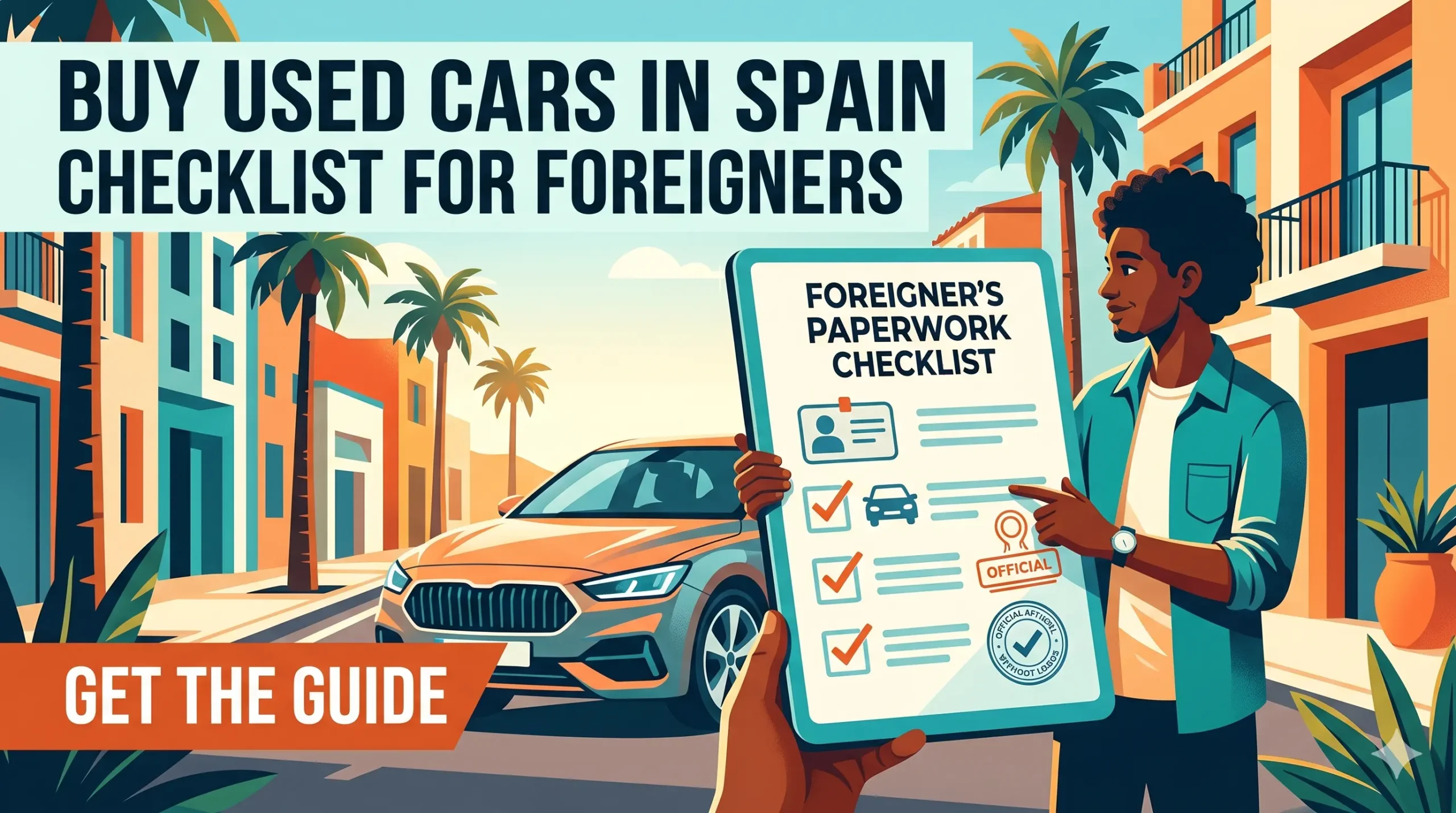
Buying Used Cars in Spain: Paperwork Checklist for Foreigners
Buying a used car in Spain without checking for hidden debts can lead to your new vehicle being embargoed by the government. I almost handed over cash for a beautiful Peugeot only to discover it carried two thousand euros in unpaid municipal fines. This guide provides the exact paperwork checklist foreigners need to safely purchase a used car and avoid inheriting someone else’s legal nightmare.
Disclosure: This post may contain affiliate links. We may earn a commission at no extra cost to you if you make a purchase through these links. Read full disclosure.
The Essential Checks Before You Hand Over Cash
When you find the perfect used car on a site like Milanuncios or Coches.net, your first instinct is usually to negotiate the price. As an expat, your first instinct must actually be extreme skepticism. In Spain, debts and embargoes are attached to the vehicle itself, not the driver. If you buy a car with unpaid taxes, you are legally buying that debt.
Requesting the Informe de Vehículo from the DGT
Before you even test drive the car, you must obtain an Informe de Vehículo (Vehicle Report) from the Dirección General de Tráfico (DGT). This official government document is the absolute holy grail of the Spanish used car market.
You can request a basic, free report online that simply tells you if there are any active blocks on the car preventing a sale. However, you must pay the small administrative fee (around nine euros) to download the Informe Detallado (Detailed Report). This document reveals the true history of the car: how many previous owners it had, if the mileage has been rolled back, if it was previously registered as a rental car, and crucially, if it has a reserva de dominio (a financing block) or an active embargo from the tax agency.
To download this report while you are physically standing in front of the seller inspecting the car, you need a flawless mobile connection. Relying on an expat-friendly provider like Tiekom ensures your mobile data does not drop out when you are trying to authenticate your identity on the fragile DGT portal. If the seller refuses to give you the license plate number or the chassis number (VIN) to run this check, walk away immediately.
Validating the ITV (Inspección Técnica de Vehículos)
The Inspección Técnica de Vehículos (ITV) is Spain’s mandatory roadworthiness test. A car must pass this strict mechanical and emissions inspection regularly (annually for cars over ten years old).
When inspecting the paperwork, you must demand to see the physical ITV card and the most recent inspection report (hoja de inspección). It is not enough for the seller to simply say the car “passed.” You need to verify that the ITV is currently en vigor (valid). If you buy a car with an expired ITV, the DGT will not allow you to legally transfer the title into your name.
Furthermore, the detailed inspection sheet will list any faltas leves (minor defects). While minor defects do not fail the inspection, they are a fantastic negotiation tool. If you see that the suspension is wearing down or the oil is weeping slightly, you know exactly what repairs are looming. Budgeting for these inevitable mechanical repairs is a core part of managing your Cost of Living in Spain: Budgeting for Expats.
Ensuring the IVTM Road Tax is Paid
The Impuesto sobre Vehículos de Tracción Mecánica (IVTM) is the annual municipal road tax paid to the local town hall. Spanish law strictly dictates that the person who owns the car on January 1st of the current year is legally responsible for paying the entire year’s road tax.
You must ask the seller to provide the physical bank receipt proving they paid the IVTM for the current fiscal year. If they have not paid it, the municipal government puts a block on the vehicle, and the DGT will instantly reject your attempt to transfer the ownership. Do not take their word that they “will pay it next week.” If the tax is unpaid, the transfer halts. To understand how these municipal taxes integrate into your overall fiscal footprint in the country, deeply review Taxes in Spain: Guide for Expats.
The Mandatory Paperwork for the Cambio de Titularidad
Transferring ownership of a vehicle in Spain is known as the Cambio de Titularidad. It is an intensely bureaucratic process that requires both the buyer and the seller to produce flawless, original documentation.
Your Identification and Residency Documents
As a foreigner, the Spanish government requires absolute proof of your identity and your physical address before they will allow you to register a vehicle.
You must bring your original passport and your physical Foreigner Identity Card (TIE) containing your NIE number. If you are an EU citizen, you need your green residency certificate and your home country passport.
Equally critical is your Certificado de Empadronamiento (municipal census registration). The DGT uses this document to assign your vehicle to a specific municipality for future road taxes and traffic fines. The padrón certificate must be issued within the last three months; an older copy will be rejected. Managing this exact paperwork correctly is also necessary if you plan to park on the street in your neighborhood, a survival tactic outlined in How to Get a Resident Parking Permit in Spain (ZBE/Zones). For a refresher on how to ensure your proof of address documents are legally pristine, check What Proof of Address Do Spanish Banks Accept?.
The Compraventa Contract and Payment Proof
You and the seller must sign a Contrato de Compraventa (Sales Contract) in triplicate. You can easily find standardized templates online. The contract must explicitly state the date and the exact time (hora exacta) the vehicle was handed over.
Documenting the exact minute of the handover is a massive legal shield. If the seller gets caught by an automated speed camera while driving the car to meet you, that time stamp proves you were not the driver, saving you from a devastating fine. To understand how ruthlessly the Spanish traffic system pursues these penalties, review Speed Cameras in Spain: How Fines Are Notified to Residents.
When executing the actual payment, Spanish anti-fraud laws strictly prohibit cash transactions over 1,000 euros if one of the parties is acting as a business. Even in private sales, paying in cash is highly discouraged. You must execute a secure bank transfer and keep the physical receipt. If you need to move large sums of money from your home country to fund this purchase, utilizing agile digital platforms rather than high-fee legacy banks is vital. For a comprehensive strategy on moving this capital securely, read Sending Money to/from Spain: Comparing Banks vs Transfer Services.
The Impuesto de Transmisiones Patrimoniales (ITP)
Buying a used car from a private seller triggers the Impuesto de Transmisiones Patrimoniales (ITP), a regional transfer tax. You cannot finalize the ownership transfer at the DGT until this tax is paid to the regional tax authority (Hacienda autonómica).
The ITP percentage varies drastically depending on which Autonomous Community you live in, typically ranging from 4% to 8% of the vehicle’s value. However, you do not calculate this tax based on the price you actually paid the seller. The government uses its own official valuation tables (tablas de valoración) based on the car’s make, model, and age.
You must fill out Form 620 (Modelo 620), pay the tax at a collaborating bank or online, and secure the stamped receipt. Attempting to process these dense regional tax forms online requires immense patience and a flawless internet connection. Using a reliable provider like Tiekom for your home fiber ensures the government portals do not crash midway through processing your payment.
Dealerships vs Private Sellers: Navigating the Friction
You must decide whether the financial savings of buying from a private individual outweigh the massive bureaucratic convenience of buying from an established dealership (concesionario).
The Gestoría Advantage
If you buy a car from a private seller, you must handle the DGT appointment, the ITP tax payment, and the contract drafting yourself. This means spending days navigating hostile government offices.
To bypass this nightmare, Spanish locals and expats universally rely on a Gestoría (an administrative agency). For a fee of roughly 50 to 100 euros, a gestor will take your IDs, the signed contract, and the car’s paperwork, and they will process the entire transfer with the DGT and the tax agency on your behalf. They issue you a justificante profesional (a temporary legal document) that allows you to drive the car immediately while they process the permanent title.
If you buy a used car from a registered dealership, they almost always include the gestoría service in the price. The dealership handles the entire transfer, pays the necessary taxes, and hands you the keys. It is infinitely less stressful for an expat who is still learning the language and building their local infrastructure, an adjustment phase covered in Opening a Bank Account in Spain as a Non-Resident.
Warranties and Consumer Protection
Spanish consumer protection laws give buyers far less protection on private sales than on dealership purchases.
If you buy a used car from a registered dealership, Spanish law mandates that they must provide a minimum one-year mechanical warranty (garantía). If the engine blows up a month later, the dealership is legally obligated to repair it.
If you buy from a private seller, there is no mandatory warranty. You are only protected against vicios ocultos (hidden defects) for six months. Proving a hidden defect in a Spanish civil court requires hiring an expert mechanic to testify that the seller intentionally hid the damage prior to the sale, which is an incredibly expensive and nearly impossible legal battle.
| Feature | Private Seller (Particular) | Dealership (Concesionario) |
| Purchase Price | Generally lower | Higher (includes overhead and profit) |
| Transfer Taxes (ITP) | Buyer pays (4% – 8%) | Exempt (Dealership charges 21% IVA included in price) |
| Paperwork Handling | Buyer must process or hire a Gestoría | Handled entirely by the dealership |
| Legal Warranty | 6 months for “hidden defects” only | Minimum 1-year comprehensive warranty |
Setting Up Insurance and Gear Before Driving
It is completely illegal to drive a vehicle in Spain without active third-party liability insurance (seguro a terceros). The insurance is tied to the car and the specific driver. You cannot simply borrow the seller’s insurance to drive the car home.
You must call an insurance broker or set up a policy online the exact day you finalize the contract. To quickly compare policies and upload your driving history documents from your home country, having a fast, reliable internet connection via Tiekom is incredibly helpful.
Furthermore, Spanish law requires every vehicle to carry specific emergency equipment. You must have at least one high-visibility reflective vest inside the cabin (not in the trunk) and two warning triangles, though the triangles are rapidly being phased out and replaced by the mandatory V-16 flashing emergency beacon. Do not drive away without these. You can easily order the homologated V-16 emergency light and a multipack of high-visibility vests from Amazon Spain so they are waiting for you at your apartment before you even buy the car.
Finally, navigating unfamiliar Spanish highways requires a steady GPS. Holding your phone while driving will result in a 200-euro fine and a massive loss of points. Before you get behind the wheel of your new vehicle, ensure you have ordered a sturdy dashboard phone mount from Amazon Spain to keep your navigation secure, legal, and hands-free.
References
Primary sources (official)
- Dirección General de Tráfico (DGT) – Informe de Vehículo: https://sede.dgt.gob.es/es/vehiculos/informe-de-vehiculo/
- Dirección General de Tráfico (DGT) – Transferencias de vehículos: https://sede.dgt.gob.es/es/vehiculos/transferencias-de-vehiculos/
- Agencia Tributaria – Modelo 620 (Impuesto sobre Transmisiones Patrimoniales): https://sede.agenciatributaria.gob.es/Sede/procedimientoini/GF08.shtml
Other helpful sources
- RACE – Trámites para comprar un coche de segunda mano: https://www.race.es/tramites-comprar-coche-segunda-mano
- Expatica – Buying, selling, and importing cars in Spain: https://www.expatica.com/es/living/transportation/buying-a-car-in-spain-101458/
Disclaimer
The information provided in this article is for educational and informational purposes only and does not constitute formal legal, financial, or tax advice. Spanish automotive regulations, the specific percentages applied to the Impuesto de Transmisiones Patrimoniales (ITP) by individual Autonomous Communities, and the DGT procedures for the Cambio de Titularidad are highly complex and subject to frequent legislative updates. Always verify the vehicle’s legal status by pulling an official DGT report and consider utilizing a certified administrative agent (Gestor Administrativo) to execute the legal transfer of ownership and ensure compliance with all regional tax obligations.