How to Register for Local Waste Collection and Recycling Services
You’ve moved into a new Spanish flat, the boxes are stacked to the ceiling, and you suddenly wonder whether you have to sign up for rubbish collection, who gets the waste bill, and how anyone at the town hall even knows you exist. This guide explains how waste collection and the waste tasa actually reach you, step by step, and how to plan a move that doesn’t bury your new street in cardboard.
Disclosure: This post may contain affiliate links. We may earn a commission at no extra cost to you if you make a purchase through these links. Read full disclosure.
How Waste Collection Registration Works in Spain
When I moved into my first Spanish apartment, I spent a whole afternoon searching for a “sign up for rubbish collection” form. I assumed it worked like electricity or internet, where you call a provider and open a contract. It doesn’t, and knowing that early saves you a lot of stress.
There Is No Sign-Up Form: The Service Follows the Property
Household waste collection in Spain is a municipal service. Your ayuntamiento, or the company or public body it contracts, empties the street bins whether you have been in the building for ten years or ten minutes. You don’t open an account to be allowed to throw your rubbish away. The service is tied to the dwelling and the municipality, not to a personal contract.
What does need sorting out is the money side. That means the waste charge, usually called the tasa de basuras or tasa de residuos, has to reach the right person, at the right address, with a payment method that works. Spain has no single national procedure for this. Each ayuntamiento sets its own rules in its ordenanza fiscal, the municipal tax bylaw. Some bill the waste tasa as its own receipt. Some collect it alongside other municipal charges. Some route it through the water bill. Many smaller towns hand collection of the tasa over to a provincial tax body.
So your first real task is to ask your own ayuntamiento three questions:
- How is the waste tasa billed here?
- Who is the person legally liable for it?
- How do I make sure the bill reaches me?
The answers vary a lot from town to town. Neighbours and estate agents tend to describe their old town, not yours.
If you haven’t registered your address yet, do that too. Being on the padrón isn’t a sign-up for rubbish collection, but it puts you on the municipal radar for local services. See How to Register Your Address (Empadronamiento) as a Renter in Spain for the full walkthrough.
Where the Standalone Waste Tasa Comes From: Ley 7/2022
If you’ve heard Spaniards grumbling about a “new” rubbish bill, the reason is a specific national law. Ley 7/2022 on waste and contaminated soils came into force on 10 April 2022. Article 11.3 required local authorities to set up a waste charge within three years of the law coming into force. That charge must be:
- Specific and separate: a dedicated charge for municipal waste, either a tasa or a non-tax public charge.
- Non-deficit: it can’t be set below what the service costs.
- Cost-based: it must reflect the real cost of collection, transport and treatment.
- Open to pay-as-you-throw: it must allow systems where households that produce less waste can pay less.
In practice, this is why so many municipalities rewrote their ordinances and why the waste charge is now more visible on your paperwork. The amount, the way it’s calculated and the billing schedule all come from your ayuntamiento’s ordinance. Some towns base it on property characteristics, some on water consumption, and some are trialling pay-as-you-throw models. The only reliable figure is the one in your own municipality’s ordinance or on the receipt it sends you.
Who Is Liable: Owners, Tenants and the October 2026 LAU Change
This is the question that causes the most arguments between landlords and tenants. The person liable for the waste tasa is defined by the municipal ordinance, under tax law. That person is the obligado tributario. In many towns the ordinance points to the owner of the property, but you have to check your own.
For renters, there is an important rule in the Ley de Arrendamientos Urbanos. From 8 October 2026, under Real Decreto-ley 29/2026, LAU article 20.1 says that taxes tied to the dwelling may not be imposed on the tenant. The exception is where the tenant is the person liable under tax law.
Put simply, if you rent, find out from your ayuntamiento whether you or your landlord is the obligado tributario for the waste tasa:
- If your landlord is the liable person: the rule above applies to taxes tied to the dwelling.
- If the ordinance makes the occupant liable: you are the obligado tributario, and the bill is yours.
If your situation is unclear, or your lease predates that date, get advice from your local consumer office or a tenant association before you pay or refuse anything. For keeping a clean record of these conversations, see Dealing with Landlords in Spain: Communication Tips and Paper Trail.
Step-by-Step: Getting the Waste Tasa Billed Correctly After You Move
Here’s the process I now follow every time I move, and the one I walk friends through over coffee. It isn’t glamorous, but it stops surprise receipts from turning up months later addressed to the previous owner.
For Owners Who Have Just Bought a Home
When you buy, the property changes hands at the notary. Municipal records, including whoever is down as liable for the waste tasa, don’t always update themselves on the same day. Your ayuntamiento may update its records from cadastral and registry information, or it may expect you to notify it directly. It depends on the town.
- Check your purchase paperwork for any reference to municipal charges, and ask the seller or the notary’s office whether the waste tasa was up to date at completion.
- Find out whether your municipality bills the waste tasa itself, through the water bill, or through a provincial tax collection body. Examples include SUMA Gestión Tributaria in Alicante province and OPAEF in Seville province.
- Ask the relevant office whether you need to request a change of holder, a cambio de titularidad, for the waste tasa. Ask what documents they want, typically your escritura, your NIE or DNI, and proof of identity.
- Ask which payment methods they accept and set one up, ideally a direct debit.
- Keep a copy of every receipt alongside your IBI paperwork, because the two often follow similar timetables.
For the wider picture of recurring homeowner costs, see Property Taxes in Spain: IBI, Community Fees, and Annual Costs.
For Renters Moving Into a Flat
Renters usually have less admin, but you still want certainty.
- Read your lease for any clause about municipal charges, and note the date you signed it.
- Contact your ayuntamiento or its tax office and ask who the obligado tributario for the waste tasa is at your address.
- If the waste tasa is collected through the water bill and the water contract is in your name, ask the water company and the ayuntamiento how that charge is treated.
- Write to your landlord by email or WhatsApp summarising what the ayuntamiento told you, so both of you have the same information in writing.
- If anything doesn’t add up, take your lease and the ayuntamiento’s answer to your local consumer information office, the OMIC, or a tenant association.
If you share a flat and the waste tasa does land on the occupants, agree a split before the first bill arrives. See How to Split Bills With Flatmates in Spain: Apps and Fair Methods.
Setting Up Payment and Online Access
Most municipalities and provincial tax bodies let you pay in more than one way: at a partner bank, by card through their website, or by direct debit. Online procedures usually need you to identify yourself, typically with Cl@ve or a digital certificate. For how those identification systems work, see Cl@ve System Explained: Accessing Spain Government Services Online.
My strong advice is to set up a direct debit, a domiciliación, as soon as the ayuntamiento confirms you are liable. Missed municipal receipts can pick up surcharges, and it’s far easier to let the bank handle it. The mechanics are covered in Setting Up Direct Debits for Bills in Spain Domiciliacion Guide. Many town halls also offer a lot of their tax procedures online, which is useful if you don’t fancy queuing at the oficina de atención al ciudadano. See Using Spanish ‘Ayuntamiento’ Services: What You Can Do Online.
Using the Service: Bins, Bulky Pickup and the Punto Limpio
Once the paperwork is clear, the day-to-day part is mostly about sorting rubbish properly and knowing where large items go.
What Goes in Which Container
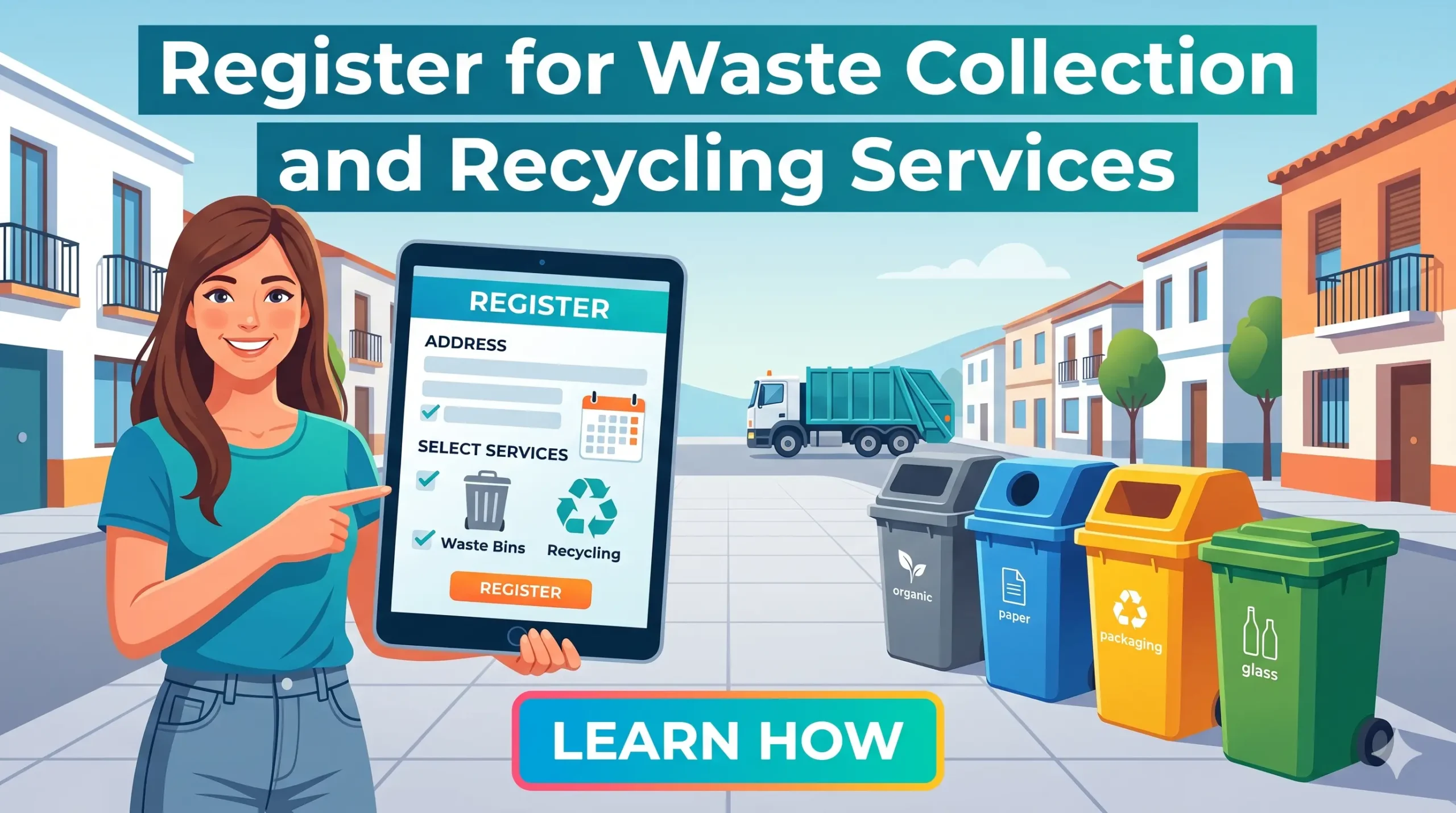
The national colour scheme for street containers is broadly the same across Spain. Local variations do exist, especially for organic waste, so always read the sticker on the container itself.
| Container colour | Common name | What goes in | What stays out |
|---|---|---|---|
| Yellow | Envases | Plastic packaging, cans, cartons such as milk and juice briks | Toys, kitchen utensils, hard plastic objects |
| Blue | Papel y cartón | Paper, flattened cardboard boxes | Greasy pizza boxes, used tissues |
| Green igloo | Vidrio | Glass bottles and jars, without lids | Ceramics, drinking glasses, mirrors, light bulbs |
| Brown | Orgánico | Food scraps, coffee grounds, small amounts of garden waste | Nappies, cat litter, cigarette ends |
| Grey | Resto | Everything that fits none of the above | Hazardous items, batteries, electronics |
Batteries, oil, paint, electronics and medicines don’t belong in any street container. Batteries usually go to collection points in shops. Medicines go to the SIGRE points in pharmacies. The rest goes to the punto limpio. For the trickier cases, see Recycling in Spain: Bin Colors, Rules, and Common Confusion. Some buildings also have their own rules about where and when bags go down to the street, set by the comunidad de propietarios.
Furniture, Mattresses and Moving Boxes
This is where new arrivals get caught out. You can’t leave an old sofa next to the containers and walk away. Most municipalities run a bulky waste collection service, the recogida de muebles y enseres or voluminosos. Depending on the city, it works one of two ways:
- By appointment: you book by phone, through an app or on the ayuntamiento’s website. Madrid, for example, handles many requests through its 010 citizen line.
- By schedule: a set collection day applies in each neighbourhood. Barcelona works this way, with items left outside your building on the evening your area is scheduled.
Each town decides when, where and how much you can put out, so check before you carry anything downstairs. Leaving items outside the permitted arrangements can lead to a fine under local ordinances.
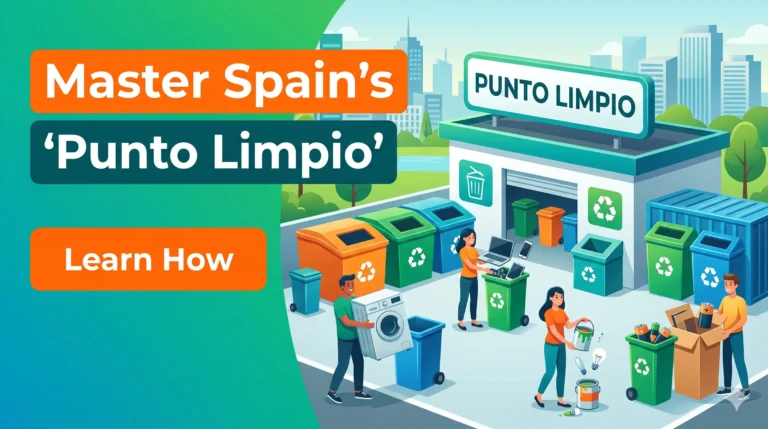
Moving cardboard is the other headache. Dozens of boxes stuffed into the blue container at once annoys your neighbours and blocks the bin for everyone. Flatten them and spread them over several days. For a large volume, take them to the punto limpio. Its procedures and accepted items are explained in How to Use Spain’s Recycling Punto Limpio Facilities.
Planning a Move Without a Rubbish Mountain: Why Sirelo Belongs in Your Plan
After several Spanish moves, here’s what I’ve learned: a lot of waste stress comes from the move itself. That includes things you could have sold, items that don’t fit the new flat, packaging piled in the hallway, and the frantic hunt for a bulky collection slot the week you get your keys. The best fix is choosing the right removal company before moving day, and that’s where Sirelo earns its place.
How Sirelo Helps You Compare Movers
Sirelo is a comparison platform for removal companies. You describe your move once, and you can receive quotes from several movers to compare side by side, along with customer reviews to help you judge them. Instead of phoning around in your best nervous Spanish, you put the options next to each other and compare what each one actually includes.
For waste in particular, that comparison matters more than people expect. When I compare quotes, I look for answers to questions like these:
- Does the company remove packaging materials after unpacking?
- Will it take away unwanted furniture, and how does it dispose of it?
- Will it help with items that have to go to a punto limpio?
- Does it supply reusable crates instead of single-use cardboard?
Not every mover offers these services. Each company sets its own prices and terms, so read each quote carefully and check the company’s own page for current details.
Using Sirelo also helps with the building-access headaches that come with Spanish moves: narrow streets, small lifts, and comunidades with strict rules about the communal areas. A mover who knows the area is more likely to plan around them. For what to check before signing with any removal company, see How to Choose a Moving Company in Spain (What to Check).
A Moving-Week Checklist That Keeps Waste Under Control
Here’s the sequence I recommend to friends. It pairs the admin from earlier with smart use of Sirelo.
- Six to eight weeks out: request quotes through Sirelo, and ask each mover specifically about packaging removal and furniture disposal.
- Four weeks out: sell or give away what you won’t take, and book your old town’s bulky collection or plan a punto limpio trip for anything left over.
- Two weeks out: confirm your chosen mover, ideally one you found through Sirelo with clear terms on disposal, and check your new building’s rules on moving hours and communal spaces.
- Moving week: pack by room, keep packaging tidy, and agree with the movers what they will take away.
- First week in the new home: contact your new ayuntamiento about the waste tasa as described above, set up payment, and register on the padrón if you haven’t already.
- First month: flatten and recycle leftover cardboard over several collection cycles, and drop hazardous items at the punto limpio.
For the full sequence of utilities and contracts to switch over, see Moving House in Spain: Hiring Movers and Registering Utilities.
Spanish bureaucracy can feel like it was designed to test your patience, and waste admin is a good example. There’s no sign-up form for collection, yet there’s still a bill to sort out, and every town does it slightly differently. The good news is that once you know the waste tasa follows the property and the municipal ordinance, the steps above make it manageable.
If you’re planning a move right now, request your removal quotes through Sirelo first, compare what each company will do with your packaging and unwanted furniture, and give yourself one less pile of rubbish to worry about.
Disclaimer
This article is for general informational purposes only and does not constitute professional advice. Laws, prices and regulations vary by location and change over time. Consult a qualified professional for guidance on your specific situation.