How to Handle Minor Injuries in Spain: First Steps and Where to Go
Slicing your hand on a broken glass or twisting an ankle leaves expats paralyzed over whether to hit the emergency room or stay home. I once sat bleeding on my kitchen floor in Madrid, completely unsure if a local pharmacy could stitch me up. This guide breaks down exactly where to go for minor injuries to avoid massive waiting rooms.
Disclosure: This post may contain affiliate links. We may earn a commission at no extra cost to you if you make a purchase through these links. Read full disclosure.
The Frontline Triage at the Spanish Pharmacy
When you suffer a minor scrape, a mild burn from the oven, or a stubbed toe, your first instinct back home might be to raid your bathroom cabinet or run to a massive supermarket to buy medical supplies. In Spain, your immediate frontline defense is the local pharmacy, known universally as the farmacia.
What the Farmacia Can Actually Treat
Spanish pharmacists are highly trained medical professionals who act as strict, respected gatekeepers for community health. You cannot buy basic medical supplies at a standard grocery store; you must visit the pharmacy, easily identifiable by the glowing green cross on the street.
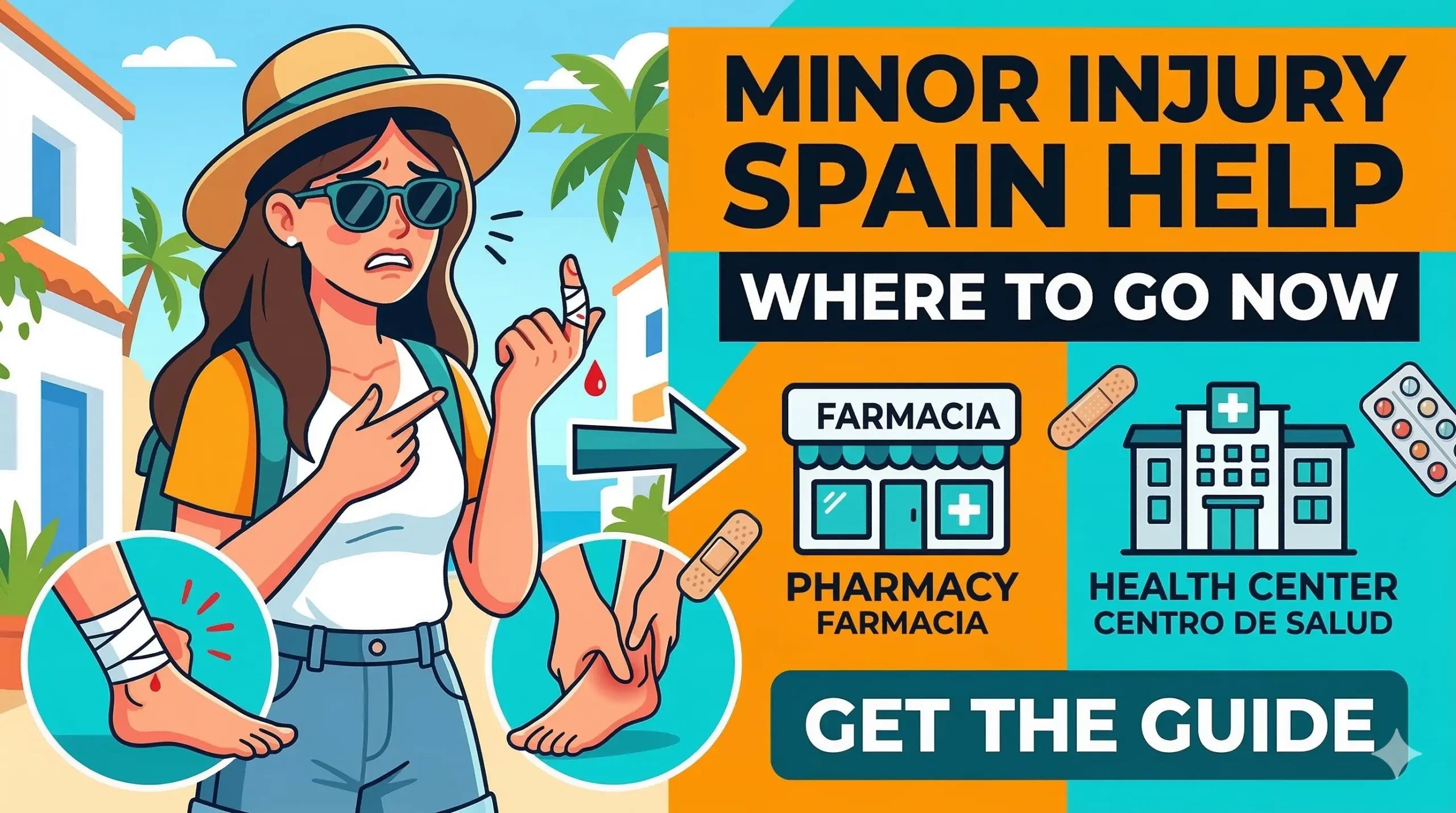
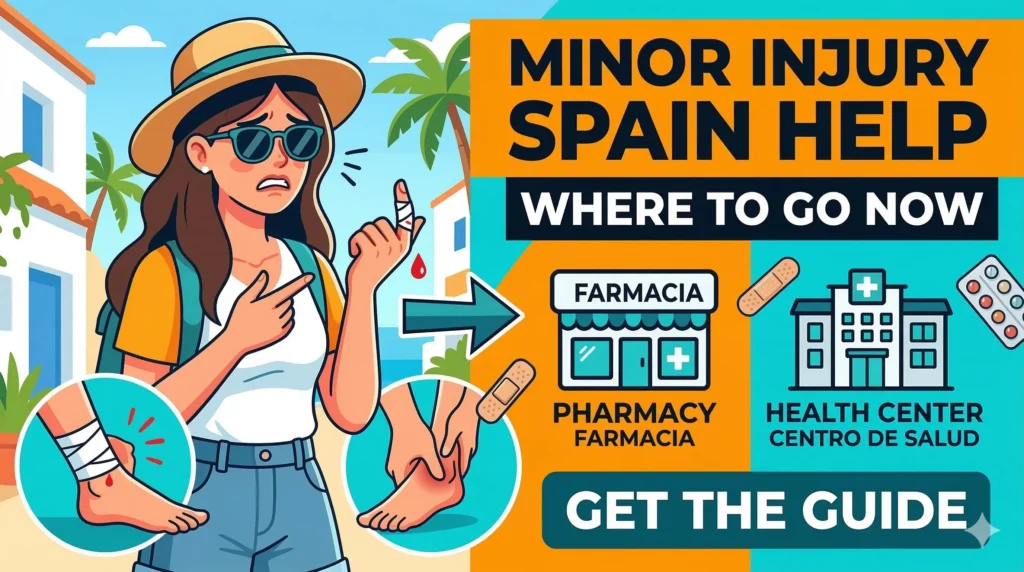
If you walk in with a shallow cut, a minor scrape, or a mild cooking burn, the pharmacist can legally assess the wound, clean it, and sell you the necessary clinical-grade supplies. You will quickly realize that standard foreign products like Neosporin do not exist here. Instead, pharmacists will heavily push liquid antiseptics like Cristalmina (a chlorhexidine spray) or Betadine, alongside standard sterile gauze. To understand exactly how much clinical advice they are legally allowed to dispense over the counter, read our overview on Can a Pharmacist in Spain Help With Minor Illness? What to Expect. They can be incredibly helpful for frontline triage, saving you a trip to the doctor for superficial wounds.
When the Pharmacist Will Turn You Away
However, a pharmacist’s power has strict legal boundaries. If your cut is deep enough to require stitches, or if your twisted ankle is swelling rapidly and they suspect a fracture, they will immediately refuse to treat you. They cannot administer local anesthesia, they cannot close a gaping wound, and they certainly cannot prescribe heavy painkillers or antibiotics without a doctor’s signature.
They will simply wrap the injury in temporary gauze and point you toward the nearest medical clinic. To ensure you are not caught off guard at home bleeding onto your shoes before you can even reach a professional, making sure your apartment is properly stocked in advance is absolutely vital. Review our guide on Preparing a Simple Home First-Aid Kit for Spain (Expats Checklist) so you have the basics on hand to stabilize yourself before heading out the door.
Navigating Public Clinics vs Emergency Rooms
If the pharmacy turns you away, you must enter the actual Spanish healthcare system. Knowing which door to walk through is the difference between getting patched up in thirty minutes and waiting six hours in a plastic chair.
Using Your Local Centro de Salud
If your minor injury happens during normal business hours—which are usually 8:00 AM to 8:00 PM on weekdays—your absolute best option in the public system is your local primary care clinic. You do not need to book a prior appointment for a bleeding wound or an acute injury.
When you walk into the clinic, bypass the regular doctor’s appointment queue. You need to speak to the receptionist or the celador (the administrative warden at the door) and ask for the nursing station (enfermería) or primary care emergencies (urgencias de atención primaria). The nurses here are fully equipped to stitch up deep culinary cuts, dress moderate burns, remove splinters, and administer emergency tetanus shots. If you have not navigated the bureaucracy to get your public health card yet, read What Is a ‘Centro de Salud’ in Spain and How Do You Register? so you are not turned away at the administrative desk when you are in pain.
When to Head to Urgencias
If your injury requires diagnostic imaging like an X-ray for a suspected broken wrist, or if it happens in the middle of the night on a Sunday, your local clinic will not be able to help you. You must go to a hospital emergency room (urgencias).
However, you must mentally prepare for the wait. Spanish public hospitals use a strict triage color system to manage the massive influx of patients. A minor injury like a sprained ankle or a sliced finger will be coded green or blue. Because your injury is not actively life-threatening, you will be placed at the bottom of the priority list. You will sit in the waiting room while heart attacks, severe traumas, and respiratory crises are rushed ahead of you. It is entirely common to wait four to six hours for a minor fracture. To know exactly where these massive hospitals are located in your city, check out How to Find a 24-Hour Clinic in Spain (Urgencias). When you finally see the triage nurse, you must be able to communicate the exact mechanism of injury quickly and accurately; memorize the vocabulary in Spanish Emergency Phrases: How to Describe Symptoms Quickly to avoid diagnostic delays.
The Private Healthcare Advantage for Minor Accidents
Waiting five hours in a crowded, noisy public hospital with a throbbing, swollen thumb is exactly why so many expats completely abandon the state system for urgent care and minor injuries.
Skipping the Public Queue
If you want to bypass the massive public triage bottlenecks, securing a premium private health policy through an expert, expat-focused broker like Innoinsure is a massive tactical advantage. A dedicated, bilingual agent from Innoinsure can seamlessly set up a policy that grants you immediate, unrestricted access to a vast network of top-tier private urgent care clinics.
With a comprehensive policy secured through Innoinsure, the administrative contrast is staggering. You simply walk into a pristine private clinic, present your insurance card at the front desk, and are usually sitting in front of an X-ray machine or getting your cut stitched up by an English-speaking doctor in under thirty minutes. There is no battling for priority against hundreds of other patients. You can deeply explore the systemic differences between these parallel medical routes in our overview of the Spain Healthcare System for Expats: Public vs Private.
Telemedicine for Triage
Sometimes, you are not entirely sure if an injury even warrants a clinic visit. If you trip on the cobblestones and your knee is slightly swollen the next morning, or if you accidentally burn your arm on a hot pan, dragging yourself across town to sit in a waiting room is exhausting.
Many modern policies brokered by Innoinsure feature robust, twenty-four-hour digital doctor access. You can consult an English-speaking general practitioner via your smartphone, show them the wound or the swelling via secure video, and they will tell you whether you actually need to head to the clinic for an X-ray or antibiotics. When you manage your urgent care through an Innoinsure policy, you eliminate the guesswork entirely. Discover how to safely leverage this incredible digital perk to save time in Telemedicine in Spain: When It’s Useful and What to Expect. If your minor injury was caused by a traffic incident, such as a low-speed scooter crash, ensuring you gather the right liability paperwork before leaving the scene or the clinic is critical; read What to Do After a Minor Accident in Spain: Insurance and Care Steps for proper guidance.
Post Injury Recovery and Holistic Care
Getting stitched up, put in a cast, or having a burn dressed is only the first step of the journey. Surviving the recovery phase requires adapting your consumer habits to the local retail environment so you do not drain your wallet.
Bridging the Retail Gap
When you leave the clinic or the emergency room, the doctor will likely send you back to the local pharmacy to buy crutches, specialized waterproof bandages, scar-reduction creams, or heavy-duty joint braces. You will quickly discover that Spanish pharmacies charge absolutely staggering retail markups for these non-subsidized recovery items.
If you try to buy high-grade hydrocolloid blister patches, potent glucosamine for a recovering joint, arnica gel for severe bruising, or clean-ingredient burn salves at a physical Spanish pharmacy, the cost will be shockingly high. The selections are severely limited, and advanced recovery wellness is largely treated as a luxury retail expense rather than a medical necessity. To fully grasp the baseline of these hidden retail medical costs across the country, see our detailed overview on Health Costs in Spain: Typical Co-Pays and Out-of-Pocket Fees.
Healing at Home
To completely bypass this frustrating retail gap, the savvy international community in Spain relies heavily on iHerb. By ordering your specialized wound care items, premium joint-support formulas, and potent natural anti-inflammatories directly through iHerb, you gain access to the exact, trusted holistic brands you successfully used back home without paying the localized pharmacy tax.
Having a dedicated holistic recovery stash delivered directly to your Spanish door via iHerb ensures you are actively fortifying your body’s natural healing process. Whether you need collagen peptides to help repair torn ligaments after a bad sprain, or specialized zinc ointments to prevent a kitchen burn from scarring, navigating a foreign medical system is chaotic and exhausting. Relying on iHerb to effortlessly restock your specific preventative and recovery arsenal puts the control firmly back in your hands. You can avoid the overwhelming local markup completely by utilizing iHerb for your baseline recovery care, allowing you to focus your energy entirely on healing and getting back to enjoying your life in Spain.
| Injury Type | Primary Treatment Location | Typical Wait Time | Best For |
| Superficial Scrape / Mild Burn | Local Pharmacy | Immediate | Antiseptics, basic bandages, frontline triage advice |
| Deep Cut (Needing Stitches) | Primary Care Clinic | 30 to 60 Minutes | Quick daytime wound closure by a nurse, tetanus shots |
| Suspected Bone Fracture | Public or Private ER | 1 to 6 Hours | X-rays, casts, severe pain management, specialist review |
| Minor Sprain / Bruising | Digital Telemedicine | 10 to 15 Minutes | Remote assessment, advice on home care, digital prescriptions |
References
Primary sources (official)
- Ministerio de Sanidad – Urgencias atendidas en hospitales del Sistema Nacional de Salud: https://www.sanidad.gob.es/estadEstudios/sanidadDatos/tablas/tabla27.htm
- Ministerio de Sanidad – Cartera de servicios comunes de atención primaria: https://www.sanidad.gob.es/profesionales/prestacionesSanitarias/CarteraDeServicios/ContenidoCS/2AtencionPrimaria/home.htm
Other helpful sources
- Expatica – Emergency numbers and helplines in Spain: https://www.expatica.com/es/healthcare/healthcare-basics/emergency-number-spain-102154/
- Citizens Advice Bureau Spain – Healthcare Information: https://www.citizensadvice.org.es/faq/healthcare/
Disclaimer
The information provided in this article is for educational and informational purposes only and does not constitute formal medical or emergency response advice. The triage capabilities of local pharmacies, the wait times at public emergency rooms, and the availability of specific private clinics vary significantly across Spain’s autonomous communities. Always prioritize your physical safety over administrative convenience. If you or a family member experience a severe, life-threatening injury, heavy arterial bleeding, a head trauma, or a loss of consciousness, do not attempt to self-triage or wait for a digital appointment; dial 112 immediately to request an ambulance.