Preparing a Simple Home First-Aid Kit for Spain (Expats Checklist)
Slicing your finger open in the kitchen and realizing your Spanish apartment has absolutely zero bandages or antibacterial cream is a stressful expat initiation. I once bled onto my own shoes while frantically trying to locate an open pharmacy on a Sunday afternoon. This guide explains exactly how to stock a practical, legally compliant home first-aid kit in Spain.
Disclosure: This post may contain affiliate links. We may earn a commission at no extra cost to you if you make a purchase through these links. Read full disclosure.
The Reality of Spanish Pharmacies
In the United States, the United Kingdom, or Australia, building a first-aid kit is as simple as tossing a bottle of generic pain relievers, some antibiotic ointment, and a box of assorted bandages into your grocery cart while buying milk. When you move to Spain, you must quickly adapt to the reality that this level of retail convenience simply does not exist.
The Spanish government tightly regulates the sale and distribution of all medical supplies to ensure patient safety and prevent improper self-medication. You cannot buy basic pain relievers, cold medicine, antihistamines, or medicated ointments at a supermarket like Mercadona, Carrefour, or Lidl. You must physically go to a licensed farmacia, which is easily identifiable by the large, glowing green cross mounted above the street entrance.
Navigating this state-regulated monopoly requires understanding how local Spanish pharmacists operate as frontline medical gatekeepers. You do not browse aisles of medication; you must walk up to the counter and ask the pharmacist directly for every single pill or cream you need. They will ask you about your symptoms before handing over the box. To understand how to leverage their impressive clinical expertise without needing to secure a formal doctor’s note for minor scrapes and bruises, check out Can a Pharmacist in Spain Help With Minor Illness? What to Expect.
Essential Supplies for Your Spanish First-Aid Kit
When building your botiquín de primeros auxilios (first-aid kit) for your new Spanish apartment, you must learn the local vocabulary and the culturally accepted brand names. Expats often panic when they walk into a farmacia and realize their go-to, trusted home country brands are completely unavailable.
Wound Care and Antiseptics
The Spanish climate guarantees you will spend significantly more time outdoors. Whether you are hiking the dusty trails of Andalusia or swimming along the rocky coves of the Costa Brava, proper wound care is an absolute daily necessity.
In Spain, the standard, universally recognized triple-antibiotic ointment that many North Americans rely on (like Neosporin) is not available over the counter. If you ask for it, the pharmacist will likely look confused. Instead, Spanish medical professionals heavily push liquid antiseptics to disinfect cuts and abrasions. You should ask the pharmacist for Cristalmina (a very popular, clear chlorhexidine spray) or Betadine (the classic brown povidone-iodine solution).
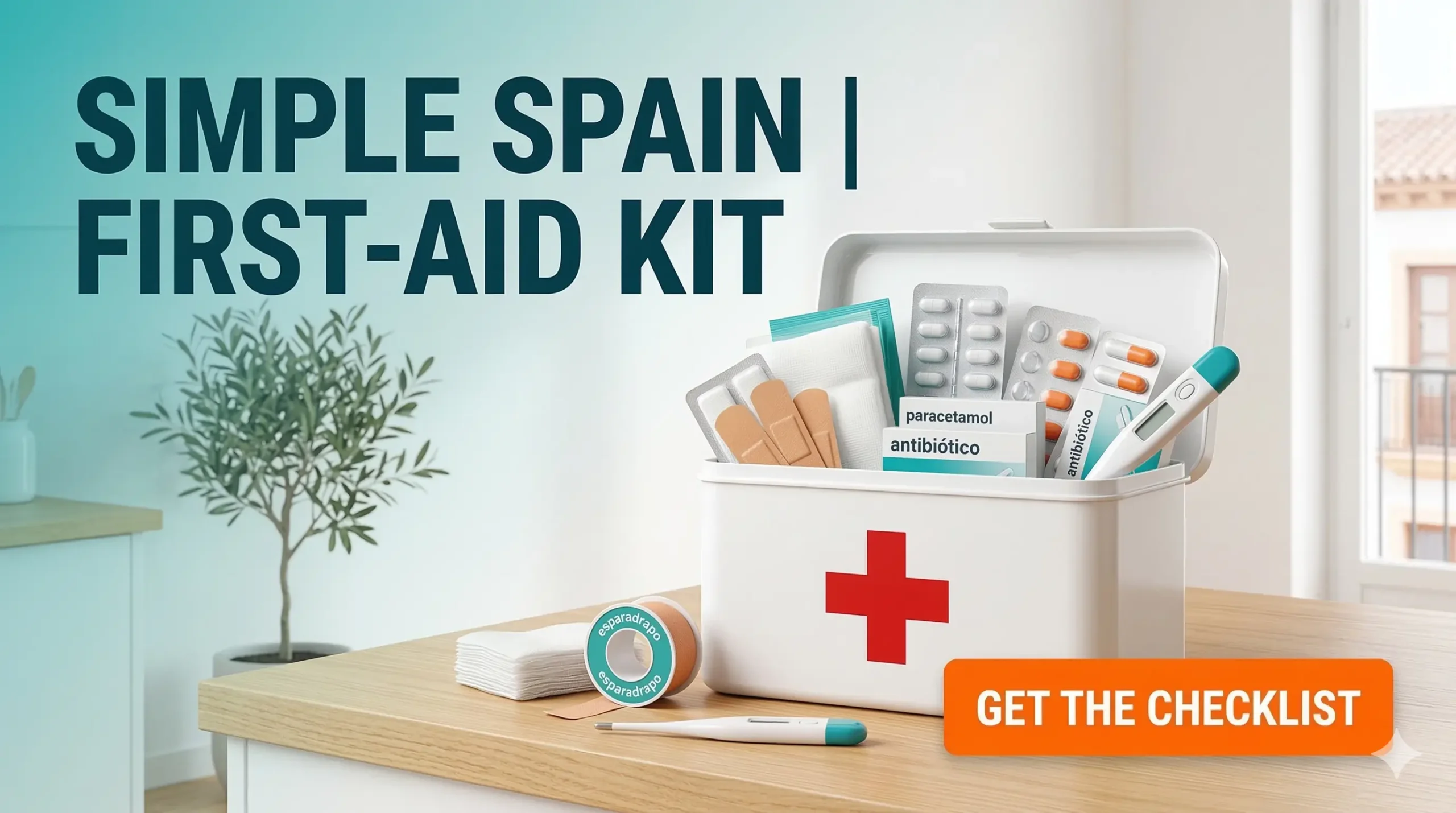
For physical wound coverage, ask for tiritas (standard adhesive plasters or Band-Aids) and a box of gasas estériles (sterile gauze squares). You will also want a roll of esparadrapo (medical adhesive tape) to secure the gauze. If your basic home first-aid kit fails to contain a severe, deep bleeding wound, you need to know exactly how to communicate the physical crisis to a local emergency dispatcher; read How to Handle Medical Emergencies If You Don’t Speak Spanish so you are thoroughly prepared for the worst-case scenario.
Pain Relief and Fever Reducers
For managing sudden tension headaches, reducing viral fevers, and treating minor joint sprains, the holy trinity in the Spanish pharmaceutical world consists of Paracetamol, Ibuprofeno, and Nolotil.
It is vital to note that the Spanish Ministry of Health recently cracked down heavily on high-dosage over-the-counter medicine sales. Today, you can generally only buy smaller doses, such as 400mg of Ibuprofen or 500mg to 650mg of Paracetamol, without a prescription. If you want the much stronger 600mg Ibuprofen or 1-gram Paracetamol boxes, you are legally required to provide a doctor’s digital script. If you are already integrated into the state-funded public system and want to know exactly how much these subsidized prescriptions will cost you out of pocket, review Understanding Co-Payments at Spanish Pharmacies Copago.
You should also be aware of Nolotil (the brand name for metamizole). It is a highly effective, incredibly common Spanish painkiller prescribed for severe pain. However, it is strictly banned in several Northern European countries and the United States due to severe, sometimes fatal, adverse reactions in certain genetic populations. As an expat, it is generally safer to stick to the active ingredients your body already knows.
Digestive Relief and Allergy Medications
Expat stomachs take a severe beating during the first few months in Spain. The sudden shift to a rich Mediterranean diet, the different mineral composition of local tap water, and the culturally mandated late-night tapas culture will inevitably cause gastrointestinal distress.
Your home first-aid kit should permanently include Almax (a fast-acting antacid for severe heartburn) and Fortasec (the local brand of loperamide used to stop sudden diarrhea). For sudden allergic reactions to the aggressive local olive tree pollen or painful insect bites, you will want to keep an over-the-counter antihistamine readily available, such as Ebastina or Loratadina.
| Home Country Item | Spanish Equivalent | Primary Use in First-Aid Kit |
| Band-Aids / Plasters | Tiritas | Covering minor superficial cuts and scrapes |
| Neosporin / Antiseptic | Cristalmina or Betadine | Disinfecting open wounds to prevent infection |
| Tylenol / Panadol | Paracetamol (e.g., Gelocatil) | Reducing fever and treating mild to moderate pain |
| Advil / Nurofen | Ibuprofeno (e.g., Neobrufen) | Anti-inflammatory for sprains, swelling, and headaches |
| Imodium | Fortasec | Immediate relief for acute traveler’s diarrhea |
| Medical Tape | Esparadrapo | Securing sterile gauze pads over larger wounds |
Bypassing the Pharmacy for Preventative Care
While local Spanish pharmacies are the absolute only legal place to get acute chemical painkillers and antibiotics, their government-protected monopoly means they charge absolutely staggering retail markups for basic, non-medicated holistic wellness items and advanced first-aid supplies.
If you try to build a truly comprehensive, holistic home kit by purchasing items like high-grade Manuka honey for minor kitchen burns, advanced hydrocolloid blister patches for long weekend hikes, or potent oral ginger extract for chronic nausea at a physical Spanish pharmacy, your monthly budget will take a massive, unnecessary hit. To fully grasp the baseline of these hidden retail markups across the country, see our detailed overview on Health Costs in Spain: Typical Co-Pays and Out-of-Pocket Fees.
To completely bypass this frustrating retail gap, the savvy international community in Spain relies heavily on iHerb. By ordering your preventative first-aid supplies, clean-ingredient burn salves, and premium zinc ointments directly through iHerb, you gain immediate access to the exact, trusted wellness brands you successfully used back home without draining your wallet at a local physical chemist.
Having a dedicated holistic wellness and recovery stash delivered directly to your Spanish door via iHerb ensures you are actively fortifying your home before an accident ever happens. Navigating a foreign retail medical system is chaotic and exhausting; relying on iHerb to effortlessly restock your specific preventative arsenal puts the financial and physical control firmly back in your hands. You can avoid the overwhelming local pharmacy markup completely by utilizing iHerb for your baseline home care kit, allowing you to save your money for genuine medical emergencies.
Managing Medical Emergencies Beyond the Kit
A simple home first-aid kit is only designed to stabilize minor injuries, halt superficial bleeding, and lower mild fevers. When a boiling water kitchen burn blisters severely, a child’s weekend fever refuses to break, or a twisted ankle begins to swell uncontrollably, you must escalate your medical care quickly and efficiently.
Finding a Farmacia de Guardia
If you slice your hand open cooking dinner at 11:00 PM on a Saturday and realize your newly built first-aid kit is missing sterile gauze, you cannot just wait until Monday morning.
Every single municipality in Spain, from massive urban centers like Madrid to tiny coastal villages, operates a legally mandated, rotating Farmacia de Guardia (on-call pharmacy) system. This ensures that at least one local pharmacy in your immediate district is open 24 hours a day, 365 days a year. You can usually find a printed schedule taped to the front glass door of any closed pharmacy telling you exactly which location is currently open for the night, or you can search your local municipality’s website.
Escalating to Private Healthcare Networks
If the home injury is simply too severe for over-the-counter triage, navigating the chronically crowded public hospital emergency rooms can be an agonizing, hours-long ordeal. Waiting four hours in a plastic chair while bleeding through a towel is a nightmare.
This specific logistical bottleneck is exactly why utilizing an expert, expat-focused broker like Innoinsure is a massive tactical advantage for your health and sanity. A dedicated, bilingual agent from Innoinsure can seamlessly set up a premium private health policy that grants you immediate, unrestricted access to a vast network of top-tier, fast-moving private hospitals and urgent care centers.
With a comprehensive policy secured through Innoinsure, you bypass the chaotic public waitlists completely. If you suffer a deep cut that clearly requires professional stitches, you simply open your private provider’s app, locate the nearest private emergency clinic, and get treated immediately by English-speaking staff. To fully understand the operational and cultural differences between these two distinct medical worlds, review our deep dive into the Spain Healthcare System for Expats: Public vs Private.
Furthermore, if you just have a minor, unidentifiable skin infection spreading from a scrape and do not want to commute across town late at night, many modern policies brokered by Innoinsure feature robust 24/7 digital doctor access. You can show the on-call doctor your infected wound via a secure video call and have an antibiotic prescription sent instantly to your phone. Discover how to safely leverage this incredible digital perk in Telemedicine in Spain: When It’s Useful and What to Expect. If the home injury is immediately life-threatening, such as a severe head trauma or uncontrolled arterial bleeding, you must bypass telemedicine completely; read How to Find a 24-Hour Clinic in Spain Urgencias so you know exactly which physical emergency room to rush to without hesitation.
References
Primary sources (official)
- Cruz Roja Española (Spanish Red Cross) – Botiquín de Primeros Auxilios en Casa: https://www2.cruzroja.es/web/ahora/-/todo-lo-que-debe-tener-botiquin-primeros-auxilios-casa
- Ministerio de Sanidad – Estrategias para reducir riesgos de la automedicación: https://www.sanidad.gob.es/biblioPublic/publicaciones/docs/200006-2.pdf
Other helpful sources
- Expatica – Guide to Doctors and GPs in Spain: https://www.expatica.com/es/healthcare/healthcare-services/doctor-in-spain-576715/
Disclaimer
The information provided in this article is for educational and informational purposes only and does not constitute formal medical or pharmaceutical advice. Spanish pharmaceutical regulations regarding over-the-counter medication dosages and the availability of specific active ingredients are subject to frequent legislative updates. Always consult directly with a licensed Spanish pharmacist (farmacéutico) or a registered medical professional before taking new medications, and never use a home first-aid kit as a substitute for professional emergency medical treatment. If you experience a severe or life-threatening medical emergency, dial 112 immediately.