Spanish Emergency Phrases: How to Describe Symptoms Quickly
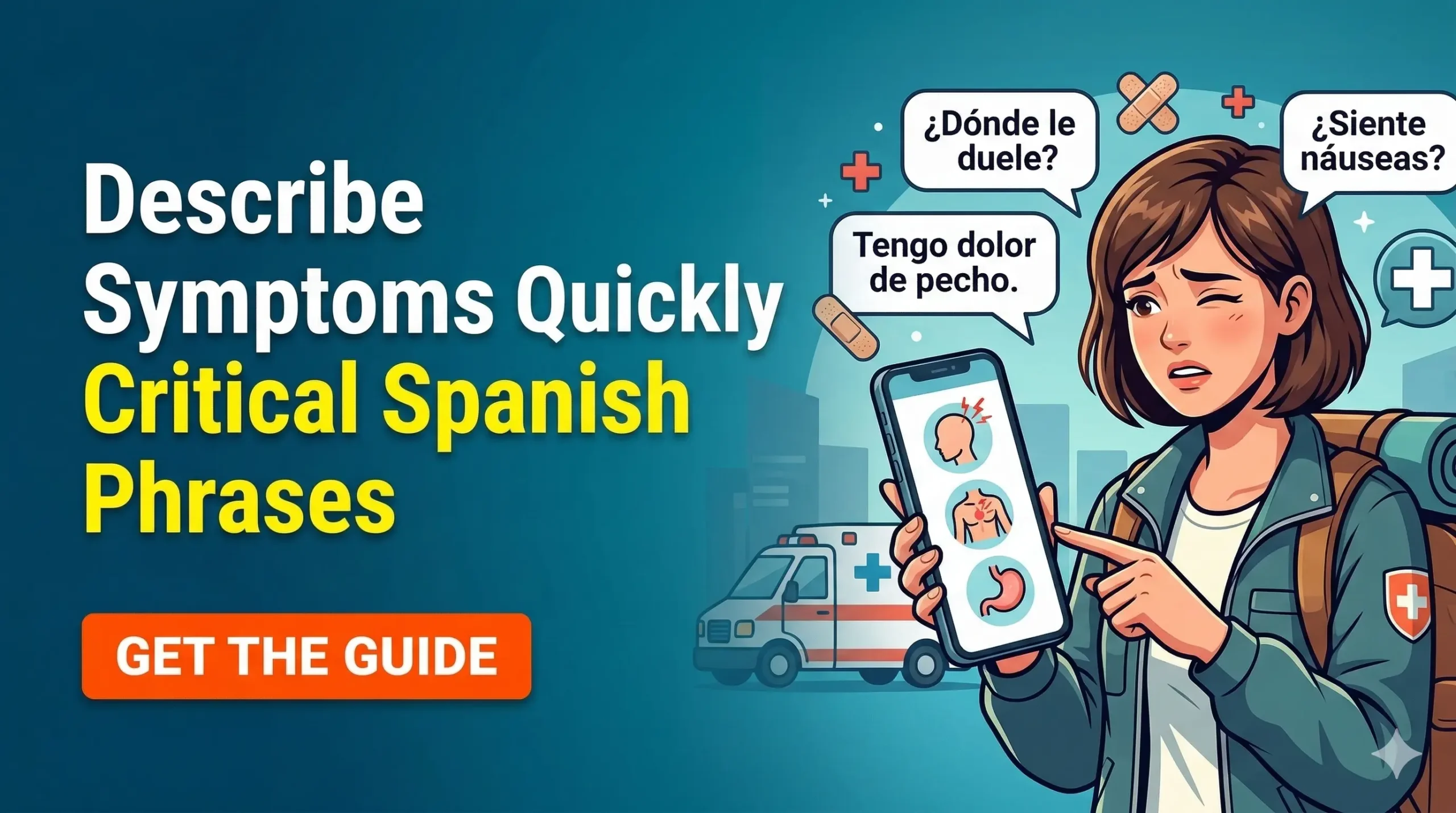
Staring at a triage nurse while your chest is tight, completely forgetting how to say “I can’t breathe” in Spanish, is a uniquely terrifying expat nightmare. I once spent ten agonizing minutes pantomiming a severe allergic reaction in an Andalusian emergency room because my brain froze. This guide provides the exact Spanish emergency phrases you need to describe symptoms quickly.
Disclosure: This post may contain affiliate links. We may earn a commission at no extra cost to you if you make a purchase through these links. Read full disclosure.
The Reality of the Language Barrier in Spanish Clinics
Living in Spain is an incredible adventure, but the romanticized vision of expat life comes to a screeching halt the second you experience a medical emergency. When you are in physical pain, the linguistic part of your brain simply shuts down, and understanding how to navigate the local clinical environment becomes your most urgent priority.
Overcoming Panic and Brain Fog
Even if you have spent years diligently studying Spanish grammar and can effortlessly order a complex round of tapas in a loud bar, medical Spanish is an entirely different beast. When adrenaline floods your system due to a sudden injury or a terrifying symptom, your cortisol spikes, effectively wiping out your carefully practiced vocabulary. It is incredibly common for fluent expats to revert entirely to their native language or resort to frantic Spanglish and wild hand gestures when standing in front of a doctor.
Furthermore, the environment in a Spanish emergency room does not cater to hesitation. Spanish medical professionals are clinically brilliant, but they work in a high-pressure, fast-paced system. They speak incredibly quickly, and the concept of a “privacy line” at a triage desk is virtually nonexistent. You will likely have to loudly declare your highly personal symptoms while three other patients stand directly behind you. Validating this anxiety is the first step; you are not failing at your expat life because you forgot the word for “dizziness” while panicking. You simply need a reliable, memorized toolkit of direct phrases.
When to Use the Pharmacy versus the Emergency Room
Before you start shouting emergency phrases, you need to ensure you are actually in the right building. A common mistake anxious foreigners make is rushing straight to the massive regional hospital for a minor issue, like a mild urinary tract infection, a persistent cough, or a minor cooking burn. In Spain, sending non-life-threatening issues to a major hospital absolutely clogs the system, and you will be punished with a six-to-eight-hour wait time in a plastic chair.
For highly acute but minor issues, your first line of defense should actually be the local neighborhood chemist. Spanish pharmacists are highly trained medical professionals who can legally dispense excellent triage advice and certain strong medications that you might assume require a hospital visit. You can learn exactly how to leverage their frontline expertise in our guide on Can a Pharmacist in Spain Help With Minor Illness? What to Expect.
If the issue is too complex for the pharmacist but not a life-or-death crisis, you should seek out a local urgent care center (known locally as a PAC) rather than the main hospital. Knowing where these specific doors are located in your neighborhood is crucial; we break down this exact search process in How to Find a 24-Hour Clinic in Spain (Urgencias).
Essential Spanish Phrases for Urgent Symptoms
When you finally approach the medical professional, you must be as direct and concise as possible. Do not try to translate complex English idioms like “I feel under the weather” or “My head is pounding.” Stick to literal, undeniable symptoms.
Describing Pain and Its Exact Location
The most fundamental phrase you need to master is “Me duele…” (My [body part] hurts) or “Tengo dolor en…” (I have pain in…). Pointing to the specific body part while saying these phrases is universally understood, but adding descriptive adjectives helps the triage nurse understand the severity of the situation immediately.
If the pain is sharp and stabbing, you use the word punzante. If it is a dull, constant ache, you can describe it as sordo or constante. Providing the exact nature of the pain allows the staff to assign you the correct triage color code, dictating how fast you are seen.
| English Phrase | Spanish Translation | Pronunciation Guide | Context / Usage |
| I have chest pain. | Tengo dolor en el pecho. | TEN-go do-LOR en el PEH-cho. | Suspected heart issues, severe anxiety. |
| My stomach hurts a lot. | Me duele mucho la barriga / el estómago. | Meh DWEH-leh MOO-cho lah bah-REE-gah. | Food poisoning, appendicitis. |
| It is a sharp pain. | Es un dolor punzante. | Es oon do-LOR poon-ZAN-teh. | Sudden injuries, passing kidney stones. |
| I feel very dizzy. | Me siento muy mareado/a. | Meh SYEN-to moy mah-reh-AH-do/a. | Vertigo, dehydration, potential fainting. |
| I have been vomiting. | He estado vomitando. | Eh es-TAH-do vo-mee-TAN-do. | Severe gastrointestinal distress. |
Fever Breathing Issues and Allergic Reactions
Some symptoms require immediate, rapid intervention, bypassing standard pain complaints. If you are experiencing a severe allergic reaction or respiratory distress, you must communicate this the absolute second you reach the triage desk.
If you are struggling to pull air into your lungs, clearly state: “No puedo respirar” (I cannot breathe). If you know you have been exposed to a severe allergen, such as a bee sting or a specific food, you must declare your allergy instantly by saying, “Soy alérgico/a a…” (I am allergic to…), followed by the trigger, such as los cacahuetes (peanuts) or la penicilina (penicillin).
If you or your child is burning up, the phrase “Tengo fiebre muy alta” (I have a very high fever) is essential. If the situation is so severe that you cannot physically transport yourself to the clinic and you need to summon an ambulance to your house, you must navigate the national emergency dispatch. For a complete walkthrough of that terrifying phone call, read How to Call 112 in Spain: What to Say and What Happens Next. Alternatively, if the symptom stems from a physical trauma like a car bump or a bad fall, understanding the specific insurance paperwork required upon arrival is vital; review What to Do After a Minor Accident in Spain: Insurance and Care Steps.
Navigating the Triage Desk with Confidence
Once you have successfully stated your primary symptom, the triage nurse (enfermera de triaje) will immediately fire back a series of rapid questions to complete your medical intake. Anticipating these questions prevents the conversation from stalling.
Important Questions the Nurse Will Ask You
The very first question you will hear after declaring your pain is almost always: “¿Desde cuándo?” (Since when?). The nurse needs to know the timeline of your symptoms. You should respond with simple timeframes: “Desde hace dos horas” (For two hours) or “Desde ayer” (Since yesterday).
Next, they will absolutely ask: “¿Toma alguna medicación?” (Do you take any medication?) or “¿Tiene alguna enfermedad crónica?” (Do you have any chronic illnesses?). If you are managing a long-term health issue like diabetes, hypertension, or a thyroid condition, trying to translate your exact pharmaceutical dosages on the spot is incredibly dangerous.
The smartest expat hack is to keep a translated, printed list of your exact medical history and current prescriptions tucked inside your wallet at all times. You simply hand this piece of paper to the nurse, entirely bypassing the risk of a mistranslation. If you need help organizing this specific long-term paperwork and understanding how local pharmacies handle foreign prescriptions, our guide on Chronic Conditions in Spain: Managing Ongoing Care as an Expat is an invaluable resource.
Utilizing Private Insurance for Bilingual Care
If the thought of memorizing Spanish medical vocabulary and facing a loud, crowded public triage desk still fills you with absolute dread, you have another highly effective option: bypass the public system entirely. The vast majority of expats who want the comfort of explaining their symptoms in their native English opt for the private healthcare sector, a cultural divide we explore deeply in the Spain Healthcare System for Expats: Public vs Private.
This is exactly where utilizing a specialized, expat-focused broker like Innoinsure becomes a massive lifesaver. A dedicated, bilingual agent from Innoinsure can seamlessly filter the massive Spanish market and match you with a premium health plan that grants you immediate, unrestricted access to a vast network of top-tier, English-speaking private doctors and clinics in your specific city.
By securing your policy through Innoinsure, you essentially buy your way out of the language barrier. You can literally open your provider’s app, find a highly-rated private hospital that actively advertises bilingual staff, and walk into a calm, quiet waiting room where the receptionist actually speaks your language. To fully understand the financial structure of these premium networks before you sign a contract, read our breakdown on How to Compare Private Health Plans: Deductibles, Co-Pays, Networks.
Furthermore, many modern policies brokered by Innoinsure include robust 24/7 digital health features. If you are experiencing terrifying symptoms like severe diarrhea or a migraine and simply cannot face a taxi ride to a clinic, you can consult an English-speaking doctor via secure video call from your couch. Discover how to leverage this incredible technology safely in our guide on Telemedicine in Spain: When It’s Useful and What to Expect.
Supporting Your Recovery Once You Are Home
Surviving the clinic visit, successfully communicating your symptoms, and finally getting discharged with a diagnosis is a massive expat victory. However, the adrenaline crash that follows a medical emergency in a foreign country is brutal, and you must proactively support your physical recovery once you are back in your apartment.
Stocking Your Expat First Aid Kit
While the local Spanish pharmacy will efficiently fill any acute pharmaceutical prescriptions the hospital gave you—like strong antibiotics or heavy painkillers—they frequently fall incredibly short when it comes to holistic, preventative wellness and recovery aids.
After a severe illness or a highly stressful medical scare, your immune system is severely depleted, and your gut flora might be wrecked by hospital medications. You desperately need to support your biology, but finding high-grade, clean-ingredient stress relief supplements, premium gut-fortifying probiotics, or even simple, familiar organic cough drops in a local farmacia is deeply frustrating. When local pharmacies do happen to stock these international holistic brands, the retail markups they charge are absolutely staggering, turning basic wellness into a luxury expense.
To completely bypass this frustrating retail gap, the savvy international community in Spain relies heavily on iHerb. By ordering your post-ER recovery supplements—such as highly absorbable magnesium glycinate to calm your shattered nervous system, potent adaptogens to regulate your stress hormones, and high-quality vitamin C—directly through iHerb, you gain access to the exact, trusted wellness brands you successfully used back home without draining your wallet.
Having a dedicated holistic recovery stash delivered directly to your Spanish door via iHerb ensures you are actively fortifying your body’s cellular repair during your vulnerable recovery period. Managing a medical crisis abroad is chaotic and exhausting; relying on iHerb to effortlessly restock your recovery arsenal puts the control firmly back in your hands. You do not have to wander between five different Spanish health food stores looking for a specific herbal tea; you simply order it on iHerb and focus entirely on resting in bed, knowing your wellness needs are fully covered.
References
Primary sources official
- Ministerio de Sanidad (Ministry of Health Spain) – Asistencia Sanitaria: https://www.sanidad.gob.es/
- Protección Civil – Emergency 112 Information: https://www.proteccioncivil.es/
Other helpful sources
- Expatica – Emergency numbers and helplines in Spain: https://www.expatica.com/es/healthcare/healthcare-basics/emergency-number-spain-102154/
- European Commission – 112 in Spain: https://digital-strategy.ec.europa.eu/en/policies/112-spain
Disclaimer
The information provided in this article is for educational, linguistic, and informational purposes only and does not constitute formal medical or legal advice. Triage protocols and the availability of English-speaking staff vary significantly across Spain’s autonomous communities and individual hospital administrations. If you are experiencing a severe, life-threatening medical emergency, do not delay care by attempting to perfectly translate your symptoms—dial 112 immediately to connect with Spanish emergency dispatch services and request an English translator.