Tips for Visiting a Dentist in Spain If You Fear Needles
Trying to explain a severe needle phobia to a Spanish dental receptionist while your tooth throbs is a uniquely terrifying expat milestone. I once bolted from a waiting room in Madrid because I couldn’t confirm if the dentist used numbing gel first. This guide explains how to navigate Spanish dental clinics, request sedation, and communicate your anxiety effectively.
Disclosure: This post may contain affiliate links. We may earn a commission at no extra cost to you if you make a purchase through these links. Read full disclosure.
Understanding Spanish Dental Clinics and Anesthesia
When you first move to Spain, you might assume that the country’s world-renowned universal healthcare system covers everything from head to toe. Unfortunately, adult dental care is the glaring exception, which dramatically alters how you seek treatment for a toothache.
The Public vs Private Dental Reality
The state-funded public health system is strictly limited when it comes to oral health. If you show up to a public clinic with a cavity or in need of a root canal, they will not treat it. The public system generally only covers extractions in the event of severe, life-threatening infections or facial trauma.
This means that as an expat, you will be thrust entirely into the private dental market. The good news is that the private dental sector in Spain is massive, highly competitive, and remarkably affordable compared to North America or Northern Europe. The bad news is that because it is a private marketplace, the level of “chairside manner” and anxiety accommodation varies wildly from clinic to clinic. To understand how the broader medical system divides these public and private responsibilities, you can review our guide on Spain Healthcare System for Expats: Public vs Private.
How Spanish Dentists Handle Pain Management
Spanish dentists (odontólogos) are exceptionally well-trained, often utilizing the latest European clinical technology. However, the medical culture here is notoriously direct. A Spanish dentist is focused on clinical efficiency and solving the physical problem quickly. They do not typically spend twenty minutes holding your hand and talking you through deep breathing exercises unless you explicitly stop them and demand a slower pace.
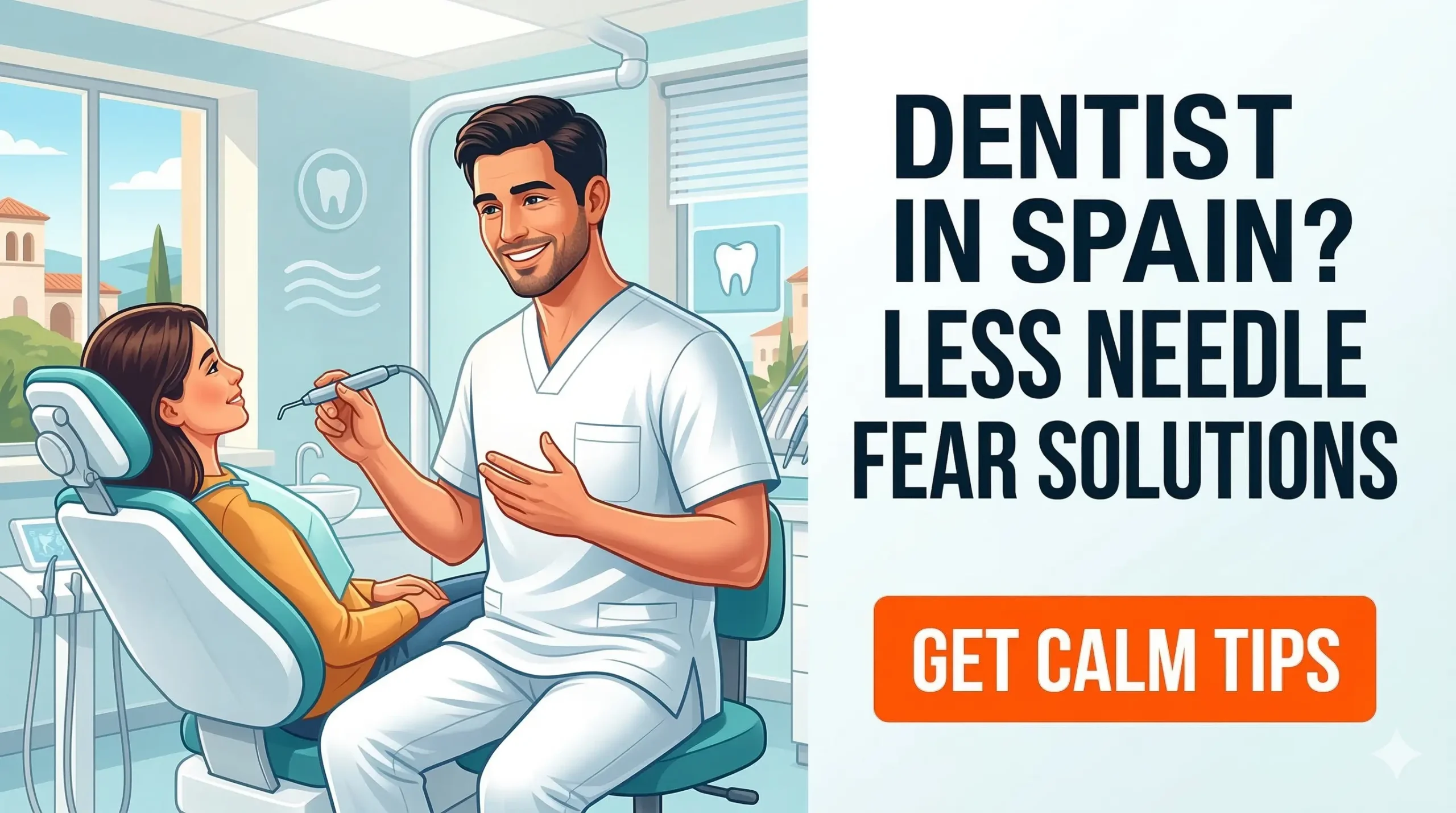
When it comes to the dreaded needle, local anesthesia (anestesia local) is universally used for fillings, root canals, and extractions. However, the use of a pre-injection numbing gel (anestesia tópica)—a staple in American and British pediatric and anxiety-focused dentistry—is not always the default standard of care for adults in Spain. Many older Spanish dentists simply go straight for the injection. If you have a severe needle phobia, the sudden, unannounced pinch can send you into a full-blown panic attack. You must learn to forcefully advocate for yourself before the chair even leans back.
How to Communicate Your Fear of Needles
The psychological toll of navigating a healthcare system in a second language cannot be understated. When you are terrified of needles, your brain is already in a “fight or flight” response. Trying to conjugate Spanish verbs while your heart is racing is a recipe for disaster.
Essential Spanish Vocabulary for Dental Anxiety
You cannot just sit in the chair and hope the dentist notices your white knuckles or heavy breathing. You must verbalize your fear the moment you walk into the consultation room. Do not be embarrassed; dentists see this every day. Telling them you have a phobia allows them to adjust their pace. Being able to clearly ask for numbing gel gives you the control back. Here are the critical phrases you need to memorize or print out before your appointment.
| English Phrase | Spanish Translation | Pronunciation Guide |
| I have a severe phobia of needles. | Tengo fobia a las agujas. | TEN-go FO-bee-ah ah las ah-GOO-has |
| Please, can you use numbing gel first? | Por favor, ¿puede usar gel anestésico primero? | Por fa-VOR, PWE-deh oo-SAR hel ah-nes-TEH-see-ko |
| I need a moment to breathe. | Necesito un momento para respirar. | Ne-seh-SEE-to oon mo-MEN-to pa-ra res-pee-RAR |
| Does this treatment hurt? | ¿Duele este tratamiento? | DWE-leh ES-teh tra-ta-MYEN-to |
| Please stop. | Pare, por favor. | PA-reh, por fa-VOR |
Finding an English-Speaking Dentist
Even with a vocabulary cheat sheet, trying to manage a panic attack in a second language is exhausting. If your fear of needles is paralyzing, your best strategy is to entirely remove the language barrier by finding a dentist who is fluent in English. In major expat hubs like Barcelona, Madrid, Valencia, and the Costa del Sol, there are hundreds of private clinics that cater specifically to the international community.
Finding these specialized, anxiety-friendly clinics is exactly why utilizing an expert, expat-focused broker like Innoinsure is a massive advantage. A dedicated, bilingual agent from Innoinsure can seamlessly set up a premium private dental policy (seguro dental) that grants you access to a curated network of top-tier, English-speaking dentists.
With a dental policy secured through Innoinsure, you do not have to blindly guess which local clinic on your street will be gentle. You simply open your provider’s app and filter for clinics that explicitly advertise English services and anxiety management protocols. To fully understand how these private dental networks operate and what is actually covered under a standard policy, read our thorough breakdown on How to Compare Private Health Plans: Deductibles, Co-Pays, Networks.
Sedation Dentistry Options in Spain
If numbing gel and a bilingual dentist are not enough to get you into the chair, you need to explore sedation dentistry. In Spain, this is officially known as sedación consciente (conscious sedation), and it has become increasingly popular in modernized clinics specifically designed to treat odontophobia.
Conscious Sedation and Laughing Gas
There are two main types of sedation available in Spain. The first is laughing gas (óxido nitroso). While extremely common in the United States, laughing gas is somewhat rare in standard, small-scale Spanish street clinics. You will usually only find it in larger, specialized dental centers or maxillofacial clinics.
The second, and much more common option for severe anxiety in Spain, is intravenous (IV) conscious sedation (sedación intravenosa). Under Spanish medical law, a dentist cannot simply administer IV sedation themselves. A licensed medical anesthesiologist (anestesiólogo) must be physically present in the room to monitor your vitals, heart rate, and oxygen levels throughout the entire procedure. You are placed into a deep state of relaxation—you will not care about the needle, and you will likely have zero memory of the procedure—but you are awake enough to follow basic commands.
Insurance Coverage for Sedation
Because IV sedation requires bringing a specialized medical doctor (the anesthesiologist) into the dental clinic for several hours, it is not cheap. Standard dental treatments like fillings or extractions might be highly affordable in Spain, but adding IV sedation will easily add €250 to €450 to your final out-of-pocket bill.
This is where your insurance strategy becomes critical. Basic private health insurance policies rarely cover the cost of elective dental sedation. However, specialized dental add-ons brokered through Innoinsure can sometimes offer heavily discounted rates for sedation services within their specific clinic network. By consulting with an agent, you can clarify exactly what your financial exposure will be before you book the anesthesiologist. To grasp the baseline of standard out-of-pocket medical costs in this country, see our detailed overview on Health Costs in Spain: Typical Co-Pays and Out-of-Pocket Fees.
Holistic Anxiety Management Before Your Appointment
Dental anxiety does not just happen in the chair; it ruins your sleep for days leading up to the appointment. Managing your nervous system beforehand is crucial to ensuring you actually show up to the clinic.
Natural Calming Aids and Supplements
If you walk into a local Spanish pharmacy (farmacia) asking for something to calm your nerves, the pharmacist will likely offer you Valerian root drops or mild herbal teas (tila). While helpful for mild stress, Spanish pharmacies frequently fall incredibly short when it comes to high-grade, bioavailable holistic supplements. If you are looking for potent L-theanine, high-absorbency magnesium glycinate to relax your jaw muscles, or specialized adaptogens, the local physical selections are severely limited and carry absolutely staggering retail markups.
To completely bypass this frustrating retail gap, the savvy international community in Spain relies heavily on iHerb. By ordering your pre-appointment anxiety supplements directly through iHerb, you gain access to the exact, trusted holistic brands you successfully used back home to manage your panic.
Having a dedicated calming stash delivered directly to your Spanish door via iHerb ensures you can start regulating your nervous system a week before the dentist appointment. You can proactively manage your cortisol levels with premium ashwagandha from iHerb, ensuring you are physically relaxed before you even sit in the waiting room. Navigating a foreign medical system is stressful enough; relying on iHerb to effortlessly restock your specific preventative wellness arsenal puts the control firmly back in your hands, saving you significant money on unsubsidized wellness products.
Post-Treatment Pharmacy Runs
Once the procedure is over and the sedation wears off, the true physical recovery begins. Your Spanish dentist will likely hand you a paper prescription for painkillers (usually Enantyum or standard Ibuprofen) and possibly an antibiotic. You must take this prescription to a local pharmacy.
Unlike back home, you cannot buy these heavy painkillers at a supermarket. You must go to the pharmacist. To understand exactly how to navigate this frontline triage and what the pharmacist can legally dispense if you are still in pain, check out Can a Pharmacist in Spain Help With Minor Illness? What to Expect. If you are entirely new to the country and haven’t even registered at your local clinic yet, read What Is a ‘Centro de Salud’ in Spain and How Do You Register? to understand your geographic pharmacy zones.
If you get home and realize the pain is worsening, or if you suspect an infection, returning to a Spanish dental clinic in the middle of the night is impossible. If you have an active policy, many modern premium plans feature robust 24/7 digital doctor access. You can consult an English-speaking general practitioner via your smartphone to assess the pain and get a new digital prescription. Discover how to safely leverage this incredible digital perk in Telemedicine in Spain: When It’s Useful and What to Expect. If the pain is accompanied by a severe fever or facial swelling outside of normal hours, you need to know how to navigate the public emergency room; read How to Find a 24-Hour Clinic in Spain (Urgencias) so you know exactly where to go. And if it is an absolute crisis where you cannot breathe due to an allergic reaction to the dental anesthesia, you must dispatch an ambulance immediately—review Spanish Emergency Phrases: How to Describe Symptoms Quickly to ensure you can communicate the crisis.
References
Primary sources (official)
- Consejo General de Dentistas de España: https://consejodentistas.es/
- Ministerio de Sanidad – Salud Bucodental: https://www.sanidad.gob.es/ciudadanos/proteccionSalud/saludBucodental/home.htm
Other helpful sources
- PubMed – Conscious sedation in Spanish dental schools: Current situation: https://pmc.ncbi.nlm.nih.gov/articles/PMC6704054/
Disclaimer
The information provided in this article is for educational and informational purposes only and does not constitute formal medical, dental, or psychological advice. The availability of conscious sedation, laughing gas, and English-speaking dental professionals varies significantly depending on the specific private clinic and autonomous community in Spain. Always consult directly with a licensed Spanish dentist or a medical anesthesiologist regarding your specific phobias, pain management options, and sedation eligibility before undergoing any dental procedure.