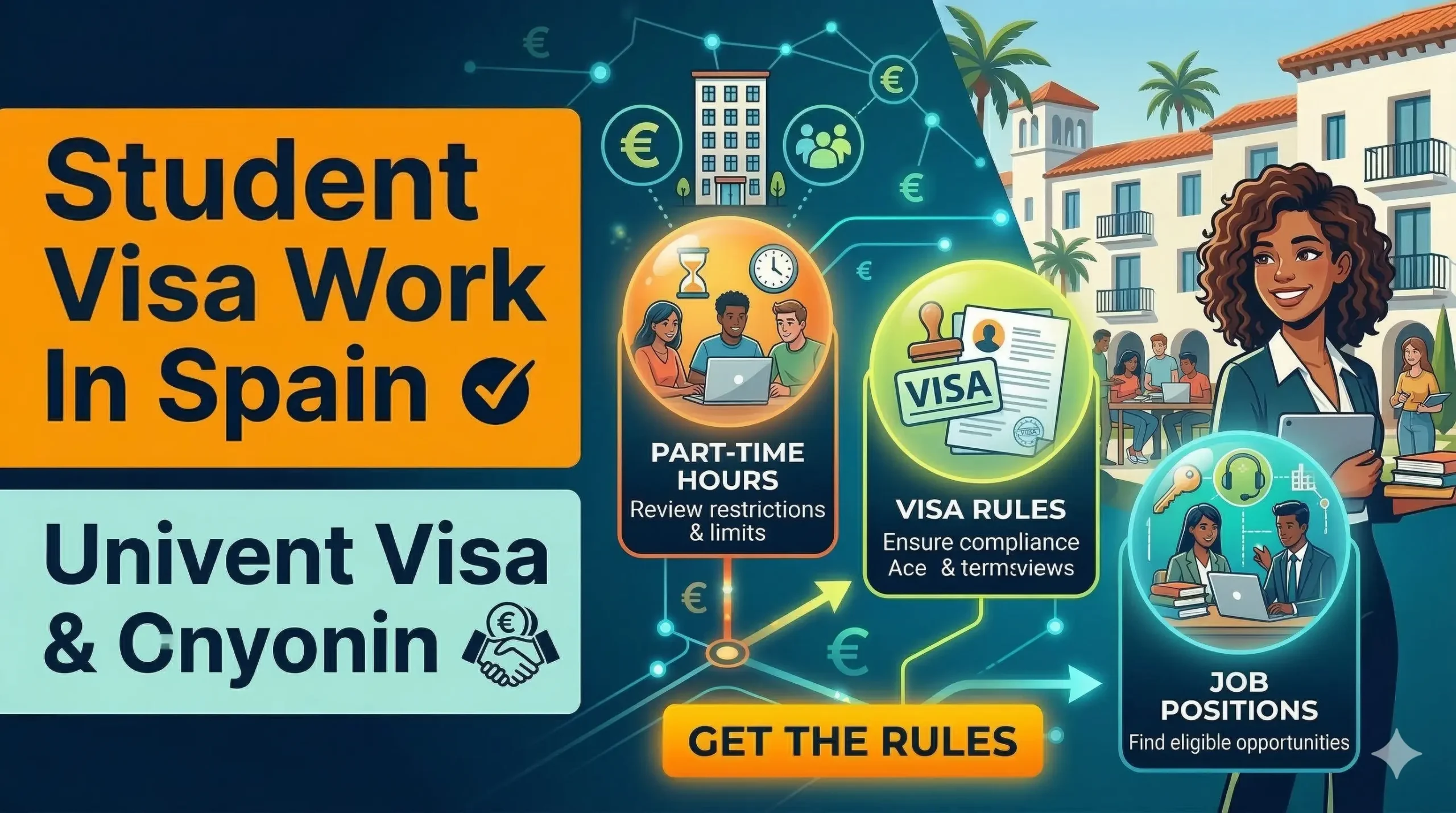
Working Part‑Time on a Spain Student Visa: Hours and Requirements
Watching your savings rapidly drain while studying in Spain is terrifying, especially when navigating notoriously complex immigration laws to earn some side income. I spent my entire first semester paralyzed by the fear of accidentally working illegally and losing my visa. This guide breaks down the exact hours, legal requirements, and administrative steps to safely work part-time on a Spanish student visa.
Disclosure: This post may contain affiliate links. We may earn a commission at no extra cost to you if you make a purchase through these links. Read full disclosure.
The New Legal Reality of Student Visas in Spain
For decades, international students in Spain operated under incredibly restrictive, almost punitive employment laws that made it nearly impossible to legally fund their studies. However, the Spanish government recently enacted massive, sweeping reforms to the immigration framework, fundamentally altering the economic reality for expats. Understanding these new legal boundaries is the absolute foundation of your job search.
The 30 Hour Work Limit Revolution
Historically, the Spanish student visa strictly capped international students at exactly twenty hours of work per week. This low ceiling forced many expats into extreme poverty or pushed them into the dangerous, illegal underground economy just to afford their rent. Recognizing this crisis, the Spanish government officially reformed the immigration law (Reglamento de Extranjería) to increase the legal working limit to 30 hours per week for student visa holders.
Many local Spanish employers are entirely unaware of the recent legal changes regarding foreign students, or worse, they will attempt to pressure you into working unrecorded overtime hours. You must clearly state your legal 30-hour limitation upfront and refuse any contract that attempts to push you past this legal threshold. To ensure your chosen academic path even qualifies for these updated working rights, you must review Spain Student Visa: What Study Programs Qualify?.
Automatic Right to Work vs Explicit Authorization
The most agonizing point of confusion for international students is the actual wording printed on their Foreigner Identity Card (TIE). Many students pick up their physical card at the police station only to discover the terrifying phrase “no autorizado a trabajar” (not authorized to work) stamped across the back. This does not mean you cannot work; it means your right to work requires manual activation.
The law splits students into two distinct categories. If you are enrolled in higher education—meaning a recognized bachelor’s degree, a master’s program, a PhD, or high-level vocational training (Formación Profesional)—you generally possess the automatic right to work up to 30 hours a week. Your TIE might explicitly state “autoriza a trabajar,” meaning you can sign an employment contract the exact same day you are hired without asking the government for permission.
Geographic and Schedule Restrictions
The Spanish government issues your student visa under the strict assumption that your primary, overriding purpose in the country is your education. Therefore, any employment you undertake must be completely supplementary and strictly compatible with your academic schedule. You cannot skip mandatory university lectures to pick up a morning shift at a cafe.
If your university classes run from 9:00 AM to 2:00 PM every weekday, your employment contract must explicitly reflect an afternoon, evening, or weekend schedule. If the immigration office or the Ministry of Labor cross-references your employment contract with your university timetable and discovers a direct temporal conflict, they will instantly flag your file, potentially jeopardizing your ability to renew your visa the following year.
Types of Work Allowed and What is Strictly Forbidden
When you begin handing out your CV in Spain, you must intimately understand the different legal structures of employment. Signing the wrong type of contract, or agreeing to work without one, can lead to immediate deportation.
Cuenta Ajena Standard Employment Contracts
The vast majority of international students will seek work por cuenta ajena, which translates to working as a standard employee for a company. Under this legal framework, the company assumes the heavy administrative burden of your employment. They are legally required to draft a formal contract, register you with the Spanish Social Security system, and withhold your income taxes.
Working por cuenta ajena provides you with immense legal protections. You are guaranteed the prorated equivalent of the Spanish Minimum Interprofessional Wage (SMI) based on your 30-hour schedule. You are legally entitled to paid vacation days, paid sick leave, and mandatory workplace accident insurance.
When you accept a job offer, the human resources department will demand to see your physical TIE card containing your NIE (Foreigner Identification Number) and your passport. If you possess the automatic right to work, they will finalize your contract immediately. If you do not, they must initiate the authorization process. To understand exactly how these standard employment contracts are structured and what clauses to look out for, you must read Spanish Salary Basics: Gross vs Net Pay and Common Deductions.
Cuenta Propia Freelancing on a Student Visa
A frequent question among highly skilled expats—such as graphic designers, freelance writers, or remote tech consultants—is whether they can work for themselves while on a student visa. Legally, the answer is yes; you can apply for authorization to work por cuenta propia (as a self-employed freelancer). Administratively, it is an absolute nightmare.
To freelance legally in Spain, you must register as an autónomo. The Spanish government views self-employment with intense scrutiny. To be approved for self-employment as a student, you must submit a comprehensive, localized business plan to a professional Spanish association (like UPTA or ATA) to prove your business is economically viable. You must also prove you have the liquid capital to invest in the business without relying on public funds.
If approved, you are suddenly thrust into the brutal Spanish freelance tax system. You will be legally obligated to pay a massive, fixed monthly Social Security quota regardless of how much profit you actually make, and you must file complex quarterly VAT (IVA) and income tax returns. Attempting to manage this administrative burden while studying full-time is incredibly difficult. Before you even consider this route, you must thoroughly decode the requirements in Autonomo Registration in Spain.
The Danger of Working Under the Table
Because navigating the legal employment framework is stressful, and because the 30-hour limit restricts earning potential, thousands of desperate international students fall into the trap of the black market. In Spain, working under the table for cash is colloquially known as cobrar en B (getting paid in “B money”).
You will undoubtedly find local bars, cafes, and nightclubs willing to pay you cash in hand to avoid paying their required corporate Social Security taxes. You must aggressively refuse these offers. Working under the table strips you of every single labor right you possess. If you burn your hand in a commercial kitchen, you have zero workplace accident insurance. If the boss decides not to pay you at the end of the month, you cannot go to the police without admitting you broke immigration law.
| Employment Type | Administrative Burden for Student | Legal Protections | Risk Level |
| Cuenta Ajena (Employee) | Low (Employer handles registration) | High (Minimum wage, sick leave) | Zero (If under 30 hours) |
| Cuenta Propia (Freelancer) | Extremely High (Business plan, quarterly taxes) | Medium (You manage your own risk) | Moderate (Administrative errors are heavily fined) |
| Prácticas (Internship) | Low (University handles the convenio) | Medium (Educational focus, stipend varies) | Zero (Explicitly sanctioned) |
| Cobrar en B (Under the table) | None | Absolute Zero | Critical (Deportation risk) |
Navigating Taxes and Payroll as a Student
Getting hired is only the first step. To actually get paid, you must integrate yourself into the formidable Spanish tax and social security infrastructure. This system is entirely unforgiving of administrative ignorance.
Securing Your Social Security Number
Before you can legally work a single hour in Spain, you must possess a Número de Seguridad Social (NSS). Your NIE (the identification number on your student visa) is not a Social Security number. They are two entirely distinct databases.
To acquire this number, you must complete the official Form TA.1 and submit it to the Tesorería General de la Seguridad Social (TGSS). Historically, this required an agonizing physical appointment, but it can now frequently be executed online if you possess a valid Spanish Digital Certificate or Cl@ve. Once you have this unique number, it remains yours for the rest of your life in Spain.
You must hand this Social Security number to your employer’s HR department before your first day of work. They use this number to formally register your employment (dar de alta) in the Social Security system. If you begin working before this official registration is processed, you are technically working illegally, even if you have signed a paper contract.
Understanding Your Payslip and Net Pay
When you receive your first Spanish payslip (nómina) at the end of the month, the final number deposited into your checking account will be significantly lower than the hourly rate you were promised during your interview.
Even as a part-time student worker, you are subject to the heavy deductions that fund the Spanish welfare state. Your employer will automatically deduct your portion of Social Security contributions (typically around 6.5% of your gross pay) to cover public healthcare, unemployment, and professional training.
Furthermore, your employer is legally required to withhold a percentage of your salary for the Impuesto sobre la Renta de las Personas Físicas (IRPF), which is your personal income tax. Because part-time students generally earn very little over the course of the fiscal year, this withholding rate is usually set to a bare minimum of 2%. However, you must actively ensure your employer is applying the correct bracket so you do not face a sudden tax bill in the spring. To deeply understand how these deductions impact your overarching financial strategy, review Spanish Taxes: Guide for Expats.
Managing International Finances Effectively
If your 30 hours of part-time work simply is not enough to cover the exorbitant rent in a city like Madrid or Barcelona, you will likely need to pull survival funds from your home country savings. Alternatively, if your part-time Spanish job pays well, you might need to send euros back to the United States or the UK to service lingering student loans.
Moving this capital through traditional legacy banks will decimate your fragile student budget. Legacy banks hide massive, punitive profit margins in terrible currency exchange rates and charge exorbitant SWIFT wiring fees simply to push the money across borders. To fiercely protect your part-time wages and your survival savings, veteran expats universally use dedicated transfer specialists like Wise.
By routing your international transfers through Wise, you secure the transparent mid-market exchange rate, bypassing the legacy banking spreads entirely. This ensures that every single euro you earn from your part-time job actually stays in your pocket rather than lining the accounts of corporate bank managers. For a comprehensive look at how to set up your localized banking infrastructure to seamlessly receive your part-time payroll without branch friction, carefully read Student Finances in Spain: Bank Accounts and Budgeting Tips.
Finding Part-Time Work as an Expat Student
The legal right to work is useless if nobody is willing to hire you. The Spanish job market is notoriously difficult, suffering from high youth unemployment. As an international student, you must strategically target specific sectors that desperately need your unique foreign skill set.
Overcoming the Language Barrier in the Job Market
The most brutal reality of the Spanish part-time job market is that the vast majority of local retail, hospitality, and administrative jobs require absolute, flawless fluency in Spanish. If you walk into a Zara clothing store or a traditional Spanish tapas bar looking for a 30-hour-a-week job, and you cannot rapidly decode a local customer’s heavy accent, the manager will throw your CV directly into the trash.
You cannot rely on English to survive in the domestic Spanish job market. You must rapidly and aggressively accelerate your professional and conversational Spanish vocabulary. Passive learning on gamified apps is entirely insufficient for the workplace. Utilizing SpanishPod101 during your daily commute is an incredibly effective strategy to build the precise, street-level vocabulary required to survive a Spanish job interview.
By engaging with the structured audio modules on SpanishPod101, you train your ear to comprehend the rapid, colloquial Spanish spoken by local managers and customers, completely removing the panic of the language barrier. For a broader look at linguistic survival in a professional environment, review Learning Spanish for Work and Study: Fast‑Track Strategy.
Target Industries for International Students
Because domestic Spanish jobs are highly competitive, your most lucrative strategy is to leverage your native language and your international background. You must target industries where being a foreigner is an absolute requirement, not a liability.
The most traditional and reliable part-time work for English, German, or French native speakers is in the private language academy sector. Spain has an insatiable demand for native-speaker language tutors. While many academies exploit workers, reputable schools are frequently desperate for native speakers to lead evening conversation classes or prepare Spanish teenagers for their Cambridge exams.
Beyond teaching, the booming tourism sectors in coastal cities, the Balearic Islands, and major hubs like Barcelona offer immense opportunities. High-end hotels, international tour companies, and boutique travel agencies actively seek multilingual students to manage front desks and lead specialized tours. To master the localized networking required to penetrate these specific industries, you must implement the strategies outlined in Finding a Job in Spain: CV, Interviews, and Networking.
Paid Internships Prácticas Extracurriculares
If your ultimate goal is to build your resume rather than simply paying your rent, you should aggressively pursue paid internships (prácticas). In Spain, internships operate under a completely different legal framework than standard employment contracts, offering a massive bureaucratic advantage to student visa holders.
Internships are executed through an official Convenio de Prácticas (Internship Agreement). This is a three-way, legally binding contract signed by you, the hiring company, and your Spanish university. Because the university officially sanctions the internship as an educational pursuit, the bureaucratic friction of work authorization is completely bypassed.
Transitioning from a Student Visa to a Work Permit
The ultimate goal for many international students working a 30-hour part-time job is to eventually transition into a full-time, indefinite corporate contract and secure standard Spanish residency. The government has drastically simplified this pipeline.
The Post Study Job Search Visa
Historically, international students were forced into a terrifying race against the clock to find a corporate sponsor before their student visa expired in July. If they failed, they had to leave the country. Recognizing that they were losing highly educated talent, Spain introduced the Visado para la Búsqueda de Empleo (Job Search Visa).
If you successfully graduate from a recognized higher education institution in Spain (a bachelor’s, master’s, or PhD), you can legally apply to extend your residency for a full 12 months specifically to look for highly skilled employment or to launch your own business.
During this 12-month bridge period, you are legally permitted to remain in the country without being enrolled in classes. It completely removes the panic of the impending graduation deadline, allowing you to interview with major Spanish firms without the stigma of an expiring visa.
Modifying to a Regular Work Permit
When you finally land that coveted full-time job offer during your job search year, or even during your studies, you must execute a modification of your residency status (Modificación de Estancia por Estudios a Residencia y Trabajo).
Previously, students had to wait three agonizing years before they could legally modify their student status into a standard work permit. The recent immigration reforms obliterated this rule. You can now modify your student visa into a full work permit the exact moment you successfully graduate, provided the job offer meets the minimum wage requirements and the role aligns with your level of education.
Executing this modification fundamentally shifts your life in Spain. You cease being a temporary student and become a formal, tax-paying resident of the state. The time you spend on a full work permit begins counting towards your eventual permanent residency and Spanish citizenship. To ensure your university degree actually qualifies for this seamless transition into the corporate workforce, you must meticulously verify its institutional standing by reviewing Professional Qualifications in Spain: Recognizing Foreign Degrees.
Furthermore, once you transition to a full corporate payroll, your financial infrastructure must flawlessly handle the localized taxation, utility setups, and long-term rental agreements that define adult expat life. If you still possess home-country financial obligations, continuing to utilize Wise to manage your cross-border wealth ensures your new, higher corporate salary is not slowly siphoned away by legacy bank conversion fees. By understanding these legal boundaries and respecting the 30-hour limit, your part-time student job serves as the perfect springboard into a permanent, highly successful Spanish career. To navigate the unspoken rules of your new corporate office, prepare yourself by reading Spanish Work Culture: Hours, Holidays, and Workplace Etiquette.
References
Primary sources (official)
- Boletín Oficial del Estado (BOE) – Reforma del Reglamento de Extranjería 2022: https://www.boe.es/diario_boe/txt.php?id=BOE-A-2022-12504
- Ministerio de Inclusión, Seguridad Social y Migraciones – Estancia por estudios: https://www.inclusion.gob.es/web/migraciones/w/estancia-por-estudios
- Tesorería General de la Seguridad Social – Altas, bajas y variaciones de datos de trabajadores: https://www.seg-social.es/wps/portal/wss/internet/Trabajadores/Afiliacion/10817/31190
Other helpful sources
- Expatica – Working in Spain as a student: https://www.expatica.com/es/working/employment-basics/working-in-spain-as-a-student-104533/
- The Local Spain – What are the rules for working on a student visa in Spain?: https://www.thelocal.es/20220901/what-are-the-rules-for-working-on-a-student-visa-in-spain
Disclaimer
The information provided in this article is for educational and informational purposes only and does not constitute formal legal, financial, or immigration advice. Spanish immigration regulations, including the exact application of the 30-hour work limit, the specific conditions required for a Convenio de Prácticas, and the exact procedures for modifying a student visa into a standard residency permit, are highly complex and subject to frequent legislative updates by the Ministerio de Inclusión, Seguridad Social y Migraciones. Always verify the exact work authorization explicitly printed on your Foreigner Identity Card (TIE) and consult directly with a certified immigration lawyer (abogado de extranjería) or a registered labor advisor (graduado social) before signing any legally binding employment contracts.