Professional Qualifications in Spain: Recognizing Foreign Degrees
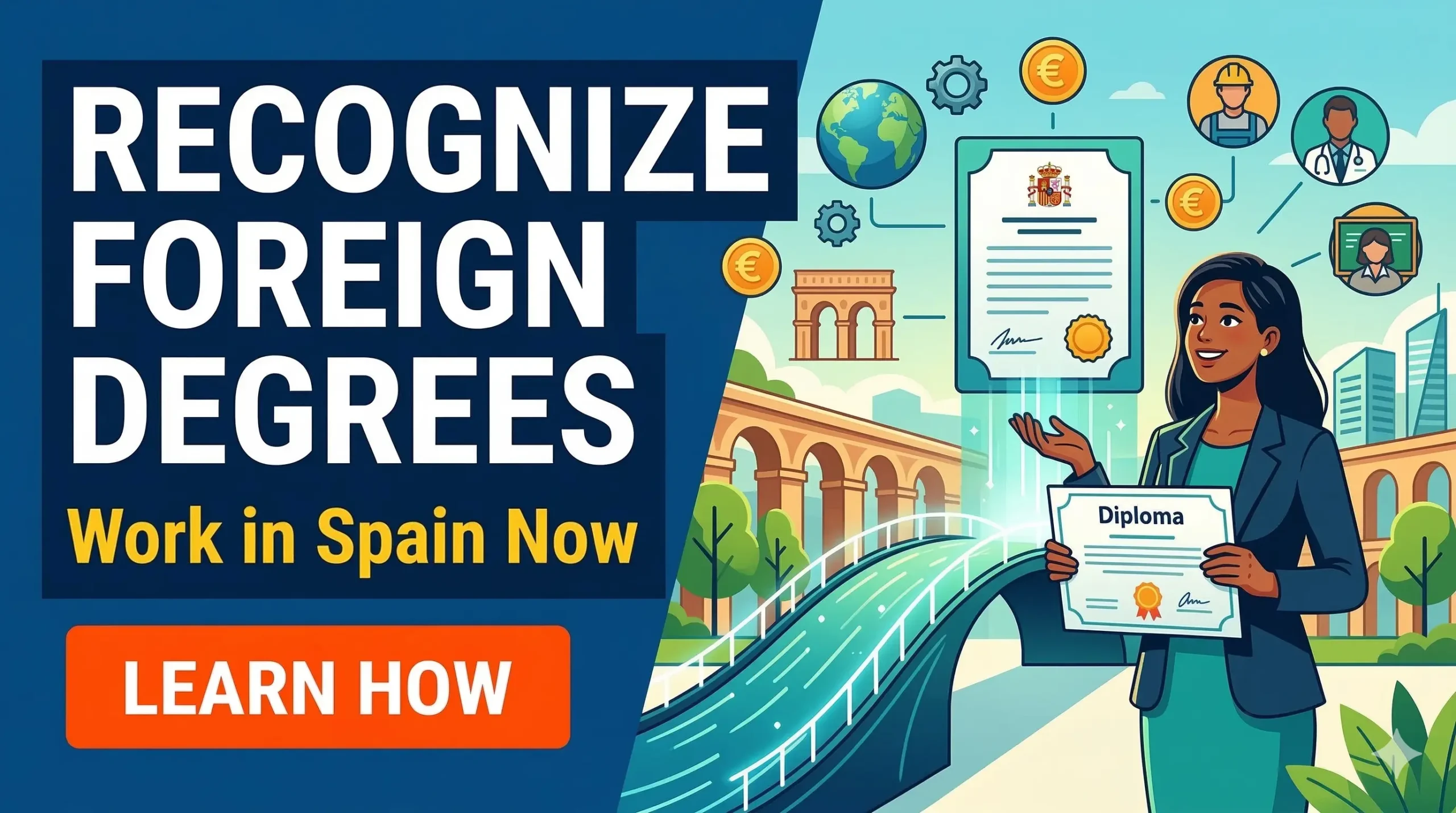
I spent eighteen agonizing months waiting for the Spanish Ministry of Universities to validate my foreign engineering degree, effectively freezing my career while I watched local graduates take jobs I was overqualified for. Navigating the archaic system of degree recognition in Spain is a true test of expat endurance. This comprehensive guide decodes the exact paperwork, timelines, and bureaucratic pathways required to get your professional qualifications legally recognized.
Disclosure: This post may contain affiliate links. We may earn a commission at no extra cost to you if you make a purchase through these links. Read full disclosure.
The Brutal Reality of Spanish Degree Recognition
When you step off the plane in Madrid or Barcelona with a beautifully framed master’s degree from a prestigious foreign university, you quickly realize that the Spanish administrative state does not care about your alma mater’s global ranking. Until the Spanish government stamps a piece of paper verifying your education, your degree is legally invisible.
Why Your Foreign Degree Means Nothing Initially
The Spanish labor market operates on a deeply entrenched system of formal certifications and localized bureaucratic validation. In many Anglo-Saxon countries, a hiring manager simply looks at your resume, conducts an interview, and trusts your stated educational background. In Spain, corporate human resources departments and public institutions are bound by rigid legal frameworks that frequently require official proof that your foreign education mathematically equals a Spanish degree.
This friction is not just administrative; it is deeply cultural. Spanish recruiters are highly risk-averse. If they are choosing between a local candidate with a standard Spanish Grado (Bachelor’s) and an expat with a foreign degree that has not been officially recognized by the Ministry of Universities, they will almost universally choose the local candidate simply to avoid internal compliance headaches.
To overcome this inherent bias, you must understand exactly how to present your unverified qualifications while simultaneously fighting the government bureaucracy behind the scenes. This is exactly why mastering your pitch and localizing your resume is critical, a process we outline extensively in Finding a Job in Spain: CV, Interviews, and Networking. You cannot simply wait for the government; you must hustle while the paperwork slowly grinds through the system.
Regulated Versus Unregulated Professions
The very first step in your journey is determining whether your specific career is classified as a regulated profession (profesión regulada) or an unregulated profession. This single distinction dictates exactly which bureaucratic nightmare you are about to enter and how long it will ultimately take.
Regulated professions are careers that directly impact public health, safety, or fundamental rights. This explicitly includes doctors, nurses, architects, lawyers, civil engineers, psychologists, and public school teachers. If you operate in one of these fields, it is completely illegal for you to practice your profession in Spain without securing a full, rigorous validation of your degree. You cannot simply hang a shingle and start treating patients or signing architectural blueprints.
Unregulated professions, conversely, encompass the vast majority of the modern corporate world. If you are a digital marketer, a software developer, a business consultant, a graphic designer, or a sales executive, your profession is not legally regulated by the state. You are not legally required to validate your degree to sign an employment contract. However, many traditional Spanish corporations will still stubbornly request some form of official equivalence just to satisfy their internal HR checklists.
The Time and Emotional Cost of the Process
Validating a foreign degree in Spain is not a weekend project; it is an endurance marathon that routinely breaks the spirit of perfectly qualified professionals. You must mentally and financially prepare for a process that can easily stretch from six months to over two years, depending on your specific country of origin and the complexity of your university transcripts.
During this agonizing waiting period, you will likely suffer severe professional stagnation. Many highly qualified doctors and engineers are forced to take entry-level hospitality or administrative roles simply to pay rent while they wait for the Ministry of Universities to review their dossier. The psychological toll of working a job drastically beneath your skill level while navigating an opaque bureaucracy is the single hardest part of the expat transition.
You must build a massive financial runway to survive this transitional period. Relying purely on local Spanish entry-level wages while paying exorbitant application fees and sworn translation costs will drain your savings rapidly. Structuring your relocation budget to survive a two-year career freeze is absolutely essential, a strategy we detail completely in Cost of Living in Spain: Budgeting for Expats.
Deciphering the Three Pathways Homologacion Equivalencia and Convalidacion
Spain does not offer a single, unified “degree translation” button. The Ministry of Universities divides the recognition process into three highly distinct legal pathways. Choosing the wrong pathway will result in your application being rejected a year later, forcing you to start over.
Homologacion for Regulated Professions
Homologación is the most rigorous, exhausting, and legally binding process available. This pathway is exclusively reserved for individuals seeking to practice a regulated profession in Spain. When you apply for homologación, you are asking the Spanish government to declare that your foreign degree is completely equal to a specific, highly regulated Spanish university degree that grants access to a specific professional license.
Because the stakes are so high for public safety, the Ministry scrutinizes your university syllabus (plan de estudios) with surgical precision. They will compare the exact hours you spent studying specific subjects against the mandatory hours required in Spanish universities. If your medical degree from Colombia or your engineering degree from the United States lacks a specific module required by Spanish law, your homologación will be conditionally approved pending medidas compensatorias (compensatory measures), which forces you to pass additional exams at a Spanish university before receiving your final license.
Equivalencia for General Academic Recognition
If you hold a degree in an unregulated field—such as Business Administration, Marketing, Computer Science, or Fine Arts—you must apply for Equivalencia (Equivalence). This process is slightly less excruciating than homologación because the government is not granting you a professional license; they are merely validating your academic level.
When you secure an equivalencia, the Ministry issues a certificate stating that your foreign education mathematically equals a Spanish Grado (Bachelor’s) or Máster (Master’s) within a specific branch of knowledge, such as “Social Sciences” or “Engineering and Architecture.” It validates that you possess a legitimate university-level education.
This certificate is incredibly valuable if you intend to apply for competitive public sector jobs (oposiciones), where possessing a verified university degree is a rigid prerequisite to even sit for the civil service exam. It is also highly useful for silencing stubborn traditional HR departments that demand proof of your education before finalizing your corporate contract.
Convalidacion for Partial University Credit
The third pathway, Convalidación, is specifically designed for expats who did not actually finish their degree in their home country, or who wish to transfer their foreign academic credits to a Spanish university to complete their education locally.
Unlike the other two pathways, convalidación is not handled by the federal Ministry of Universities in Madrid. It is handled entirely by the specific Spanish university where you intend to enroll. You must take your foreign transcripts directly to the admissions office of your chosen Spanish institution, and the dean of the specific faculty will arbitrarily decide which of your foreign credits they are willing to accept.
This process is highly subjective. One university in Valencia might accept sixty of your credits, while a university in Madrid might only accept thirty. If you are attempting this route, you must aggressively negotiate with the university administration. Navigating the localized bureaucracy of Spanish student life requires immense patience and financial planning, which you can decode by reviewing Student Finances in Spain: Bank Accounts and Budgeting Tips.
| Recognition Pathway | Target Audience | Evaluating Body | Typical Processing Time |
| Homologación | Regulated professions (Doctors, Lawyers, Architects) | Ministry of Universities | 12 to 36 months |
| Equivalencia | Unregulated professions (Business, Tech, Arts) | Ministry of Universities | 6 to 24 months |
| Convalidación | Students transferring partial credits | Individual Spanish Universities | 1 to 3 months |
The Administrative Nightmare Preparing Your Documents
The Spanish administrative state operates on an absolute obsession with authenticated, physically verified paperwork. You cannot simply upload a PDF of your diploma and expect a result. Gathering the required documentation is a global logistical puzzle.
The Apostille of The Hague Requirement
Your original, beautiful university diploma is legally worthless to the Spanish government unless it bears the Apostille of The Hague (La Apostilla de La Haya). The Apostille is an international certification that verifies the absolute authenticity of the signature on your academic documents, proving to Spain that your degree is not a forgery.
You cannot get an Apostille in Spain. It must be issued by the competent governmental authority in the exact country where the degree was issued. If you studied in the United States, you must send your notarized transcripts and diploma to the specific Secretary of State in the state where your university is located. If you studied in the UK, you must route it through the Foreign, Commonwealth & Development Office (FCDO).
You must strictly follow the chronological order of authentication. You must obtain the Apostille on the original documents before you do absolutely anything else. If you translate your documents first and then get them apostilled, the Spanish Ministry will reject the dossier because the Apostille itself has not been translated.
Navigating Sworn Translators Traductores Jurados
Once your original diploma, full academic transcripts, and detailed university syllabus are properly apostilled, they must be translated into formal Spanish. You cannot translate these documents yourself, and you cannot use a standard, cheap online translation agency.
The Ministry of Universities strictly mandates that all foreign language documents must be translated by a Traductor Jurado (Sworn Translator) who is officially licensed and registered with the Spanish Ministry of Foreign Affairs (MAEC). These translators possess a specific, legally binding stamp and signature that validates the accuracy of the translation under penalty of perjury.
Sworn translations are incredibly expensive. Because university syllabuses can run into dozens or hundreds of pages detailing every single module you studied, a full translation dossier can easily cost between 300 and 800 euros. To manage these massive, unexpected administrative costs without losing money to terrible bank exchange rates, veteran expats utilize Wise. By moving your home savings to Spain through Wise, you secure the transparent mid-market rate, saving you immense capital when paying your sworn translators.
Securing Certified Copies Compulsas
You must never, under any circumstances, send your original, one-of-a-kind university diploma or original Apostille in the mail to the Spanish government. If they lose it—which happens—it is gone forever.
The Spanish system requires you to submit copias compulsadas (certified true copies) of your original documents. A compulsa is a physical stamp placed on a photocopy by a Spanish civil servant or a licensed Notary Public, legally verifying that they have seen the original document with their own eyes and that the photocopy is an exact match.
Historically, you had to physically visit a Spanish embassy or a government registry office to secure these certified copies. Today, the system has largely digitized, allowing you to scan the original documents during your in-person verification appointment at a public registry, which then electronically attaches the certified copies directly to your digital file.
The Digital Submission Process and Government Portals
The era of mailing massive, heavy binders of paper to Madrid is slowly ending. The Ministry of Universities now strongly enforces digital submissions through their centralized electronic headquarters (Sede Electrónica). However, accessing this portal requires navigating another layer of Spanish digital bureaucracy.
Securing Your Digital Certificate or Clave
To even log into the Ministry of Universities’ portal and initiate your application, you must possess a highly secure digital identity recognized by the federal government. A basic username and password are not sufficient.
You must authenticate your identity using the federal Cl@ve system or a physical Digital Certificate (Certificado Digital) installed directly onto your computer’s web browser. For a foreigner, securing this digital identity is practically impossible from abroad, as it requires a physical visit to a Spanish registry office with your passport and Foreigner Identification Number (NIE).
If you are already in Spain, securing this digital identity must be your absolute highest priority. Without it, you cannot apply for degree recognition, you cannot file taxes, and you cannot access the public healthcare portal. To completely bypass the massive confusion of setting up this mandatory infrastructure, you must strictly follow the technical setup steps detailed in Cl@ve and Digital Certificate: Accessing AEAT (Tax Agency) Online.
Uploading Your Dossier to the Sede Electronica
Once you successfully log into the Sede Electrónica, you will navigate to the specific section for either Homologación or Equivalencia. The portal is notoriously clunky, frequently timing out or rejecting files that are too large.
You must meticulously scan your sworn translations and your apostilled originals in high-definition PDF format, ensuring the file sizes are compressed sufficiently to meet the portal’s strict limitations. The system will guide you through a series of forms where you must input your personal data, your university details, and the specific Spanish degree you are attempting to equate your education to.
When you successfully hit submit, the portal will generate a digital receipt known as a resguardo. You must save this PDF immediately. This resguardo features a unique tracking code and serves as your absolute legal proof that the government has received your application.
Paying the Tasas Government Fees
Submitting the application is not free. You must pay a mandatory administrative tax known as a tasa to the Spanish government. For degree recognition, this is typically done by generating a specific tax form known as the Modelo 790 (Code 107).
The fee is generally around 160 to 170 euros, though it fluctuates slightly year by year. Historically, you had to print this form and physically take it to a Spanish bank branch to pay it in cash. Today, the digital portal allows you to pay the fee via a secure payment gateway using a Spanish debit or credit card.
If you do not yet have a local Spanish bank account, the payment gateway will likely reject your foreign US or UK credit card. To gracefully bypass this systemic friction, modern expats open a localized digital account with N26. By utilizing an N26 account, you instantly receive a recognized Spanish IBAN directly from your smartphone, allowing you to seamlessly pay the government tasas without fighting with local branch tellers. For a comprehensive look at setting up this vital local infrastructure safely, read Opening a Bank Account in Spain as a Non-Resident.
Surviving the Wait Times and Tracking Your Application
Pressing submit on the portal is merely the end of the beginning. You are now entering the darkest phase of the recognition process: the waiting game. The Ministry is notorious for its severe lack of communication.
The Silence of the Ministry of Universities
In late 2022, the Spanish government passed Royal Decree 889/2022, boldly promising to modernize the homologación process and strictly limit the maximum processing time to exactly six months. In reality, the massive, historical backlog of applications means this six-month deadline is routinely and aggressively ignored.
For the first several months, you will hear absolutely nothing. If you log into your Sede Electrónica tracking dashboard, your status will likely sit statically at Pendiente (Pending) or En trámite (In processing). Do not panic. This silence is entirely normal. Calling the Ministry hotline is generally useless, as the operators can only see the exact same generic status that you see on your dashboard.
Responding to Requerimientos Requests for More Info
If the evaluators reviewing your university syllabus discover a discrepancy, or if a scan of your apostille is illegible, they will not simply reject your application. They will issue a formal Requerimiento (Request for Requirement).
This notification will drop into your digital inbox, and it halts the ticking clock on your application. You are typically given a highly strict deadline—usually 10 to 15 working days—to acquire and upload the missing documentation. If you fail to respond to the requerimiento within the legal window, the government will legally assume you have abandoned the process, and they will permanently archive your file. You must actively check your digital inbox every single week while your application is pending.
What to Do If Your Application is Rejected
Eventually, the Ministry will issue a formal resolution (resolución). If you applied for equivalencia, you will generally either be fully approved or denied outright. If you applied for homologación, you might receive a conditional approval (resolución condicionada).
A conditional approval means your foreign degree is almost equal to the Spanish equivalent, but it lacks specific vital modules. The government will mandate medidas compensatorias, requiring you to pass a specific set of aptitude tests or complete an internship at a Spanish university to bridge the gap. You have a set number of years to complete these requirements before the conditional approval expires.
If your application is rejected entirely, you have the legal right to file an administrative appeal (recurso de alzada) within one month of the notification. If you reach this stage, you must hire a specialized Spanish administrative lawyer. Fighting the Ministry on your own during an appeal is a guaranteed failure.
Language Requirements and Cultural Integration
If you are fighting for the homologación of a regulated profession, your technical university knowledge is only half the battle. You must explicitly prove to the Spanish state that you can communicate flawlessly with local citizens.
Proving Spanish Fluency for Regulated Roles
For highly sensitive roles—such as medicine, psychology, or nursing—the Spanish government strictly mandates that you must hold a verified, official B2 or C1 level of Spanish proficiency according to the Common European Framework of Reference (CEFR).
You cannot simply claim you speak Spanish well. You must attach an official diploma from the Instituto Cervantes—either the DELE or the SIELE certification—directly to your homologación dossier. If you do not include this language certification, your application will be instantly paused.
Achieving a C1 level in clinical or legal Spanish is monumentally difficult. You cannot achieve this by mindlessly playing gamified language apps. You need rigorous, structured, and advanced academic training. Veteran expats heavily rely on SpanishPod101 to bridge this massive linguistic gap. By utilizing the advanced, highly structured audio modules and grammar breakdowns on SpanishPod101, you can aggressively train your ear to comprehend the complex, high-speed professional Spanish required to pass the DELE exam and satisfy the Ministry’s strict requirements.
Professional Vocabulary Beyond the Basics
Even if your profession is unregulated and does not legally require a language certificate, attempting to integrate into the Spanish corporate world without high-level fluency is career suicide.
If your marketing degree is officially granted equivalencia, but you cannot rapidly debate a project scope in a meeting with a Spanish director, the recognized degree is functionally useless. You must aggressively expand your industry-specific vocabulary. Spending twenty minutes a day on SpanishPod101 studying targeted business and corporate modules ensures you do not freeze during high-stakes interviews.
Networking While Your Degree is Pending
Do not sit in your apartment for eighteen months waiting for the Ministry of Universities to approve your degree. The Spanish job market is heavily reliant on personal relationships and the cultural concept of el enchufe (the personal connection).
You must aggressively attend local industry meetups, trade fairs, and expat networking events while your paperwork is pending. When you meet a local hiring manager, you can confidently state, “My equivalencia is currently en trámite under the new digital system, but my skills are ready to deploy immediately.” Building deep personal trust often compels Spanish companies to hire you in a slightly different, unregulated consultant capacity while the formal bureaucracy resolves itself.
Financial and Career Survival During the Transition
Surviving the multi-year degree recognition process requires a massive pivot in your immediate career strategy. You must find alternative ways to generate localized income while maintaining your legal residency.
Working in Unregulated Roles Temporarily
If you are a licensed dentist from Argentina waiting for your homologación, you obviously cannot treat patients in Madrid. However, your vast technical knowledge is still highly valuable.
Many highly skilled expats survive the waiting period by pivoting their careers into adjacent, unregulated sectors. Medical professionals often find lucrative temporary roles in healthcare administration, medical translation, or clinical sales representation. Engineers frequently pivot into un-credentialed software development, technical writing, or project management.
To execute this pivot, many expats choose to bypass the rigid corporate hiring structures and register as independent freelancers to consult for international clients. This allows you to generate income entirely legally while bypassing the Spanish HR departments that demand official degrees. To navigate this highly complex secondary bureaucratic web, you must master the rules outlined in The Autonomo System in Spain: How to Register as a Freelancer.
Managing Cross Border Finances Safely
If you cannot find immediate alternative employment in Spain, you will likely be surviving by drawing down the savings you accumulated in your home country.
If you are constantly wiring money from your US or UK bank account to your Spanish checking account to pay your rent and groceries, legacy banking fees will silently destroy your financial runway. To protect your survival fund during this vulnerable transitional period, you must execute all your cross-border capital movements via Wise. By routing your savings through Wise, you secure the transparent mid-market exchange rate, completely eliminating the hidden banking spreads that traditional banks use to extract your wealth. To fully grasp how these invisible fees drain your budget over a two-year waiting period, review Sending Money to/from Spain: Comparing Banks vs Transfer Services.
Transitioning to the Spanish Payroll System
The day your homologación or equivalencia is finally approved is a massive victory. You can finally step into the specific career you trained for. However, stepping into the Spanish corporate system introduces an entirely new set of financial realities.
When you secure that coveted Spanish employment contract, you must intimately understand that the massive gross salary number the recruiter offers you is an illusion. The Spanish state heavily subsidizes its infrastructure through aggressive progressive income taxes and massive Social Security deductions. To ensure you understand exactly how much money will actually hit your checking account each month, and to negotiate your new contract fairly, you must read Spanish Salary Basics: Gross vs Net Pay and Common Deductions.
References
Primary sources (official)
- Ministerio de Universidades – Homologación de títulos extranjeros: https://www.universidades.gob.es/homologacion-de-titulos-extranjeros-de-educacion-superior-a-titulos-oficiales-universitarios-espanoles-de-grado-o-master-que-den-acceso-a-profesion-regulada-en-espana/
- Ministerio de Universidades – Equivalencia de títulos extranjeros: https://www.universidades.gob.es/equivalencia-de-titulo-extranjero-de-educacion-superior-a-titulacion-y-a-nivel-academico-de-grado-o-master-universitarios-oficiales-en-ramas-de-conocimiento-y-campos-especificos/
- Ministerio de Asuntos Exteriores (MAEC) – Listado de Traductores Jurados: https://www.exteriores.gob.es/es/ServiciosAlCiudadano/Paginas/Traductores-Jurados.aspx
Other helpful sources
- Expatica – Getting your foreign qualifications recognized in Spain: https://www.expatica.com/es/working/employment-basics/recognizing-foreign-qualifications-in-spain-104543/
- The Local Spain – How to get your foreign degree recognized in Spain (Homologación): https://www.thelocal.es/20221019/how-to-get-your-foreign-degree-recognised-in-spain
Disclaimer
The information provided in this article is for educational and informational purposes only and does not constitute formal legal, educational, or immigration advice. The Spanish bureaucratic processes regarding Homologación, Equivalencia, and Convalidación are highly complex and subject to frequent legislative updates by the Ministerio de Universidades, including the ongoing implementation of Royal Decree 889/2022. The exact requirements for the Apostille of The Hague and Sworn Translations depend heavily on your country of origin and specific bilateral treaties. Always consult directly with the Spanish Ministry of Education, the Ministry of Universities, or a certified immigration lawyer (abogado de extranjería) regarding the validation of your specific international credentials before relying on them for employment or visa applications.