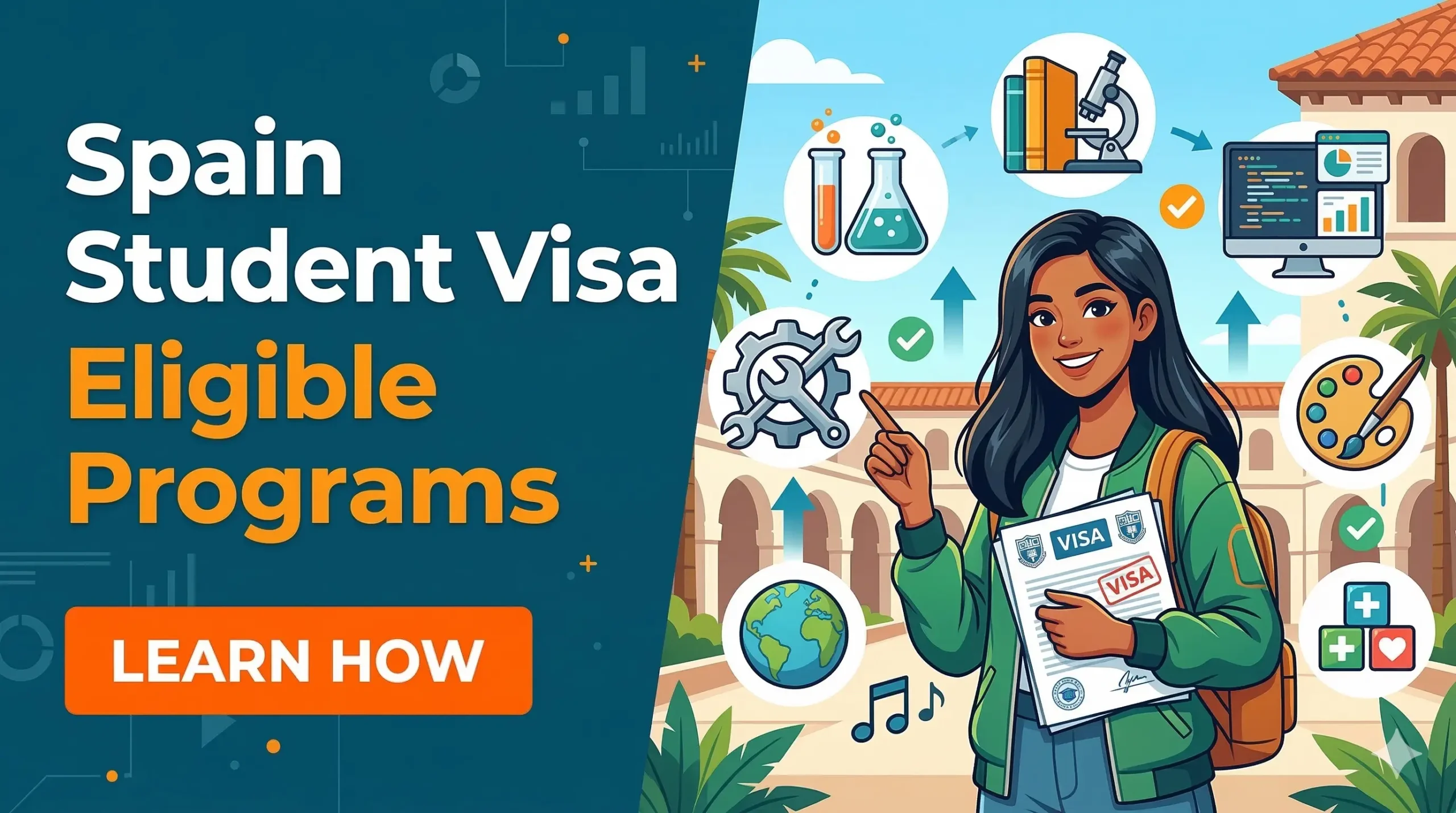
Spain Student Visa: What Study Programs Qualify?
Paying four thousand euros upfront for an immersive language course, only to have the Spanish consulate ruthlessly reject your visa because the academy wasn’t officially accredited, is a uniquely devastating heartbreak. I once lost my entire summer scrambling to re-enroll in a different school after facing this exact bureaucratic nightmare. This guide reveals exactly which study programs actually qualify for a Spanish student visa so your application is bulletproof.
Disclosure: This post may contain affiliate links. We may earn a commission at no extra cost to you if you make a purchase through these links. Read full disclosure.
The Bureaucratic Maze of Spanish Student Visas
The Spanish immigration system (Extranjería) operates on a very strict, highly literal set of rules. You cannot simply sign up for a casual yoga class or a part-time online marketing seminar and expect the government to grant you a year-long residency permit. The study program you choose is the absolute foundation of your entire visa application.
The Instituto Cervantes Accreditation Rule
The most common and devastating mistake expats make is assuming that any language school in Spain qualifies for a student visa. It absolutely does not. If you are applying for a visa based on studying the Spanish language, the academy must be officially accredited by the Instituto Cervantes.
The consulate will actively look for this specific accreditation seal on your acceptance letter (carta de admisión). If you enroll in a cheap, unverified neighborhood academy or a trendy startup school that has not yet passed the rigorous government inspections, the consulate will instantly reject your visa application. You will lose your application fees, and it is highly likely the unaccredited school will refuse to refund your massive upfront tuition payment.
Before you wire a single euro to a language school, you must independently verify their status on the official Instituto Cervantes directory. This is non-negotiable. Furthermore, while the school will provide the paperwork for your visa, your actual success in the classroom depends heavily on your baseline knowledge. Showing up on day one completely blind to Spanish grammar will leave you overwhelmed. Using a structured digital platform like SpanishPod101 before you arrive ensures you do not waste your expensive, visa-mandated classroom hours struggling with absolute beginner concepts. To understand how navigating these language barriers affects your broader social integration, review Spanish Work Culture: Hours, Holidays, and Workplace Etiquette.
Minimum Hour Requirements for Visa Approval
The second insurmountable hurdle is the minimum hour requirement. The Spanish government issues student visas exclusively for full-time studies. In the eyes of the consulate, “full-time” strictly translates to a minimum of 20 hours of in-person classes per week.
If you enroll in a recognized university but only sign up for 15 hours of modules a week to allow yourself time to travel, your visa will be denied. If you sign up for a language school that offers 10 hours of grammar and 10 hours of “unsupervised cultural activities,” the consulate will likely flag and reject the application. The 20 hours must be strictly academic, heavily structured, and closely monitored by the institution.
Furthermore, remote or purely online study programs generally do not qualify for a standard Spanish student visa. The entire legal premise of the visa is that your physical presence in Spain is absolutely mandatory to complete the coursework. If a consulate official determines that you could easily complete the program from your laptop in your home country, they will reject you. You must prove that the program requires your physical attendance.
Language Schools and Cultural Exchange Programs
For the vast majority of adult expats looking for a legal pathway into Spain without navigating the intense corporate sponsorship route, long-term language programs are the most accessible option.
Choosing the Right Spanish Academy
When selecting a language academy for your visa, you must look beyond the glossy marketing brochures. The school must provide a highly specific, officially stamped acceptance letter that clearly states you have paid the tuition in full, that the program exceeds 20 hours per week, and that the duration of the course aligns with the length of the visa you are requesting.
If you apply for a six-month course, you will receive a short-term student visa. Crucially, short-term visas (under 180 days) do not grant you a physical Foreigner Identity Card (TIE), which makes setting up your life locally incredibly difficult. If you want a TIE to open a traditional bank account or sign a standard apartment lease, you must enroll in a program that lasts longer than six months.
Surviving an intensive 20-hour-a-week language program is mentally exhausting. Many expats experience severe burnout by month three. To prevent this, you should supplement your classroom learning with self-paced, contextual audio lessons on your commute. Utilizing SpanishPod101 allows you to absorb complex grammatical rules at your own speed, reinforcing the intense lessons you receive at the academy and dramatically improving your listening comprehension for real-world interactions.
The Auxiliares de Conversacion Loophole
There is a massive, highly popular loophole in the Spanish student visa system known as the Auxiliares de Conversación (North American Language and Culture Assistants) program, or the BEDA program.
Technically, participants in these programs enter Spain on a standard student visa. However, they are not sitting in a university lecture hall paying tuition. Instead, they are placed in Spanish public or concerted schools to act as English language assistants for 12 to 16 hours a week. In exchange for this “cultural study,” the government pays them a tax-free monthly stipend (usually ranging from 700 to 1,000 euros, depending on the region).
This program is the holy grail for young expats because it solves the legal residency problem and provides a baseline survival income simultaneously. However, the stipend is rarely enough to live comfortably in major hubs like Madrid or Barcelona without dipping heavily into your savings. To accurately forecast if the Auxiliar stipend will cover your rent and groceries, you must review Cost of Living in Spain: Budgeting for Expats.
University Degrees and Higher Education
If your goal is to genuinely advance your global career rather than simply take a gap year, enrolling in the Spanish higher education system provides an incredibly strong, undeniable foundation for your student visa application.
Public Versus Private Universities
Both public and private Spanish universities are universally recognized by the Ministry of Education, meaning an acceptance letter from either will practically guarantee your student visa approval (provided your financials are in order). However, the expat experience differs wildly between the two.
Public universities (like the Complutense in Madrid or the University of Barcelona) are incredibly cheap, often costing only a few thousand euros a year for non-EU citizens. However, their administrative bureaucracy is famously hostile. Applying to a public university often requires you to legally validate your foreign high school diploma or previous bachelor’s degree through a maddening, months-long government process known as Homologación or Equivalencia. Check more about the tuition fees and costs in universities through our guide on Tuition Fees in Spain: Public vs Private Universities.
Private universities, conversely, are vastly more expensive, but their admissions departments operate like highly efficient international corporations. They will actively help you bypass the government bureaucracy, accept your foreign transcripts directly, and issue the exact, perfectly formatted acceptance letters the consulate demands within days. If you are struggling with the broader reality of university administration, you can find further survival tactics in Student Finances in Spain: Bank Accounts and Budgeting Tips.
Master Programs and Business Schools
Spain boasts some of the most prestigious, globally ranked business schools in the world, including IE, IESE, and ESADE. Enrolling in a Master’s degree or an MBA at one of these institutions is a flawless pathway to a student visa.
More importantly, completing a Master’s degree in Spain drastically alters your long-term immigration trajectory. Under recent modifications to the Spanish immigration laws, international students who graduate from a recognized higher education program in Spain can easily transition their student visa into a highly coveted post-study job search visa (visado para la búsqueda de empleo).
This specific visa allows you to remain in Spain for an additional year to aggressively network and find a corporate sponsor, completely bypassing the agonizing “three-year wait” rule that historically trapped international students. To maximize your chances of securing a localized contract during this post-graduate window, you must immediately implement the networking strategies detailed in Finding a Job in Spain: CV, Interviews, and Networking.
Vocational Training and Specialized Courses
Not all valid study programs involve sitting in a sterile university lecture hall. Spain offers robust, highly respected alternatives for expats focused on specialized trades and creative industries.
The Formacion Profesional System
The Formación Profesional (FP) system is Spain’s official network of vocational training. Divided into Grado Medio (intermediate) and Grado Superior (advanced), these programs focus intensely on practical, immediate job skills rather than theoretical academic research.
You can study everything from web development and robotics to dental hygiene and renewable energy installation. Crucially, official FP programs are fully recognized by the Ministry of Education, meaning they perfectly qualify for a standard long-term student visa.
The FP route is an incredible, often overlooked strategy for expats. These programs are significantly cheaper than private master’s degrees, and they heavily involve mandatory corporate internships (prácticas). These internships place you directly inside local Spanish companies, providing invaluable localized networking that frequently leads directly to full-time employment contracts upon graduation.
Non Traditional Creative and Culinary Arts
Many expats dream of moving to Spain to learn how to cook authentic Mediterranean cuisine, design fashion, or study flamenco. Can you get a visa to attend culinary school? Yes, but with intense caveats.
If you enroll in a casual, two-hour-a-week cooking class at a local community center, the consulate will reject you. However, if you enroll in a massive, internationally recognized culinary institute (like Le Cordon Bleu in Madrid or the Basque Culinary Center), and the program operates for more than 20 hours a week leading to an official, recognized certificate, the consulate will approve the visa.
The same applies to acting conservatories, pilot training schools, and intensive coding bootcamps. The burden of proof is entirely on you to demonstrate that the academy is a registered educational entity (centro de enseñanza autorizado) and that the workload is a full-time, rigorous commitment. If the consulate suspects the course is a thinly veiled excuse to take a year-long vacation, they will deny the application.
| Study Program Type | Qualifies for Visa? | Key Visa Requirement | Best Expat Use Case |
| Language Academy | Yes | MUST be Instituto Cervantes accredited | Gap years, initial cultural immersion |
| Public University (Grado/Master) | Yes | Official acceptance letter & Homologación | Long-term academic goals, budget-conscious |
| Private Business School (MBA) | Yes | Proof of full tuition payment | Executive networking, fast-tracking a work visa |
| Formación Profesional (FP) | Yes | Official Ministry recognition | Learning a specialized trade, securing internships |
| Online / Remote Degrees | No | Physical presence is not required | Cannot be used for a Spanish residency visa |
Financial Proof and Administrative Survival
Securing the perfect acceptance letter from an accredited Spanish school is only half the battle. The consulate will ruthlessly examine how you intend to pay for your life while studying, as student visas do not inherently grant you the right to work full-time.
Proving Your Financial Means IPREM
The Spanish government uses an official economic index called the IPREM (Indicador Público de Renta de Efectos Múltiples) to determine exactly how much money you need to survive.
To secure your student visa, you must mathematically prove to the consulate that you possess 100% of the monthly IPREM for every single month of your intended stay. In 2026, this translates to demonstrating you have access to exactly €600 per month. If your course is 10 months long, you must show a liquid bank balance of at least €6,000, completely separate from the money you already spent on your tuition and your mandatory private health insurance.
If you are relying on your parents to sponsor your studies, they must provide a legally notarized letter assuming full financial responsibility, alongside their own extensive bank statements. The consulate will not accept screenshots of stock portfolios or volatile cryptocurrency wallets; they demand highly liquid, easily accessible cash in a standard checking or savings account.
Bypassing High Bank Fees Safely
When you are finally accepted into a qualifying program, the school will aggressively demand a massive upfront tuition payment via international wire transfer before they issue your official carta de admisión.
If you walk into a traditional legacy bank in the United States, the UK, or Australia and ask them to wire five thousand euros to a Spanish university, you will be financially crushed. Traditional banks hide punitive, aggressive profit margins in terrible currency exchange rates. You could easily lose hundreds of dollars of your hard-earned tuition budget simply to invisible banking spreads and intermediary SWIFT fees.
To fiercely protect your educational capital, you must bypass the legacy banking system entirely and use a dedicated currency specialist like Wise. By executing your massive tuition payments through a Wise account, you successfully secure the true, transparent mid-market exchange rate.
Furthermore, once you arrive in Spain and secure your TIE, you will need to open a localized account to pay your rent and manage your daily life, a process explained deeply in Opening a Bank Account in Spain as a Non-Resident. When you need to move your monthly allowance from your home country to your new Spanish account to cover groceries, routing those transfers through Wise ensures you do not bleed capital every single month. Managing this cross-border flow efficiently is the absolute core of your expat financial survival, which you can master by reading Sending Money to/from Spain: Comparing Banks vs Transfer Services and learning how localized billing works in Renting in Spain: How to Budget for Deposits, Fees, and Utilities.
References
Primary sources (official)
- Ministerio de Asuntos Exteriores – Visado de Estudios: https://www.exteriores.gob.es/Consulados/londres/es/ServiciosConsulares/Paginas/Consulares/Visado-de-estudios.aspx
- Instituto Cervantes – Buscador de Centros Acreditados: https://acreditacion.cervantes.es/centros_espana.htm
- Ministerio de Inclusión, Seguridad Social y Migraciones – IPREM: https://www.iprem.com.es/
Other helpful sources
- Expatica – Guide to studying in Spain: https://www.expatica.com/es/education/higher-education/study-in-spain-106757/
- The Local Spain – How to apply for a student visa in Spain: https://www.thelocal.es/20220816/how-to-apply-for-a-student-visa-in-spain
Disclaimer
The information provided in this article is for educational and informational purposes only and does not constitute formal legal, financial, or immigration advice. Spanish immigration regulations regarding minimum study hours, the exact monetary value of the IPREM index, and the specific accreditation requirements of the Instituto Cervantes are highly complex and subject to frequent, unannounced legislative updates by the Ministerio de Asuntos Exteriores. Always verify the exact visa prerequisites directly with the specific Spanish consulate having jurisdiction over your home region before committing massive upfront capital to a foreign educational institution.