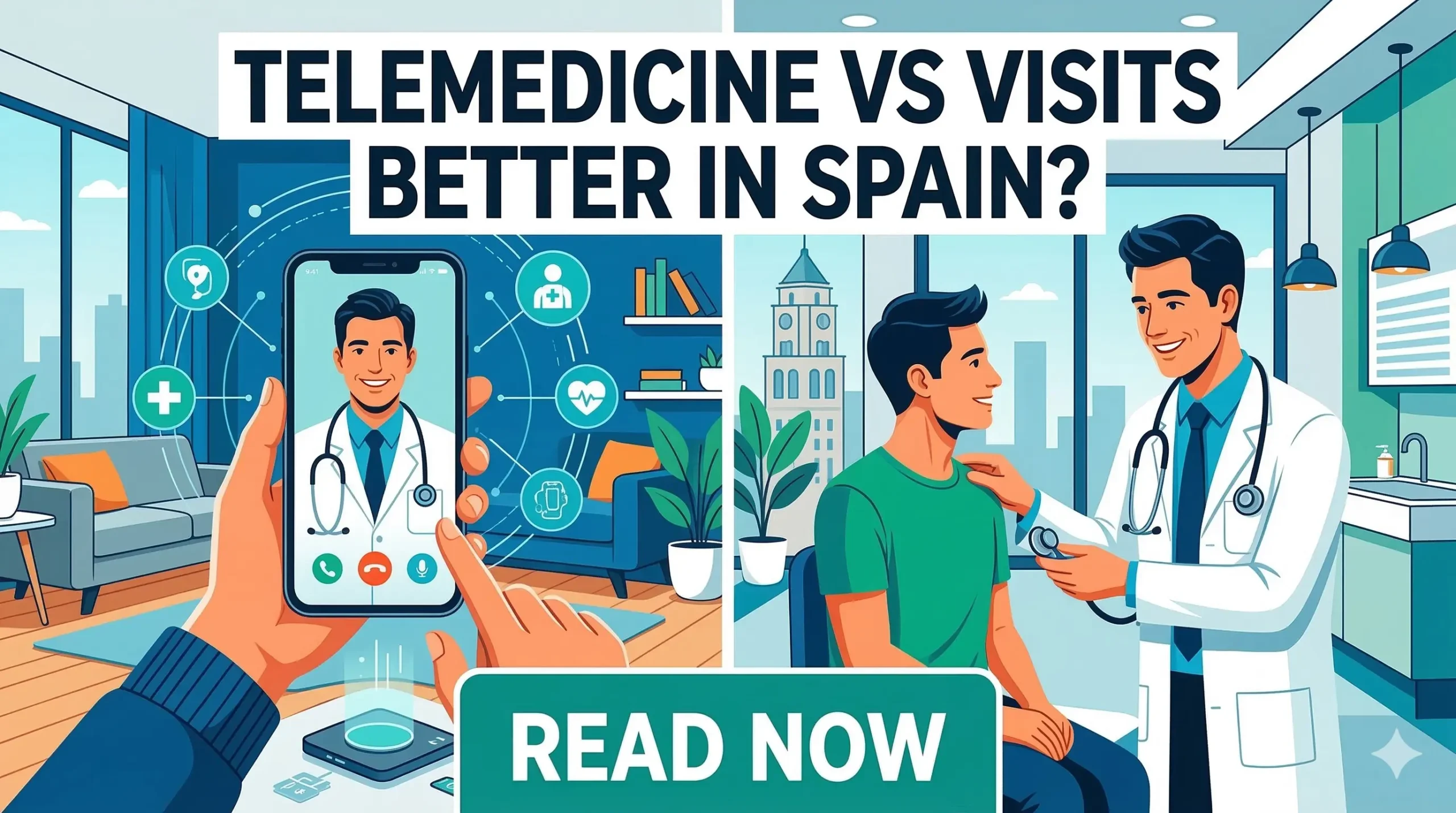
Telemedicine vs In-Person Visits: Which Is Better in Spain?
Waking up with a burning fever and debating whether to drag yourself to a crowded Spanish clinic or navigate a confusing app is an expat rite of passage. I once spent four hours shivering in a Madrid waiting room for a simple antibiotic script I could have gotten via video. This guide explains when to use telemedicine versus in-person visits in Spain.
Disclosure: This post may contain affiliate links. We may earn a commission at no extra cost to you if you make a purchase through these links. Read full disclosure.
The Reality of Telemedicine in Spain
Since the global pandemic, the Spanish healthcare system has rapidly adopted remote medical consultations. However, the experience of accessing a doctor through a screen or a phone call varies wildly depending on whether you are using the state-funded system or navigating the private sector.
How Public System Telehealth Works
In the Spanish public healthcare system, telemedicine is incredibly common, but it is rarely the high-tech video call you might expect. When you use your regional health app to book a remote consultation, it is almost exclusively a cita telefónica—a standard phone call.
The primary frustration expats face with these public phone appointments is the sheer unpredictability. The doctor will call you at some point during your scheduled block, often from a hidden or blocked caller ID. If you miss the call because you were in the shower or didn’t hear your phone ring, you lose the appointment and must start the booking process all over again.
Furthermore, the language barrier on a standard phone call is infinitely more difficult to navigate than an in-person visit. Without visual cues, hand gestures, or the ability to point to where it hurts, trying to decipher rapid-fire Spanish medical advice through a crackling phone speaker is terrifying. If you are deeply integrated into the state system and want to know how to set up these calls, you should first review What Is a Centro de Salud in Spain and How Do You Register. However, for most non-fluent foreigners, public telehealth is an anxiety-inducing experience best reserved for simple administrative tasks, like renewing a long-term prescription or requesting the continuation of official medical leave, a process detailed in How to Get a Sick Note in Spain Baja Medica Overview.
The Private Digital Health Revolution
If public telehealth feels like a relic of the past, private telemedicine in Spain feels like living in the future. The massive surge in expats utilizing private healthcare has forced major insurers to develop incredibly sophisticated, multilingual digital health platforms.
This stark contrast is exactly why utilizing an expert, expat-focused broker like Innoinsure is a massive tactical advantage for your health and sanity. A dedicated, bilingual agent from Innoinsure can seamlessly set up a premium private health policy that grants you immediate access to robust 24/7 video consultations.
With a comprehensive policy secured through Innoinsure, you bypass the anxiety of waiting for a random phone call. You simply open your provider’s app, select an English-speaking general practitioner or specialist, and initiate a high-definition video call. You can physically show the doctor the strange rash on your arm or the swelling in your throat. They can instantly generate a private digital prescription (receta electrónica privada) that appears as a QR code on your phone, allowing you to walk straight into any local pharmacy. To fully understand the operational differences between these two medical worlds, review our deep dive into the Spain Healthcare System for Expats: Public vs Private. Having an Innoinsure policy turns a stressful medical hurdle into a manageable, highly communicative experience without ever leaving your couch.
When to Choose an In-Person Clinic Visit
Despite the massive convenience of video calls, telemedicine has strict clinical limitations. Knowing when to close your laptop and physically walk into a clinic is vital for your safety and proper diagnosis.
Physical Exams and Diagnostic Testing
A digital doctor cannot listen to your lungs with a stethoscope, palpate your swollen abdomen, or swab your throat for strep. If you are experiencing complex symptoms—such as severe, localized abdominal pain, a lingering chest infection that makes breathing difficult, or a suspected broken bone after a fall—you absolutely must be seen in person.
In-person visits are also mandatory if you need diagnostic testing. Blood panels, urinalysis, X-rays, and ultrasounds require physical medical infrastructure. If you book a telemedicine appointment for chronic fatigue, the digital doctor will simply write you a referral order (volante) to go to a physical laboratory anyway, essentially adding an unnecessary administrative step to your care. If you are experiencing acute, severe pain, bypass the digital triage completely and read How to Find a 24-Hour Clinic in Spain Urgencias so you know exactly which physical emergency room to rush to.
Navigating Language and Cultural Nuances
Sometimes, pointing to where it hurts is significantly more effective than trying to translate it. For many expats, the physical presence of a doctor provides a massive psychological comfort. In an in-person setting, a doctor can read your body language, notice if you look visibly pale or dehydrated, and physically guide you through the examination.
If you end up at a public clinic where the doctor speaks zero English, physical proximity allows you to use tools like Google Translate on your phone, showing the screen back and forth. You can also bring a bilingual friend to advocate for you, which is much harder to coordinate on a spontaneous telehealth phone call. To ensure you can communicate effectively the moment you walk through the clinic doors, memorize the essential vocabulary found in Spanish Emergency Phrases: How to Describe Symptoms Quickly.
Bridging the Gap Between Virtual and Physical Care
Whether you choose a digital consultation from your living room or wait in a physical clinic, the final steps of your healthcare journey always collide in the real world: getting your medication and recovering.
Managing Prescriptions and Pharmacy Runs
In Spain, the pharmacy (farmacia) is the ultimate bridge between your doctor and your recovery. If you complete a public telehealth phone call, the doctor will upload your prescription directly to your physical public health card (SIP card). If you use a private app via your Innoinsure network, you will receive a digital QR code. In both scenarios, you must physically walk to the pharmacy to collect the medication.
Spanish pharmacists are highly trained professionals who often serve as a secondary triage point. If you used a telemedicine app for a minor issue, the pharmacist can confirm the dosage instructions and answer any lingering questions the video doctor might have rushed through. To understand exactly how much help these local chemists can legally provide, check out Can a Pharmacist in Spain Help With Minor Illness? What to Expect. Be aware that if you received a private prescription via your telemedicine app, you must pay the full retail price for the drug, as you are not utilizing the state subsidy system; a dynamic we explain deeply in Understanding Co-Payments at Spanish Pharmacies Copago.
Holistic Recovery at Home
Surviving an illness abroad requires more than just taking the antibiotics prescribed during your five-minute video call. Public Spanish doctors and private telemedicine general practitioners are incredibly efficient at treating acute infections, but they rarely focus on holistic aftercare or immune system recovery.
If you ask a Spanish doctor via video call how to rebuild your gut flora after a heavy round of medication, they will usually just tell you to eat some local yogurt. If you walk into a physical Spanish pharmacy looking for high-grade, multi-strain probiotics, clean-ingredient Vitamin C, or potent immune-boosting adaptogens, you will be deeply frustrated. The selections are severely limited, and the retail markups on these wellness items are absolutely staggering, turning basic recovery into a massive luxury expense. You can grasp the baseline of these hidden retail markups in our breakdown on Health Costs in Spain: Typical Co-Pays and Out-of-Pocket Fees.
To completely bypass this frustrating retail gap, the savvy international community in Spain relies heavily on iHerb. By ordering your post-illness recovery supplements, potent antioxidants, and premium daily vitamins directly through iHerb, you gain access to the exact, trusted wellness brands you successfully used back home without draining your wallet.
Having a dedicated holistic wellness stash delivered directly to your Spanish door via iHerb ensures you are actively fortifying your body while resting from your illness. Navigating a foreign healthcare system—whether digitally or physically—is chaotic and exhausting. Relying on iHerb to effortlessly restock your specific preventative wellness arsenal puts the control firmly back in your hands. You can avoid the local pharmacy tax completely by utilizing iHerb for your ongoing preventative care, ensuring you bounce back faster and avoid having to book another doctor’s appointment anytime soon.
Comparing Your Options: A Quick Guide
To help you decide which route is best for your specific medical situation today, use this comparison matrix.
| Healthcare Feature | Telemedicine (Private Video App) | In-Person Visit (Clinic) | Public Telehealth (Phone) |
| Best Used For | Minor infections, rashes, quick prescriptions, medical advice | Severe pain, physical exams, diagnostic tests, complex illness | Chronic prescription renewals, minor administrative tasks |
| Wait Time | Immediate to a few hours | Days (Private) to Weeks (Public) | Scheduled blocks (often delayed) |
| Language Barrier | Low (Easy to filter for English doctors) | Medium to High (Depends on the facility) | Extremely High (Phone audio only) |
| Convenience | Excellent (No travel required) | Poor (Travel and waiting rooms) | Good (But highly unpredictable timing) |
| Physical Diagnostics | Impossible | Essential and immediate | Impossible |
Ultimately, having the flexibility to choose between a rapid video call and a thorough physical examination is the hallmark of a secure expat life. Ensure your administrative bases are covered so you can make the right clinical choice when you actually need it.
References
Primary sources (official)
- Ministerio de Sanidad – Salud Digital: https://www.sanidad.gob.es/ciudadanos/saludDigital/home.htm
- Instituto para el Desarrollo e Integración de la Sanidad (IDIS) – Sanidad Privada Reports: https://www.fundacionidis.com/
Other helpful sources
- Expatica – Healthcare in Spain: https://www.expatica.com/es/healthcare/
- Citizens Advice Bureau Spain – Healthcare Information: https://www.citizensadvice.org.es/faq/healthcare/
Disclaimer
The information provided in this article is for educational and informational purposes only and does not constitute formal medical or administrative advice. The availability of telemedicine, English-speaking professionals, and specific digital health applications varies significantly across Spain’s autonomous communities and private insurance providers. Telemedicine is never a substitute for emergency medical care. If you experience severe chest pain, difficulty breathing, or severe trauma, bypass telemedicine completely and dial 112 or proceed to the nearest emergency room immediately.