Spanish Bank Transfer Terms: Transferencia, Bizum, SEPA Explained
Trying to split a dinner bill or pay your new landlord in Spain should not require a finance degree, but navigating the local banking terminology is notoriously confusing. I remember staring blankly at my phone, terrified I was accidentally sending my rent money into the void. This guide decodes Spanish bank transfers, helping you move your money safely and efficiently.
Disclosure: This post may contain affiliate links. We may earn a commission at no extra cost to you if you make a purchase through these links. Read full disclosure.
Decoding the Standard Transferencia Bancaria
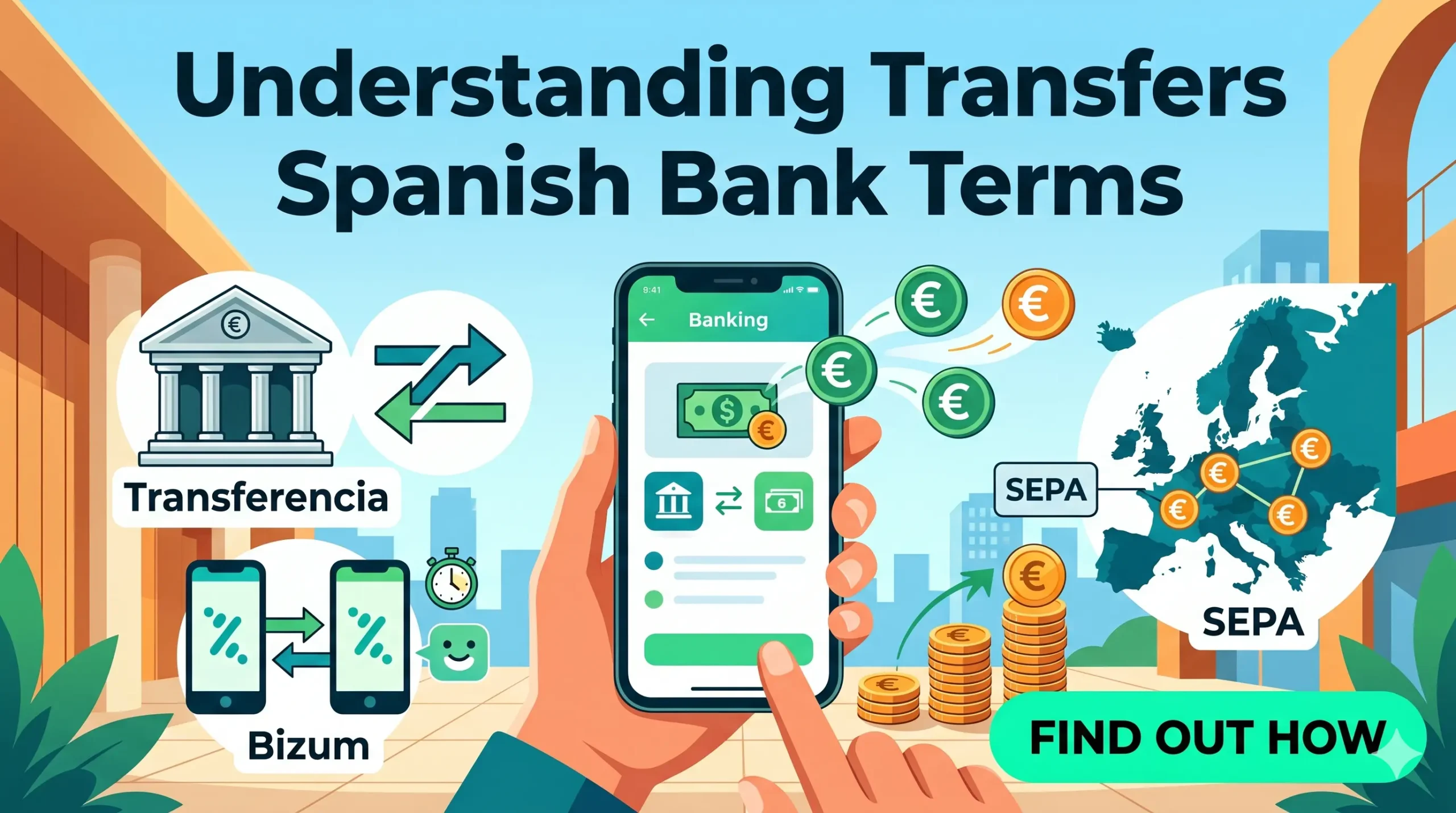
When a Spanish landlord, local business, or friend asks you to send them a transferencia, they are asking for a standard domestic wire transfer. In many countries, doing a direct bank-to-bank transfer to pay for a haircut or a used bicycle feels outdated or clunky, but in Spain, it is the absolute backbone of everyday financial life.
Ordinaria Versus Inmediata
When you initiate a transfer inside your Spanish banking app, you will typically be presented with two primary options. A transferencia ordinaria (standard transfer) usually takes one full business day to clear. If you send the money on a Friday afternoon, the recipient will absolutely not see it until Monday or Tuesday.
A transferencia inmediata (instant transfer) guarantees the money arrives in the recipient’s bank account in less than ten seconds, available 24 hours a day, 365 days a year. Historically, legacy Spanish banks charged exorbitant fees—sometimes up to 3 euros—simply for the privilege of sending your own money instantly. However, recent European Union regulations are forcing banks to equalize these costs, making instant transfers the new standard. Still, to avoid being nickel-and-dimed by traditional branch banks, managing your daily finances through N26 is highly practical. N26 offers an incredibly clean interface for standard transfers without the predatory hidden fees common to legacy Spanish institutions, making paying your monthly rent entirely stress-free.
The Anatomy of Your Spanish IBAN
To execute any transferencia, you must have the recipient’s IBAN, which stands for International Bank Account Number. A Spanish IBAN always begins with the letters “ES” followed by exactly 22 digits. These digits represent the specific bank code, the branch code, two control digits for security, and your exact account number.
You will become intimately familiar with your own Spanish IBAN because you must provide it to your employer to receive your monthly salary, and you must give it to utility companies to set up your automatic monthly payments. If you are struggling to understand how to mandate these automatic payments from your account, reviewing How Direct Debits (Domiciliación) Work in Spain: Setup and Cancellations is an essential next step to ensure your electricity is never shut off.
When sending a transfer, you must also fill out the Concepto (reference) field. This is not optional if you want to maintain a good relationship with your landlord. You must explicitly write what the payment is for, such as “Mes de Alquiler” followed by the month and apartment number, so their accounting software registers it correctly.
Navigating SEPA Transfers as an Expat
As an expat, your financial footprint rarely exists entirely within the borders of one country. This is where the broader European banking framework comes into play, expanding how and where you can send a transferencia.
What the Single Euro Payments Area Actually Is
SEPA stands for the Single Euro Payments Area. It is a massive European Union initiative designed to make cross-border electronic payments within the zone as fast, easy, and secure as domestic transfers. There are currently 36 member countries participating in the SEPA network.
In practical terms, this means that sending euros from your Spanish bank account to a friend’s bank account in Germany, France, or Italy is legally identical to sending money to your next-door neighbor in Madrid. The transfer uses the exact same transferencia ordinaria system and should take the exact same amount of time without incurring any international wire fees.
Beating Illegal IBAN Discrimination
While SEPA sounds flawless in theory, expats frequently encounter a highly frustrating administrative wall known as IBAN discrimination.
According to EU law, any Spanish company—whether it is a local gym, a telecom provider, or a massive utility company—is legally required to accept any valid SEPA IBAN for a direct debit. In reality, many antiquated Spanish accounting departments and localized billing software systems will explicitly reject your IBAN if it does not begin with “ES”. If you try to pay your Spanish internet bill with your old French or Irish bank account, you will likely be blocked.
Fighting this discrimination legally takes months of filing formal complaints with the Banco de España. The fastest, most pragmatic solution is to simply secure a local account. By signing up with N26, you instantly receive a fully recognized Spanish IBAN directly from your phone. This completely eliminates the friction of dealing with stubborn Spanish utility companies and ensures your essential services are easily established. If you are ready to set up your local financial base, exploring Opening a Bank Account in Spain: Step-by-Step for Foreigners will guide you through the process.
Bizum The Ultimate Spanish Payment App
If you go out for tapas with Spanish friends, you will inevitably hear someone say, “Hazme un Bizum” (Do a Bizum for me). It has become a verb in daily Spanish life. Understanding this system is practically a cultural requirement for integrating into Spanish social circles.
How to Activate and Use Bizum
Bizum is not a standalone application that you download from the app store like Venmo or CashApp. It is a universal payment network integrated directly into the mobile applications of almost every single bank operating in Spain.
To activate it, you simply log into your Spanish bank’s app, navigate to the Bizum section, and link your Spanish mobile phone number to your bank account. You can only link your phone number to one bank account at a time. Once activated, you can send money to anyone else in Spain who has Bizum simply by selecting their phone number from your contact list. The transfer is instantaneous and completely free. If you want to dive deeper into its cultural impact, reading What Is Bizum in Spain and How Do Expats Use It? is highly insightful.
Bizum is an absolute lifesaver for roommates. If one person pays the shared electricity bill, the others can instantly reimburse them. Learning How to Split Household Bills in Spain: Fair Methods for Flatmates is infinitely easier once everyone in the apartment has their Bizum activated. Additionally, Bizum is increasingly used for online shopping; many Spanish eCommerce stores now feature a Bizum checkout button alongside traditional credit card options.
Common Limits and Security Restrictions
Because Bizum is instantaneous and effectively irreversible, the banks impose strict limits to prevent devastating fraud and money laundering.
While limits vary slightly between specific banking institutions, the standard maximum you can send in a single Bizum transaction is usually 1,000 euros. Furthermore, most banks cap the amount you can receive via Bizum at 2,000 euros per day. It is strictly designed for domestic Spanish transactions. You cannot use Bizum to send money to a foreign phone number or a non-Spanish bank account.
| Transfer Method | Typical Speed | Primary Use Case | Regional Scope |
| Transferencia Ordinaria | 1 Business Day | Paying rent, settling large invoices. | SEPA Zone (36 countries) |
| Transferencia Inmediata | Under 10 seconds | Urgent payments requiring tracking. | SEPA Zone |
| Bizum | Instantaneous | Splitting dinners, small peer-to-peer debts. | Spain Only |
| SWIFT Wire | 2 to 5 Business Days | Moving money to/from the US, UK, Australia. | Global (Non-SEPA) |
Moving Money Internationally Outside SEPA
While SEPA and Bizum handle your daily European life perfectly, expats almost always have deep financial ties outside the eurozone. Moving money across currencies is where the legacy Spanish banking system becomes incredibly hostile to your wallet.
Why SWIFT Transfers Crush Your Wallet
If you need to transfer your initial relocation savings from the United States, the United Kingdom, or Canada into your new Spanish account, you must step outside the seamless SEPA network. Traditional banks execute these global transfers using the antiquated SWIFT network.
SWIFT relies on a chain of intermediary correspondent banks to physically move the money across borders. Every bank in that chain takes a cut, often referred to as a “lifting fee.” If you wire a rental deposit to your new landlord via SWIFT, the landlord might receive 20 euros less than expected because an intermediary bank skimmed a fee, causing immense frustration and a demand for a second transfer. Worse, your home bank or your Spanish receiving bank will hide a massive profit margin inside a terrible currency exchange rate. If you want to understand the exact mechanics of these legacy systems, reading Spanish IBAN, SEPA, and SWIFT: Sending and Receiving Money Explained is highly recommended.
Modern Solutions for Global Finances
To protect your hard-earned savings from legacy banking fees, you must use modern transfer networks. When moving your living expenses across borders, relying on Wise is the smartest financial strategy you can deploy. By using Wise, you bypass the SWIFT network entirely. You get the real mid-market exchange rate and pay a tiny, transparent upfront fee, ensuring your relocation budget stretches significantly further in Spain.
If you are currently comparing different ways to manage your initial capital, reviewing Sending Money to/from Spain: Comparing Banks vs Transfer Services will help you map out the most cost-effective strategy.
As you settle into Spanish life and start earning a local salary, you will likely want to invest your surplus euros. However, buying investment products through Spanish high-street banks usually locks you into expensive, localized mutual funds with high management fees. Instead, many expats use Interactive Brokers to build a portable, global portfolio. You can easily fund your Interactive Brokers account using a free SEPA transfer from your local Spanish bank. Utilizing Interactive Brokers allows you to maintain total control over your investments, elegantly separating your long-term wealth building from your daily Spanish checking account. Keeping your global finances agile ensures you never feel trapped by regional banking limitations.
References
Primary sources (official)
- Banco de España – SEPA transfers: https://clientebancario.bde.es/pcb/en/menu-horizontal/productosservici/serviciospago/traspasostransfe/guia-textual/tipos/Transferencia_SEPA.html
- Banco de España – Instant Transfers Regulation: https://clientebancario.bde.es/pcb/es/blog/novedades-en-pagos-inmediatos-a-partir-del-9-de-octubre-de-2025.html
- Bizum Official Platform Guidelines: https://bizum.es/
Other helpful sources
- Portal de la Administración General del Estado: https://administracion.gob.es/
Disclaimer
The information provided in this guide is exclusively for educational and informational purposes and does not constitute official legal, banking, or financial advice. Banking regulations, transfer limits, and SEPA compliance rules are highly complex and subject to frequent updates by the Banco de España and the European Central Bank. While we strive to ensure absolute accuracy, you should always verify the latest transfer requirements, security limits, and fee structures directly with your chosen financial institution before initiating any large or cross-border transactions.