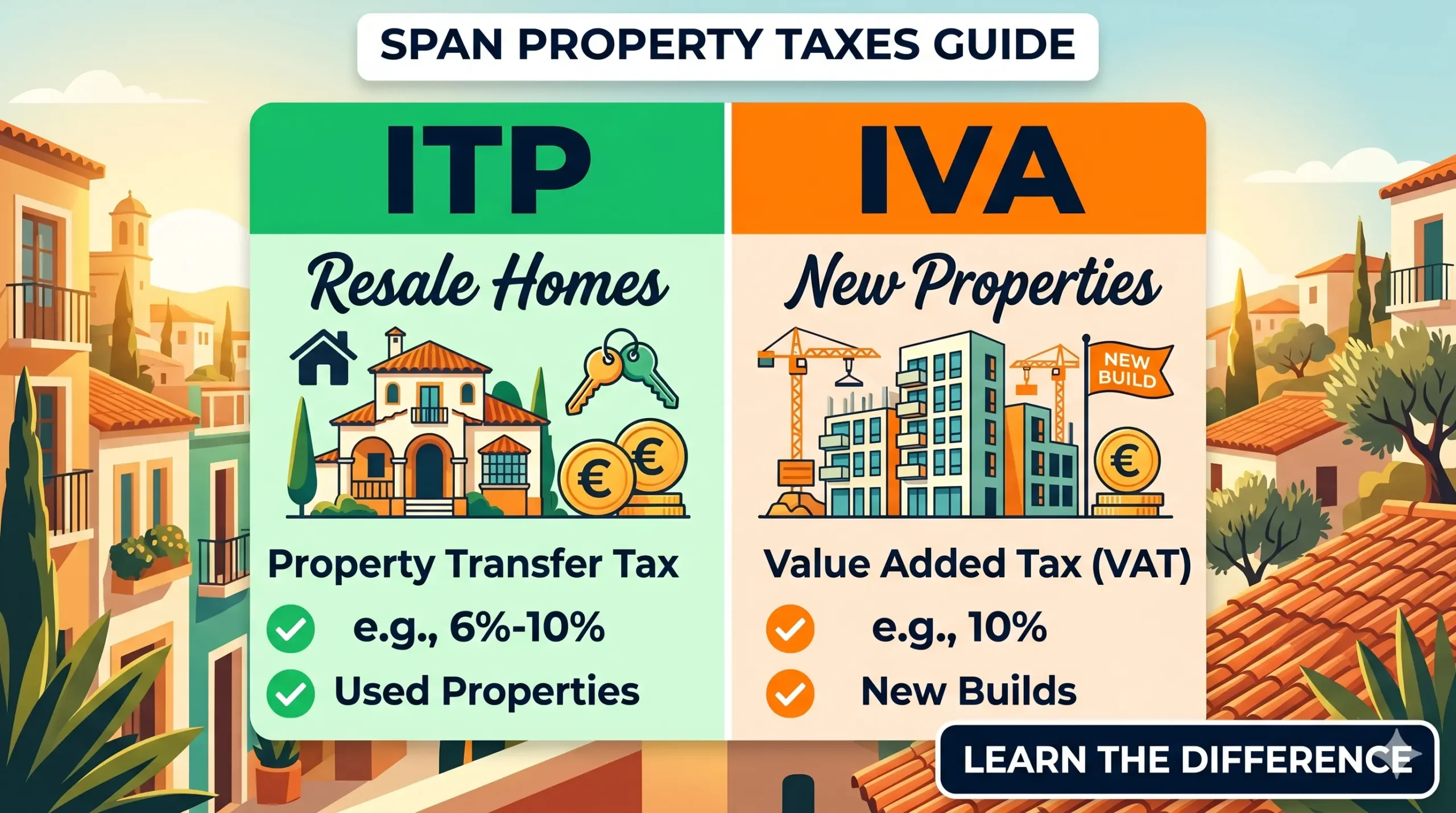
Buying Property in Spain: What Is ITP vs IVA
Thinking you have found your dream Mediterranean apartment only to be blindsided by hidden property taxes is a brutal expat initiation. I nearly lost my ideal home in Valencia when the notary casually mentioned a thirty thousand euro tax bill I had entirely failed to budget for. This guide decodes the critical differences between ITP and IVA so you can calculate the true cost of buying Spanish real estate.
Disclosure: This post may contain affiliate links. We may earn a commission at no extra cost to you if you make a purchase through these links. Read full disclosure.
The Financial Shock of Spanish Real Estate Taxes
When expats begin browsing Spanish property portals, they usually focus entirely on the sticker price of the home. Coming from countries where the seller typically absorbs the majority of the closing costs or where property transfer taxes are relatively low, the Spanish system is a massive, highly expensive culture shock.
As a general rule of thumb, you must have an additional ten to fifteen percent of the property’s purchase price saved in liquid cash just to cover the taxes and administrative closing costs. You cannot roll these taxes into a Spanish mortgage; the bank will only lend you money based on the physical value of the property, meaning the tax burden falls entirely on your upfront cash reserves.
Why the Property Type Determines Your Tax Rate
The specific tax you are legally obligated to pay depends entirely on the history of the property you are purchasing. The Spanish tax system draws a rigid, non-negotiable line between brand-new properties and secondhand properties. You will never pay both ITP and IVA on the purchase price of the same home; it is always one or the other.
Understanding which side of the line your target property falls on is the first step in protecting your relocation budget. Before you can legally pay either of these taxes, you must be registered in the Spanish administrative system. You cannot sign a title deed or file a tax return without a Foreigner Identity Number, making the steps outlined in Getting an NIE for Employment or Study: Practical Overview the mandatory starting point for any property hunt.
Understanding IVA on New Build Properties
If you are buying a brand-new apartment directly from a developer, or a villa that has never been legally transferred to a private owner before, your transaction is subject to the Value Added Tax. In Spain, this is known as IVA (Impuesto sobre el Valor Añadido).
The Flat National Rate for New Homes
Unlike many other Spanish property taxes, the IVA on newly built residential properties is a flat, national rate. Currently, the IVA is set at exactly ten percent of the purchase price across mainland Spain and the Balearic Islands. The only exception is the Canary Islands, which operates under a different tax regime called IGIC, where the rate is significantly lower at six and a half percent.
If you purchase a new build directly from the promoter for 400,000 euros, your IVA bill will be exactly 40,000 euros. This money is typically paid directly to the developer alongside your purchase installments, and the developer is responsible for remitting it to the Spanish tax authority (Agencia Tributaria). It is important to grasp how this consumer tax functions differently from your annual income declarations, a distinction clarified in What Is the Difference Between IRPF and IVA in Spain?.
The Added Sting of the AJD Stamp Duty
There is a massive catch when buying a new build property. Because you are paying IVA, Spanish law mandates that you must also pay a secondary tax known as AJD (Actos Jurídicos Documentados). This is the Spanish equivalent of Stamp Duty.
The AJD tax is applied to the notarization of the official title deeds. Unlike the flat IVA rate, the AJD is controlled by the autonomous regional governments. Depending on where your new home is located, the AJD rate typically fluctuates between 0.5 percent and 1.5 percent of the declared property value. Therefore, on a new build, your true tax burden is the 10 percent IVA plus the regional AJD stamp duty, bringing your total tax overhead to roughly 11.5 percent of the purchase price.
Understanding ITP on Resale Properties
If the property you are buying has had previous owners, the IVA completely disappears from the equation. Instead, the transaction is governed by the ITP (Impuesto de Transmisiones Patrimoniales), which translates to the Property Transfer Tax. The vast majority of expats buying historic apartments in city centers or older coastal villas will deal exclusively with the ITP.
How Regional Governments Set the ITP Rate
The most frustrating aspect of the ITP for foreign buyers is that the rate is entirely localized. The Spanish national government delegates the collection and regulation of the ITP to the seventeen autonomous communities. This means that crossing a regional border can drastically alter your purchasing power.
If you buy a 300,000 euro resale apartment in Madrid, your ITP rate is generally 6 percent, resulting in an 18,000 euro tax bill. If you buy a heavily identical 300,000 euro resale apartment in Valencia, the standard ITP rate is 10 percent, resulting in a 30,000 euro tax bill. That is a 12,000 euro difference simply based on geography.
| Spanish Autonomous Community | Standard ITP Rate for Resale Properties | AJD Rate (For New Builds / Mortgages) |
| Madrid | 6% | 0.75% |
| Andalusia | 7% | 1.2% |
| Catalonia | 10% | 1.5% |
| Valencia | 10% | 1.5% |
| Balearic Islands | 8% to 13% (Progressive scaling) | 1.5% |
Note: Many regions offer reduced ITP rates for buyers under the age of 35, large families, or individuals with recognized disabilities, provided the property will be their permanent, primary residence.
The Reference Value Trap Valor de Referencia
In January 2022, the Spanish government introduced a massive legal change to how the ITP is calculated, and it frequently catches expats completely off guard.
Historically, you paid the ITP percentage based on the price you and the seller agreed upon at the notary. Today, you are legally obligated to pay the ITP based on either the actual purchase price OR the official cadastral Reference Value (Valor de Referencia de Catastro), whichever is higher.
If you negotiate a brilliant deal and buy a house for 200,000 euros, but the Spanish cadastral registry claims the reference value of that property is 250,000 euros, you must pay the 10 percent ITP on the 250,000 euro valuation. If you pay based on your purchase price, Hacienda will send you a complementary tax bill months later with added late penalties. Understanding how to interact with the government’s digital tax portals to verify these valuations before you sign is crucial, a process heavily outlined in How to Pay Taxes in Spain Online: AEAT Payment Options.
Executing the Purchase and Managing Your Capital
Once you calculate your exact tax burden, you must actually move the money to execute the deed at the notary. This is where legacy banking systems frequently exploit foreign buyers.
Bringing Your Funds into Spain
Spanish property taxes like the ITP must be paid within thirty working days of signing the official title deed (escritura) using the official tax form Modelo 600. To pay the seller and the subsequent tax bills, your capital must be sitting securely in Spain.
If your primary savings are located in the United States, the United Kingdom, or Australia, you will need to transfer hundreds of thousands of euros across borders. If you initiate a standard international wire transfer through a traditional high-street bank, you will be decimated by hidden SWIFT network fees and highly predatory exchange rate markups. Losing three percent of your property budget to a bank’s exchange margin could cost you the equivalent of a new kitchen.
To fiercely protect your purchasing power, you must route your international real estate funds through Wise. By utilizing Wise, you bypass the expensive, antiquated SWIFT network entirely. You secure the real, transparent mid-market exchange rate and pay a clear, fractional upfront fee. This ensures that every single dollar or pound you transfer retains maximum value when converted to euros, giving you the liquid capital necessary to cover the seller’s asking price and the looming ITP tax bill. Exploring the deep mechanics of these cross-border savings is exactly why checking Sending Money to/from Spain: Comparing Banks vs Transfer Services is a vital step in the property buying process.
Securing a Local Spanish Bank Account
At the notary table, Spanish sellers expect to be paid via a guaranteed banker’s draft (cheque bancario) issued by a Spanish institution, or via a confirmed local transfer under the guidance of your lawyer. You cannot hand them a foreign check.
To execute the purchase seamlessly, you need a highly functional local bank account. Traditional Spanish banks are notorious for demanding endless physical paperwork and charging expats heavy quarterly maintenance fees simply to keep the account open after the purchase is complete. To bypass these legacy costs, establishing your daily operational account with N26 is highly strategic. N26 issues a fully recognized local Spanish IBAN directly from your smartphone interface.
You can use your N26 account to seamlessly handle the complex domestic transfers required by Spanish notaries and tax agencies. Because N26 eliminates the punitive monthly fees common to branch banks, it is an incredibly efficient tool for managing your new property’s local overhead, from community fees to ongoing utility mandates. This frictionless approach is precisely why digital alternatives dominate lists comparing the Best Low-Fee Bank Accounts in Spain for New Residents. If you have not secured this infrastructure yet, reviewing Opening a Bank Account in Spain: Step-by-Step for Foreigners and understanding local routing rules via Spanish Bank Transfer Terms: Transferencia, Bizum, SEPA Explained is your next critical move.
Protecting Your Remaining Wealth
Successfully navigating the ITP, the AJD, and the notary fees to secure the keys to your Spanish home is a massive financial milestone. However, if you have remaining relocation funds or ongoing investment income, managing that surplus correctly is your final hurdle.
Leaving large sums of surplus savings sitting idle in a localized Spanish retail bank exposes your wealth to inflation and restricts your geographical flexibility. Furthermore, holding all your assets in a local checking account can subject your broader wealth to local bureaucratic scrutiny. To build robust, long-term wealth securely, many veteran expats transfer their remaining capital into a global brokerage account like Interactive Brokers.
Utilizing Interactive Brokers allows you to build a sophisticated, multi-currency portfolio that remains entirely portable and insulated from the high fees of local Spanish retail investment products. It elegantly separates your long-term global wealth building from the administrative chaos of your daily Spanish property maintenance. Should the Spanish tax agency require proof of your worldwide financial standing, Interactive Brokers generates incredibly clean, standardized annual reports, making it simple to maintain compliance. Fully understanding the necessity of this compliance is deeply explored in Foreign Income Reporting in Spain: What Residents Need to Know and Spanish Taxes for Foreign Residents: Practical Guide to Staying Compliant. Keeping your financial footprint agile through platforms like Interactive Brokers ensures your money is always working for you, allowing you to relax and actually enjoy the Spanish property you fought so hard to acquire.
References
Primary sources official
- Agencia Tributaria (AEAT) – Impuesto sobre Transmisiones Patrimoniales y Actos Jurídicos Documentados (ITP and AJD): https://sede.agenciatributaria.gob.es/Sede/impuestos-tasas/impuesto-transmisiones-patrimoniales-actos-juridicos-documentados.html
- Agencia Tributaria (AEAT) – El IVA en la compraventa de viviendas: https://sede.agenciatributaria.gob.es/Sede/ayuda/manuales-videos-folletos/manuales-practicos/manual-iva-2023/capitulo-2-hecho-imponible-entregas-bienes/concepto-entrega-bienes/compraventa-viviendas.html
Other helpful sources
- Colegio de Registradores de España – Guía para la compra de vivienda: https://www.registradores.org/
- Portal de la Administración General del Estado – Impuestos Autonómicos: https://administracion.gob.es/
Disclaimer
The information provided in this guide is exclusively for educational and informational purposes and does not constitute official legal, real estate, or tax advice. Spanish property taxes, the Impuesto sobre Transmisiones Patrimoniales (ITP), Value Added Tax (IVA), and the regulations surrounding cadastral Reference Values (Valor de Referencia) are highly complex and subject to frequent legislative updates by national and autonomous regional governments. While we strive to ensure absolute accuracy, you should always verify the exact tax percentages, payment deadlines, and valuation methods with a registered Spanish real estate lawyer (abogado) and an official tax advisor (asesor fiscal) before committing funds to a property transaction.