How to Split Household Bills in Spain: Fair Methods for Flatmates
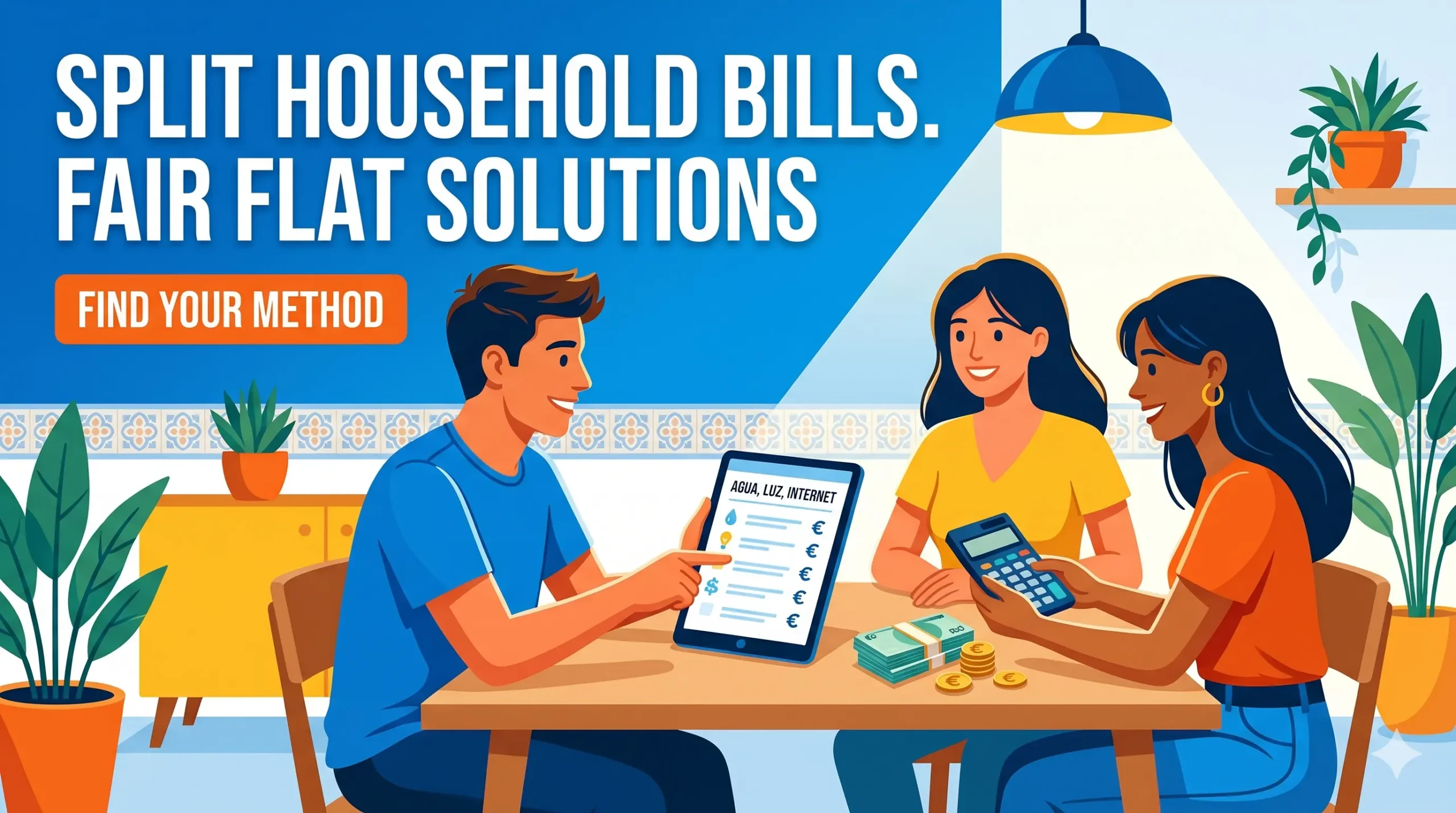
Trying to manually calculate who owes what for a bi-monthly Spanish water bill that arrives three weeks late is a guaranteed way to destroy a friendship. I once spent an entire evening arguing with my Barcelona flatmates over a randomly issued municipal trash tax we never saw coming. This guide provides exact, fair frameworks to split household expenses without the drama.
Disclosure: This post may contain affiliate links. We may earn a commission at no extra cost to you if you make a purchase through these links. Read full disclosure.
The Chaos of Spanish Utility Billing Cycles
If you have just moved to Spain from the United States or the United Kingdom, you are likely accustomed to a highly predictable financial rhythm. Rent is due on the first of the month, and utility bills arrive like clockwork shortly after. The Spanish system completely shatters this expectation, which is why splitting bills with roommates is so uniquely frustrating here.
Unpredictable Billing Frequencies
In Spain, household expenses rarely align on a clean monthly schedule. While your electricity and internet might be billed every thirty days, your water bill (factura del agua) is frequently issued bi-monthly or even quarterly, depending on your municipality. Furthermore, you will occasionally be hit with highly localized annual charges, such as the tasa de basuras (municipal trash collection tax).
When a massive bi-monthly water bill arrives just as one flatmate is moving out and a new one is moving in, the math becomes a nightmare. Someone always feels cheated. To avoid this chaos, every household needs a baseline understanding of what to expect, which is why reviewing Typical Utility Bills in Spain: Electricity, Gas, Water (Examples) is the very first step you should take before signing a shared lease.
The Contract Holder Conundrum
The second major hurdle is the administrative structure of Spanish utilities. In Spain, a utility contract has a titular (the legal owner of the contract) and a pagador (the person whose bank account pays the bill). Often, landlords refuse to keep the utilities in their name, forcing one of the flatmates to become the legal contract holder.
If you volunteer to be the titular, you take on immense legal and financial risk. If your roommates refuse to pay their share, the utility company does not care; they will come after your checking account, and eventually, your credit score. If a flatmate leaves without paying, you are left holding the bag. Understanding how you can legally control, block, or shift these automated payment mandates is a critical survival skill outlined in How Direct Debits Domiciliacion Work in Spain: Setup and Cancellations.
Setting Up the Legal and Financial Ground Rules
To survive shared living in Spain, you must treat your flat like a small business. You need a centralized financial hub, clear rules, and frictionless peer-to-peer payment methods.
Creating a Central Hub for Expenses
Spanish utility companies operate almost exclusively through a system called domiciliación bancaria (direct debit). They demand a local Spanish IBAN to automatically pull the funds they are owed. Trying to manage four different roommates sending money to a legacy bank account that charges you hidden fees for receiving transfers is an administrative nightmare.
To bypass this friction, the designated bill payer should open a dedicated operational account with N26. N26 issues a fully recognized local Spanish IBAN directly from your smartphone interface without the punitive monthly maintenance fees common to legacy high-street banks. By designating an N26 account as the central household hub, you receive instant push notifications the second a utility bill is debited. This immediate transparency prevents flatmates from questioning the amounts and keeps the household perfectly organized. This frictionless integration is exactly why digital alternatives dominate guides comparing the Best Low-Fee Bank Accounts in Spain for New Residents and Opening a Bank Account in Spain: Step-by-Step for Foreigners.
Leveraging the Spanish Peer to Peer Network
Once the designated payer has the central hub established, the rest of the flatmates need a reliable way to send their share of the money. Cash is messy, impossible to track, and leads to endless “I paid you last week” arguments.
The undisputed solution in Spain is Bizum. Bizum is the ubiquitous peer-to-peer payment network integrated directly into the Spanish banking infrastructure. It links directly to your Spanish phone number and your local bank account. When the N26 notification pops up showing an 80-euro electricity bill, the bill payer can instantly open Bizum and send a 20-euro request to each of the three flatmates. The flatmates accept the request on their phones, and the money arrives in the central account within three seconds.
Mastering this tool is culturally and financially mandatory for anyone living in shared housing. If you do not have it set up yet, diving into What Is Bizum in Spain and How Do Expats Use It? and Spanish Bank Transfer Terms: Transferencia, Bizum, SEPA Explained will save you hours of financial frustration.
Fair Calculation Methods for Shared Living
The technology only solves how the money moves; you still have to agree on how the expenses are mathematically divided. The “fair” method depends entirely on the layout of your apartment and the habits of your flatmates.
The Equal Split versus Usage Based Breakdown
The standard approach for most young professionals and students is the straight equal split. You total the rent, the internet, the water, and the electricity, and divide it strictly by the number of people in the apartment. This is the easiest method to manage, but it only works if everyone has similar lifestyles.
However, remote work has completely upended this dynamic. If you have two flatmates who leave for an office at 8:00 AM and return at 7:00 PM, and one flatmate who works from home, running the air conditioning and the espresso machine all day, an equal split is deeply unfair. In these scenarios, a usage-based or proportional split is required. You might agree to split rent equally, but the work-from-home flatmate agrees to pay a slightly higher percentage (e.g., 40% instead of 33%) of the monthly electricity bill (factura de la luz).
| Splitting Method | How It Works | Best Used For | Potential Drawbacks |
| The Equal Split | Total costs divided by number of tenants. | Students or flatmates with identical working hours. | Unfair to those who travel frequently or work long office hours. |
| Proportional (Room Size) | Rent divided based on square footage or amenities (e.g., ensuite bathroom). | Flats with drastically different bedroom sizes. | Requires upfront negotiation; doesn’t address utility usage. |
| Proportional (Usage) | Utilities split based on time spent in the apartment. | Remote workers sharing with office workers. | Can lead to petty arguments over who left the lights on. |
| The Fixed Contribution | One tenant pays a flat “all-inclusive” rate to the master tenant. | Subletting a room for a short, fixed period. | Master tenant absorbs all the risk of utility price spikes. |
Handling Rent and Deposit Discrepancies
Rent and deposits are significantly more complicated than utility bills. In Spain, the legal security deposit (fianza) is strictly regulated by the Ley de Arrendamientos Urbanos (LAU). If you are moving into a shared flat where one person is the master tenant, you must be incredibly careful about handing over massive sums of cash for your portion of the deposit.
Before you send your share, you must clearly document what happens when you decide to leave. Does the master tenant return your deposit, or are you responsible for finding a replacement flatmate to buy you out? Establishing these rules via a written internal agreement is vital. You can learn how to protect yourself from getting trapped in these financial loopholes by reviewing How to Negotiate Rent in Spain: Financial Prep and Tactics and How to Pay a Rental Deposit in Spain Safely (Avoid Fraud).
Managing Cross-Border and Long-Term Finances
Shared living often involves a revolving door of international expats. This international dynamic introduces hidden banking fees that can slowly drain a household’s collective wealth if left unmanaged.
Transferring Your Share from Back Home
When a new flatmate arrives from the United States, the United Kingdom, or Australia, their savings are usually still sitting in their home country’s currency. When it comes time to pay their share of the deposit or the first month’s rent, they often attempt to execute a standard international wire transfer directly from their legacy bank to the designated bill payer’s Spanish account.
This is a massive financial mistake. The legacy bank will crush the transfer with hidden SWIFT network fees and terrible exchange rate markups. The payer might be expecting exactly 500 euros, but only 475 euros will arrive due to intermediary bank skimming. This instantly triggers an argument.
To eliminate this friction, the new flatmate must route their international transfer through Wise. By utilizing Wise, you bypass the expensive, antiquated SWIFT network entirely. Wise converts the home currency to euros using the real, transparent mid-market exchange rate. The flatmate can instruct Wise to deliver the exact euro amount required directly to the central N26 account, ensuring the household budget remains perfectly balanced. The mathematical advantage of this cross-border strategy is heavily mapped out in Sending Money to/from Spain: Comparing Banks vs Transfer Services.
Protecting Your Personal Savings from Shared Liabilities
Finally, surviving shared living in Spain requires strict financial compartmentalization. The absolute worst mistake you can make is keeping your entire life savings in the same local checking account you use to pay your flatmates and fund your daily tapas runs.
If a major dispute occurs—perhaps the landlord claims you severely damaged the property and wins a civil judgment, or a local tax authority claims a massive unpaid debt against the master lease—the Spanish legal system has the supreme authority to freeze localized retail accounts. Waking up to find your entire net worth paralyzed over a shared housing dispute is a terrifying reality detailed in What to Do If Your Spanish Bank Account Is Frozen (Common Causes).
To build robust long-term wealth securely while navigating the chaos of shared living, many veteran expats transfer their surplus capital into a global brokerage account like Interactive Brokers. Utilizing Interactive Brokers allows you to build a sophisticated, multi-currency portfolio that remains entirely portable and heavily insulated from localized Spanish retail banking embargoes.
It elegantly separates your long-term global wealth from the administrative drama of your daily flatmate expenses. If you eventually decide to move to a new country or return home, your investments do not need to be liquidated; they travel with you. Furthermore, Interactive Brokers generates incredibly clean, standardized annual reports, making it simple to maintain compliance with the strict tax structures detailed in Foreign Income Reporting in Spain: What Residents Need to Know. Keeping your financial footprint agile ensures the money you save by living with flatmates continues to grow efficiently, completely insulated from local household disputes.
References
Primary sources (official)
- Boletín Oficial del Estado (BOE) – Ley 29/1994, de Arrendamientos Urbanos (LAU): https://www.boe.es/buscar/act.php?id=BOE-A-1994-26003
- Banco de España – Bizum y las transferencias inmediatas: https://clientebancario.bde.es/pcb/es/blog/bizum–te-contamos-todos-sus-secretos.html
Other helpful sources
- Idealista – Gastos compartidos en pisos de alquiler: https://www.idealista.com/
- Portal de la Administración General del Estado – Vivienda: https://administracion.gob.es/
Disclaimer
The information provided in this guide is exclusively for educational and informational purposes and does not constitute official legal, real estate, or financial advising. Spanish rental laws, the specific limits outlined in the Ley de Arrendamientos Urbanos (LAU) regarding subletting and deposits, and the tax implications of transferring funds between individuals are highly complex and subject to change. While we strive to ensure absolute accuracy, you should always consult a registered Spanish real estate lawyer (abogado) before entering into a master lease agreement, signing a sublet contract, or assuming legal liability for household utility contracts.