Spain’s Great Art Museums: Prado, Reina Sofía, and Beyond
Standing in front of a world-famous masterpiece only to realize you are too exhausted to appreciate it is a common expat rite of passage. I still remember my first time at the Prado, wandering aimlessly for three hours before realizing I’d missed the Velázquez room entirely because I hadn't planned my route. This guide solves the overwhelm of Spain's massive art scene, providing a strategic roadmap to the must-see galleries without the typical tourist burnout.
Disclosure: This post may contain affiliate links. We may earn a commission at no extra cost to you if you make a purchase through these links. Read full disclosure.
The Golden Triangle of Art in Madrid
If you are living in or visiting Madrid, the Paseo del Prado is essentially your second home. This boulevard hosts three of the world’s most significant art repositories, collectively known as the Golden Triangle. Each museum offers a distinct personality and era of art, meaning you shouldn't try to tackle all three in a single weekend unless you have the stamina of a marathon runner.
The Prado Museum (Museo del Prado)
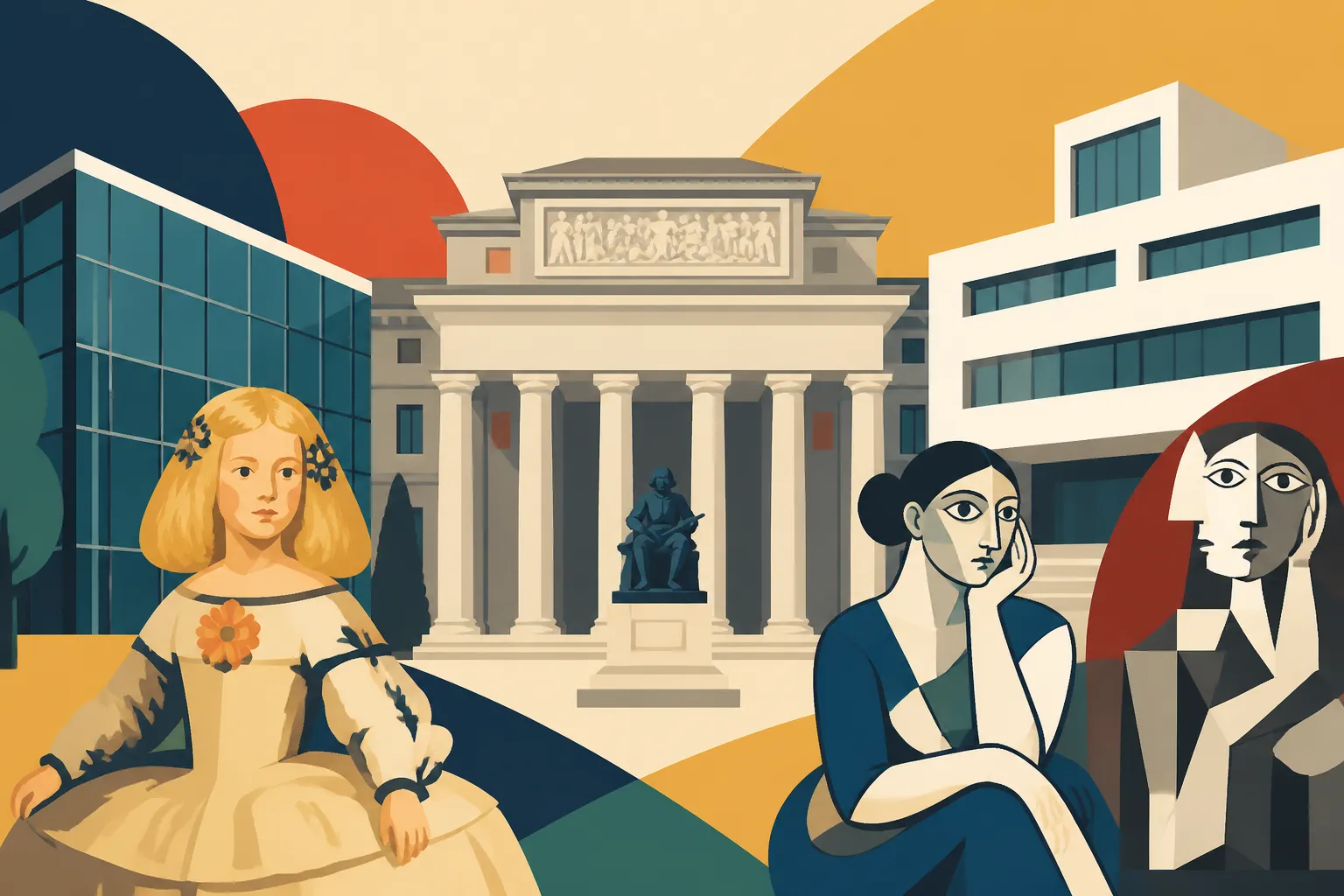
The Prado is the crown jewel of Spanish culture. It isn't just a museum; it is a visual history of the Spanish monarchy’s tastes over several centuries. When you walk through those heavy doors, you are seeing what the kings and queens of Spain chose to collect, which explains why the collection of Titian, Bosch, and Rubens is so incredibly dense. For most of us expats, the Prado becomes a place of repeat visits. You quickly learn that trying to see all 8,000+ works in one go is a fool's errand.
My advice is to head straight for the Velázquez rooms on the first floor. Seeing Las Meninas in person is a transformative experience, but don't overlook the "Black Paintings" of Francisco Goya in the basement levels. These haunting, dark murals were painted directly onto the walls of his home during his final years of illness and isolation. They offer a raw, visceral look into the Spanish soul that contrasts sharply with the formal royal portraits upstairs. Because the museum is so vast, many people choose to book skip-the-line access through GetYourGuide to save their energy for the galleries rather than the sidewalk.
Beyond the art, the Prado’s physical layout can be a bit of a labyrinth. There are two main buildings: the original Villanueva building and the modern Jerónimos wing. If you’re meeting friends, always specify which entrance you’re at, or you’ll spend twenty minutes searching for each other near the Goya statue. After a few hours of intense observation, the nearby Retiro Park offers the perfect mental palate cleanser. It’s a local tradition to grab a caña and some olives in the nearby Literary Quarter after a long session with the masters. For more context on how these institutions fit into the broader history, check out History, Art, and Architecture in Spain.
Reina Sofía Museum (Museo Nacional Centro de Arte Reina Sofía)
While the Prado looks back at the glory of the empire, the Reina Sofía is firmly rooted in the modern and contemporary. This is where Spain grapples with its 20th-century history, specifically the trauma of the Civil War and the subsequent dictatorship. The museum is housed in a former 18th-century hospital, and the stark, white corridors still hum with a certain clinical intensity. The addition of the Jean Nouvel-designed red wing added a futuristic contrast that defines the Madrid skyline.
The absolute "must" here is Picasso’s Guernica. It is massive, monochromatic, and emotionally shattering. Visitors often spend an hour just sitting in front of it, absorbing the symbolism of the bull and the horse. But the Reina Sofía is more than just one painting. It holds an incredible collection of Salvador Dalí and Joan Miró, showcasing the Spanish contribution to Surrealism.
One thing that surprises many newcomers is the museum's commitment to political and social art. You’ll find rooms dedicated to feminist art, anti-war movements, and experimental film. It’s a place that asks you to think, not just look. If you are planning a visit, keep in mind that the museum often has free entry hours in the evenings, though the queues can be legendary. To understand how to navigate these timing quirks, you might find Public Holidays in Spain: How They Affect Travel and Opening Hours helpful for planning your visit around local closures.
Thyssen-Bornemisza National Museum
The Thyssen is the "Goldilocks" of the triangle—not too big, not too small, and perfectly curated. What makes it unique is that it started as a private collection. While the Prado and Reina Sofía are state-curated, the Thyssen feels like walking through the home of an incredibly wealthy, art-obsessed friend. It fills the gaps that the other two miss, covering everything from Italian Primitive art to English Portraiture and American 19th-century landscapes.
For me, the Thyssen is the most "user-friendly" museum. The layout is chronological, starting on the top floor and working your way down. You can literally walk through the history of Western art in a single afternoon. It’s also home to some stunning works by Impressionists like Monet and Degas, which are harder to find in the other two major Madrid galleries.
If you’re staying nearby, the area around the Thyssen is full of high-quality hotels. Travelers often find it useful to check Booking.com for options in the Huertas or Retiro neighborhoods if you want to be within walking distance of all three museums. Being able to walk home after a day of "museum eyes" is a luxury you won't regret. For those looking to settle in for a longer stay, seeing how this fits into your Best Area to Stay in Madrid choices is essential for any art lover.
Beyond the Capital: Regional Masterpieces
Spain's art scene is fiercely regional, reflecting the country's diverse linguistic and cultural identities. You haven't truly seen Spanish art until you've left Madrid and headed toward the coast or the northern mountains. Each of these galleries is a destination in itself, often defining the entire city it resides in.
The Guggenheim Museum Bilbao
The Guggenheim didn't just bring art to Bilbao; it completely transformed a decaying industrial port into a global cultural hub. The building itself, designed by Frank Gehry, is a masterpiece of titanium and limestone that looks like a futuristic ship docked on the Nervión River. Many visitors find that even people who "don't like art" fall in love with the Guggenheim because of the architecture and the massive outdoor sculptures like Jeff Koons' Puppy and Louise Bourgeois' Maman (the giant spider).
Inside, the spaces are cavernous. The museum focuses on large-scale installations that wouldn't fit anywhere else. Richard Serra’s The Matter of Time, a series of massive weathering steel spirals, is a permanent fixture that you can actually walk through. It’s a sensory experience that changes the way you perceive space and sound.
Getting to Bilbao from Madrid or Barcelona is surprisingly easy. I usually use Omio to compare the fast trains (AVE) and bus options, as the scenery through the Basque Country is spectacular. Once you’re there, the city’s food scene—specifically the pintxos—is the perfect accompaniment to the high-concept art. If you're coming for a quick trip, you might want to look into How to Plan a Multi-City Trip Across Spain to see how to link Bilbao with other northern gems.
Picasso Museum (Barcelona and Málaga)
Pablo Picasso was born in Málaga and spent his formative years in Barcelona, and both cities celebrate him with dedicated museums. The Museu Picasso in Barcelona is particularly special because it’s housed in five adjoining medieval palaces in the El Born district. It focuses heavily on his early years, showing that before he was a cubist revolutionary, he was a child prodigy who could paint with the realism of an old master.
The Málaga museum, on the other hand, offers a more personal look at the artist's roots. It’s located in the Buenavista Palace, right in the heart of the historic center. If you’re visiting both, you get a complete picture of his evolution. In Barcelona, the museum is tucked away in narrow, winding streets where the atmosphere of the 19th century still lingers.
Because these museums are smaller than the giants in Madrid, they can feel very crowded very quickly. It is absolutely essential to book your tickets in advance through a platform like GetYourGuide, especially during the summer months. You don't want to be the person standing in a 90-minute line under the Mediterranean sun. For those exploring the Catalan capital, you can often combine a museum visit with other landmarks, as detailed in How to See Gaudí's Buildings in Barcelona in One Day.
Dalí Theatre-Museum in Figueres
Located in the town of Figueres, about an hour and a half north of Barcelona, the Dalí Theatre-Museum is perhaps the most bizarre and entertaining museum in the world. Dalí himself designed it to be a "surrealist object," and it’s built into the ruins of the town’s former theater. From the giant eggs perched on the roof to the Mae West Room where the furniture forms a face, it’s a total immersion into his eccentric mind.
Visiting Figueres feels like a pilgrimage. You see where he was born, where he worked, and eventually, where he was buried (his crypt is inside the museum). It’s not just about paintings; there are mechanical installations, jewelry designed by Dalí, and holographic art. It’s a "museum" in the sense that a carnival is a "park."
The easiest way to visit is a day trip from Barcelona. Again, checking Omio for the high-speed train to Figueres-Vilafant will save you hours of driving. For expats living in Catalonia, this is the place you take your friends when they visit from home—it never fails to leave them speechless. It’s a great example of the unique sites listed in Spain's UNESCO World Heritage Sites: A Visitor's Guide.
Comparison of Spain's Major Art Museums
| Museum | Location | Focus | Key Work | Best Time to Visit |
|---|---|---|---|---|
| Museo del Prado | Madrid | 12th – 19th Century | Las Meninas (Velázquez) | Weekday mornings at opening |
| Reina Sofía | Madrid | Modern & Contemporary | Guernica (Picasso) | Two hours before closing |
| Thyssen-Bornemisza | Madrid | Western Art History | Christ and the Woman of Samaria (Duccio) | Lunchtime (14:00 – 16:00) |
| Guggenheim | Bilbao | Contemporary / Post-War | The Matter of Time (Serra) | Tuesday or Wednesday |
| Museu Picasso | Barcelona | Early Career Picasso | Science and Charity (Picasso) | Late afternoon |
| Dalí Theatre-Museum | Figueres | Surrealism | Labyrinth (Dalí) | First slot of the day |
Practical Strategies for Museum Lovers
After years of living here, I’ve developed a few "golden rules" for navigating these cultural powerhouses. Spanish museums are incredible, but they are also demanding. If you go in without a plan, you’ll likely end up with a headache and a blurry camera roll of things you don't remember seeing.
Avoiding the "Museum Burnout"
The biggest mistake is trying to see everything. At the Prado, pick three rooms you really care about and see those first. Everything else is a bonus. Visitors are often advised to "look for the light." Many Spanish galleries are designed to use natural light, which changes the appearance of the paintings throughout the day.
Wear your most comfortable shoes. I cannot emphasize this enough. The floors in the Golden Triangle are largely marble or hardwood, and after four hours, your lower back will let you know it. Also, take advantage of the museum cafes. The Thyssen has a particularly lovely terrace that feels like an oasis in the middle of the city.
Finally, learn a few key phrases in Spanish to help you navigate. Even if the staff speaks English, a polite "Disculpe, ¿dónde está la sala de Goya?" goes a long way. If you’re worried about the language barrier, brushing up with Spanish Slang and Everyday Expressions for Visitors can give you that extra bit of confidence.
Free Entry Hours and Budget Tips
Almost every state-owned museum in Spain has free entry hours. For the Prado, it’s usually the last two hours of the day (Monday–Saturday 18:00–20:00). For the Reina Sofía, it’s often Sunday mornings and Monday/Wednesday-Saturday evenings. However, "free" comes with a price: the crowds. During these hours, the galleries are packed, and the atmosphere changes from a quiet temple of art to a busy marketplace.
If you are a resident, your NIE (foreigner ID number) or TIE card might grant you discounts or even free access to certain municipal museums. Always ask "Ustedes tienen descuentos para residentes?" (Do you have discounts for residents?). You might be surprised.
For the big-ticket items like the Guggenheim or Picasso, there are rarely free hours, so your best bet is a "city pass" or booking through a consolidator. I often use GetYourGuide for these because they bundle audio guides and sometimes skip-the-line privileges that the museum's own website doesn't highlight. To find out more about visiting without breaking the bank, see How to Get Into the Prado Museum for Free.
Logistics: Getting There and Staying Nearby
Planning an art-focused trip requires a bit of logistical savvy. Spain is a large country, and while the high-speed rail network is fantastic, you still need to think about your home base and your transit times to ensure you aren't spending more time in stations than in galleries.
Planning Your Route Across Spain
If you’re doing the "Art Tour," I recommend starting in Madrid for three days, then taking the train to Bilbao for two days, and finishing in Barcelona. This route is incredibly efficient thanks to the AVE and Iryo train services. Use Omio to book these tickets at least a few weeks in advance; prices for Spanish trains work much like airline tickets—they go up as the seats fill up.
If you’re traveling between regions, remember that the "siesta" culture still affects some smaller regional museums. While the big ones in Madrid stay open all day, smaller galleries in cities like Seville or Valencia might close from 14:00 to 17:00. Always check the official website the morning of your visit.
For those who want to see it all, a multi-city approach is best. You can find detailed advice on how to structure such a trip in our guide on How to Plan a Multi-City Trip Across Spain. It covers everything from baggage storage at stations to the best travel apps for expats.
Finding the Right Base for Art Lovers
In Madrid, the "Literary Quarter" (Barrio de las Letras) is the ultimate spot. It’s situated right behind the Thyssen and Prado. It’s a neighborhood where writers like Cervantes once lived, and today it's filled with independent bookstores and cozy cafes. Staying here means you can beat the crowds at the museum doors every morning.
In Barcelona, I’d avoid staying directly on Las Ramblas. Instead, look at the Eixample district or El Born. Eixample is home to much of the Modernist architecture, while El Born puts you right next to the Picasso Museum. I always use Booking.com with the map filter set to "distance from museum" to find the quietest streets that are still central.
Wherever you stay, make sure you're near a Metro line. Spanish public transport is clean, safe, and incredibly cheap compared to the US or UK. Being three stops away from a museum is often better than being right next to it if it means you can find a quieter, more "local" apartment.
Disclaimer
This guide is for informational purposes only. While we strive to provide the most accurate and up-to-date information regarding museum hours, ticket prices, and travel logistics in Spain, these details are subject to change by the institutions and service providers mentioned. Always verify specific requirements, such as booking windows and ID requirements for discounts, on the official museum or transport websites before your journey. Prices and availability for third-party platforms like Omio, GetYourGuide, and Booking.com may vary.